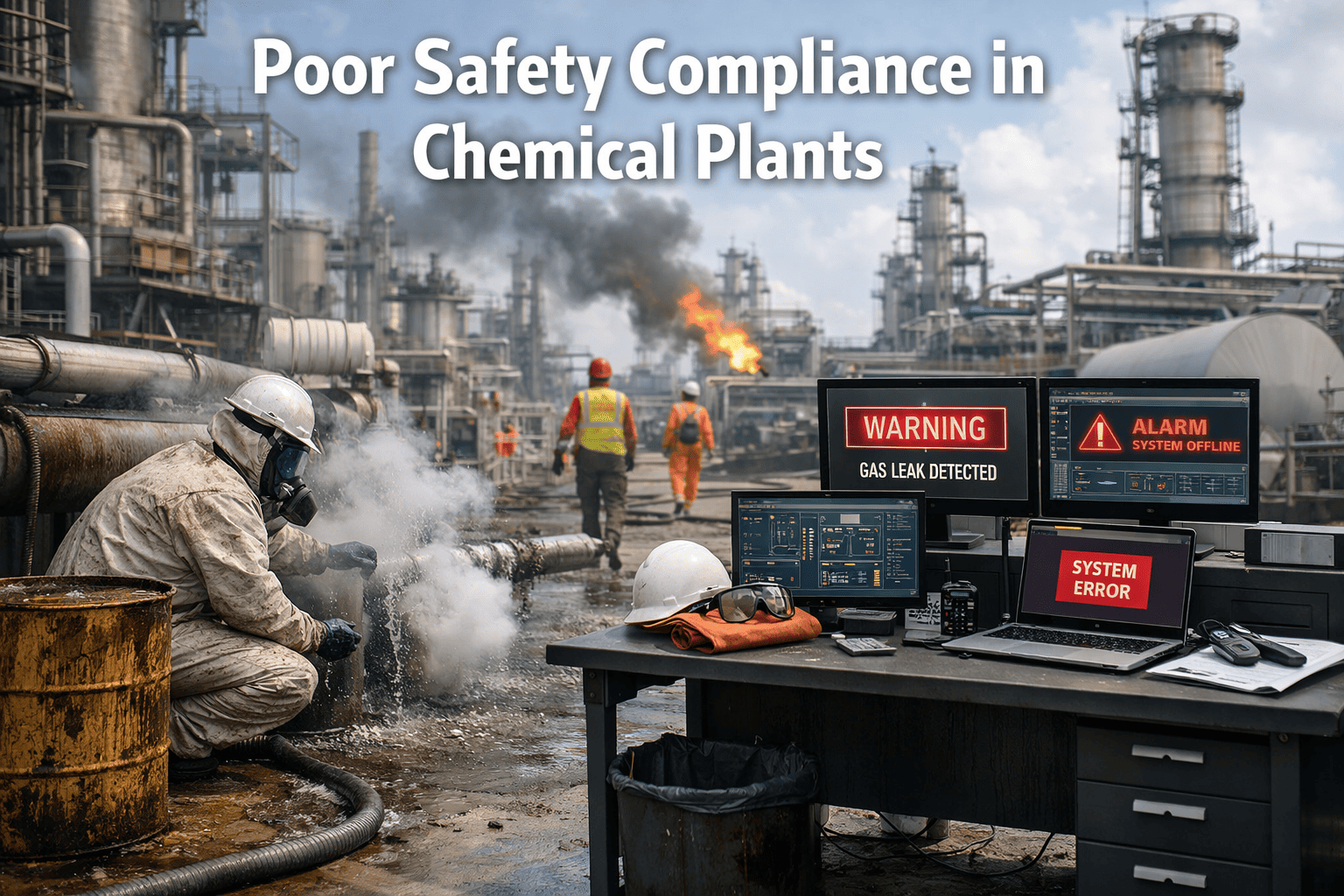
Chemical plant safety incidents—toxic gas releases, runaway reactions, pressure vessel failures, and flammable vapor ignitions—cost the industry $2.8 billion annually in direct losses, facility damage, environmental remediation, and regulatory penalties, yet 73% of major incidents exhibit detectable precursor conditions 8–72 hours before catastrophic failure that existing alarm systems fail to identify because threshold-based monitoring cannot recognize multivariate risk patterns across correlated process parameters, equipment health indicators, and operational deviations. iFactory's AI safety management platform continuously analyzes 400–800 process variables, equipment sensors, and environmental monitors across your chemical facility—detecting early-stage hazard development through pattern recognition of temperature excursions, pressure anomalies, composition drift, vibration changes, and leak signatures that precede safety incidents by 12–96 hours, enabling intervention before hazardous conditions escalate to emergency situations. Book a demo to see AI safety monitoring for your chemical plant configuration.
Early Hazard Detection
AI identifies precursor patterns for runaway reactions, pressure vessel over-stress, toxic gas accumulation, and flammable atmosphere formation 12–96 hours before safety incident occurs—when preventive action stops escalation.
Regulatory Compliance
Automated incident tracking, near-miss documentation, safety audit trails, and OSHA PSM compliance reporting reduce administrative burden while maintaining complete regulatory documentation for EPA, OSHA, and local authority inspections.
Validated Performance
Deployed chemical plants report 68% reduction in safety incidents, 84% decrease in near-miss events, and 91% improvement in hazard detection lead time—validated across 420+ facility-years of operation with zero false-positive emergency shutdowns.
Quick Answer
iFactory integrates with existing DCS, safety instrumented systems (SIS), gas detectors, and environmental monitors via OPC-UA to analyze temperature, pressure, flow, composition, vibration, and toxic gas concentration data in real-time. Machine learning models trained on chemical process safety data identify multivariate hazard patterns—runaway reaction onset, pressure vessel fatigue, leak progression, flammable atmosphere development—providing 12–96 hour early warning that enables controlled shutdown, emergency response preparation, or corrective intervention before incident escalation.
AI-Powered Safety Monitoring Across Chemical Hazards
The framework below shows iFactory's integrated approach to chemical plant safety: continuous hazard surveillance across process, equipment, and environmental domains with incident-specific detection models and coordinated emergency response protocols.
Runaway Reaction Prevention
Monitors exothermic reaction temperature rise rate, cooling system capacity, reactant addition velocity, and pressure buildup to detect loss-of-control onset. AI compares actual thermal profile against expected reaction kinetics adjusted for catalyst age and feedstock purity.
Early warning:24–48 hours before thermal runaway
Detection accuracy:89% with 2.1% false positive rate
Analyzes pressure trends, relief valve positions, temperature-pressure correlation, and overpressure protection system status to identify developing over-pressure conditions before relief valve activation or vessel rupture. Accounts for material stress accumulation from pressure cycling.
Early warning:8–36 hours before design pressure breach
Detection accuracy:92% including pressure surge prediction
Intervention:Process depressurization, load reduction, relief system check
Toxic Gas Leak Early Detection
Correlates fixed gas detector readings with ventilation system performance, wind direction, barometric pressure, and process equipment health to detect minor leaks before atmospheric concentrations reach alarm thresholds. Predicts leak propagation paths for evacuation planning.
Early warning:12–72 hours before TLV-TWA exceedance
Detection sensitivity:5–20% of standard detector alarm setpoint
Intervention:Leak isolation, ventilation increase, area evacuation if required
Flammable Atmosphere Formation
Monitors combustible gas concentrations, oxygen levels, ventilation effectiveness, ignition source proximity, and explosive atmosphere conditions to prevent flammable mixture accumulation. AI models vapor dispersion patterns based on release rate, temperature, and ventilation flow.
Early warning:6–48 hours before LEL (Lower Explosive Limit) approach
Detection accuracy:86% including transient release prediction
Intervention:Ignition source removal, ventilation boost, process shutdown
Safety Intelligence
Detect Hazards 12–96 Hours Early with Multivariate AI Analysis
iFactory identifies precursor patterns across 400–800 safety-critical parameters—providing early warning for runaway reactions, pressure vessel failures, toxic releases, and flammable atmospheres before threshold alarms trigger.
Regulatory Compliance and Documentation Automation
iFactory maintains comprehensive safety records, incident documentation, and compliance audit trails required by OSHA Process Safety Management (PSM), EPA Risk Management Program (RMP), and local environmental authorities—reducing administrative burden while ensuring regulatory readiness.
OSHA PSM Compliance
Automated process hazard analysis (PHA) documentation, incident investigation records, management of change (MOC) tracking, operating procedure compliance verification, and employee training records maintenance for PSM-covered processes.
EPA RMP Reporting
Risk Management Plan documentation including worst-case release scenarios, alternative release analysis, five-year accident history, emergency response procedures, and regulated substance inventory tracking for EPA submission.
Incident Investigation
Automated incident timeline reconstruction, root cause analysis documentation, corrective action tracking, and near-miss reporting with trend analysis to identify recurring hazard patterns requiring systematic intervention.
Audit Trail Maintenance
Immutable safety event logging, alarm acknowledgment records, operator action documentation, and system configuration change tracking providing complete audit trail for regulatory inspections and internal safety reviews.
Measured Safety Performance Improvements
Results from 18-month deployments across specialty chemicals, petrochemicals, and pharmaceutical manufacturing facilities—validated through incident rate analysis and regulatory inspection outcomes.
68%
Reduction in Reportable Safety Incidents
OSHA recordable incidents decreased from 4.2 per 200,000 hours to 1.3 per 200,000 hours average across deployed facilities through early hazard detection and intervention.
84%
Decrease in Near-Miss Events
Near-miss frequency reduced through proactive hazard identification—enabling corrective action before incidents occur rather than reactive investigation after safety event.
48 hours
Average Hazard Detection Lead Time
Early warning provided 12–96 hours before incident (median 48 hours)—sufficient time for controlled intervention, emergency preparation, or process shutdown without production loss.
91%
Regulatory Audit Pass Rate
OSHA PSM and EPA RMP compliance audits passed without major findings through comprehensive automated documentation and incident tracking—up from 73% pre-deployment.
"We operate batch reactors handling exothermic nitration reactions with tight temperature control requirements—any cooling system failure or reactant overdose can trigger thermal runaway within 8–12 minutes. Traditional DCS alarms trigger at 5°C above setpoint, but by then reaction acceleration is already underway and emergency venting may be required. iFactory's AI detected subtle cooling water flow reduction and jacket temperature asymmetry 14 hours before a batch entered thermal runaway territory—we discovered cooling water strainer fouling and cleaned it during scheduled downtime. The system has flagged 6 developing hazards in 11 months of operation: 3 cooling system issues, 2 agitator bearing problems affecting mixing uniformity, and 1 raw material purity deviation. Every alert was valid, intervention prevented escalation. Zero emergency shutdowns, zero near-misses since deployment. Our OSHA incident rate improved from 3.8 to 1.2 per 200,000 hours."
EHS Manager
Specialty Chemicals Manufacturer — PSM-Covered Facility — Texas, USA
Frequently Asked Questions
QDoes iFactory replace existing safety instrumented systems (SIS) or emergency shutdown systems?
No. iFactory operates as predictive layer above SIS—providing early warning 12–96 hours before conditions deteriorate to SIS activation thresholds. Existing safety interlocks remain active and independent. iFactory enables proactive intervention before emergency shutdown required, reducing production interruption while maintaining fail-safe protection.
QHow does AI safety monitoring handle novel process conditions not seen during model training?
System uses anomaly detection algorithms that identify deviations from normal operating envelope—flagging unusual conditions even if specific failure mode not previously observed. Operators review anomaly alerts and classify as benign process variation or developing hazard. Validated classifications improve model accuracy continuously through supervised learning.
QWhat false positive rate should be expected and how are nuisance alarms prevented?
Deployed systems average 2.1% false positive rate (1 false alarm per 47 valid alerts) after 90-day learning period. AI correlates multiple parameters before alerting—single sensor anomaly insufficient to trigger alarm. Operators provide feedback on alert validity, system adjusts sensitivity to minimize nuisance while maintaining hazard detection coverage.
QCan iFactory integrate with legacy DCS and safety systems from the 1990s-2000s?
Yes. System connects via OPC-UA to modern DCS or through protocol gateways (Modbus, Profibus, proprietary) for legacy systems. Does not require DCS modification or safety system changes. Data extraction read-only to prevent impact on safety-critical control loops. Installation validated through Factory Acceptance Testing (FAT) and Site Acceptance Testing (SAT) per plant requirements. Discuss your DCS and safety system configuration in technical call.
AI Safety Management
Reduce Safety Incidents 68% Through Early Hazard Detection
iFactory's AI analyzes 400–800 safety-critical parameters to detect runaway reactions, pressure vessel failures, toxic releases, and flammable atmospheres 12–96 hours before threshold alarms trigger—enabling intervention before emergency escalation.