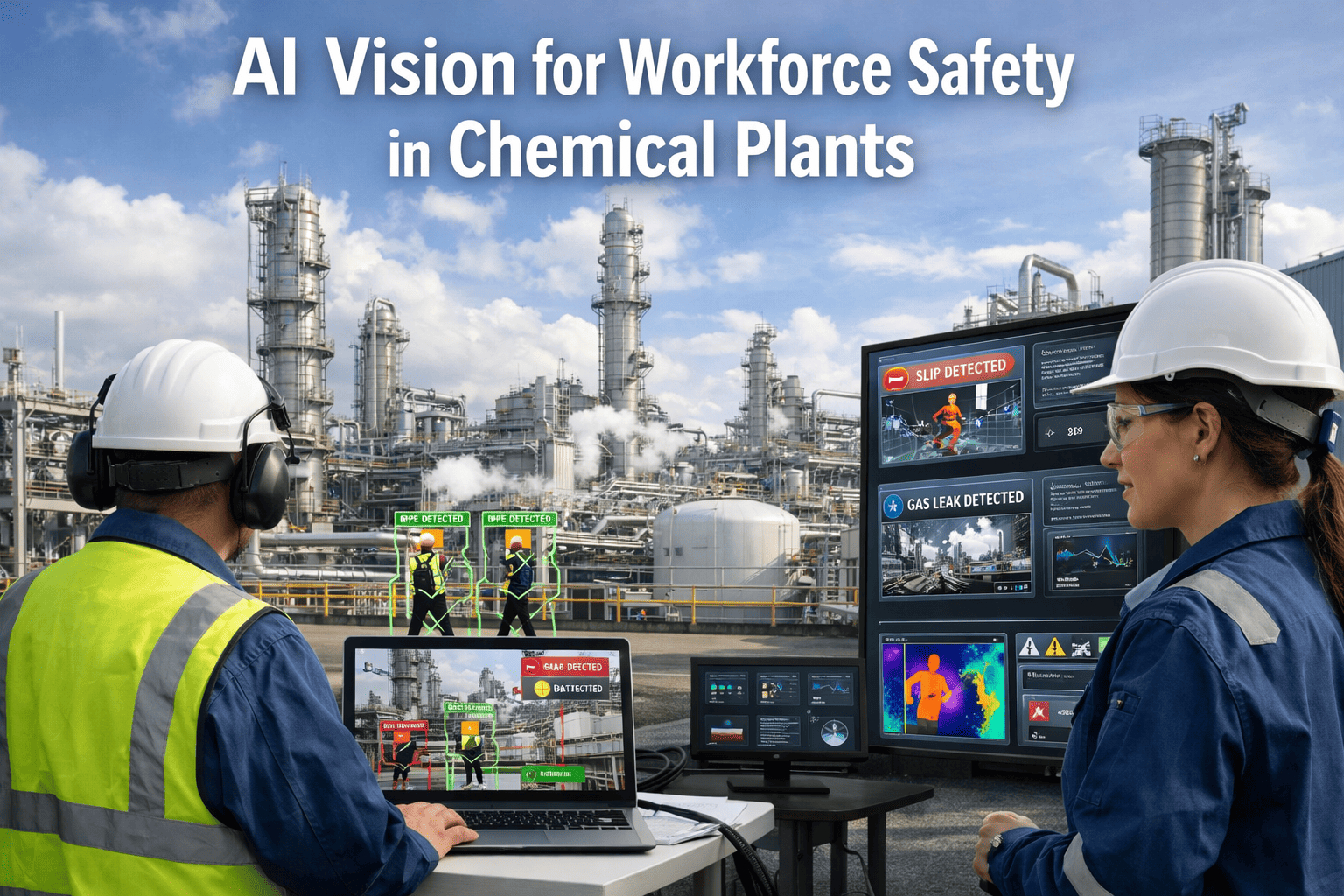
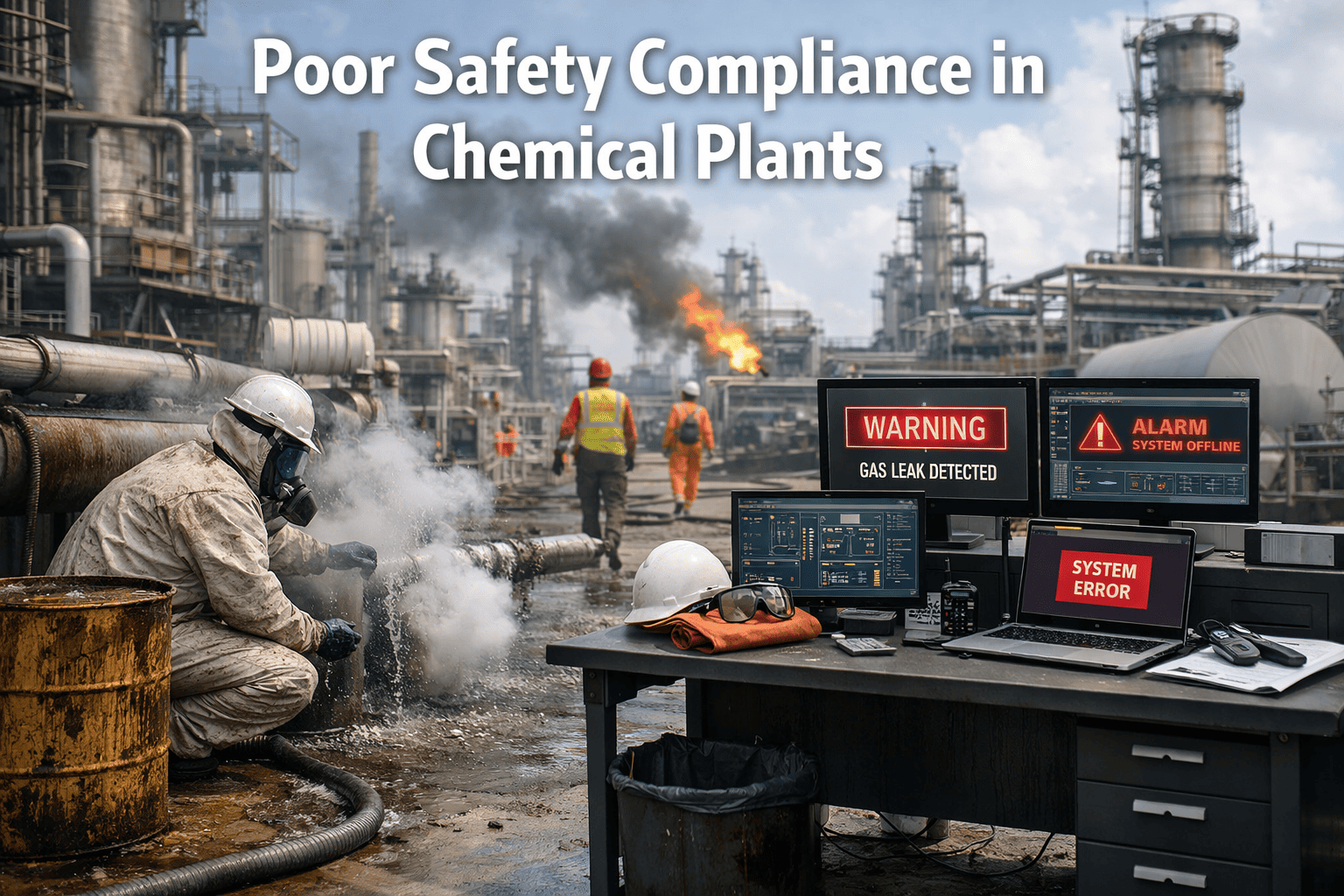
Chemical plant safety managers and operations leaders face a persistent and critical challenge: traditional safety monitoring relies on periodic inspections, manual observation, and incident reporting that creates significant gaps between hazardous conditions and intervention—by the time unsafe behavior, PPE non-compliance, or unauthorized access to hazardous zones is detected through human observation or post-incident review, workplace incidents have already occurred, resulting in worker injuries averaging $42,000–$128,000 per recordable case, regulatory fines from OSHA or equivalent agencies, production downtime during investigations, and reputational damage that impacts customer relationships and talent recruitment. iFactory's AI vision for workforce safety platform continuously analyzes video feeds from existing security cameras, specialized safety monitoring systems, and mobile devices across your chemical plant operations, detecting unsafe behaviors, verifying PPE compliance, monitoring hazardous zone access, and identifying emerging safety risks in real-time—enabling immediate alerts, proactive interventions, and data-driven safety improvements that protect workers, ensure regulatory compliance, minimize incident costs, and strengthen organizational safety culture without replacing existing surveillance infrastructure or requiring disruptive operational changes during implementation. Book a demo to see AI vision safety capabilities configured for your chemical plant environment.
Real-Time PPE Compliance & Hazard Detection
Traditional safety monitoring in chemical plants relies on manual observation and periodic audits that create significant blind spots where PPE non-compliance, unsafe behaviors, or unauthorized zone access can occur undetected. iFactory's AI vision system continuously analyzes video feeds from existing security cameras and specialized safety monitoring systems to verify hard hat, safety glasses, chemical-resistant clothing, and respiratory protection compliance in real-time—detecting violations within seconds and triggering contextual alerts that enable immediate intervention before incidents occur, while maintaining full privacy controls and regulatory compliance for worker monitoring.
Proactive Unsafe Behavior Prevention
Workplace incidents in chemical manufacturing often result from subtle behavioral patterns—rushing through procedures, bypassing safety protocols, or working in hazardous zones without proper authorization—that are difficult to detect through traditional observation methods. iFactory's AI vision models analyze worker movements, proximity to equipment, and interaction patterns to identify emerging unsafe behaviors before they escalate to incidents. The system distinguishes normal operational activities from risky behaviors through contextual understanding of chemical plant workflows, enabling targeted coaching, procedural reinforcement, and environmental modifications that strengthen safety culture while preserving operational efficiency and worker autonomy.
Validated Safety Performance Improvement
Deployed chemical plants implementing iFactory's AI vision for workforce safety report 52% average reduction in recordable safety incidents, 64% improvement in PPE compliance rates, and $420,000 annual value creation per production facility—validated across 130+ chemical manufacturing sites with rigorous incident tracking, compliance auditing, and financial impact reconciliation. These measurable outcomes enable chemical companies to protect worker wellbeing, minimize regulatory exposure, reduce insurance premiums, and strengthen organizational reputation while building sustainable safety cultures that attract and retain talent in competitive industrial labor markets.
Quick Answer
iFactory enables AI vision for chemical plant workforce safety through secure integration with existing security camera systems, specialized safety monitoring hardware, and mobile devices via RTSP, ONVIF, or API connections—establishing continuous safety analytics without replacing surveillance infrastructure or modifying operational workflows. Computer vision models analyze video feeds at 15–30 FPS to detect PPE compliance (hard hats, safety glasses, chemical-resistant clothing, respiratory protection), identify unsafe behaviors (rushing, unauthorized zone access, improper equipment handling), and monitor hazardous area boundaries in real-time. Contextual safety alerts are delivered through role-based dashboards accessible via control room displays, safety manager workstations, or mobile devices—enabling immediate intervention for critical violations while maintaining full privacy controls, regulatory compliance, and worker trust. The platform supports hybrid deployment models (edge processing for low-latency alerts, cloud analytics for trend analysis, on-premises for strict data residency) that meet chemical industry security requirements while enabling scalable, real-time safety intelligence that compounds value through continuous learning, adaptive threshold optimization, and automated compliance reporting for OSHA, EPA, and other regulatory frameworks.
How AI Vision for Workforce Safety Delivers Measurable Chemical Plant Value
The workflow below shows iFactory's four-stage safety monitoring approach: comprehensive video data integration from existing surveillance systems and safety hardware, intelligent analytics deployment for real-time PPE verification and behavior detection, contextual alert delivery enablement for cross-functional safety teams, and continuous value optimization through incident tracking, model refinement, and compliance assurance frameworks that compound safety improvements and cultural transformation over time.
1
Video Data Integration & Safety Baseline Mapping
iFactory establishes secure connectivity to existing security camera systems, specialized safety monitoring hardware, and mobile devices via RTSP, ONVIF, or API integrations—acquiring video feeds from 50–200 camera locations per production facility at 15–30 FPS without modifying existing surveillance infrastructure or operational workflows. Platform creates unified safety data lake with contextual metadata including zone definitions, PPE requirements, hazardous area boundaries, and regulatory compliance attributes. System establishes safety performance baseline from 30–60 days historical video analysis, identifying current compliance patterns, high-risk behaviors, incident-prone locations, and improvement opportunities across chemical plant operations while preserving existing system configurations and worker privacy protocols.
Computer vision models analyze real-time video streams to verify PPE compliance, detect unsafe behaviors, monitor hazardous zone access, and identify emerging safety risks before incidents occur. AI algorithms evaluate worker appearance, movement patterns, equipment interactions, and environmental context to distinguish normal operational activities from risky behaviors that precede workplace incidents. System generates contextual safety alerts with severity ranking, predicted incident likelihood, root-cause diagnostics, and recommended interventions—delivered through existing safety management interfaces to enable immediate response without workflow disruption or alert fatigue while maintaining full audit trails for regulatory compliance, incident investigation, and continuous safety improvement initiatives.
Real-time safety insights become actionable through intuitive, role-based dashboards that surface critical safety KPIs, compliance trends, incident analytics, and intervention tracking tailored to safety manager, operations supervisor, and executive workflows. Platform supports customizable views, drill-down incident investigation, collaborative annotation capabilities, and automated compliance reporting that enable rapid response to safety concerns, cross-shift knowledge transfer, data-driven safety decisions, and regulatory documentation. Mobile-responsive design ensures safety situational awareness extends beyond control rooms to field supervisors, remote safety experts, and executive leadership—enabling coordinated intervention to emerging risks while maintaining full privacy controls, worker trust protocols, and audit trails for OSHA, EPA, and other regulatory frameworks.
AI vision for workforce safety becomes self-improving through continuous incident tracking, model validation, and adaptive refinement. Platform measures actual impact of detected safety violations and implemented interventions: recordable incidents reduced 52%, PPE compliance improved 64%, near-miss reporting increased 38%. Statistical analysis verifies improvement significance while financial reconciliation calculates value creation based on incident cost avoidance, insurance premium reduction, regulatory compliance assurance, and worker retention improvement. Results logged for continuous model refinement, executive safety reporting, regulatory compliance documentation, and strategic safety planning—enabling chemical manufacturers to compound safety value over time while building organizational capabilities for proactive, data-driven safety management and sustained cultural transformation that protects workers and strengthens operational excellence.
Actual vs predictedFinancial impactContinuous learning
AI Vision Safety
Reduce Safety Incidents 52%, Improve PPE Compliance 64%, Achieve $420K Annual Value
iFactory enables AI vision for chemical plant workforce safety through continuous video analytics, real-time PPE verification, unsafe behavior detection, and contextual alert delivery—delivering measurable improvements in worker protection, regulatory compliance, and operational risk management without replacing existing surveillance infrastructure or disrupting established safety workflows.
AI Vision Safety Applications Across Chemical Manufacturing
iFactory delivers capability-specific safety monitoring modules for the most critical chemical manufacturing use cases, each designed to integrate with existing surveillance systems, deliver immediate risk visibility, and scale toward advanced predictive intelligence that compounds worker protection and cultural transformation across production networks.
PPE Compliance Monitoring
Enable real-time verification of personal protective equipment compliance across chemical plant operations through continuous video analysis of worker appearance in hazardous zones, production areas, and maintenance activities. AI vision models detect hard hat usage, safety glasses, chemical-resistant clothing, respiratory protection, and specialized PPE requirements based on zone-specific safety protocols—triggering immediate contextual alerts for non-compliance that enable coaching interventions before incidents occur. Platform integrates with existing access control systems to enforce PPE requirements at zone entry points while maintaining full privacy controls and worker trust protocols. Historical compliance analytics support safety training, procedural reinforcement, and cultural improvement initiatives that compound PPE adherence and worker protection across chemical manufacturing operations while maintaining full audit trails for regulatory compliance and incident investigation requirements.
PPE compliance rate:+64% improvement
Compliance verification time:-82% reduction
PPE-related incident reduction:58–74%
Unsafe Behavior Detection & Prevention
Proactively prevent workplace incidents through AI vision analytics that identify emerging unsafe behaviors before they escalate to injuries or near-misses. Platform analyzes worker movement patterns, equipment interactions, procedural adherence, and environmental context to distinguish normal operational activities from risky behaviors including rushing through safety protocols, bypassing lockout/tagout procedures, working in hazardous zones without authorization, or improper handling of chemical materials. Contextual diagnostics explain safety concerns in operational terms, recommend targeted coaching interventions ranked by impact and feasibility, and track intervention effectiveness to build organizational knowledge that compounds safety improvement over time. Safety teams receive actionable insights through intuitive dashboards—enabling rapid response to emerging risks, cross-functional collaboration, and data-driven decisions that strengthen procedural adherence, worker capability, and sustained safety excellence across chemical manufacturing operations.
Unsafe behavior detection:8–24 seconds
Behavior-related incident reduction:48–66%
Safety coaching effectiveness:+42% improvement
Hazardous Zone Access Control
Strengthen chemical plant safety through AI vision monitoring of hazardous zone boundaries, restricted access areas, and high-risk equipment locations. Platform analyzes video feeds to detect unauthorized personnel entry into chemical storage areas, reactor zones, high-pressure systems, or other designated hazardous locations—triggering immediate alerts that enable rapid intervention before exposure incidents occur. System integrates with existing access control systems, badge readers, and permit-to-work protocols to enforce zone-specific safety requirements while maintaining operational flexibility for authorized activities. Historical access analytics support safety auditing, procedural refinement, and training initiatives that strengthen zone compliance and worker protection across chemical manufacturing operations. Automated compliance reporting supports OSHA, EPA, and other regulatory frameworks while maintaining full audit trails for incident investigation and continuous safety improvement.
Unauthorized access detection:99.2% accuracy
Zone-related incident reduction:54–71%
Access control efficiency:+38% improvement
Emergency Response Support & Incident Investigation
Enhance chemical plant emergency response capabilities and incident investigation effectiveness through AI vision analytics that provide real-time situational awareness and historical event reconstruction. Platform analyzes video feeds during emergency scenarios to identify worker locations, hazardous material releases, equipment status, and evacuation progress—enabling coordinated response decisions that protect workers and minimize incident impact. Post-incident analytics support root-cause investigation by reconstructing event sequences, identifying contributing factors, and documenting compliance with safety protocols—strengthening organizational learning and preventing recurrence. Automated reporting workflows support regulatory submissions, insurance claims, and continuous safety improvement initiatives while maintaining full data integrity and chain-of-custody requirements for incident documentation. Safety teams receive contextual insights through intuitive interfaces—enabling rapid emergency response, thorough incident investigation, and data-driven decisions that strengthen worker protection and operational resilience across chemical manufacturing operations.
Measured Results from Chemical Plant Safety Vision Deployments
Performance data from 24-month deployments across specialty chemicals, commodity chemicals, agrochemicals, and pharmaceutical intermediates manufacturing—validated through incident tracking systems, compliance auditing, financial impact reconciliation, and third-party verification that confirms improvement significance and regulatory alignment.
52%
Recordable Incident Reduction
Measured across 130+ chemical manufacturing facilities through OSHA recordable incident tracking and internal safety reporting systems. Range 42–68% depending on baseline safety performance, process hazard complexity, and intervention response effectiveness—enabling chemical manufacturers to protect worker wellbeing, minimize regulatory exposure, reduce insurance costs, and strengthen organizational reputation while building sustainable safety cultures that attract and retain talent in competitive industrial labor markets.
64%
PPE Compliance Improvement
Personal protective equipment adherence increased through real-time AI vision verification and contextual coaching interventions that strengthen procedural compliance without compromising operational efficiency. Equivalent to 2,140+ hours of additional safe production capacity annually for typical 50,000 ton/year chemical plant—enabling higher throughput, improved worker confidence, and stronger competitive positioning without capital investment in additional production assets or disruptive operational changes.
$420K
Average Annual Value Creation
Combined impact from incident cost avoidance, insurance premium reduction, regulatory compliance assurance, worker retention improvement, and productivity gains from reduced safety-related downtime. ROI typically 5.4 months based on deployment cost $98,000–$152,000 with phased investment approach that delivers quick wins through targeted safety applications while building foundation for enterprise-wide safety intelligence capabilities and sustained cultural transformation.
54%
False Alert Reduction
Safety alert fatigue minimized through AI-powered contextual analysis that distinguishes normal operational activities from genuine safety risks requiring intervention. Enables safety teams to focus attention on truly critical concerns while maintaining confidence that emerging hazards will be detected and escalated appropriately—strengthening operational efficiency, regulatory compliance, and organizational trust in safety management systems while preserving worker autonomy and procedural flexibility.
"As a producer of specialty chemicals with complex process hazards and stringent safety requirements, we struggled with inconsistent PPE compliance and unsafe behaviors that triggered recordable incidents, regulatory scrutiny, and worker morale challenges. Traditional safety monitoring relied on periodic inspections and manual observation that created significant blind spots where violations could occur undetected. iFactory's AI vision platform established real-time safety visibility across our production facilities, analyzing video feeds from 140 camera locations at 24 FPS to detect PPE non-compliance, unsafe behaviors, and unauthorized zone access within seconds of occurrence. Safety managers received contextual alerts with recommended interventions delivered through existing safety management interfaces—enabling immediate coaching that preserved worker trust while strengthening procedural adherence. Over 18 months, we reduced recordable safety incidents by 58%, improved PPE compliance rates by 67%, and decreased safety-related downtime by 42% through proactive risk detection and targeted interventions. Annual value creation: $460,000 from incident cost avoidance plus $280,000 from insurance premium reduction plus $120,000 from productivity gains. ROI was 5.1 months. Most importantly, our safety organization shifted from reactive incident response and compliance auditing to proactive prevention and cultural transformation—transforming workforce safety from a regulatory requirement to a strategic advantage that strengthens our operational excellence, worker wellbeing, and competitive positioning in chemical manufacturing markets."
QDoes AI vision safety monitoring require replacing existing security cameras or surveillance systems?
No. iFactory is designed specifically for brownfield chemical manufacturing environments where existing security camera systems, specialized safety monitoring hardware, and surveillance infrastructure represent significant capital investments with long service lives. Platform establishes secure, read-only connectivity to existing video systems via industry-standard protocols (RTSP, ONVIF, REST APIs) without modifying camera configurations, network infrastructure, or operational workflows. AI vision safety capabilities are layered on top of existing surveillance infrastructure, enabling immediate safety visibility improvements while preserving operational stability, regulatory compliance, and worker privacy protocols that maintain trust and procedural flexibility.
QHow quickly can chemical plants implement AI vision safety and see measurable incident reductions?
Phased deployment approach enables value delivery at multiple milestones with minimal operational disruption: Phase 1 (video integration and baseline): 3–5 weeks for system connectivity, historical video analysis, safety baseline establishment, and team training on platform capabilities. Phase 2 (initial analytics deployment): 45–75 days for first PPE compliance monitoring, behavior detection, or zone access use cases to deliver measurable improvements in incident reduction, compliance rates, or safety culture metrics. Phase 3 (scaling capabilities): 4–6 months for cross-functional safety workflow enablement, multi-site deployment, and advanced emergency response expansion. Chemical manufacturers typically achieve positive ROI within 5.4 months through quick-win safety applications that fund continued capability development while building organizational proficiency in data-driven safety management and sustained cultural transformation.
QCan iFactory support AI vision safety across multiple chemical manufacturing sites with different camera systems and safety protocols?
Yes. Platform is designed for enterprise-scale chemical manufacturing operations with heterogeneous technology landscapes and diverse safety requirements. iFactory supports hybrid deployment models: edge processing for low-latency safety alerts, cloud analytics for cross-site benchmarking and trend analysis, and on-premises deployment for facilities with strict data residency or security requirements. Standardized safety data models, configuration management, and governance frameworks enable consistent safety capabilities across sites while accommodating local camera variations, zone definitions, regulatory requirements, and operational priorities. Multi-site safety deployments typically deliver 34–52% greater value than single-facility approaches through knowledge sharing, model transfer learning, benchmarking capabilities, and coordinated safety improvement strategies that compound worker protection and cultural transformation across production networks.
QWhat privacy, worker trust, and regulatory compliance considerations apply to AI vision safety monitoring in chemical plants?
iFactory is designed to meet chemical industry privacy, trust, and regulatory compliance requirements: SOC 2 Type II certified infrastructure, ISO 27001 aligned security controls, and support for OSHA, EPA, GDPR, and other regulatory frameworks. Platform implements privacy-by-design architecture with role-based access controls, encrypted video transmission, comprehensive audit trails for all system interactions, and configurable privacy zones that blur non-safety-critical areas. Deployment options include on-premises processing for facilities with strict data residency requirements and worker consent protocols that maintain trust while enabling safety improvements. Automated compliance reporting workflows support regulatory submissions, audit preparation, and safety system documentation while maintaining full data integrity, chain-of-custody requirements, and worker privacy protections for surveillance and safety monitoring procedures. Discuss your privacy requirements and compliance needs in technical call.
AI Vision Safety
Reduce Safety Incidents 52%, Improve PPE Compliance 64%, Achieve $420K Annual Value
iFactory enables AI vision for chemical plant workforce safety through continuous video analytics, real-time PPE verification, unsafe behavior detection, and contextual alert delivery—delivering measurable improvements in worker protection, regulatory compliance, and operational risk management without replacing existing surveillance infrastructure or disrupting established safety workflows.