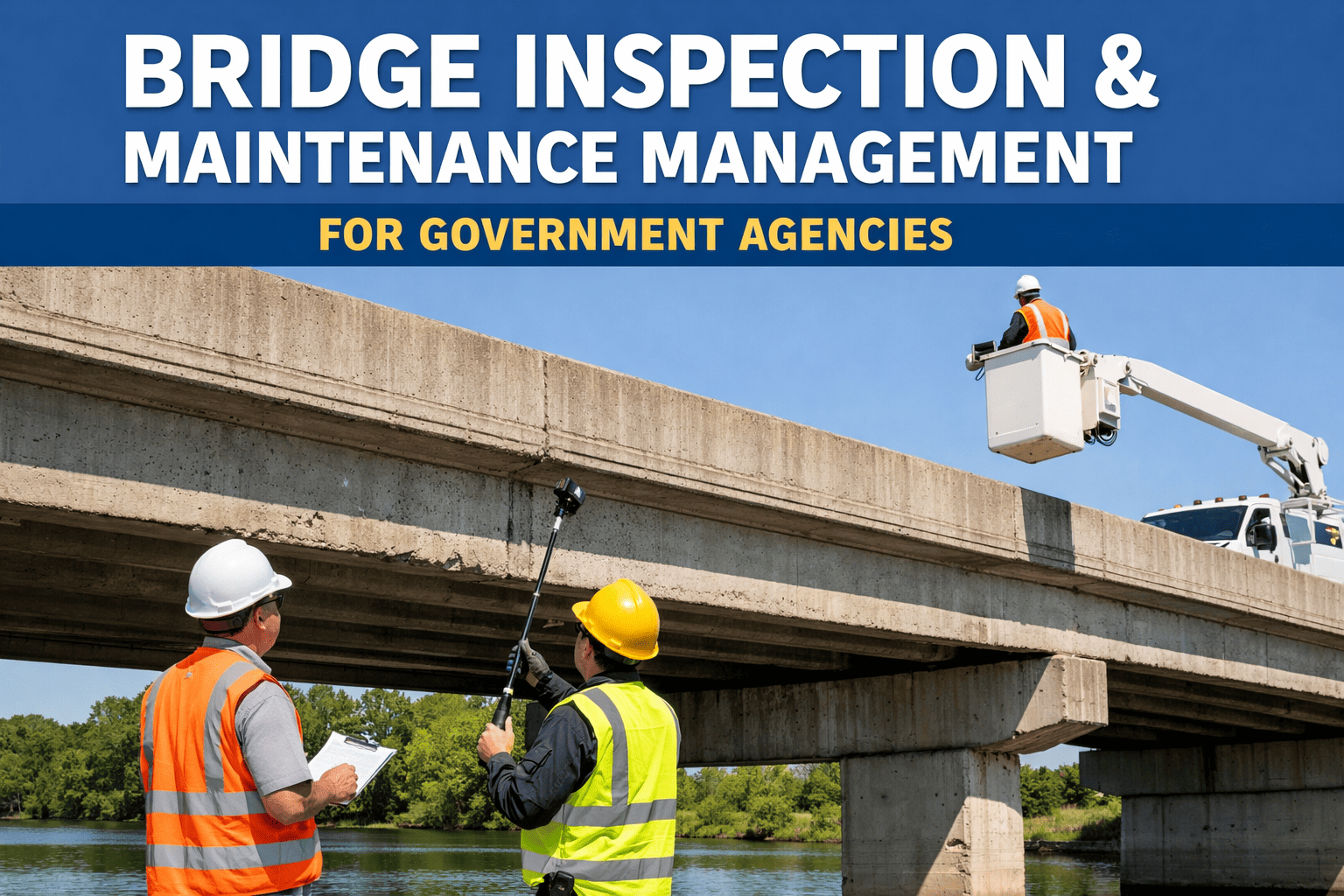
Bridge Inspection & Maintenance Management for Government Agencies
By oxmaint on March 7, 2026
The United States maintains over 623,000 highway bridges—and more than one in three needs repair or replacement. For state DOTs and local government agencies, bridge safety is not optional: the Federal Highway Administration mandates regular inspections under the National Bridge Inspection Standards, and the new Specifications for the National Bridge Inventory are reshaping how agencies collect, validate, and submit bridge condition data. Agencies that still rely on paper inspection forms, disconnected spreadsheets, and reactive repair cycles are falling behind on compliance, overspending on emergency fixes, and missing opportunities to extend bridge service life by decades. Schedule a consultation to see how a digital maintenance platform can transform your bridge inspection program.
How NBI Condition Ratings Shape Bridge Maintenance Priorities
Every bridge in the National Bridge Inventory receives condition ratings on a 0-to-9 scale for its deck, superstructure, substructure, and culvert components. These ratings are far more than compliance data points—they directly determine inspection frequency, maintenance urgency, federal funding eligibility, and load posting decisions. Without a centralized system to track ratings over time and trigger actions automatically, agencies lose the ability to intervene before deterioration accelerates past the point of cost-effective repair.
0 – 3Critical / Serious
4Poor
5 – 6Fair
7 – 8Good
9Excellent
Ratings 0–3: 12-month inspection cycle required. Immediate structural review. Load posting or closure may be necessary. Plans of Corrective Action required by FHWA.
Rating 4 (Structurally Deficient): Bridge enters "poor" classification. Eligible for Highway Bridge Program replacement funding. Sufficiency rating of 50 or below triggers replacement eligibility.
Ratings 5–6: Standard 24-month inspection cycle. Preventive maintenance critical to arrest deterioration. Sufficiency rating of 80 or below qualifies for federal repair funding.
Ratings 7–9: Bridge in good to excellent condition. Preservation activities maintain ratings and maximize return on original construction investment.
42,067
U.S. bridges are currently rated in poor condition (NBI rating of 4 or below), carrying 168 million vehicle trips every single day. The average structurally deficient bridge is 68 years old—well past the typical 50-year design life. A digital maintenance platform tracks every rating change, triggers the right inspection cycle, and ensures no bridge slips through the cracks. Get Support to start tracking NBI condition ratings across your entire bridge inventory — and catch deterioration before it reaches the "poor" threshold.
Bridge Preventive Maintenance: Activities That Extend Service Life by 25+ Years
State DOTs that invest in systematic preventive maintenance can extend a bridge's functional service life by a minimum of 25 years—with only routine upkeep needed for the first decade after treatment. The key is catching and addressing deterioration early, before a bridge rated "good" or "fair" degrades into the "poor" category where repair costs escalate dramatically. A maintenance management platform schedules these activities automatically based on inspection findings, bridge age, environmental exposure, and component condition trends.
Deck Preservation
Crack sealing and epoxy injection, deck overlays and membranes, concrete patching and delamination repair, joint cleaning and resealing, chloride barrier treatments
Inspection-driven, typically every 3–5 years for sealing activities
Superstructure Care
Steel painting and coating renewal, spot painting at corrosion sites, bearing cleaning and lubrication, fatigue crack monitoring and repair, girder impact damage assessment
Coating systems: 15–25 year cycles. Bearing lubrication: annually
Substructure Protection
Pier cap cleaning and sealing, abutment concrete repair, scour countermeasure installation, riprap placement and monitoring, erosion and sediment control
Scour monitoring: continuous during flood events. Concrete repair: as identified
Drainage & Approach
Drain clearing and unclogging, trough repair and replacement, approach slab stabilization, guardrail and transition maintenance, vegetation management around abutments
Drain cleaning: semi-annually or after major storms
Automate your bridge preventive maintenance scheduling. Stop relying on spreadsheets to track when decks need sealing, bearings need lubrication, or joints need replacement. A digital platform ties inspection findings directly to maintenance work orders—so the right crew gets dispatched before deterioration accelerates.
SNBI 2026 Transition: What Every DOT Agency Must Prepare For
The Specifications for the National Bridge Inventory are replacing the 1995 Recording and Coding Guide—the most significant change to federal bridge data standards in three decades. SNBI introduces tighter condition rating definitions, additional component-level data fields, and a separation of appraisal data from field-observed conditions. Agencies that wait until the compliance deadline will face data backlogs, coding errors, and submission failures. Those that prepare now will transition smoothly while improving data quality across their entire bridge inventory.
Mar 2025
Final NBI submission in legacy 1995 Coding Guide format
Jan 2026
SNBI data collection and verification must begin. NBI NextGen fully operational
Mar 2026
First SNBI hybrid dataset submittal with verified program fields
Mar 2028
Complete SNBI dataset required for all inspected bridges
Key SNBI Changes Agencies Must Address
New Component Ratings
Railings, bearings, joints, railing transitions, channel protection, scour, NSTM, and underwater elements now require individual condition ratings beyond the traditional deck/superstructure/substructure triad.
Tighter Rating Definitions
What rated a "7" under the old coding guide may now rate as a "6" under SNBI. Deterioration models and maintenance triggers need recalibration to match the new definitions.
Separated Appraisal & Condition Data
Scour ratings now split into a Vulnerability Code (engineering appraisal) and a Condition Rating Code (field observation). This eliminates ambiguity and produces more reliable data for maintenance decisions.
Data Validation Requirements
NBI NextGen includes built-in validation rules. A modern maintenance platform ensures data passes these checks before submission, preventing rejection and resubmission cycles.
Do not wait until 2028 to prepare. Agencies that start SNBI data collection now avoid last-minute scrambles and build higher-quality bridge records from day one. Schedule a demo to see how the platform handles new SNBI data fields, component ratings, and FHWA-compliant export formatting — ready to use from day one.
FHWA evaluates every state bridge inspection program against 23 performance metrics grouped into six categories: organization, personnel qualifications, inspection frequency, procedures, critical findings, and inventory data quality. Each metric receives one of four ratings—Compliant, Substantially Compliant, Conditionally Compliant, or Non-Compliant. Falling short triggers Improvement Plans or Plans of Corrective Action, and persistent non-compliance can affect federal funding. A digital platform monitors every metric in real time and flags risks before your next FHWA review.
Organization & Qualifications
Program Manager DesignationRole-based access with responsibility tracking
Team Leader CredentialsCertification tracking and expiry alerts
Inspector QualificationsTraining records and refresher course scheduling
Inspection Frequency & Procedures
24-Month Routine InspectionsAutomated scheduling with overdue alerts
12-Month Cycles for Poor-Rated BridgesCondition-triggered frequency adjustment
Underwater & NSTM InspectionsSpecialized inspection type management
QC/QA ProgramsReview workflows with approval chains
Critical Findings & Data Quality
Critical Finding ResponseImmediate alerts and corrective action tracking
NBI Data AccuracyBuilt-in validation against SNBI coding rules
Timely Data SubmissionPre-submission completeness checks and export
Closing the $400 Billion Bridge Repair Gap with Smarter Maintenance
Nearly 221,800 U.S. bridges need major repair or replacement, at an estimated cost exceeding $400 billion. The 2021 Infrastructure Investment and Jobs Act allocated $27.5 billion in bridge formula funding—significant, but less than 7% of the total need. Agencies cannot build their way out of this gap. The only viable strategy is to preserve bridges in good and fair condition through systematic preventive maintenance, delaying their slide into poor condition where costs multiply. A digital maintenance platform enables this shift from reactive to preventive—tracking the right interventions at the right time across every bridge in the inventory.
$400B+
Total estimated cost to address all bridge repair and replacement needs across the U.S.
$27.5B
New bridge formula funding from the 2021 Infrastructure Investment and Jobs Act
221,800
Bridges needing major repair or replacement—one in every three across the nation
With available funding covering less than 7% of the total need, preventive maintenance is not optional—it is the only financially sustainable path to keep bridges safe and in service.
Service life extended 25+ years beyond design life
PM treatments cost 3–10% of replacement
Emergency repairs drop below 20% of budget
Better ratings unlock more federal preservation funding
Start shifting from reactive repairs to preventive preservation today. Create a free account to build a centralized bridge maintenance program — schedule deck sealings, track bearing conditions, and prioritize PM treatments that keep your bridges out of the "poor" category and eligible for federal preservation funding.
Real-Time Structural Health Monitoring for Aging Bridges
With 42% of U.S. bridges over 50 years old and 15% between 40 and 49, the nation's bridge inventory is aging faster than it can be replaced. Structural health monitoring fills the gap between periodic inspections by providing continuous sensor data on strain, vibration, tilt, and temperature. When integrated with a maintenance platform, this data triggers alerts and work orders automatically—converting raw sensor readings into actionable maintenance decisions without waiting for the next scheduled inspection.
Strain & Load Monitoring
Fiber optic and foil strain gauges measure real-time stress on critical members. Alerts trigger when loads exceed design thresholds or when strain patterns indicate fatigue crack initiation.
Scour & Water Level Sensors
Sonar-based scour monitors track riverbed elevation around piers and abutments. Automated alerts activate during flood events when scour depth approaches critical thresholds.
Tilt & Displacement Tracking
Inclinometers and LVDT sensors detect pier settlement, bearing displacement, and superstructure movement. Sub-millimeter accuracy identifies problems invisible during visual inspection.
Corrosion & Environmental
Embedded corrosion rate sensors and weather stations track chloride penetration, humidity, and freeze-thaw cycles. Data drives optimized timing for deck sealing and coating renewal.
What a Digital Bridge Inspection Workflow Looks Like
Moving from paper forms to a digital inspection workflow does not just save time—it fundamentally changes the quality, consistency, and actionability of bridge condition data. Here is how agencies using a modern maintenance platform handle the complete bridge inspection lifecycle, from planning through NBI submission.
1
Automated Schedule Generation
The platform calculates inspection due dates for every bridge based on its condition rating, bridge type, and NBIS-mandated interval. Bridges rated 3 or below automatically shift to 12-month cycles. Upcoming and overdue inspections surface on a dashboard—no spreadsheet tracking required.
2
Mobile Field Data Collection
Inspectors use tablet-based forms with pre-populated bridge data, embedded coding references, and real-time validation. Photos, GPS coordinates, and element-level condition data are captured offline and sync automatically when connectivity returns.
3
QC/QA Review & Approval
Completed inspections route through a structured review workflow. The system highlights rating changes from previous inspections, flags potential coding errors, and requires reviewer sign-off before data is finalized—satisfying FHWA QC/QA requirements.
4
Automatic Work Order Creation
Inspection findings with ratings of 4 or below trigger high-priority maintenance work orders. Critical findings generate immediate SMS and email alerts to program managers. Every finding links back to the inspection record with photos and location data.
Your bridges carry millions of trips daily. Your inspection program should match that responsibility. Paper forms, disconnected databases, and reactive maintenance put public safety at risk and waste taxpayer dollars. A purpose-built digital platform centralizes your entire bridge inventory, automates NBIS compliance, and converts inspection data into preventive maintenance plans that keep bridges in service longer—at lower cost.
How does a digital platform help meet NBIS inspection frequency requirements?
The platform automatically calculates inspection due dates based on each bridge's condition rating and applicable NBIS interval—24 months for standard bridges, 12 months for those with component ratings of 3 or below. Dashboard alerts flag upcoming and overdue inspections across the entire inventory, and automated scheduling ensures no bridge misses its mandated cycle. This directly addresses FHWA Metric 7 (routine inspection frequency) during annual compliance reviews. Book a demo to see how automated scheduling and overdue alerts keep your agency compliant across all 23 FHWA metrics.
What does the SNBI transition mean for our current bridge data?
SNBI introduces new component-level ratings, tighter condition definitions, and separated appraisal and condition codes. Your existing NBI data will be transitioned to SNBI format, but agencies must verify the transitioned data and begin collecting new SNBI-specific fields. A modern platform maps legacy codes to SNBI format automatically and includes the new component rating fields—railings, bearings, joints, scour, NSTM, and underwater—ready for inspectors to populate during their next cycle.
Can the system handle multiple inspection types (routine, underwater, fracture-critical)?
Yes. The platform manages distinct schedules and specialized inspection forms for routine, underwater, fracture-critical (NSTM), damage, and special inspections. Each type has its own frequency rules, qualified inspector requirements, and data fields. Findings from all inspection types feed into a single bridge asset record, giving program managers a complete structural health picture. Get Support to manage routine, underwater, and fracture-critical inspections in one unified platform.
How quickly can a state DOT implement this platform?
Typical state DOT implementations take 8–16 weeks depending on inventory size and data migration scope. A phased approach starts with core inspection scheduling and mobile data collection in the first month, then expands to work order management, preventive maintenance programs, and advanced analytics. Most agencies begin seeing measurable compliance improvements within 30 days of go-live.
Does the mobile app work offline during field inspections?
Yes. Bridge inspections frequently occur in locations with limited or no cellular coverage—under decks, in rural areas, or around waterways. The mobile application supports full offline capability for completing inspections, capturing photos, and recording all condition ratings. Data syncs automatically when the device reconnects, with built-in conflict resolution if multiple team members are working on adjacent structures.