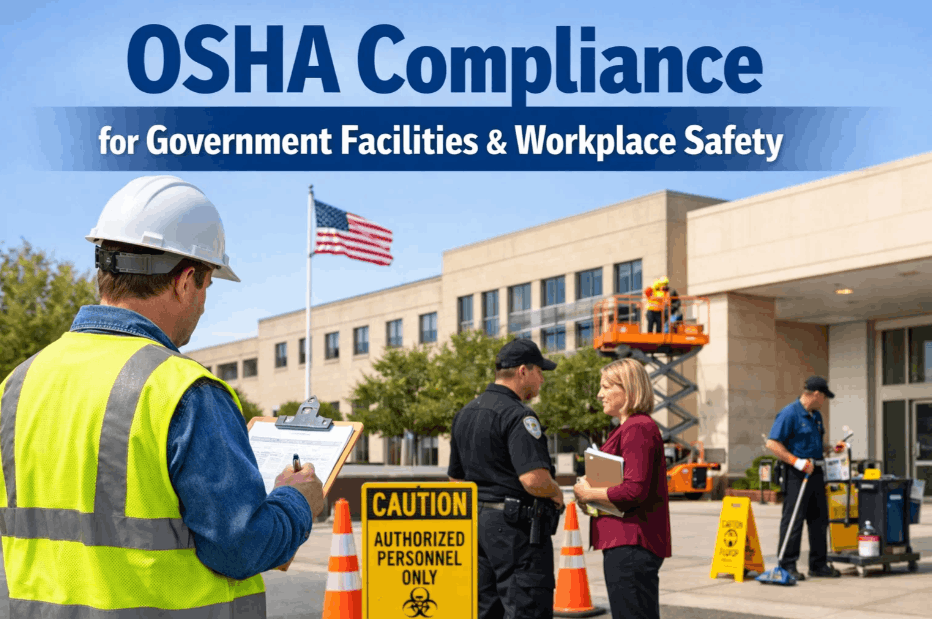
As governmental facilities and public works departments face increasing pressure to modernize, the landscape of workplace safety is shifting toward data-driven accountability. Under the current 2026 regulatory framework, federal and state-level OSHA enforcement has intensified, particularly for high-risk municipal operations such as waste management, utility maintenance, and public transport infrastructure. Transitioning from reactive paper-based logs to a predictive "Safety-First" digital twin model isn't just about avoiding hefty fines—it's about ensuring every public servant returns home safely. This guide unpacks the essential components of OSHA compliance for government agencies, from hazard assessments to real-time incident tracking. Book a free demo to digitize your compliance workflow.
Federal OSHA vs. State-Level Public Sector Coverage
Understanding who regulates your municipality is the first step toward audit readiness. While federal OSHA doesn't cover state/local government, 28 states have their own federally-approved plans.
In 2026, the emphasis on "Recordkeeping Accountability" has reached a tipping point for municipal managers. Failure to maintain a continuous, verifiable digital log of safety training and hazard assessments can result in "Willful" citations exceeding $150,000 per violation. Cities are now adopting centralized data warehouses to sync their OSHA 300 logs across public works, police, and fire departments. Book a free demo to see how iFactory handles jurisdiction-specific reporting automatically.
| Jurisdiction | Public Sector Coverage | Recordkeeping Rule | Mandatory Digital Filing |
|---|---|---|---|
| Federal OSHA | Federal Agencies only | Section 1960 | Required via ITA Portal |
| State-Plan States | State & Local Government | State-Specific (OSHA 300) | Mandatory in CA, NY, IL, and 25 others |
| Non-Plan States | Internal Governor Mandates | Agency-specific | Voluntary but recommended |
The 3 Pillars of Municipal Exposure
In 2026, inspectors are focusing on these three high-hazard areas within government facilities. Book a free demo.
Beyond these core pillars, government agencies are increasingly participating in VPP (Voluntary Protection Programs) to demonstrate safety leadership. These programs require a rigorous 3-year safety performance track record, which is impossible to maintain without a robust digital infrastructure for incident reporting and corrective action tracking. Book a free demo to learn how our VPP-ready dashboards can reduce your insurance premiums and audit frequency.
Public Works & Underground Utilities
Compliance with 29 CFR 1926 Subpart P is critical for municipal water and sewer crews. iFactory provides real-time atmospheric monitoring for confined space entry, ensuring oxygen levels, H2S, and LEL are within safe limits before any descent. We digitize the "Competent Person" checklist for trenching, providing a geo-tagged audit trail of shoring and sloping inspections that satisfy federal oversight requirements even in remote locations.
Municipal Fleet & Heavy Equipment Hubs
Managing the safety of maintenance garages requires a strict Lockout/Tagout (LOTO) protocol under 29 CFR 1910.147. Our digital LOTO ledger replaces physical logs, ensuring that every energy source is isolated and verified during vehicle repairs. Additionally, iFactory tracks chemical exposure levels and SDS (Safety Data Sheet) accessibility for fueling and paint booths, automating the "Right to Know" compliance for every worker in the facility.
Public Transit & Multi-Level Government Facilities
Eliminating fall hazards (Subpart D) and ensuring emergency egress in high-occupancy public buildings is a primary 2026 OSHA priority. iFactory's digital twins map platform edges, rooftop access points, and emergency stairwells, triggering automated maintenance alerts when life-safety equipment like fire extinguishers or emergency exit lighting fails its monthly self-test according to 29 CFR 1910.37 standards.
Digital Safety Standards: The 2026 Revision
OSHA increasingly recognizes digital "Chain of Responsibility" for safety documentation. Paper logs are no longer enough for high-complexity government facilities.
The recently implemented "Walkaround Rule" (2024-2026) has created a new challenge for facility directors: workers can now designate non-employee technical experts to join OSHA inspectors inside restricted zones. This makes real-time, tamper-proof digital safety logs more critical than ever, as any discrepancies between physical site conditions and safety records are instantly flagged by external observers. Book a free demo to see how we maintain an immutable "Digital Ground Truth" for your safety protocols.
| OSHA Standard | Digital Requirement | iFactory Solution |
|---|---|---|
| Injury Tracking (1904.41) | Electronic submission (ITA) | Automated Log 300/301 exports to federal portals |
| PPE Verification (1910.132) | Proof of hazard assessment | Computer Vision identification of hard-hat/vest compliance |
| Hazard Comm (1910.1200) | Instantly accessible SDS | QR-code based digital safety data sheet libraries at point-of-use |
5 Essential Metrics for Workplace Safety Audits
Don't wait for an inspection. Track these internal KPIs to prove your safety program's efficacy to federal regulators.
Maintaining high safety metrics is now a prerequisite for securing federal IIJA and BIL capital improvement funds. Grant reviewers at the DOT and EPA score municipal applications higher when they can prove a data-driven commitment to worker safety and reduced lost-time rates. By digitizing these metrics, you aren't just protecting workers; you're securing your municipality's financial future and credit rating. Book a free demo to leverage your safety data in your next grant application.
Total Recordable Incident Rate (TRIR)
The gold standard for safety benchmarking. iFactory calculates TRIR in real-time based on exposure hours, allowing public works directors to compare safety performance across multiple city departments instantly. Book a free demo.
Leading Indicator: Hazard Near-Miss Submissions
A safety program is only effective if it's proactive. We track the ratio of "Near Misses" reported vs actual accidents. A high reporting rate often indicates a healthy safety culture and prevents future LTI (Lost Time Injuries).
Certification Compliance Rate (%)
Are 100% of your forklift operators and trenching competent persons currently certified? Our platform sends automated SMS alerts to managers 60 days before a worker's safety certification (OSHA 10-Hr or 30-Hr) expires.
Mean Time to Hazard Correction (MTTC)
Once a hazard is identified in a government building, how long does it take to fix? Audit trails prove that hazards are abated within regulatory windows, protecting the city from "Failure to Abate" fines which exceed $150K per day.
Respiratory Protection Compliance (29 CFR 1910.134)
Critical for waste and chemical facilities. We track annual fit-test results and medical clearances for every employee required to wear a respirator, ensuring full compliance with one of OSHA's most frequently cited standards.
Is Your Facility Inspection-Ready Today?
In just 30 minutes, we can audit your current digital safety assets and show you how iFactory's unified safety portal eliminates the stress of OSHA recordkeeping for government agencies. Join the 200+ municipal departments that have already streamlined their hazard reporting workflows.
Government Safety Questions
Common compliance hurdles for public sector managers.
Q: Does OSHA apply to state and local government employees?
It depends on your state. If you are in one of the 28 "State-Plan" states (like California, Texas, or Virginia), state/local government employees **are** covered. In "Federal-Only" states, they are technically not, though many follow OSHA standards as a Best Practice / Liability shield.
Q: What is the "Walkaround Rule" and how does it affect government facilities?
The new 2024 OSHA rule allows employees to designate a third-party representative (including union or non-employee technical experts) to accompany an inspector during a facility tour. Digital records are the best way to manage this increased external scrutiny.
Q: How does iFactory assist with Log 300 recordkeeping?
Our platform captures incident reports on mobile devices at the site of the event and automatically populates the required OSHA 300, 301, and 300A forms for year-end submission. Book a free demo.
Q: What is the most common citation for municipal public works?
Trenching and Excavation (1926.651) remains the leading cause of fines and fatalities in municipal road/utility work. Any trench deeper than 5 feet must have a protective system.
Q: How long must safety records be kept by the city?
Most OSHA incident logs must be maintained for at least 5 years. Medical records and chemical exposure logs often require 30 years. iFactory provides unlimited cloud archival for these long-term mandates.
Q: Can digital sensors replace manual safety inspections?
They augment them. While a "Competent Person" must still perform physical inspections, IoT sensors for noise, air quality, and radiation provide continuous data that manual spot-checks might miss. Talk to our safety engineer.
Zero Accidents is a Choice, Not a Coincidence.
Equip your workforce with the digital tools they need to stay safe. iFactory provides the data visibility that turns "Safety Compliance" into a competitive advantage for government contracts and public trust.