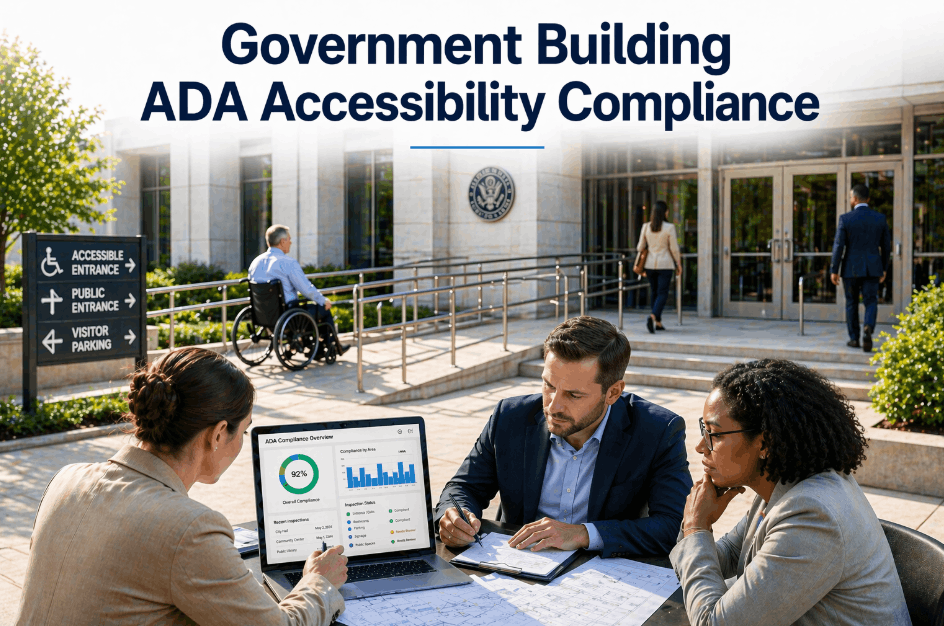
Government buildings serve every member of the public — veterans, seniors, people with disabilities, and families with young children. Yet thousands of federal, state, and municipal facilities still fall short of ADA compliance standards, exposing agencies to legal liability, civil rights complaints, and costly retrofits. In 2026, meeting ADA accessibility compliance in government buildings is no longer just a legal obligation — it's an operational priority that shapes public trust, service delivery, and facility management strategy. Whether you manage a courthouse, municipal office, DMV, or public library, this guide covers ramp requirements, restroom accessibility standards, accessible signage rules, and how modern accessibility analytics platforms are transforming how government facilities maintain continuous ADA compliance. Book a demo to see how proactive compliance monitoring works in real government facility environments.
Automate ADA Compliance Monitoring Across Your Government Facility
iFactory's accessibility analytics platform continuously tracks ADA compliance status across all critical control points — ramps, restrooms, signage, parking, and entrances — so your facility is audit-ready and litigation-resistant every day of the year.
What ADA Title II Requires for Government Buildings
The Americans with Disabilities Act Title II applies to every state and local government entity regardless of size, budget, or facility age. The 2010 ADA Standards for Accessible Design govern everything from door hardware and floor surfaces to elevator dimensions and assistive listening systems, and older buildings must remove barriers to the extent readily achievable — a standard DOJ enforcement interprets broadly. If your agency hasn't conducted a formal ADA accessibility inspection recently, the gap between your current state and full compliance may be larger than facility managers realize. Book a demo to explore how automated compliance tracking identifies those gaps before they become complaints.
ADA Ramp Requirements for Government Buildings
Accessible ramps are among the most commonly cited ADA deficiencies in government facility inspections, with the 2010 ADA Standards requiring a maximum running slope of 1:12, top and bottom landings of at least 60 inches, handrails on both sides for any rise exceeding 6 inches, cross slopes not exceeding 1:48, and compliant edge protection throughout. Common failure points include ramps with excessive cross slopes from frost heave, deteriorated edge protection, and handrails that have loosened over time without preventive maintenance tracking. Book a demo to see how condition-monitoring analytics flag ramp degradation before it creates compliance violations.
Critical Ramp Compliance Checkpoints
Maximum running slope of 1:12, minimum landing dimensions of 60" x 60", handrails on both sides for rises over 6", cross slope not exceeding 1:48, and compliant edge protection at all ramp edges — each a common violation point in public building ADA audits.
Accessible Parking & Route Requirements
Government facilities must provide accessible parking spaces at mandated ratios, with van-accessible spaces equipped with 96" access aisles, connected to the entrance via a continuous accessible route with no steps, abrupt level changes exceeding ½", or excessive running slopes.
Government Building Restroom Accessibility Standards
Every public restroom in a government facility must meet the full technical requirements of 2010 ADAS Section 603–606 — covering the 60-inch turning circle, toilet compartment widths of at least 60 inches, rear grab bars of 36 inches centered on the toilet, side grab bars of 42 inches positioned 24 inches forward of the rear wall, and faucet controls operable without tight grasping or twisting. A plumbing repair that replaces a compliant lever faucet with a knob-style fixture creates a new ADA violation overnight, invisible to facilities staff without structured monitoring. Book a demo to see how change-event tracking prevents maintenance-introduced compliance gaps in government restrooms.
Accessible Toilet Compartment Dimensions
Minimum 60" compartment width, rear grab bar centered 36" long, side grab bar 42" long positioned 24" forward of the rear wall — deviations as small as 1–2 inches from these specifications constitute ADA violations during formal inspections.
Sink Clearances and Faucet Operability
Accessible lavatories require knee and toe clearance for wheelchair approach, insulated pipes below the sink to prevent burns, and faucet controls operable with a closed fist — lever handles, push-pull controls, and sensor-activated faucets all comply; knob-style fixtures do not.
60-Inch Turning Radius Compliance
Every accessible restroom must maintain an unobstructed 60-inch diameter turning circle — a requirement commonly violated when dispensers, trash receptacles, or baby-changing stations are added without clearance review, converting a compliant restroom into a violation overnight.
Accessible Route to Restroom Facilities
The accessible route from building entrance to restroom must maintain a minimum 36" clear width, maximum ½" threshold transitions, and door hardware operable without tight grasping — the full accessible route must function as a continuous chain with no broken links.
ADA Signage Requirements for Public Buildings
ADA signage standards under Section 703 of the 2010 ADAS require tactile characters and Grade 2 Braille on all permanent room and space signs, mounted at 60 inches centerline height on the latch side of the door with the closest edge within 8 inches of the door frame. Government buildings that undergo renovation, room renaming, or departmental reorganization frequently create signage compliance gaps when old signs are removed without compliant replacement — tracking signage compliance across a large campus requires systematic inventory management that manual inspection cycles cannot maintain reliably.
ADA Government Building Compliance: Common Violation Categories
DOJ enforcement data and Title II complaint records consistently reveal the same high-frequency violation categories across federal, state, and municipal facilities — understanding these patterns allows facilities teams to prioritize remediation investments and reduce litigation exposure before the next inspection cycle.
| Violation Category | Common Deficiency | Applicable ADA Standard | Risk Level |
|---|---|---|---|
| Accessible Parking | Insufficient van-accessible spaces; non-compliant access aisles | 2010 ADAS §208–209 | High |
| Entrance Access | Non-accessible primary entrance; excessive door opening force | 2010 ADAS §206–404 | High |
| Ramp Conditions | Cross slope exceeding 1:48 due to settlement; damaged edge protection | 2010 ADAS §405–406 | High |
| Restroom Clearances | Obstructed turning space; non-compliant grab bar placement | 2010 ADAS §603–606 | Critical |
| Signage | Missing Braille; non-compliant mounting height or contrast ratio | 2010 ADAS §703 | Medium |
| Service Counters | No accessible counter section at 28–34" height; no audio induction loop | 2010 ADAS §227–904 | High |
| Accessible Route | Route gaps between parking, entrance, and key program areas | 2010 ADAS §206 | Critical |
| Assembly Spaces | Wheelchair spaces not integrated with companion seating; poor sightlines | 2010 ADAS §221 | Medium |
Transition Plans and Self-Evaluations: What Government Entities Must Maintain
Government entities with 50 or more employees are required under 28 CFR §35.105–35.150 to complete a self-evaluation of all programs, services, and facilities, and to develop a living transition plan that identifies physical barriers, describes removal methods, specifies remediation schedules, and names the responsible official — updated continuously as barriers are resolved and new ones identified. Agencies that treat their transition plan as a one-time compliance document rather than an active management tool accumulate compliance debt silently, discovering gaps only when a complaint is filed or a DOJ investigation begins. Book a demo to see how digital transition plan management keeps government accessibility programs on track and defensible.
Ongoing Program and Facility Assessment
ADA self-evaluations must cover all programs, services, activities, and physical spaces — identifying both architectural and programmatic barriers. Many agencies complete the initial evaluation but fail to update it when programs change or new facilities are acquired.
Barrier Removal Scheduling and Accountability
A compliant transition plan functions as an active project management document — with responsible officials, scheduled milestones, and completion verification — updated as barriers are removed and new ones identified, not a static report filed once and forgotten.
Accessibility Analytics for Government Buildings: Moving from Reactive to Proactive
Traditional government building ADA compliance programs operate on an audit-and-remediate model where compliance gaps exist undetected between inspection events — failing when complaints are filed during those gaps, when maintenance activities introduce new violations, and when remediation investments address the wrong priorities because current-state data is always stale. AI-powered accessibility analytics platforms change this by integrating sensor data, maintenance records, work order systems, and facility change events into a unified compliance model that surfaces violations in real time, giving government agencies the portfolio-wide dashboards that replace disconnected spreadsheets and inspection reports. Book a demo to see how continuous monitoring works across a multi-building government campus.
ADA Compliance and Government Procurement: Contractor and Renovation Obligations
Every capital project and renovation undertaken by a government entity triggers ADA path-of-travel obligations — when a primary function area is altered, the accessible entrance, route, toilet rooms, and drinking fountains serving that area must also be made accessible to the extent that costs do not exceed 20% of the primary alteration cost. Facilities that execute renovations without ADA-integrated project management frequently discover compliance deficiencies only during post-renovation inspections, requiring costly rework that upfront planning could have avoided.
Government ADA Compliance Frequently Asked Questions
Does ADA Title II apply to all government buildings regardless of age?
Yes. ADA Title II covers all state and local government entities regardless of when their facilities were built. Older buildings must remove barriers to the extent readily achievable, and any alterations must comply fully with current 2010 ADAS standards.
What is the penalty for ADA non-compliance in a government building?
Government entities face DOJ investigations, consent decrees requiring facility upgrades, and potential loss of federal funding under Section 504. Court-ordered compliance upgrades with specific timelines and ongoing monitoring requirements are also common outcomes.
How often should a government facility conduct an ADA accessibility inspection?
Best practice suggests a formal accessibility inspection at least annually, supplemented by continuous monitoring. Every renovation or maintenance event that could affect clearances or accessible features should also trigger a targeted compliance review.
What must a government ADA transition plan include?
A compliant transition plan must identify all physical barriers, describe removal methods, establish a remediation schedule, and name the responsible official. It must be publicly available and updated continuously — not a one-time filing.
Can accessibility analytics software help government facilities avoid ADA complaints?
Yes. Platforms that continuously monitor compliance status and flag violations in real time allow facilities teams to remediate issues before they generate public complaints. Agencies that shift to continuous monitoring consistently reduce complaint and investigation rates.
Turn ADA Compliance from a Liability into a Leadership Advantage
iFactory's AI-powered accessibility analytics platform gives government facility managers the continuous compliance visibility, transition plan tracking, and automated violation detection needed to pass any ADA inspection — announced or unannounced — while reducing complaint risk across your entire facility portfolio.