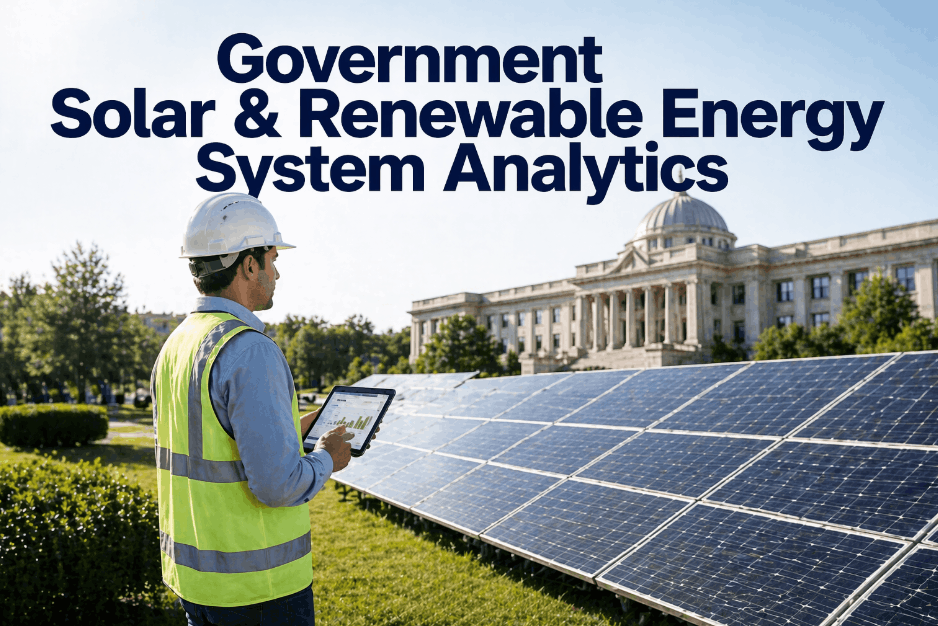
Government solar analytics and renewable energy management have become mission-critical priorities for public facility administrators in 2026. With federal clean energy mandates accelerating, state and municipal governments are deploying solar panel systems, battery storage arrays, and wind energy infrastructure across courthouses, administrative buildings, public libraries, and transit facilities — yet most agencies still lack the real-time performance monitoring infrastructure needed to protect these capital investments. Poorly maintained solar systems on government properties can lose 15–30% of their generation capacity within three years, turning clean energy assets into underperforming liabilities. Whether you manage a single public facility or a portfolio of government buildings, this guide covers solar panel maintenance, inverter monitoring, battery storage optimization, and how modern renewable energy analytics platforms are transforming how public agencies manage clean energy performance. Book a demo to see how continuous solar performance monitoring works across live government facility environments.
Optimize Solar Performance Across Every Government Facility
iFactory's renewable energy analytics platform continuously monitors solar panel output, inverter health, battery storage cycles, and system-wide performance — giving public facility teams the data they need to maximize clean energy ROI and meet government sustainability mandates year-round.
Why Government Solar Analytics Is Now an Operational Imperative
The federal government's Justice40 initiative and state-level clean energy legislation have pushed renewable energy system deployment in public buildings to record levels — but capital deployment without performance infrastructure creates a compounding risk that most facility managers do not fully appreciate. A solar photovoltaic system installed on a government building three years ago may be generating 20% less power today due to panel soiling, micro-crack formation, inverter degradation, and shading from vegetation growth — losses that are completely invisible without systematic Book a demo analytics monitoring. Government renewable energy programs that lack real-time performance data cannot demonstrate regulatory compliance, cannot justify capital reinvestment to oversight bodies, and cannot meet the energy reduction targets mandated under executive orders and state sustainability goals.
Solar Panel Maintenance Standards for Public Facility Systems
Government solar panel systems face maintenance challenges that differ meaningfully from residential or commercial installations — larger array footprints, institutional procurement cycles, and facilities management structures that were not designed with renewable energy asset maintenance in mind. Solar panel cleaning frequency, structural inspection schedules, and electrical safety testing protocols all require integration into existing facility maintenance workflows, not management as a separate discipline. Book a demo to explore how analytics-driven maintenance scheduling optimizes panel cleaning cycles based on actual soiling rate data rather than arbitrary calendar intervals.
Soiling-Based Cleaning Schedule Optimization
Government solar panels in high-particulate environments — near highways, construction zones, or agricultural areas — can lose 0.3–1% of output per day from soiling. Analytics platforms that track irradiance-adjusted performance ratios can detect soiling onset and trigger cleaning only when energy loss justifies the cost, reducing unnecessary maintenance spending while protecting output.
Mounting System and Physical Inspection Standards
Rooftop and ground-mounted solar arrays on government buildings require annual structural inspections covering racking torque, flashing integrity, conduit routing, and module frame corrosion — especially critical for coastal facilities exposed to salt-air environments. Missed structural issues that allow moisture ingress can void panel warranties and create building envelope liability.
I-V Curve Testing and Performance Verification
Current-voltage curve testing identifies individual panel degradation, bypass diode failures, and cell-level defects that are invisible to string-level monitoring. Government solar systems with panels approaching their 10-year mark should undergo scheduled I-V testing as part of formal asset lifecycle management, with results maintained in the facility's capital planning documentation.
Infrared Inspection for Hot Spot Detection
Drone-based infrared thermography of government solar arrays detects hot spots caused by cell mismatch, partial shading, soiling patterns, and faulty bypass diodes — conditions that accelerate degradation and create fire risk if undetected. Annual thermal imaging campaigns integrated with analytics platforms create persistent defect records that support warranty claims and capital replacement planning.
Inverter Monitoring and Health Management for Government Solar Systems
Solar inverters are the highest-failure-rate component in any photovoltaic system and the single largest determinant of government solar system uptime. A failed string inverter on a government building can eliminate 10–40% of system output for weeks while procurement processes for replacement equipment proceed through institutional channels — a delay that would be caught within hours by real-time inverter health monitoring. Book a demo to see how predictive inverter diagnostics identify developing faults before they cause full system outages, including MPPT tracking errors, DC arc fault events, cooling system degradation, and communication loss patterns that precede inverter failure.
String-Level Performance Deviation Monitoring
String-level monitoring compares actual versus expected output across all inverter inputs, flagging strings that deviate beyond statistical norms — enabling rapid identification of shading events, panel failures, and connection degradation without requiring physical inspection of every string junction box.
Module-Level Power Electronics Diagnostics
Government buildings with microinverter or DC power optimizer architectures benefit from module-level performance visibility that identifies individual panel-level faults without affecting system-wide output — a particularly valuable capability for large arrays where a single failing module could otherwise go undetected for months.
Real-Time Fault Classification and Prioritization
AI-powered fault classification distinguishes between nuisance alarms caused by grid events, weather anomalies, and communication dropouts versus genuine equipment faults requiring field response — reducing maintenance dispatch costs while ensuring critical failures receive immediate attention.
Inverter Replacement Planning and Capital Forecasting
Analytics platforms that track cumulative inverter operating hours, fault event history, and thermal stress accumulation provide government facility managers with data-driven replacement forecasts — enabling budget requests and procurement cycles to begin before emergency replacements become necessary.
Battery Storage System Optimization for Government Renewable Energy
Battery energy storage systems paired with government solar installations are rapidly becoming standard infrastructure for public facilities seeking energy resilience, demand charge management, and backup power capability for critical operations. Battery storage optimization requires a fundamentally different monitoring approach than generation-side analytics — state-of-health tracking, cycle depth management, thermal management system oversight, and cell-level voltage balancing must all be monitored continuously to protect the battery asset and maximize its 10–15 year design life. Government facilities that deploy battery storage without active analytics monitoring typically see battery capacity degradation 40–60% faster than facilities with optimized charge management protocols.
Common Government Solar System Performance Issues by Facility Type
Performance challenges in government renewable energy systems vary systematically by building type, roof age, geographic location, and system architecture. Understanding the failure modes most common to each facility category allows public works teams to prioritize monitoring investments and maintenance protocols where energy losses are most likely to occur.
| Government Facility Type | Common Solar Performance Issue | Primary Monitoring Priority | Impact Level |
|---|---|---|---|
| Courthouse / Judicial Building | HVAC exhaust soiling on adjacent panels; roof penetration corrosion | String-level output deviation; thermal imaging | High |
| Municipal Office Building | Shading from rooftop mechanical equipment additions post-installation | Module-level performance; shade impact modeling | High |
| Public Library | Low-slope roof ponding affecting ballasted racking systems | Structural integrity monitoring; moisture intrusion alerts | Critical |
| Transit Authority Facility | Diesel particulate soiling from adjacent bus operations | Soiling rate analytics; cleaning frequency optimization | High |
| Water Treatment Plant | Salt mist and chemical vapor corrosion on electrical connections | Inverter health monitoring; connection resistance trending | Critical |
| Public School Campus | Vegetation shading from unmanaged tree growth near ground-mount systems | Shading loss quantification; vegetation management triggers | Medium |
| Fire and Emergency Services | Battery storage thermal management failures in uninsulated apparatus bays | Battery cell temperature monitoring; SOH degradation tracking | Critical |
| Correctional Facility | Limited maintenance access windows reducing inspection frequency | Continuous remote monitoring; automated fault escalation | High |
Renewable Energy Performance Reporting for Government Accountability
Government renewable energy systems carry reporting obligations that private installations do not — energy savings must be documented for budget justification, carbon reduction must be quantified for sustainability reports, and system performance must be defensible to procurement auditors and oversight agencies. Book a demo to explore how automated performance reporting generates the audit-ready documentation that government solar programs require, including ENERGY STAR Portfolio Manager integration, EPA's Green Power Partnership reporting, and state-specific renewable portfolio standard compliance records that facilities teams currently spend hundreds of hours assembling manually from disconnected data sources.
The shift from manual data collection to automated analytics-driven reporting also changes how government solar programs are perceived by oversight bodies. Facilities that can demonstrate continuous performance monitoring, documented maintenance response times, and quantified energy savings through real-time dashboards present a fundamentally different compliance posture than agencies submitting annual reports compiled from spreadsheets. In an era of increased scrutiny over government clean energy spending, automated renewable energy analytics provide the transparency infrastructure that transforms public investment in solar from a budget line item into a demonstrable public benefit.
Integrating Government Solar Analytics with Facility Management Systems
The most significant operational challenge in government renewable energy management is not the technology itself — it is integration. Government facilities typically operate CMMS platforms, building automation systems, energy management systems, and procurement workflows that were built independently and do not share data. Solar analytics platforms that operate as isolated silos generate performance data that facilities staff cannot act on efficiently because the information does not surface within the work order and maintenance workflows they actually use daily. Modern government solar analytics deployments prioritize API-level integration with existing CMMS and BAS platforms, ensuring that performance alerts automatically generate work orders, maintenance records automatically update system performance baselines, and energy data flows into building-level dashboards that facility managers monitor as part of their standard operations cadence.
Automated Work Order Generation from Performance Alerts
When solar analytics platforms detect inverter faults, string underperformance, or battery health anomalies, direct CMMS integration creates work orders automatically — eliminating the manual handoff gap where performance data sits unactioned in an analytics dashboard while energy losses continue to accumulate during the maintenance queue delay.
Solar Output Integration with Building Load Management
Government buildings with solar plus storage systems benefit from analytics platforms that integrate renewable generation data with building load profiles — enabling automated demand response, peak shaving optimization, and grid export management that maximize the financial and grid-stabilization value of public facility clean energy assets.
Government Renewable Energy Analytics: Frequently Asked Questions
How often should government solar panels be cleaned and inspected?
Cleaning frequency depends on soiling rate, which varies by location and environmental conditions. Analytics-driven facilities clean based on performance ratio monitoring rather than fixed schedules — typically 2–4 times per year in most regions, with higher frequency for facilities near dust, pollen, or particulate sources. Annual formal inspections covering structural, electrical, and thermal assessments are best practice regardless of system age.
What metrics should government facilities track for solar system performance?
Core government solar KPIs include performance ratio (actual vs. theoretical output), specific yield (kWh per kWp), system availability, inverter uptime, degradation rate, and energy cost avoidance. Battery storage systems add state-of-health, cycle depth distribution, and round-trip efficiency as critical tracking metrics. These should be reported monthly to facility management and annually to oversight bodies.
Can renewable energy analytics help government facilities meet federal sustainability mandates?
Yes. Federal sustainability requirements under Executive Order 14057 and the Federal Building Performance Standards require documented energy performance data that analytics platforms generate automatically. Continuous monitoring creates the audit trail needed to demonstrate compliance, quantify emissions reductions, and support greenhouse gas inventory reporting under federal sustainability frameworks.
What is the typical performance degradation rate for government solar systems?
Industry-standard panel degradation rates average 0.5–0.7% per year under ideal maintenance conditions, but government solar systems without proactive maintenance and monitoring frequently experience 1.5–2.5% annual degradation due to unaddressed soiling, connection resistance buildup, and delayed fault response. Active analytics monitoring with maintenance integration typically reduces effective degradation rates by 40–60% compared to inspection-only maintenance models.
How does solar analytics improve government solar ROI?
Government solar analytics improves ROI through three mechanisms: reducing energy losses from undetected faults and soiling (typically recovering 10–25% of lost generation), extending equipment lifespan through predictive maintenance (adding 2–5 years to inverter and battery system life), and reducing maintenance labor costs through targeted dispatch rather than scheduled inspections — combined effects that typically deliver 2–3× improvement in 20-year system ROI compared to unmonitored government solar installations.
Turn Government Solar Investment into Measurable, Defensible Performance
iFactory's renewable energy analytics platform gives government facility managers continuous solar performance visibility, automated maintenance triggers, battery storage optimization, and the audit-ready reporting needed to demonstrate ROI to oversight bodies — across every public building in your portfolio, every day of the year.

-government-building-health.png)


