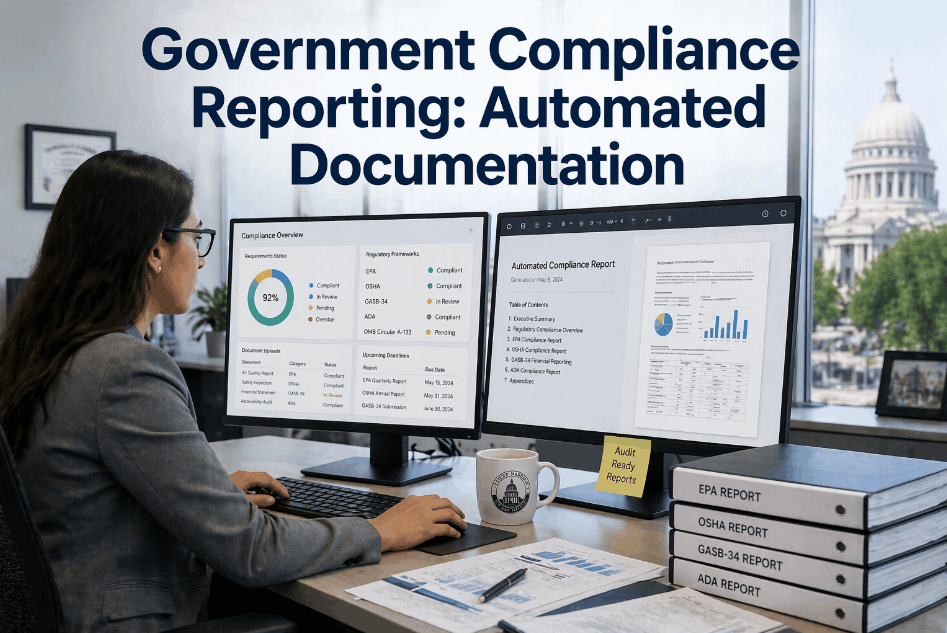
Government agencies and municipal departments lose hundreds of hours annually to manual compliance reporting — not because regulations are unclear, but because the documentation systems were never designed for the data volume, audit frequency, and multi-standard complexity of modern public sector operations. Automated government compliance reporting transforms fragmented analytics data into EPA, OSHA, GASB-34, and regulatory documentation that is always audit-ready, always accurate, and always generated without last-minute scrambles. Book a Demo to see how iFactory automates compliance documentation for public works, municipal utilities, and government facilities at every scale.
Automate Every Compliance Report — From Analytics Data to Audit-Ready Documentation
iFactory's government compliance automation platform connects your operational analytics, asset records, and regulatory obligations into one system — generating EPA, OSHA, and GASB-34 reports in minutes, not weeks, and eliminating audit gaps before your next inspection.
Why Government Compliance Reporting Is Failing Public Agencies
The regulatory environment for government and municipal operations has grown dramatically more complex over the past decade. A mid-sized city utility now reports to the EPA under Clean Water Act mandates, to OSHA on workplace safety incidents, to the Government Accounting Standards Board under GASB-34 infrastructure asset requirements, and to a state environmental agency under separate reporting schedules — each with its own format, frequency, and data structure.
Manual compliance documentation for government agencies isn't just inefficient — it creates accountability gaps that surface during federal audits, inspector general reviews, and public records requests. A missed EPA effluent report triggers a notice of violation. A GASB-34 infrastructure valuation error draws state auditor findings. An OSHA incident log discrepancy exposes the municipality to liability. The hidden cost of reactive, paper-based government audit reporting is measured in penalties, staff overtime, and public trust erosion. Book a Demo to understand how your current compliance gaps translate to regulatory risk.
The Real Cost of Manual Compliance Documentation in Government Operations
Government compliance officers and public works administrators face a documentation burden that grows with every new federal mandate, state environmental rule, and GASB accounting standard update. Understanding the specific failure points of manual systems is the foundation for building a case for compliance automation in municipal government.
Data Silos Across Departments
Environmental data sits in one system, maintenance records in another, financial asset registers in a third. Manual compliance reporting requires staff to extract, reconcile, and reformat data from multiple disconnected sources for every report cycle — creating version control risks and data integrity gaps that auditors immediately identify.
Missed Reporting Deadlines
Federal and state agencies operate on fixed reporting calendars that do not accommodate government staffing shortages, budget cycles, or competing priorities. Without automated deadline tracking and report generation, municipal compliance teams miss submission windows — triggering notices of violation, penalty assessments, and consent order requirements.
GASB-34 Infrastructure Valuation Errors
GASB-34 requires government entities to report the value and condition of infrastructure assets — roads, bridges, utilities, and public buildings — with documented depreciation calculations and maintenance investment data. Manual asset tracking produces valuation errors that generate audit findings and require costly restatements of financial reports.
No Continuous Compliance Posture
Manual government documentation is inherently retrospective — compiled after the reporting period ends rather than accumulated continuously. This means agencies are never truly audit-ready; they are always in reactive documentation mode when an inspector arrives or a federal audit is scheduled, creating preventable compliance gaps.
OSHA Incident Documentation Gaps
OSHA 300 log maintenance, incident investigation reports, and safety training records for government workforces must be continuously maintained and immediately producible upon federal inspection. Paper-based safety documentation in public works environments degrades in high-exposure conditions and creates liability exposure during OSHA audits.
Public Accountability Reporting Failures
Citizens, elected officials, and oversight bodies increasingly demand transparent, data-driven public accountability reports. Manual documentation processes produce inconsistent narratives that cannot withstand public records scrutiny — eroding community trust and creating political accountability exposure for agency leadership and elected officials.
How Automated Government Compliance Reporting Works
A purpose-built automated compliance documentation platform for government agencies is not a generic report-builder applied to public sector data. It is an end-to-end regulatory intelligence system designed around the specific standards, asset types, reporting calendars, and audit expectations of EPA, OSHA, GASB-34, and state environmental compliance frameworks. Book a Demo to see the automation engine applied to your agency's specific regulatory portfolio.
Continuous Data Ingestion from Operational Analytics
IoT sensors, SCADA systems, maintenance management platforms, and financial asset registers stream operational data continuously into the compliance engine. Environmental discharge readings, equipment maintenance logs, safety incident records, and infrastructure condition assessments are captured in real time — eliminating the end-of-period data scramble that defines manual compliance documentation cycles.
Regulatory Standard Mapping & Report Template Engine
Operational data fields are automatically mapped to the specific reporting requirements of each applicable standard — EPA Discharge Monitoring Reports, OSHA 300A annual summaries, GASB-34 infrastructure valuation schedules, and state-specific environmental reporting formats. The template engine generates complete, formatted compliance reports with the correct data fields, units of measure, and certification language for each regulatory recipient.
Automated Deadline Tracking & Submission Scheduling
Every federal, state, and local reporting obligation is loaded into the compliance calendar with submission deadlines, review windows, and signatory requirements. The system automatically triggers report generation at the correct interval, routes draft reports for internal review and certification, and maintains a documented submission record — ensuring no reporting window is missed and every submission is audit-traceable.
GASB-34 Asset Register Integration & Depreciation Automation
Infrastructure assets are maintained in a continuously updated digital asset register with acquisition costs, useful life schedules, condition ratings, and maintenance investment history. GASB-34 required disclosures — including the modified approach for eligible infrastructure — are generated automatically from asset register data, with depreciation calculations updated each fiscal year and supporting documentation archived for auditor review.
Immutable Audit Log & Public Accountability Archive
Every compliance record — environmental readings, maintenance certifications, safety logs, and financial disclosures — is stored in a tamper-evident audit archive with time-stamps, user identifications, and data source linkages. When a federal auditor, state inspector, or public records request requires documentation, the complete compliance history is retrievable in minutes. Book a Demo to see a live audit archive export from a municipal government deployment.
Regulatory Standards Covered: Government Compliance Reporting by Framework
Effective regulatory reporting automation for government agencies must cover every applicable compliance framework — from federal environmental mandates to government accounting standards and occupational safety requirements. The following table outlines the automated documentation capabilities by regulatory standard.
| Regulatory Standard | Report Types Generated | Data Sources Integrated | Reporting Frequency | Compliance Benefit |
|---|---|---|---|---|
| EPA Clean Water Act | Discharge Monitoring Reports, Pretreatment Program Reports, NPDES Permit Compliance | SCADA, lab analytical data, flow meters | Monthly/Quarterly | Eliminates manual DMR preparation and late submission penalties |
| GASB-34 | Infrastructure Asset Schedules, Depreciation Reports, Modified Approach Disclosures | Asset registers, maintenance logs, condition assessments | Annual | Audit-ready financial statements with zero restatement risk |
| OSHA Recordkeeping | OSHA 300 Log, 300A Annual Summary, 301 Incident Reports | Safety incident database, training records, medical logs | Continuous/Annual | Immediate production of complete records on federal inspection |
| EPA Clean Air Act | Title V Emission Reports, Stack Test Documentation, Deviation Reports | Continuous emissions monitors, equipment runtime logs | Quarterly/Annual | Automated deviation detection and corrective action documentation |
| State Environmental Agency | Solid Waste Management Reports, Stormwater BMPs, Chemical Inventory Tier II | Facility inventory, waste manifests, stormwater sensors | Annual/Event-driven | Single platform for all state reporting obligations |
| Public Accountability | Annual Performance Reports, Budget Transparency Disclosures, Infrastructure Condition Summaries | All operational systems, financial records | Annual/Ad hoc | Citizen-facing and council-ready reports generated automatically |
Give Your Compliance Team a System That Works Ahead of Every Audit Deadline
iFactory's government compliance automation platform generates audit-ready EPA, OSHA, and GASB-34 documentation continuously from your operational data — so your agency is always inspection-ready, not just temporarily prepared.
AI-Driven Compliance Intelligence: Beyond Automated Report Generation
The most advanced government compliance automation platforms don't just generate reports from existing data — they apply AI-driven analytics to identify compliance risk before it becomes a regulatory violation. This shifts government agencies from reactive documentation to proactive compliance management.
When a wastewater treatment plant's effluent phosphorus levels trend toward the NPDES permit limit, the AI compliance engine doesn't wait for the limit exceedance to appear in the monthly Discharge Monitoring Report. It generates a predictive alert 7–14 days in advance, triggering both an operational work order for the treatment process and a pre-emptive compliance record documenting the identified trend and corrective measures taken. Book a Demo to see predictive compliance analytics applied to your agency's specific permit parameters.
Permit Exceedance Prediction
Machine learning models analyze historical operational data and real-time sensor readings to identify parameter trends that are likely to approach or breach permit limits. Predictive alerts give operational teams a response window measured in days rather than hours — converting potential violations into documented prevention events that demonstrate good faith compliance to regulatory agencies.
Automatic Deviation Documentation
When an operational parameter does exceed a permit limit or compliance threshold, the system automatically generates a deviation report documenting the exceedance magnitude, duration, probable cause, and corrective actions taken — in the exact format required by the applicable regulatory agency. Incident-to-report time drops from days to minutes.
Cross-Standard Compliance Correlation
A single operational event — a chemical spill, equipment failure, or safety incident — may trigger reporting obligations across multiple regulatory standards simultaneously. The AI engine identifies all applicable reporting requirements from a single event record and generates the corresponding documentation for each regulatory recipient without requiring separate manual processes.
Regulatory Change Monitoring
EPA permit conditions, OSHA standards, and GASB guidance documents change on regulatory cycles that do not align with agency IT update schedules. The compliance platform monitors regulatory update feeds and automatically flags report templates and data mapping configurations that require revision when applicable standards are amended — keeping documentation requirements current without manual tracking.
GASB-34 Compliance Automation: Solving the Infrastructure Reporting Challenge
GASB Statement No. 34 represents one of the most documentation-intensive compliance requirements in government accounting, requiring public entities to report the value, condition, and depreciation of infrastructure assets that were previously excluded from government financial statements. For departments managing roads, bridges, water mains, treatment plants, and public buildings, GASB-34 compliance automation transforms a year-end accounting crisis into a continuously maintained reporting posture.
Infrastructure Asset Register Automation
Every infrastructure asset — from major bridge structures to utility distribution mains — is maintained in a digital register with acquisition cost, estimated useful life, current depreciation status, and condition rating. GASB-34 requires this data to be current and auditable at fiscal year-end. Automated asset register integration ensures valuations are continuously updated as maintenance investments are made and condition assessments are completed, eliminating the annual data reconciliation that produces audit findings.
Depreciation Schedule Generation
GASB-34 depreciation calculations require consistent application of the straight-line or modified approach method across all infrastructure asset classes. The automation platform applies the correct depreciation method per asset class, calculates annual depreciation charges, updates net asset values, and generates the complete depreciation schedule disclosures required by your state auditor — with supporting calculations archived for audit review. Manual depreciation worksheets in spreadsheets are a primary source of GASB-34 audit findings; automated schedules eliminate this risk entirely.
Condition Assessment Documentation
Governments using the GASB-34 modified approach for eligible infrastructure must maintain documented condition assessments proving that assets are being preserved at or above an established condition level. The platform automatically links field inspection results, maintenance investment records, and condition rating histories to generate the complete modified approach disclosure package — including the comparison of estimated versus actual maintenance expenditures required for audit compliance.
Implementation Roadmap: Deploying Compliance Automation in a Government Agency
Transitioning a government agency or municipal department from manual compliance documentation to an automated reporting platform does not require a multi-year IT modernization project or a legislative appropriation for new systems infrastructure. A phased deployment approach delivers measurable compliance value within weeks while building toward full regulatory integration.
Regulatory Obligation Inventory & Report Template Configuration
All applicable federal, state, and local reporting obligations are catalogued with submission deadlines, responsible staff, regulatory recipients, and data requirements. Report templates are configured for each standard — EPA DMRs, OSHA 300 logs, GASB-34 schedules, and state-specific formats — with data field mappings aligned to existing operational data sources. Book a Demo to review a sample regulatory obligation inventory for a municipal water utility.
Data Source Integration & First Automated Reports
Operational data systems — SCADA, maintenance management, safety incident databases, and financial asset registers — are integrated with the compliance engine via API connections or data connectors. The first automated compliance reports are generated, reviewed by agency compliance staff, and compared against previous manual submissions to validate data accuracy and format compliance.
Predictive Compliance Monitoring & Audit Archive Activation
AI compliance monitoring begins generating predictive alerts for permit parameters approaching threshold limits. The immutable audit archive goes live with historical data migration, giving the agency a complete documented compliance history. The compliance dashboard provides real-time visibility into reporting status, upcoming deadlines, and outstanding corrective action items across all regulatory frameworks.
Full Audit Readiness & ROI Realization
With 3+ months of continuously generated compliance documentation, the agency is fully audit-ready for EPA inspections, state environmental audits, OSHA reviews, and GASB financial audits at any moment. Compliance staff time redirects from documentation assembly to strategic regulatory management. The 4.2× improvement in audit preparation efficiency is documented and reportable to agency leadership and elected officials.
6 Capabilities to Require from Any Government Compliance Reporting Platform
Not every compliance automation tool is designed for the regulatory complexity, data governance requirements, and public accountability demands of government operations. Generic enterprise compliance platforms built for private sector industries often lack the government-specific report formats, GASB accounting integrations, and multi-agency submission capabilities that public sector entities require. Use these criteria to evaluate any automated compliance documentation platform for government agencies.
Government-Specific Report Format Library
The platform must include pre-built templates for EPA Discharge Monitoring Reports, NPDES permit reports, OSHA 300/300A/301 forms, GASB-34 infrastructure schedules, and state environmental reporting formats — not generic compliance templates that require manual reformatting before submission to regulatory agencies.
SCADA & IoT Sensor Data Integration
Government environmental and public works operations depend on SCADA systems and IoT sensor networks for operational control. The compliance platform must natively receive data from these systems — including real-time parameter readings, alarm events, and equipment status signals — and incorporate this data directly into regulatory reports without manual data extraction or re-entry.
Multi-Department & Multi-Agency Architecture
Government compliance reporting spans public works, utilities, facilities management, safety, and finance departments — each with different data systems and reporting responsibilities. The platform must support role-based access across departments, consolidate reporting obligations for multiple facilities or divisions, and maintain separate audit trails for each regulatory submission without requiring separate system instances.
Tamper-Evident Audit Archive
Government compliance records must meet the evidentiary standards of federal audits, inspector general reviews, and judicial proceedings. The platform must provide a cryptographically verifiable, tamper-evident audit archive with complete data lineage from source system to submitted report — ensuring that no record can be altered after submission without creating a documented change log.
Financial System Integration for GASB Reporting
GASB-34 compliance requires bidirectional data flow between operational asset records and government financial accounting systems. The platform must integrate with Tyler Technologies, Oracle ERP Cloud Public Sector, SAP for Government, or equivalent municipal financial systems — ensuring that infrastructure asset valuations, maintenance investments, and depreciation charges flow automatically to financial statement disclosures.
Proven Public Sector Deployment Record
Request documented deployment evidence from municipal utilities, public works departments, water and wastewater authorities, or state agency operations specifically. A compliance platform with only private sector case studies may lack the government data governance requirements, public records compliance architecture, and GASB-specific reporting logic that public entities require.
Frequently Asked Questions: Automated Government Compliance Reporting
Can automated compliance reports replace manually prepared EPA submissions?
Yes. The automated platform generates EPA Discharge Monitoring Reports, NPDES compliance certifications, and deviation notifications in the exact electronic format required by EPA's NetDMR system and equivalent state submission portals. Reports are reviewed and certified digitally by the responsible official before submission, maintaining the signatory requirements of federal permit conditions while eliminating manual data compilation entirely.
How does the system handle GASB-34 requirements for governments using the modified approach?
The platform maintains continuous condition assessment records for eligible infrastructure assets, linking field inspection results directly to GASB-34 disclosure requirements. The modified approach documentation package — including the established condition level, assessment results, and comparison of estimated versus actual maintenance expenditures — is generated automatically at fiscal year-end with full supporting documentation archived for auditor review.
What happens when a regulatory standard changes and report formats are updated?
The platform includes a regulatory monitoring module that tracks EPA, OSHA, GASB, and state agency rule updates. When a reporting standard changes, the system flags affected report templates for review and update. For minor format changes, template updates are pushed automatically. For substantive regulatory changes requiring new data collection, the compliance team receives advance notice to configure new data mapping fields before the effective date of the new requirement.
How long does implementation take for a municipal utility or public works department?
A standard deployment covering regulatory obligation inventory, report template configuration, and primary data source integration typically takes 15–20 working days for a department with up to 5 major regulatory reporting obligations. Full integration including SCADA data connections, financial system integration, and historical data migration is typically complete within 6–8 weeks — without disrupting ongoing compliance reporting obligations during the transition.
Can the system support public transparency and citizen accountability reporting requirements?
Yes. Beyond regulatory agency submissions, the platform generates public-facing accountability reports — annual water quality reports, infrastructure condition summaries, budget performance disclosures, and service level reports — using the same operational data that feeds regulatory compliance documentation. Public transparency reports are formatted for council presentations, website publication, and public records requests without additional data preparation effort.
What is the ROI timeline for government agencies implementing compliance automation?
Most government agencies document measurable ROI within 60–90 days of full deployment, driven primarily by the reduction in compliance staff overtime, elimination of regulatory penalty exposure, and accelerated audit preparation. The full operational benefit — including reduced consultant fees for audit support, avoided consent order costs, and staff time redeployment to strategic work — is typically documented within the first fiscal year of deployment.
Stop Assembling Compliance Reports. Start Running an Agency That Is Always Audit-Ready.
Join government agencies across the country who have achieved 94% compliance rate maintenance, 78% reduction in documentation time, and zero missed reporting deadlines with iFactory's automated government compliance reporting platform — purpose-built for the regulatory complexity and public accountability demands of modern public sector operations.