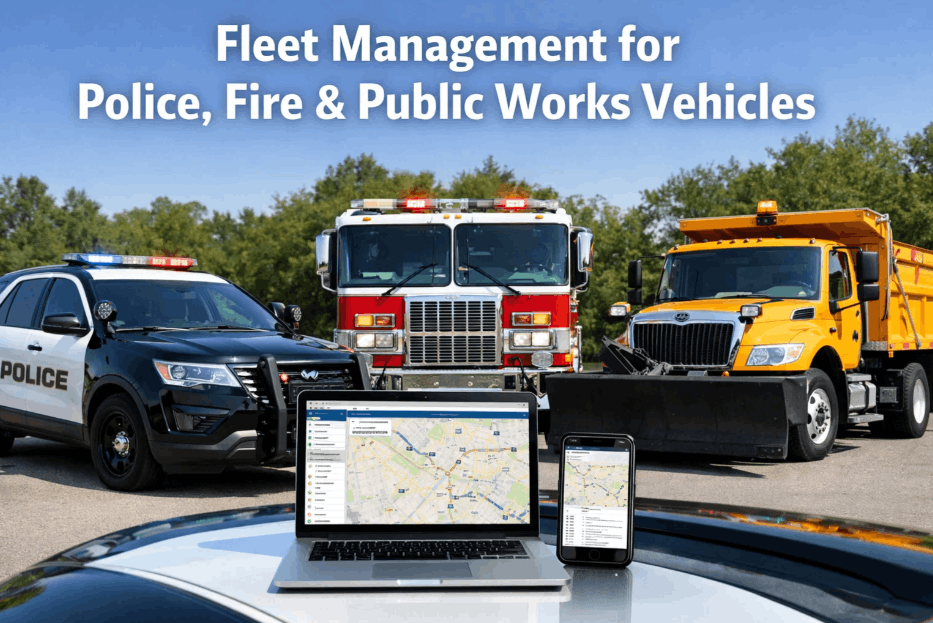
Government fleet management is one of the most operationally complex and budget-sensitive challenges facing municipal departments today. From police cruisers and fire trucks to ambulances and public works equipment, managing thousands of vehicles across departments requires more than spreadsheets — it demands real-time visibility, predictive analytics, regulatory compliance tracking, and lifecycle planning built specifically for public sector operations. Whether your agency is managing a 50-vehicle fleet or a regional fleet of 2,000+ units, a structured government fleet management program determines whether your vehicles stay mission-ready — or fail when communities need them most. If your department is still tracking service intervals manually, book a demo to see what purpose-built fleet management software looks like for public agencies.
Ready to Modernize Your Government Fleet Program?
See how integrated fleet management software helps police, fire, and public works departments track vehicles, reduce downtime, and stay audit-ready — all in one platform.
What Is Government Fleet Management?
Government fleet management is the structured oversight of publicly owned vehicles — including acquisition, maintenance scheduling, fuel consumption tracking, compliance documentation, and end-of-life replacement planning. Unlike private sector fleet operations, municipal fleet management must satisfy strict regulatory requirements, survive audit scrutiny, and support uninterrupted emergency response operations. For police departments, fire services, EMS agencies, and public works divisions, effective fleet management directly impacts public safety outcomes and departmental budget health. Departments exploring CMMS-based solutions often book a demo and discover fleet scheduling gaps within the first session.
Why Government Fleet Programs Break Down — and How to Fix Them
The most common failure patterns in municipal fleet management are not mechanical — they are systemic. Fragmented data, inconsistent service intervals, and manual documentation create compounding problems that escalate into audit findings, unplanned downtime, and fleet replacement costs years ahead of schedule. Agencies that proactively book a demo typically uncover three to four critical gaps in their existing tracking systems during a single discovery session.
Root Cause
Service intervals based on mileage estimates, not actual odometer reads
No automated alerts when vehicles are overdue for PM
Emergency vehicles pulled from service without a tracked replacement unit
Seasonal maintenance cycles not integrated into dispatch coordination
Root Cause
Fuel consumption not linked to individual vehicle profiles
No anomaly detection for excessive idling or fuel card misuse
Total cost of ownership calculated only at disposal, not continuously
Budget forecasts built on fleet age averages, not condition data
Root Cause
Paper-based inspection records unavailable during DOT or state audits
No centralized repository linking vehicle history to regulatory records
Corrective actions from inspection findings not tracked to verified closure
Certification and license renewals managed outside fleet systems
Fleet Management by Vehicle Class: Police, Fire, EMS & Public Works
Each government fleet category carries distinct maintenance requirements, regulatory obligations, and operational criticality. Effective municipal fleet management must be structured around these differences — not applied with a one-size-fits-all approach. Teams looking to standardize fleet workflows by vehicle class often book a demo to see how class-based scheduling logic works in a live environment.
Police Fleet
High-Mileage, 24/7 Operational Demand
Police cruisers run 24/7 across all shifts, accumulating mileage 2–3x faster than standard vehicles. PM schedules must cover pursuit wear, electronics health, and brake cycles. Pre-shift inspections are mandatory — any downtime directly reduces patrol coverage.
Fire Apparatus
Mission-Critical Reliability Under NFPA Standards
Fire apparatus operates under NFPA 1911/1912 standards, requiring annual pump tests and aerial load certifications. Engine hours, pump hours, and response mileage must be tracked separately. Any out-of-service unit needs immediate documented replacement activation.
EMS & Ambulances
Certification Compliance & Equipment Integration
Ambulance PM combines vehicle servicing with medical equipment certification. State EMS agencies require inspection certificates, stretcher load-test records, and equipment calibration logs. Service windows must align with restocking and decontamination so units return fully mission-ready.
Public Works Vehicles
Seasonal Load Cycles & Specialized Equipment
Dump trucks, plow trucks, sweepers, and compactors face uneven wear driven by seasonal demand. Plow equipment needs post-winter corrosion checks; summer HVAC units need pre-season service. Seasonal utilization data — not fixed calendars — should drive interval adjustments.
Municipal fleets that implement predictive maintenance analytics reduce unplanned vehicle downtime by an estimated 25–40% compared to calendar-only PM schedules. For emergency response fleets, every percentage point of downtime reduction translates directly to faster average response times and improved public safety outcomes.
Government Fleet Compliance: Regulatory Frameworks Every Department Must Track
Government vehicle fleets operate under overlapping federal, state, and local regulatory frameworks that impose minimum inspection frequencies, driver qualification standards, and strict documentation requirements. Compliance failure can result in operational shutdowns, DOT penalties, and liability exposure that far exceeds the cost of proactive compliance management.
| Fleet Category |
Governing Authority |
Key PM Requirement |
Documentation Standard |
| Police Vehicles |
State Motor Vehicle / Dept of Justice |
Pre/post-shift inspections, pursuit vehicle PM intervals, electronics certification |
Shift inspection logs, service records, pursuit incident documentation |
| Fire Apparatus |
NFPA / State Fire Marshal |
Annual pump tests, aerial device load tests, ladder certifications per NFPA 1911/1912 |
Signed test reports, annual certification records, out-of-service log |
| Ambulances & EMS |
State EMS Licensing / CMS |
Vehicle inspection certificates, stretcher testing, medical equipment calibration |
State EMS license documentation, equipment service records, calibration logs |
| Heavy Public Works Equipment |
DOT / FMCSA / State DOT |
CDL-class vehicle PM intervals, brake inspection, GVWR-specific service schedules |
Mileage/hour-based service records, brake inspection forms, operator logs |
| Fleet Fuel Systems |
EPA / State Environmental |
Underground storage tank inspection, fuel dispenser calibration, spill prevention |
Tank inspection records, calibration logs, spill prevention and response documentation |
Key Performance Indicators for Municipal Fleet Management
Effective government fleet analytics depends on tracking a defined set of performance indicators that connect daily operations to budget outcomes, vehicle availability, and compliance status. The most effective public fleet management programs monitor these KPIs continuously — not just during annual reporting cycles.
Fleet Availability Rate
Target: 95%+
Percentage of fleet units available for deployment at any given time — the primary operational health indicator for emergency fleets
PM Compliance Rate
Target: 90%+
Percentage of scheduled preventive maintenance tasks completed on time within the defined service window
Mean Time Between Failures
Trending Up
Average operating time between unplanned mechanical failures — a direct indicator of PM program effectiveness
Cost Per Mile / Hour
Trending Down
Total maintenance and fuel cost per operational unit — enables direct cost comparison across vehicle classes and model years
Reactive vs. Planned Ratio
Target: 80/20
Proportion of maintenance work that is scheduled (preventive) versus unplanned (reactive) — a leading indicator of program maturity
Lifecycle Replacement Accuracy
Trending Up
Accuracy of fleet replacement forecasts against actual vehicle end-of-life timing — reduces emergency capital budget requests
Predictive Analytics & Fuel Tracking for Government Fleets
Government vehicle analytics has evolved significantly beyond simple mileage-based service reminders. Modern municipal fleet management platforms use condition-based triggers, telematics data, and historical failure patterns to predict maintenance needs before breakdowns occur. For high-criticality fleets — fire apparatus, ambulances, and command vehicles — this shift from reactive to predictive maintenance is the single highest-leverage operational improvement available. Departments evaluating government fleet software can book a demo to see how predictive scheduling works in a live fleet environment.
1
Telematics-Driven Maintenance Triggers
Rather than relying on fixed calendar intervals, telematics-integrated fleet platforms trigger PM work orders based on actual engine hours, odometer reads, brake wear data, and fault code detection — ensuring high-use emergency vehicles receive service when needed, not on an arbitrary 30-day cycle that may be too early for light-use units and far too late for units operating double shifts.
2
Fuel Consumption Anomaly Detection
Government fleet tracking platforms can monitor fuel consumption per vehicle, per route, and per operator — flagging anomalies that indicate excessive idling, fueling irregularities, or developing mechanical inefficiencies. For departments with large fleets, fuel anomaly detection routinely identifies five to ten percent of fuel expenditure that would otherwise go undetected and unaddressed.
3
Lifecycle Cost Modeling
Government fleet software should continuously calculate total cost of ownership per vehicle — maintenance costs, fuel costs, repair frequency, and downtime impact — to provide fleet managers with data-driven replacement recommendations rather than age-only thresholds. Departments that shift from age-based to cost-based replacement decisions typically extend useful vehicle life by 15–20% while reducing per-unit lifecycle costs.
4
Cross-Department Fleet Utilization Analysis
Many municipal agencies operate underutilized vehicle pools in individual departments when shared utilization tracking would enable right-sizing the total fleet. Government vehicle analytics platforms that provide cross-departmental visibility allow fleet managers to identify chronic underutilization, consolidate redundant vehicle classes, and defer capital procurement without reducing operational capacity.
See Government Fleet Analytics in a Live Dashboard
iFactory gives public works, police, and fire departments real-time visibility into fleet availability, PM compliance rates, fuel consumption, and lifecycle costs — without manual reporting. Connect your fleet data and go live in days.
Building a Government Fleet Management Program: Step-by-Step
Structuring a sustainable government fleet management program requires more than purchasing fleet software — it requires aligning asset data, maintenance workflows, compliance documentation, and budget planning into a coherent operational system.
Step 1
Complete Fleet Inventory & Condition Assessment
Catalogue every vehicle with a unique asset ID, VIN, department assignment, current mileage or hours, and full maintenance history. Conduct a current condition assessment to establish a baseline for PM scheduling and lifecycle forecasting. Departments without accurate fleet inventories cannot build reliable budgets or compliance documentation.
Step 2
Define PM Schedules by Vehicle Class
Each vehicle class — police, fire apparatus, ambulance, heavy equipment — requires distinct service intervals, inspection checklists, and pass/fail criteria. PM schedules must incorporate manufacturer specifications, regulatory requirements, and your department's own failure history to set intervals that reflect actual operational conditions, not industry averages.
Step 3
Integrate Compliance Documentation from Day One
Every inspection, service record, corrective action, and certification renewal must be linked to the individual vehicle record — not stored in separate department files. Audit-ready documentation must be retrievable instantly, not assembled over two to four weeks when a regulatory review is announced.
Step 4
Implement Lifecycle Replacement Planning
Replace age-only replacement thresholds with total cost of ownership models that incorporate maintenance frequency, repair costs, downtime impact, and residual value. Build capital budget forecasts five to seven years out using fleet condition data — so replacement funding can be planned across budget cycles rather than requested as emergency appropriations.
Frequently Asked Questions: Government Fleet Management
What is the difference between preventive and predictive maintenance for government fleets?
Preventive maintenance follows fixed time or mileage intervals set by regulation or manufacturer specs. Predictive maintenance uses real-time telematics and fault codes to trigger service only when actual condition warrants it. Most municipal fleets run on preventive schedules, with predictive capabilities added for high-criticality assets like fire apparatus.
How does a CMMS improve government fleet compliance rates?
A fleet CMMS automates scheduling, generates work orders at defined intervals, and escalates overdue tasks without manual follow-up. Departments moving from spreadsheets typically see PM compliance jump from 60–70% to 85–95% within the first year, with a corresponding drop in audit findings.
What are the most important KPIs for a government fleet program?
The five most actionable KPIs are: fleet availability rate, PM compliance rate, mean time between failures, cost per mile or engine hour, and reactive-to-preventive ratio. Together they give fleet managers a clear picture of operational health, budget efficiency, and compliance posture.
How do government agencies manage fleet compliance for audits?
Regulators expect complete vehicle histories — service dates, technician credentials, findings, corrective actions, and closure evidence — retrievable by vehicle and date range. CMMS platforms generate these reports instantly; paper-based teams typically spend 2–4 weeks assembling the same documentation with a higher rate of gaps.
How should a municipality prioritize which vehicles to include in a fleet management program first?
Start with emergency response vehicles — fire apparatus, ambulances, and police cruisers — due to direct public safety impact and strict regulatory requirements. Then expand to heavy public works equipment with the largest deferred maintenance backlogs. A phased rollout builds momentum while moving toward full fleet coverage.
One Platform for Government Fleet Tracking, PM Scheduling & Compliance
iFactory connects government fleet registries, preventive maintenance scheduling, mobile inspection workflows, fuel tracking, and regulatory compliance documentation into a single platform built for police, fire, EMS, and public works operations — with audit-ready reporting and lifecycle analytics that keep your department ahead of every compliance requirement.