Aging bridges, overloaded water systems, deteriorating defense installations, and emergency networks stretched to their limits — government infrastructure across the United States faces a maintenance crisis that traditional methods can no longer solve. With a national maintenance backlog surpassing $2 trillion and fewer skilled technicians entering the workforce each year, public agencies are turning to a powerful convergence of AI, autonomous drones, robotics, IoT sensors, and cloud-native maintenance platforms to fundamentally rethink how critical infrastructure is inspected, monitored, and maintained. This guide examines the technology trends that are actively reshaping government infrastructure maintenance in 2026 — and what public sector leaders need to know to stay ahead. Schedule a free infrastructure technology assessment to discover which innovations deliver the fastest ROI for your agency's specific asset portfolio.
Why Government Infrastructure Maintenance Needs a Technology Overhaul
The systems that keep communities safe — bridges carrying daily commuter traffic, water treatment plants serving millions, emergency communication towers connecting first responders during disasters — were largely designed and built decades ago. The American Society of Civil Engineers consistently rates much of this infrastructure between "fair" and "poor," and the gap between what needs to be maintained and what agencies can actually address grows wider each budget cycle. Manual inspections, paper-based work orders, and calendar-driven preventive maintenance schedules simply cannot keep pace with the scale, complexity, and urgency of the problem.
Meanwhile, the workforce challenge is compounding. Qualified structural inspectors and maintenance technicians are in short supply, and agencies cannot simply hire their way out of a problem that requires exponential capacity growth. Technology is no longer a nice-to-have enhancement — it is the only viable path to closing the maintenance gap before critical failures become catastrophic failures. Create your free account and explore AI-powered workforce optimization tools that help government maintenance teams accomplish more with smaller crews and tighter budgets.
How AI-Driven Predictive Analytics Is Transforming Public Asset Management
Artificial intelligence has graduated from pilot programs to full-scale deployment in government maintenance operations during 2026. Rather than waiting for equipment to fail or following rigid service schedules regardless of actual asset condition, AI-powered predictive analytics platforms continuously monitor real-time sensor data from infrastructure assets and forecast exactly when specific components will require intervention. Research published in early 2026 demonstrates that machine learning models like XGBoost now achieve accuracy rates above 98% in predicting multiclass infrastructure failures, fundamentally changing how agencies plan budgets and allocate maintenance crews.
Drone-Powered Inspection Programs for Bridges, Towers, and Defense Assets
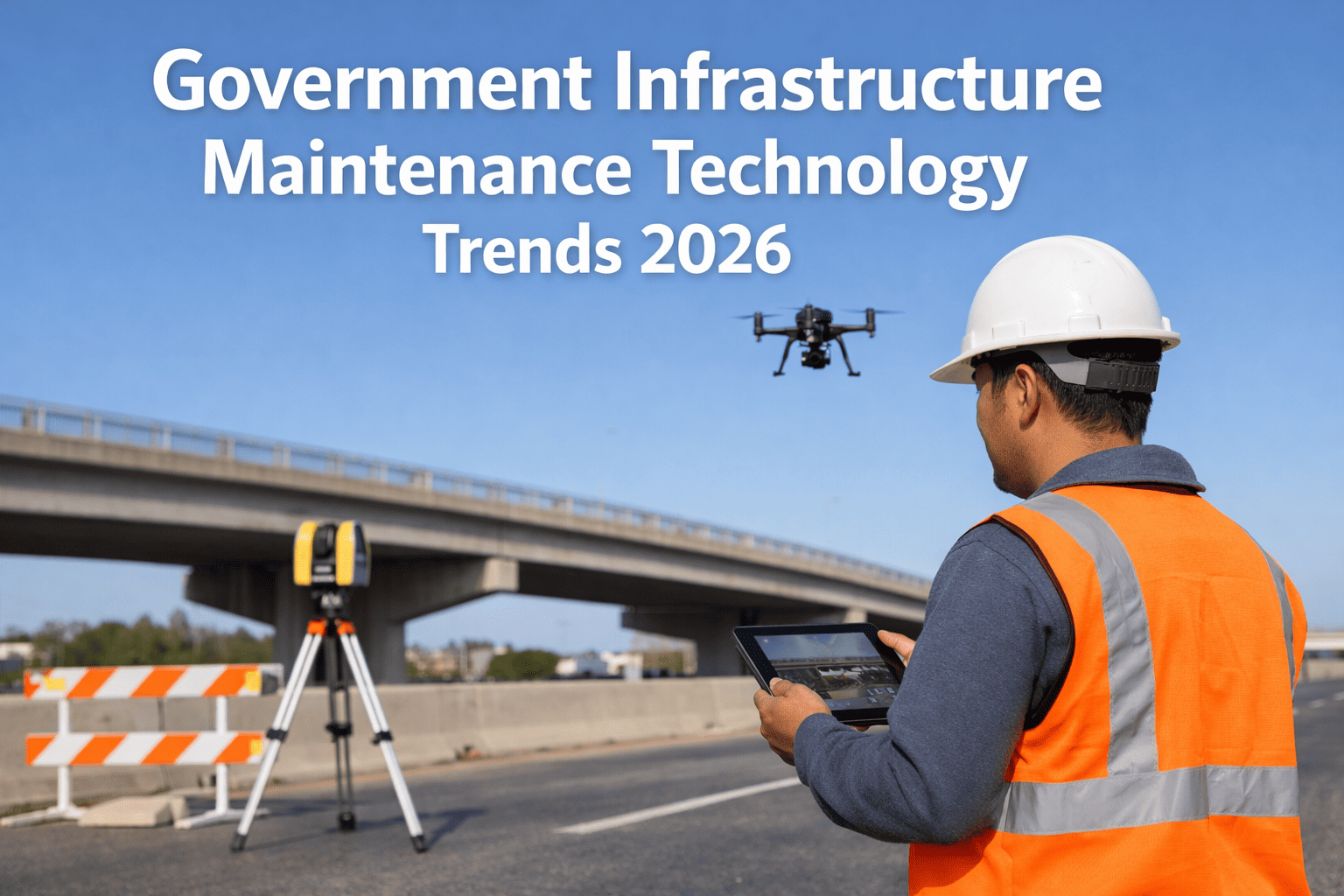
Autonomous inspection drones have moved beyond proof-of-concept into standard operating procedure for forward-thinking government agencies. Equipped with high-resolution RGB cameras, radiometric thermal sensors, and LiDAR scanners, these platforms conduct detailed structural assessments of bridges, emergency communication towers, dam spillways, and defense installations at a fraction of the cost and risk of traditional manual methods. The global drone inspection market reached $3.37 billion in 2024 and is projected to exceed $12.3 billion by 2032, with government and critical infrastructure sectors driving the fastest adoption.
The real breakthrough is not the drone hardware itself but the AI processing layer that turns aerial imagery into actionable maintenance intelligence. Computer vision models analyze footage on ingest, automatically identifying cracks, corrosion, spalling, vegetation intrusion, and thermal anomalies. Each defect is classified by severity, geo-tagged with GPS coordinates, and routed directly into the CMMS as a prioritized work order with repair specifications attached. This closes the critical gap that plagued early drone programs: raw aerial footage without analytics creates data chaos, not data intelligence. Schedule a live walkthrough of drone-to-work-order automation and see how inspection imagery converts into prioritized maintenance actions without manual data entry.
Digital Twin Technology in Public Infrastructure Lifecycle Planning
Digital twins — dynamic virtual replicas of physical infrastructure assets continuously updated with real-time sensor, inspection, and environmental data — represent one of the most transformative technologies entering government infrastructure management. Rather than relying on static inspection snapshots taken months apart, digital twins provide a living model of asset health that engineers can interrogate, stress-test, and use to forecast deterioration trajectories with unprecedented precision.
Transportation agencies are already using digital twin models of bridges to monitor fatigue accumulation and plan rehabilitation more accurately. Water utilities simulate how distribution networks behave under load spikes or storm conditions, improving both preparation and recovery speed. For defense installations, digital twins enable facility managers to model the impact of deferred maintenance on operational readiness — translating abstract backlog numbers into concrete mission risk assessments that decision-makers understand.
Autonomous Robotics Entering the Maintenance Workforce
Robotic systems designed for infrastructure inspection and maintenance tasks are moving from laboratory prototypes to field deployment. Underwater ROVs map submerged bridge foundations and dam structures without putting divers at risk. Wall-climbing robots perform ultrasonic thickness testing on storage tanks, towers, and chimneys — work that previously demanded expensive scaffolding and rope access teams. Crawling robots inspect sewer lines and stormwater networks with real-time video, AI defect classification, and GPS mapping.
The trajectory is accelerating. Boston Dynamics has committed to full production of its Atlas humanoid robot in 2026, with initial deployments at major facilities already underway. Goldman Sachs projects the humanoid robotics market will reach $38 billion over the next decade. Universal Robots highlighted four major physical AI trends in early 2026, including predictive mathematics that enables robots to anticipate environmental changes and optimize movements before execution. For government infrastructure, this means safer, faster, and more consistent maintenance execution — particularly for defense installations and emergency facilities where human access carries significant safety or security risks.
| Application | Platform Type | Target Assets | Primary Advantage |
|---|---|---|---|
| Underwater Structural Assessment | ROV / AUV | Dams, bridge foundations, port facilities | Eliminates diver risk; produces 3D submerged structure maps |
| Confined Space Inspection | Collision-tolerant drone | Tunnels, tanks, culverts, vaults | LiDAR mapping in total darkness without human entry |
| Non-Destructive Testing | Wall-climbing robot | Tanks, chimneys, towers | Ultrasonic and eddy current testing without scaffolding |
| Pipe and Sewer Survey | Crawling robot | Water mains, stormwater networks | AI defect classification with GPS-tagged video records |
| Structural Sensor Deployment | Climbing robot | Bridges, overpasses, retaining walls | Installs and services sensors in inaccessible locations |
Edge Computing and IoT Sensor Networks for Real-Time Infrastructure Monitoring
The backbone of every technology trend in this guide is data — and IoT sensor networks are how that data gets collected. Smart sensors tracking vibration, strain, temperature, moisture, corrosion progression, and energy consumption are being embedded across every category of government infrastructure. These sensor networks generate continuous condition intelligence that replaces periodic inspection snapshots with always-on awareness of asset health.
Edge computing is the critical enabler that makes this real-time monitoring practical at scale. Rather than transmitting massive volumes of raw sensor data to distant cloud servers, edge processors analyze data locally with sub-second latency, sending only actionable insights upstream. This architecture is especially important for defense and emergency infrastructure: during crisis scenarios like wildfires, floods, or security incidents, edge computing allows first responders to fuse data from drones, thermal cameras, and environmental sensors even when cellular networks are degraded or completely down.
Cybersecurity and Zero Trust Architecture for Connected Government Systems
Every sensor, drone, robot, and cloud platform described in this guide expands the attack surface of government infrastructure systems. The convergence of information technology and operational technology is creating new threat vectors that government agencies must address proactively. In 2026, cybersecurity is not a separate initiative layered on top of maintenance technology — it is a foundational requirement baked into every procurement decision, platform evaluation, and deployment plan.
Cloud-Native CMMS and the End of Desktop-Only Maintenance Software
Cloud-native computerized maintenance management systems have become the operational standard for government infrastructure in 2026. The economic case is settled: no server capital expenditure, no dedicated database administration staff, no separate disaster recovery infrastructure, and a subscription model that scales linearly with usage rather than requiring upfront capacity investment. Federated cloud architectures now satisfy even the strictest data sovereignty regulations through regional data residency options, eliminating the last major objection government agencies had to cloud migration.
Equally critical is the shift to mobile-first workflows. Government maintenance teams that still require technicians to return to a desktop terminal to log work orders are operating on a model that reduces field adoption by 23 to 31 percent. In 2026, native mobile CMMS applications with offline capability, QR code asset scanning, photo and video documentation, and voice-to-text notes are the minimum baseline. Wearable integration — smartwatch notifications, hands-free voice command logging, and real-time inventory scanning — is the next frontier that leading agencies are already exploring. Start a free trial and test mobile maintenance workflows on your own assets — including offline work order logging, QR code scanning, and photo-based documentation from the field.
Where Different Infrastructure Types Stand on Technology Adoption
Not every category of government infrastructure is at the same stage of technology readiness. Some sectors have moved aggressively into production-scale deployment while others remain in early exploration. Understanding this landscape helps agencies benchmark their own progress and identify the highest-impact opportunities for near-term investment.
| Infrastructure Category | AI Predictive Maintenance | Drone Inspection | Digital Twins | IoT Sensors |
|---|---|---|---|---|
| Bridges and Highways | Scaling | Production | Piloting | Scaling |
| Defense Installations | Production | Production | Scaling | Production |
| Water and Wastewater | Piloting | Scaling | Piloting | Scaling |
| Emergency Communications | Scaling | Production | Early Stage | Production |
| Public Facilities | Piloting | Early Stage | Early Stage | Piloting |
| Energy Grid | Production | Production | Scaling | Production |