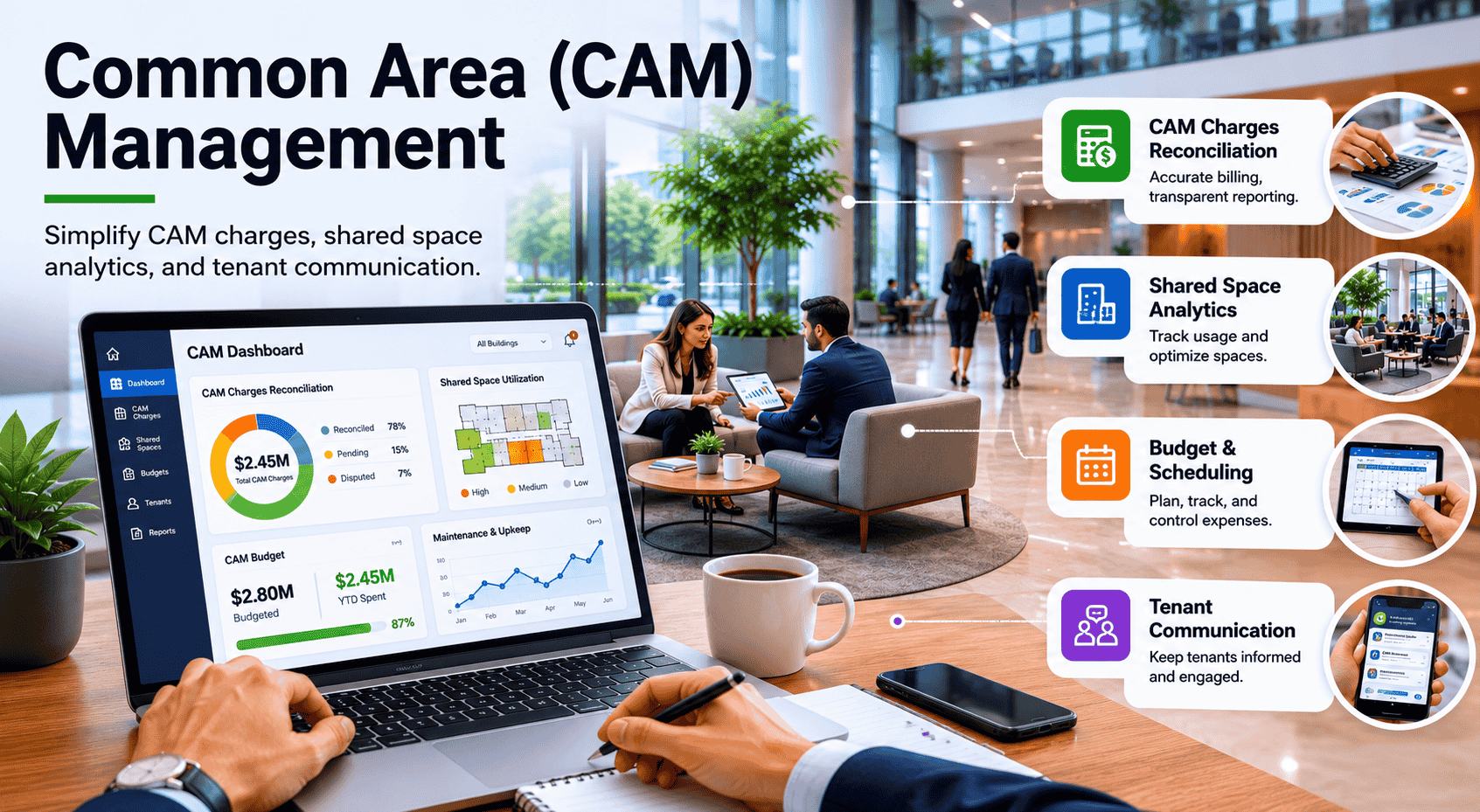
Common Area Maintenance charges are one of the largest variable costs in commercial real estate — and the single biggest source of landlord-tenant disputes. iFactory CAM Management brings expense tracking, pro-rata allocation, and audit-ready reconciliation into one platform that turns the most contentious lease conversation into a transparent monthly workflow. Book a demo to see how.
Turn Year-End Reconciliation From a Crisis Into a Routine
A practical guide to managing Common Area Maintenance in commercial properties — covering expense categorization, pro-rata allocation, annual reconciliation, dispute prevention, and the workflows that keep CAM transparent across the tenant base.
Two Categories of Shared-Space Expenses
CAM expenses break into two clear buckets — internal common areas inside the building, and external common areas across the site. Knowing what belongs in each category is the first step toward an accurate reconciliation. The lease defines specifics, but these are the typical inclusions across most NNN commercial properties.
Internal Common Areas
External Common Areas
What Tenants Are Actually Paying For — Itemized
Within those two categories, CAM expenses break down into specific line items that show up on every reconciliation statement. Understanding the typical share each represents helps both landlords and tenants flag anomalies and detect categorization errors before they become disputes.
Janitorial & Cleaning
Lobby cleaning, corridor mopping, restroom servicing, trash collection
Utilities (Common Areas)
Electricity, water, gas, HVAC for shared spaces only
Landscaping & Snow Removal
Grounds maintenance, seasonal services, exterior care
Security & Life Safety
Guard services, CCTV, fire alarm monitoring, access control
Property Management Fees
Management company's fee, typically 3–5% of gross revenues
Repairs & Maintenance
Routine and reactive repairs to shared infrastructure
Insurance (Building)
General liability and property insurance for shared portions
How a Well-Run CAM Year Actually Flows
CAM isn't a year-end event — it's a continuous workflow. Estimates are set at the start of the year, monthly charges flow throughout, and reconciliation happens after the books close. Each phase has its own discipline. Get any of them wrong and the year-end reconciliation becomes a multi-week dispute marathon.
Annual Budget & Estimate Setting
Property budget set based on prior year actuals plus inflation. Estimated CAM per square foot calculated. Tenant monthly charges established and billed alongside rent.
Monthly Tracking & Categorization
Every invoice categorized at the point of receipt. Recoverable CAM expenses tagged. Capital improvements, marketing, and admin items kept separate. Mid-year review at month 6.
Books Close & Actuals Compile
All CAM-tagged expenses pulled from the GL. Vendor invoices verified. Total recoverable CAM finalized. Allocation calculated per tenant pro-rata share.
Reconciliation Statement Sent
Each tenant receives an itemized reconciliation showing actual vs. estimated CAM. True-up bill or credit issued. Lease-specified dispute window opens (typically 30-60 days).
Tenant Review & Resolution
Tenants review documentation, request supporting invoices, raise disputes within the lease-specified window. Negotiated adjustments documented. Final reconciliation closed.
Turn Annual CAM Reconciliation Into a 30-Minute Workflow
Our team maps your tenant roster, lease structures, and CAM categories — then configures iFactory with expense categorization at the point of work order completion, pro-rata allocation by tenant, and one-click reconciliation statements that ship with full supporting documentation.
Where CAM Reconciliation Usually Goes Wrong
Almost every CAM dispute traces back to one of six recurring categorization or allocation errors. Knowing them in advance — and building workflows that prevent them — is the difference between a clean reconciliation and a multi-week back-and-forth with tenant counsel.
Capital Improvements Charged as CAM
Replacing a roof or repaving a parking lot isn't maintenance — it's capital. Improperly categorizing capital projects as recoverable CAM is the most common (and most contestable) error.
Marketing & Admin Costs Bundled In
Building marketing, leasing commissions, and excessive admin overhead don't belong in CAM. Leases typically allow only a defined management fee — usually 3-5% of gross revenues.
Cap Overruns Not Tracked
Negotiated leases often include annual CAM caps. Failing to track each tenant's cap and applying the cap during reconciliation creates immediate audit findings and tenant overcharges.
Vacancy Gross-Up Mistakes
Multi-tenant buildings with vacant space require gross-up adjustments to fairly allocate fixed costs. Mistakes here under- or over-bill tenants and trigger disputes when discovered.
Missed Lease-Specific Exclusions
Tenants negotiate exclusions — anchor tenants exclude landscaping, some exclude property management fee. Missing tenant-specific exclusions during allocation is a fast track to litigation.
Missing Supporting Documentation
When tenants exercise their audit right, they expect invoice-level support for every line item. Reconciliations without backing documentation default to tenant-favorable resolutions in disputes.
Five Habits of Dispute-Free CAM Operations
The properties that never have CAM disputes share five operational habits. Each one is straightforward in isolation — together they create the documentation trail and transparency that makes the reconciliation statement self-explanatory when it reaches the tenant.
Categorize at Point of Receipt
Every invoice tagged with CAM-recoverable status when received — not at year-end. Eliminates the largest source of reconciliation errors.
Photograph and Document Work
Common-area maintenance work logged with photos, vendor signatures, and timestamps. When tenants ask, the supporting evidence is already attached.
Mid-Year Tenant Statements
Send tenants a half-year snapshot of CAM spend versus estimate. Surfaces issues months before year-end when corrections are cheaper.
Per-Tenant Exclusion Tracking
Each tenant's negotiated exclusions and caps stored in the lease abstract and applied automatically during allocation.
Itemized Reconciliation Statements
Statements show line-item detail with the supporting invoice IDs. Transparency at issuance eliminates the request-for-documentation phase entirely.
From the Asset Management Side
CAM Operations Lead
The single mental shift that transforms CAM operations is treating it as a real-time workflow rather than a year-end project. Every invoice that hits the GL needs a recoverable-or-not flag at the moment of entry. Every maintenance work order needs a CAM category assigned at completion. When that discipline runs all year, reconciliation becomes a 30-minute export rather than a four-week reconstruction.
Conclusion: CAM Is a Workflow, Not a Year-End Event
Common Area Maintenance is the most contentious line item in commercial real estate — but it doesn't have to be. The properties that run CAM well treat it as a continuous operational discipline, not a once-a-year reconstruction project. Expense categorization happens at the moment invoices arrive. Tenant exclusions and caps are encoded in the system. Maintenance work captures supporting documentation as a routine output. By the time year-end arrives, reconciliation is a confirmation rather than a discovery. The financial accuracy, the tenant relationships, and the audit defensibility all flow from that single discipline shift.
Frequently Asked Questions
What's the difference between CAM and operating expenses?
CAM is a subset of operating expenses — specifically the recoverable portion attributable to maintaining common areas. Operating expenses include everything the landlord spends to run the property; CAM is the portion that gets allocated to tenants per the lease. Lease language defines exactly what's recoverable as CAM and what stays with the landlord as a property cost.
How is each tenant's CAM share calculated?
The standard formula is: (Tenant's Leasable Square Footage ÷ Total Leasable Square Footage) × Total Recoverable CAM Expenses. This is called the pro-rata share. Modifications apply for vacant space (gross-up calculations), tenant-specific exclusions, and negotiated caps — which is why the calculation is rarely as simple as it looks on paper.
When does CAM reconciliation typically happen?
Most commercial leases require annual reconciliation within 60-120 days after the fiscal year closes. The landlord issues a statement showing actual CAM versus estimated payments, with a true-up bill or credit. Tenants then have a lease-specified review window — typically 30-60 days — to dispute or request supporting documentation before the reconciliation closes.
What expenses do NOT belong in CAM?
Capital improvements (roof replacement, parking lot resurfacing, HVAC system replacement) are typically not recoverable as CAM — they're capital expenditures. Marketing and leasing costs, executive compensation, mortgage interest, depreciation, and landlord-specific legal fees also fall outside standard CAM. Lease language is the final authority, but these are the most common exclusions.
How does iFactory handle CAM management specifically?
Every work order and vendor invoice gets a CAM-recoverable flag at creation. Lease abstracts store tenant-specific exclusions, caps, and gross-up rules. The platform calculates pro-rata allocation automatically and generates itemized reconciliation statements with invoice-level supporting documentation. When tenants exercise audit rights, the full evidence package is one click away — eliminating the discovery scramble that drags disputes for weeks.
Make CAM Reconciliation the Easiest Conversation You Have
Stop reconstructing the CAM year in four-week sprints every January. Bring expense categorization, lease abstract logic, pro-rata allocation, and reconciliation documentation into one platform built for multi-tenant commercial portfolios.