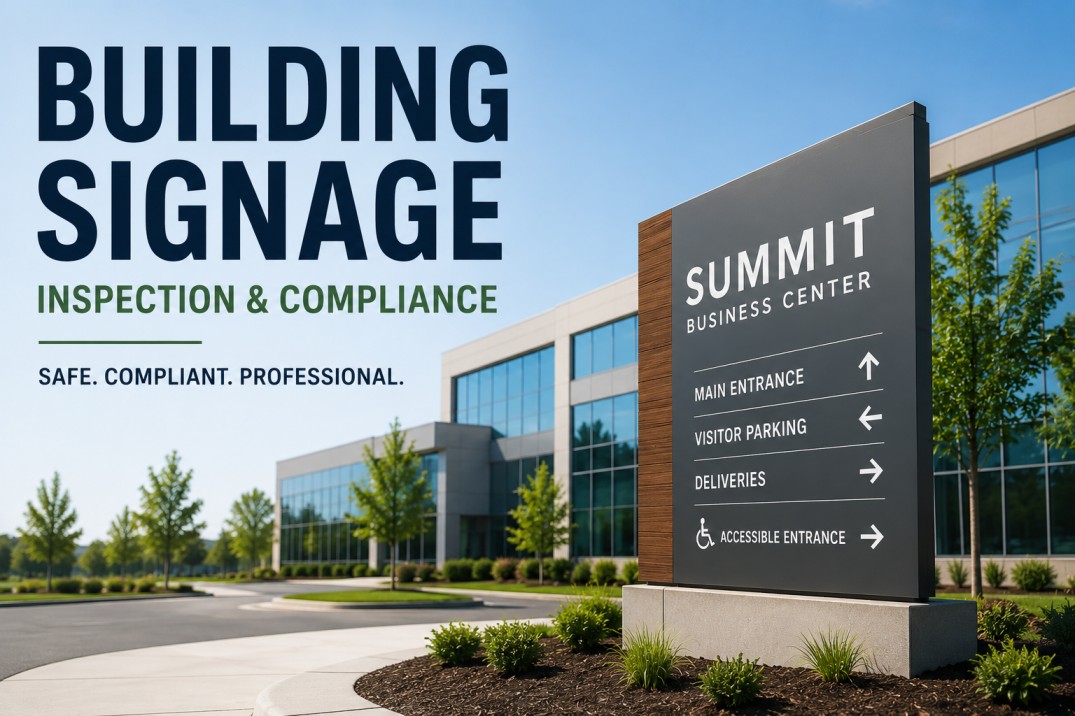
Building signage is the most visible communication layer of any commercial property — monument signs identify the property, directional signage guides visitors, tenant directories communicate occupancy, and regulatory signage ensures code compliance — yet signage is frequently overlooked in facility maintenance programs until a letter falls off a monument sign or an ADA compliance lawsuit arrives. Illuminated sign failures create dark, unreadable signage that diminishes curb appeal and creates safety hazards, while non-compliant or damaged signage can trigger municipal fines and ADA litigation with settlements averaging $25,000–$60,000. A systematic signage analytics program — encompassing illumination checks, structural inspections, ADA compliance verification, and local code audits — extends sign service life by 30–50%, eliminates emergency sign repair costs, and maintains the professional property image that tenants and visitors expect. This guide provides facility managers and property owners with a data-driven framework for scheduling, inspecting, and budgeting signage maintenance across commercial portfolios.
Building Signage Analytics & Compliance for Commercial Properties
Eliminate dark signage and compliance risk. iFactory's platform tracks every building sign — from monument to tenant directory — automates inspection scheduling, and digitizes compliance documentation across your portfolio.
Building Signage Types & Failure Profiles
Commercial building signage encompasses a wide range of types — from illuminated monument signs to interior wayfinding and regulatory signage. Each type has distinct components, failure modes, and maintenance requirements.
Monument & Ground Signs
Freestanding signs at property entrances, typically internally illuminated with LED or neon. Common failures include water ingress at seams, photocell malfunction, graffiti, landscape overgrowth obscuring visibility, and foundation settling causing tilting. Structural inspection for anchor integrity is critical after seismic or high-wind events.
Inspect: MonthlyBuilding-Mounted Wall Signs
Channel letters, illuminated cabinet signs, and dimensional letters mounted to building facades. Failure modes include loose mounting brackets, water ingress behind letters, LED module burnout, and caulk seal failure at penetrations. Annual structural check of all anchor points is required for wind load safety.
Inspect: QuarterlyTenant Directory & Lobby Signs
Interior directory boards, individual tenant door signs, and suite identification. Failures include burned-out backlighting, scratched or faded acrylic faces, missing or outdated tenant name inserts, and damaged mounting hardware. Essential for professional building image and emergency responder identification.
Update: Tenant ChangesWayfinding & Directional Signs
Pedestrian-scale directional signs, parking lot wayfinding, building directory maps, and amenity identification. Subject to vehicle impact, vandalism, UV fading, and landscape overgrowth. Wayfinding consistency across a multi-building campus requires a coordinated sign plan and regular condition audits.
Inspect: MonthlyRegulatory & Life Safety Signs
ADA room identification, fire exit signs, no-smoking signage, handicap parking signs, and emergency assembly point markers. These signs have legal compliance requirements and must be maintained in place, legible, and properly mounted. Missing or damaged regulatory signs create liability exposure and code violation risk.
Check: AnnuallyIlluminated Sign Electrical Systems
Ballasts, drivers, transformers, photocells, timers, and wiring that power illuminated signage. Failure modes include surge damage, capacitor failure, photocell calibration drift, and water-damaged electrical connections. Electrical inspection requires qualified sign electrician per NFPA 70 (NEC) and local code requirements.
Inspect: AnnuallyKeep every sign illuminated, legible, and code-compliant. iFactory's signage analytics platform tracks illumination hours, structural condition, and permit renewal dates across every sign in your portfolio.
ADA Signage Compliance Requirements
ADA Standards for accessible signage are specific and enforceable. Non-compliant signage is a frequent finding in ADA lawsuits and municipal inspections. The following table summarizes key ADA signage requirements for commercial properties.
| ADA Requirement | Specification | Applicable Signs | Common Violation |
|---|---|---|---|
| Character Height | 5/8 inch minimum, 2 inch maximum | Room IDs, directional, exit | Characters too small or too large |
| Raised Characters | 1/32 inch minimum raised above surface | Permanent room identification | Flat printed text instead of raised |
| Braille | Grade 2 Braille, domed, below corresponding text | Permanent room identification | Missing or incorrect Braille |
| Contrast | 70% minimum light-on-dark or dark-on-light contrast | All accessible signage | Low-contrast colour combinations |
| Mounting Height | 48–60 inches to baseline of raised characters | Tactile signage beside doors | Signs mounted too high or low |
| Finish & Glare | Eggshell, matte, or other non-glare finish | All accessible signage | Glossy finishes that reflect light |
| Location | On latch side of door, 48–60 inches high | Permanent room identification | Signs on push side or incorrect height |
| Pictograms | Field 6 inches min height; text below not beside | Accessible routes, restrooms, exits | Text beside instead of below pictogram |
Signage Inspection & Maintenance Matrix
A consolidated inspection schedule ensures every sign — from monument to regulatory — receives appropriate attention at the right interval. The following matrix maps signage types to inspection frequency and responsible party.
| Component | Monthly | Quarterly | Annual | 5-Year |
|---|---|---|---|---|
| Monument Sign Illumination | ||||
| Wall Sign Channel Letters | ||||
| Wayfinding & Directional | ||||
| Tenant Directory Condition | ||||
| Photocell & Timer Function | ||||
| ADA Compliance Audit | ||||
| Electrical System Inspection | ||||
| Sign Permit Renewals | ||||
| Structural & Anchor Check | ||||
| Full Sign Condition Survey |
From ADA Braille verification to illuminated sign photocell calibration — iFactory digitizes every signage inspection across your entire portfolio.
Cost of Deferred Signage Maintenance
Deferred signage maintenance compounds quickly. A single burned-out LED letter in a monument sign can make an entire property look neglected, while non-compliant ADA signage creates legal exposure that dwarfs the cost of routine inspection and replacement.
Preventive Maintenance
Monthly illumination checks, quarterly structural inspection, annual electrical verification, and ADA compliance audit. Keeps all signage functional, legible, and code-compliant. The most cost-effective signage management strategy available.
Annual Budget ItemReactive Repair
Emergency sign lighting repair, graffiti removal, letter replacement, and electrical troubleshooting. Reactive repairs cost 3–5x scheduled maintenance due to rush service fees, equipment rental, and after-hours labour premiums.
3–5x PM CostLiability & Fines
ADA signage compliance lawsuits, municipal sign code violations with daily fines, and slip-and-fall claims from dark or damaged signs. Preventable through annual ADA audits and routine structural inspections.
Preventable RiskFull Sign Replacement
Complete monument sign rebuild, channel letter set replacement, or tenant directory system upgrade. Required when deferred maintenance has caused structural deterioration, water damage, or electrical system failure beyond economical repair.
Capital EventFrequently Asked Questions
How often should commercial building signs be inspected?
Illuminated signs (monument, wall-mounted, canopy) should receive a monthly nighttime visual inspection to confirm all lighting elements are operational and the sign face is legible. Wall-mounted channel letters and building ID signs should receive a quarterly structural inspection to verify mounting bolts and brackets are secure and water seals are intact. Annual inspections should include electrical system verification (photocells, timers, ballasts, drivers), ADA compliance audit, and local sign code compliance check. A comprehensive structural and condition survey should be performed every 5 years. Signs in coastal or high-wind areas should increase inspection frequency by 50%.
What are the ADA requirements for commercial building signage?
ADA Standards require permanent room identification signs to have raised characters (minimum 1/32 inch), Grade 2 Braille, a minimum 70% contrast between text and background, a non-glare finish, and mounting at 48–60 inches to the baseline of raised characters on the latch side of doors. Directional and informational signs must comply with character height, contrast, and finish requirements but are not required to have raised characters or Braille. Exit signs must comply with both ADA and IBC requirements. Annual ADA compliance audits should verify every sign in the building meets current standards, including any tenant improvements or renovations that may have altered sign locations or added new occupancy classifications.
How long do illuminated sign components typically last?
Service life varies by component type. LED modules in illuminated signs: 50,000–100,000 hours (5–11 years at 24/7 operation). Fluorescent lamps: 20,000–30,000 hours (2–3 years). Neon: 30,000–50,000 hours (3–5 years). LED drivers and power supplies: 50,000–70,000 hours. Photocells: 3–5 years. Sign face acrylic: 10–15 years before yellowing or crazing. Sign structure (aluminium or steel): 20–30 years with proper maintenance. Sealants and gaskets: 5–7 years. LED retrofits typically pay for themselves within 2–3 years through energy savings alone, while also eliminating the labour cost of frequent lamp replacement.
Do commercial building signs require permits or inspections?
Yes. Most municipalities require a sign permit for new installation, modification, or replacement of commercial signage. Permit requirements typically include structural engineering approval for wind load compliance, electrical permit for illuminated signs, and zoning verification for size, height, and setback compliance. Some jurisdictions require annual sign inspection and permit renewal, particularly for freestanding monument signs over a certain height. Sign code regulations vary significantly by municipality — what is permitted in one jurisdiction may be prohibited in another. It is the property owner's responsibility to maintain current sign permits and verify compliance with local zoning ordinances. iFactory's platform tracks sign permit renewal dates and stores permit documentation for every sign in your portfolio.
What documentation should I maintain for building signage?
Essential signage documentation includes: sign inventory with manufacturer, installation date, lamp/LED type, and warranty information; sign permit documentation from the local jurisdiction; monthly and annual inspection checklists with photo evidence; illumination monitoring logs showing burn hours and photocell calibration dates; ADA compliance audit reports with sign-by-sign compliance status; structural inspection reports for monument and large wall signs; repair and replacement records with contractor information; and electrical inspection documentation per NFPA 70. iFactory's platform centralizes all signage asset documentation with automated inspection scheduling, permit renewal date tracking, and compliance audit management across your entire portfolio.
How can I prioritize signage repairs across multiple buildings?
Prioritize by safety and compliance risk first: non-functioning exit signs, missing ADA signage, and monument signs with structural damage require immediate attention. Next, address visibility and image issues: burned-out monument sign letters and damaged tenant directory signage affect property perception and tenant satisfaction. Finally, schedule preventive maintenance such as annual electrical inspections, ADA compliance audits, and structural surveys based on the maintenance calendar. iFactory's platform aggregates signage inspection findings across your entire portfolio into a single prioritized work queue, automatically scoring each defect by safety risk, compliance severity, and visibility impact — so your budget and team are directed to the highest-impact signage issues first.
Transform signage management from reactive lamp replacement to data-driven compliance and asset life-cycle management. Book an iFactory walkthrough to see how portfolio-level signage analytics work.