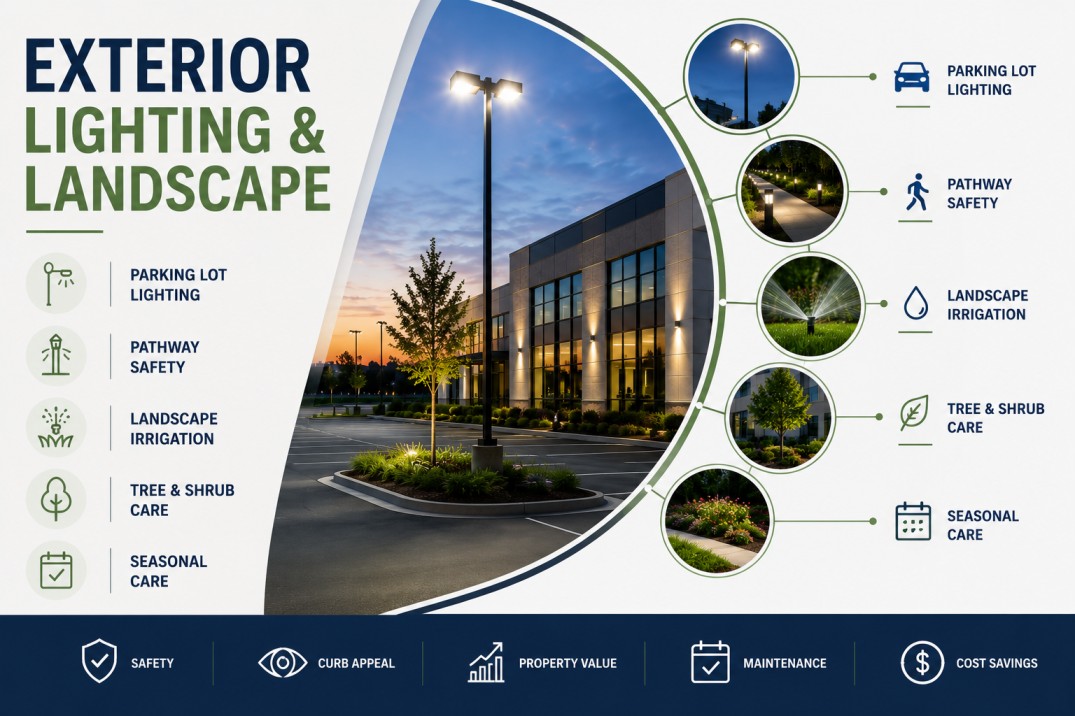
Exterior lighting and landscape systems are the most visible components of any commercial property — they shape first impressions, support tenant safety, and directly impact property valuation — yet they are frequently managed reactively rather than through a structured analytics program. Parking lot lighting failures create slip-and-fall liability after dark, overgrown landscaping obscures sight lines and security cameras, and irrigation system leaks waste thousands of gallons of water annually before they are detected. A data-driven exterior lighting and landscape maintenance program reduces energy consumption by 25–35%, extends fixture and plant service life, and maintains the polished curb appeal that tenants, investors, and municipal inspectors expect. This guide provides facility managers and property owners with a systematic framework for scheduling, inspecting, and budgeting exterior site maintenance across commercial portfolios.
Exterior Lighting & Landscape Analytics for Commercial Properties
Keep every site amenity in peak condition — from parking lot poles to perimeter plantings. iFactory's platform tracks exterior lighting and landscape assets, automates inspection scheduling, and digitizes grounds maintenance across your portfolio.
Exterior Lighting Systems: Components & Failure Profiles
Commercial exterior lighting encompasses everything from parking lot pole fixtures to building accent lighting and pathway bollards. Each component has a distinct service life, failure mode, and inspection requirement.
Parking Lot Pole Lighting
LED shoebox or cobra-head fixtures on steel or aluminium poles. Common failures include LED driver burnout (6–8 yr life), photocell malfunction, pole corrosion at the base, and loose anchor bolts. Light level degradation of 30% indicates group replacement is needed.
LED Life: 50,000–100,000 hrsBuilding Accent & Façade Lighting
Wall packs, uplights, and linear LED strips that highlight architectural features. Prone to water ingress at gaskets, bird nesting behind fixtures, and thermal cycling that degrades seal integrity. IR thermography detects overheating drivers before failure.
Inspect: QuarterlyPathway & Bollard Lights
Low-level pedestrian-scale fixtures along walkways, entrances, and plazas. Subject to vehicle impact, vandalism, landscape overgrowth, and standing water at the base. Conduit corrosion below grade is a common hidden failure requiring periodic insulation resistance testing.
Replace: Every 10–15 yrsSignage & Monument Lighting
Internally illuminated monument signs, tenant directory boards, and building identification. Failure modes include water ingress at the sign face gaskets, neon or LED module burnout, and photocell or timer malfunction. Sign permits often require annual compliance verification.
Inspect: MonthlySecurity & Area Lighting
Floodlights, wall packs with motion sensors, and security pole lights covering loading docks, dumpster enclosures, and building perimeters. Motion sensor false triggering, lamp head misalignment, and DVR integration failures are common. Essential for insurance compliance.
Test: MonthlyLighting Controls & Photocells
Photocells, time clocks, occupancy sensors, and lighting control panels that automate exterior light schedules. Surge damage, failed capacitors, and incorrect programming after power events are the most common failures. Verify schedule monthly against sunrise/sunset tables.
Re-calibrate: AnnuallyEliminate dark spots and reduce energy waste. iFactory's lighting analytics platform tracks fixture age, photometric performance, and maintenance history across every site.
Landscape Systems: Zones & Maintenance Cadence
Commercial landscape maintenance spans distinct zones with different plant material, irrigation requirements, and seasonal maintenance windows. A zone-based maintenance plan ensures appropriate care for each area while controlling costs.
| Landscape Zone | Maintenance Tasks | Frequency | Seasonal Considerations |
|---|---|---|---|
| Entry & Monument Plantings | Pruning, weed removal, mulch refresh, seasonal colour rotation | Weekly growing season; bi-weekly dormant | Annual colour change spring + fall; holiday plantings Dec |
| Turf & Lawn Areas | Mowing, edging, fertilization, aeration, weed control | Weekly growing season; monthly dormant | Overseed in fall; pre-emergent in spring; irrigation adjusted monthly |
| Tree & Shrub Beds | Pruning, mulching, pest monitoring, soil testing, deep root watering | Monthly growing season; quarterly dormant | Structural pruning every 3–5 yrs; storm damage check post-winter |
| Irrigation System | Head adjustment, leak detection, controller programming, rain sensor test | Monthly during operation; annual winterization | Blowout lines before freeze; spring start-up and head replacement |
| Hardscape & Walkways | Sweeping, weed removal, joint sand replacement, crack sealing | Monthly; annual deep clean | Power wash in spring; joint stabilization before winter |
| Dumpster & Service Areas | Grate cleaning, odour control, pest management, fence repair | Weekly | Pressure wash quarterly; grease trap inspection annually |
| Stormwater & Drainage Features | Detention basin inspection, inlet clearing, outlet verification | Quarterly; after major storms | Pre-wet season clearing; post-storm sediment removal |
Exterior Lighting & Landscape Inspection Matrix
A consolidated inspection schedule ensures no exterior amenity is overlooked. The following matrix maps every lighting and landscape component to its required inspection frequency and responsible party.
| Component | Weekly | Monthly | Quarterly | Annual |
|---|---|---|---|---|
| Signage & Monument Illumination | ||||
| Security & Area Floodlights | ||||
| Entry Plantings & Turf | ||||
| Dumpster Enclosure & Service Areas | ||||
| Parking Lot Pole Lights | ||||
| Pathway & Bollard Lights | ||||
| Irrigation System Operation | ||||
| Tree & Shrub Bed Condition | ||||
| Façade Accent Lighting | ||||
| Lighting Controls & Photocells | ||||
| Lighting Panel & Electrical | ||||
| Tree Risk Assessment (Qualified Arborist) | ||||
| Hardscape & Walkway Condition | ||||
| Photometric Light Level Survey |
From photometric compliance to irrigation water budgets — iFactory digitizes every exterior lighting and landscape inspection across your entire portfolio.
Seasonal Maintenance Calendar
Exterior lighting and landscape maintenance is inherently seasonal. A calendar-based approach ensures critical tasks are completed within their correct windows and no seasonal requirement is overlooked.
Spring
Irrigation start-up and head replacement. Turf aeration and overseeding. Mulch refresh in all planting beds. Prune winter-damaged branches. Power wash hardscapes and walkways. Inspect all parking lot poles for winter salt damage and anchor bolt torque. Replace any fixtures damaged by ice or snow loads.
March – MaySummer
Weekly mowing and edging. Irrigation schedule adjusted monthly based on evapotranspiration data. Pest and disease monitoring in shrub beds. Photometric light level survey after dark. Inspect all photocell function against actual sunset times. Verify security lighting coverage after tree canopy fills in.
June – AugustFall
Irrigation winterization — blowout all lines before first freeze. Turf fertilization and overseeding. Leaf removal schedule. Plant tree and shrub installations for dormant season root establishment. Install holiday seasonal colour and lighting. Test emergency generator connections for holiday lighting displays.
September – NovemberWinter
Snow removal route verification and salt storage inspection. Prune dormant trees and shrubs. Inspect all light poles for corrosion at grade. Verify emergency lighting function during short daylight periods. Annual lighting panel and control system inspection. Plan spring replacement and capital projects.
December – FebruaryCost of Deferred Exterior Maintenance
Deferring exterior lighting and landscape maintenance creates compounding costs — from emergency fixture replacements and landscape restoration to liability claims and diminished property value.
Scheduled Maintenance
Routine landscape maintenance, lighting inspections, and irrigation management. Keeps all exterior amenities in peak condition with predictable annual budgeting. The lowest-cost approach to exterior property management.
Annual ContractReactive Repairs
Emergency pole light replacement, irrigation leak repair, tree storm damage cleanup, and turf restoration. Reactive repairs cost 3–5x scheduled maintenance due to after-hours labour, rush shipping, and equipment rental.
3–5x PM CostLiability & Compliance
Slip-and-fall claims from inadequate lighting, trip-and-fall from hardscape defects, tree limb drop claims, and municipal fines for overgrown lots or non-compliant signage illumination. Preventable through routine inspection.
Preventable CostPremature Replacement
Widespread lighting system replacement due to deferred group relamping, irrigation system rebuild from freeze damage not winterized, and landscape restoration from neglected pest infestations or irrigation failures.
Capital AvoidanceFrequently Asked Questions
How often should commercial parking lot lights be inspected?
Parking lot pole lights should receive a monthly nighttime visual inspection to confirm all fixtures are operational and light levels appear uniform. A full photometric survey measuring foot-candle levels at grade should be conducted annually per IESNA RP-20 standards. Pole anchor bolt torque testing and corrosion inspection at the base should be performed annually for steel poles and every 3 years for aluminium. Group LED fixture replacement is typically scheduled when light output degrades 30% from initial installation, typically at 70,000–80,000 operating hours.
What is the most cost-effective exterior lighting upgrade for commercial properties?
LED conversion with integrated photocell and occupancy-based controls delivers the fastest ROI of any exterior lighting upgrade. Typical payback period is 1.5–3 years through 50–65% energy reduction, eliminated lamp replacement labour, and reduced HVAC load from lower heat output. Adding networked lighting controls with scheduling, dimming, and real-time fault detection extends savings to 70% and provides remote monitoring capability. Properties considering LED upgrades should also evaluate pole and fixture replacement to consolidate installation costs.
How can I reduce landscape water consumption without sacrificing appearance?
Smart irrigation controllers with evapotranspiration (ET) sensors reduce water consumption 20–35% by adjusting schedules based on real-time weather data. Additional strategies include: drip irrigation for shrub beds (50% more efficient than spray), soil moisture sensors that override scheduled cycles when sufficient moisture is present, rain sensors that shut off irrigation during precipitation, and hydrozoning — grouping plants with similar water needs on the same irrigation zone. Regular irrigation audits identify leaks, misaligned heads, and overspray onto hardscapes that waste water. Most commercial properties recover smart controller investment within 18–24 months through water savings alone.
When should commercial trees be pruned or removed?
Structural pruning for young trees should be performed every 3–5 years during the dormant season to establish strong branch architecture. Maintenance pruning for mature trees is typically on a 5–7 year cycle. Hazard pruning (deadwood, broken limbs, clearance pruning) should be performed as identified during annual tree risk assessments by a certified arborist. Tree removal is indicated when: more than 50% of the canopy is dead, the trunk has significant decay or cavity, the tree is within falling distance of a building and has structural defects, or the species is invasive or in terminal decline. Arborist risk assessments should follow ISA TRAQ protocols.
What documentation should I maintain for exterior lighting and landscape systems?
Essential documentation includes: lighting fixture inventory with lamp types, wattage, installation dates, and warranty information; photometric survey reports showing compliance with IESNA light level standards; pole anchor bolt torque test records; irrigation as-built drawings and zone maps; irrigation water usage logs and monthly meter readings; tree inventory with species, size, condition rating, and risk assessment dates; landscape maintenance contracts and scope of work documents; seasonal colour change records; and annual exterior maintenance budget versus actual reports. iFactory's platform centralizes all exterior asset documentation with automated inspection schedule generation and condition trend analysis.
How can I prioritize exterior maintenance across multiple properties?
Prioritize by safety and compliance risk first: non-functioning security lighting, trip hazards on walkways, and dead or hazardous trees require immediate attention. Next, address curb appeal deficiencies visible to tenants and visitors — overgrown entry plantings, burned-out parking lot lights, and stained hardscapes. Finally, schedule preventive maintenance such as irrigation audits, pole inspections, and tree pruning based on the seasonal calendar. iFactory's platform aggregates exterior inspection findings across your entire portfolio into a single prioritized work queue, automatically scoring each defect by safety risk, visibility impact, and maintenance urgency — so your team and budget are directed to the highest-impact exterior issues first.
Transform exterior property management from reactive maintenance to data-driven site analytics. Book an iFactory walkthrough to see how portfolio-level exterior lighting and landscape management works.
.jpg)