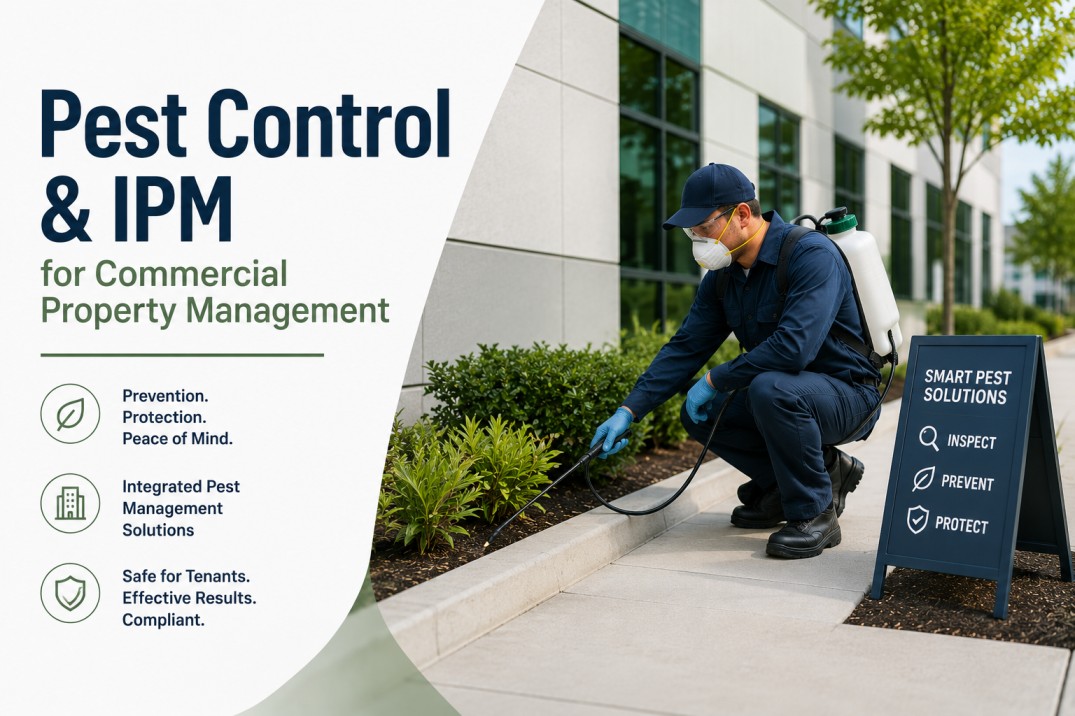
Pest management in commercial properties is fundamentally different from residential pest control — the stakes include tenant health and safety, brand reputation, regulatory compliance, and liability exposure that can reach hundreds of thousands of dollars in a single infestation event. Rodents gnaw through electrical wiring causing fire hazards, cockroach allergens trigger asthma liability in multi-family common areas, and bed bugs in office environments can shutter a floor for weeks. An Integrated Pest Management (IPM) program — which emphasizes prevention, monitoring, and targeted treatment over broad-spectrum chemical application — reduces pesticide use by 60–80%, eliminates emergency pest events, and maintains the healthy environment that tenants, employees, and health inspectors expect. This guide provides facility managers and property owners with a data-driven framework for implementing and managing IPM programs across commercial portfolios.
Pest Control & IPM for Commercial Property Management
Protect tenants and your property from pest-related liability. iFactory's platform digitizes IPM inspection schedules, vendor service verification, and pest incident tracking across your entire portfolio.
Commercial Pest Threats & Risk Profiles
Each pest species presents unique risks to commercial properties — from structural damage to health liability. Understanding the threat profile of each pest is the foundation of an effective IPM program.
Rodents (Mice & Rats)
Rodents cause structural damage by gnawing on wood, drywall, insulation, and electrical wiring — responsible for an estimated 30% of commercial building fires of unknown origin. They contaminate food surfaces with droppings and urine, trigger asthma allergies, and carry hantavirus and leptospirosis. A single mouse pair can produce 60 offspring per year.
Exclusion Is Primary DefenseCockroaches
Cockroach allergens are a leading trigger of asthma in multi-family and commercial settings. German cockroaches breed rapidly — a single egg case produces 30–40 nymphs that reach reproduction in 60 days. They thrive in warm, moist environments near food and water sources, making commercial kitchens, break rooms, and mechanical rooms high-risk zones.
Sanitation + MonitoringBed Bugs
Bed bugs in commercial environments — offices, hotels, healthcare facilities, and common-area furniture — are among the most expensive pests to remediate. Treatment requires heat treatment (120°F+), chemical application, and often furniture disposal. A single undetected bed bug can grow to a floor-wide infestation within 6–8 weeks. Prevention through regular inspection is critical.
Inspect: Weekly High-RiskFlies & Drain Pests
Fruit flies, drain flies, and phorid flies breed in organic matter in drains, garbage disposals, mop sinks, and trash areas. They indicate sanitation failures and create negative impressions for tenants and visitors. Phorid flies in particular can indicate a hidden organic material source such as a dead rodent or leaking sewer line.
Eliminate Breeding SourcesAnts & Crawling Insects
Ants — particularly carpenter ants and odorous house ants — enter buildings seeking food, water, and shelter. Carpenter ants nest in moisture-damaged wood and can cause structural damage over time. Pavement ants and pharaoh ants are common in commercial kitchens. Identification of the species determines the treatment strategy and nesting location.
Identify Species FirstStinging Insects
Wasps, hornets, and bees nesting in building eaves, wall voids, landscaping, and playground equipment create serious liability for tenant and visitor stings. Yellowjackets are aggressive and nest in wall voids and ground cavities. Removal requires licensed professionals and may require structural opening to access nests in wall cavities.
Remove: Licensed OnlyStop pests before they become tenant complaints. iFactory's IPM platform digitizes every monitoring station check, vendor service report, and pest incident across your entire portfolio.
Integrated Pest Management (IPM) Program Structure
A structured IPM program moves beyond scheduled pesticide sprays to a data-driven approach that emphasizes prevention, monitoring, and targeted intervention. The following five pillars form the foundation of every effective commercial IPM program.
Inspection & Monitoring
Deploy sticky traps, pheromone traps, and rodent bait stations at perimeter and interior locations. Document trap catch counts weekly — zero catch for 4 consecutive weeks indicates successful control. Map trap locations on building floor plans and digitize catch data to identify infestation patterns and hotspot zones. Use trend data to predict seasonal pest pressure shifts.
Prevention & Exclusion
Seal all cracks and openings larger than 1/4 inch at building exterior with copper mesh and sealant. Install door sweeps, weatherstripping, and air curtains at all exterior doors. Maintain landscape vegetation clearance of 18 inches from building foundations. Grade soil away from foundations to eliminate standing water. Repair all leaking pipes and fixtures within 48 hours.
Sanitation & Habitat Modification
Eliminate pest food, water, and harborage sources. Maintain trash room cleanliness with daily pickup and weekly deep cleaning. Ensure dumpsters are 50 feet from building entrances with tight-fitting lids. Eliminate clutter in storage areas, mechanical rooms, and janitor closets. Clean drain lines monthly with biological drain cleaner to prevent fly breeding.
Targeted Treatment
Apply pesticides only when monitoring data confirms pest presence and threshold levels are exceeded. Use baits and gels over broad-spectrum sprays to minimize chemical exposure. Rotate chemical classes to prevent resistance. Document every treatment — product used, application location, rate, and target pest. Maintain current pesticide applicator licenses and SDS sheets.
Documentation & Communication
Maintain a central digital log of all pest monitoring data, treatment records, vendor service reports, and tenant pest complaints. Provide annual IPM program summary to building ownership. Post required pesticide application notices per state and local regulations. Document all tenant communication regarding pest issues — including response times, actions taken, and resolution status.
Commercial IPM Monitoring Schedule
A risk-based monitoring schedule ensures appropriate surveillance for each pest type and building area. The following matrix maps monitoring frequency by pest type and location.
| Area / Pest Type | Weekly | Monthly | Quarterly | Annual |
|---|---|---|---|---|
| Kitchen & Break Room (roaches, flies) | ||||
| Trash Room & Dumpster Area (flies, rodents) | ||||
| Exterior Rodent Bait Stations | ||||
| Mechanical Room & Basement | ||||
| Common Area & Lobby | ||||
| Tenant Space (office, retail) | ||||
| Exterior Perimeter Inspection | ||||
| Exclusion & Seal Verification | ||||
| Vendor Contract Compliance Audit |
From trap catch counts to vendor compliance — iFactory digitizes every IPM monitoring point across your entire portfolio.
Pest Control Vendor Management
The quality of pest control service varies significantly across vendors. A structured vendor management program ensures consistent, documented, and effective service delivery across all properties in your portfolio.
| Vendor Requirement | Specification | Verification Method | Frequency |
|---|---|---|---|
| License & Insurance | State pesticide applicator license, $2M+ liability insurance | Certificate of insurance review | Annually |
| Scope of Service | Written IPM plan with monitoring, treatment, and reporting protocols | Contract review | Upon renewal |
| Service Reports | Digital reports within 24 hours including trap counts, treatments, and recommendations | Report timeliness audit | Monthly |
| Chemical Use Log | Product name, EPA number, amount applied, location, target pest, applicator name | Log review | Quarterly |
| Emergency Response | 4-hour response for urgent pest issues, 24-hour for non-urgent | Response time tracking | Per incident |
| Continuing Education | 8 hours annual IPM training per applicator | Training certificate review | Annually |
Cost of Inadequate Pest Management
Reactive pest management costs significantly more than a proactive IPM program — in direct remediation costs, reputational damage, and legal liability. The following cost comparison illustrates the financial impact of pest management approach.
Proactive IPM Program
Monthly monitoring, quarterly inspections, exclusion maintenance, sanitation support, and documentation. Keeps all pest populations below threshold levels. The lowest-cost pest management approach over any 5-year period.
Annual ContractReactive Pest Control
Scheduled spray-only service, emergency callbacks, and repeat treatments for unresolved infestations. Cost 3–5x higher than IPM due to redundant chemical applications and emergency service premiums.
3–5x IPM CostInfestation Remediation
Bed bug heat treatment and furniture disposal, rodent damage repair and rewiring, cockroach remediation with tenant relocation. Emergency remediation costs 20–50x the annual IPM program cost for the affected area.
Preventable CostFines & Legal Exposure
Health department fines for pest infestation, tenant lawsuits for pest-related health impacts, and regulatory penalties for pesticide misapplication or improper documentation. Preventable through documented IPM compliance.
Preventable RiskFrequently Asked Questions
What is the difference between IPM and traditional pest control?
Traditional pest control relies on scheduled broad-spectrum pesticide applications regardless of whether pests are present — a calendar-based spray approach. IPM uses monitoring data to determine if treatment is needed, when, and where — a data-driven approach. IPM emphasizes prevention through exclusion and sanitation, uses targeted treatments (baits, gels, traps) over broad-spectrum sprays, maintains detailed documentation of every monitoring and treatment action, and continuously evaluates program effectiveness to adjust strategies. IPM typically reduces pesticide use by 60–80% while achieving better long-term pest control outcomes. Many states and municipalities now require IPM approaches for commercial and multi-family properties.
How often should commercial pest control service occur?
Service frequency depends on property type, pest pressure, and building use. Food service and multi-family properties with kitchens typically require weekly monitoring of high-risk areas (kitchens, trash rooms) and monthly full-property monitoring. Office and retail properties typically require monthly monitoring with quarterly full-property inspections. All properties should receive annual exterior perimeter inspection and exclusion audit. Service frequency should be adjusted based on monitoring data — properties with sustained zero-catch periods may reduce frequency, while properties experiencing seasonal pest pressure increases should increase monitoring during those periods. iFactory's platform tracks trap catch data to recommend optimal service frequency for each property.
How should tenants report pest issues in multi-tenant buildings?
Tenants should have a clear, documented pest reporting process — typically a dedicated email address, online portal, or work order system. Management should acknowledge receipt within 4 business hours and schedule inspection within 24 hours for common pests (roaches, ants, flies) or immediately for high-risk pests (bed bugs, rodents, stinging insects). All pest complaints should be logged in a central system with: tenant name and unit, date reported, pest type observed, inspection date and findings, treatment actions taken, and resolution date. Trend analysis of complaint data identifies building-wide pest issues that may require program-level adjustments. iFactory's platform integrates tenant pest reporting with vendor dispatch and service verification workflows.
What documentation is required for commercial pest management compliance?
Required documentation varies by jurisdiction but typically includes: written IPM plan for the property, current pesticide applicator licenses for all technicians, pesticide application records (product, EPA number, amount, location, target pest, applicator) maintained for 3–7 years, monitoring trap catch logs with dates and locations, notification records demonstrating compliance with state-mandated tenant notification requirements for pesticide applications, pest complaint log with response and resolution documentation, and annual IPM program effectiveness report. Many states require that IPM records be made available to health department inspectors upon request. iFactory's platform centralizes all pest management documentation with automated record retention and compliance reporting.
How can I evaluate my pest control vendor's performance?
Key performance indicators for pest control vendors include: trap catch trends (declining or stable zero-catch indicates effective control), service report timeliness (digital reports within 24 hours), complaint response time (within defined SLA), treatment documentation completeness (all fields filled, photos provided), pesticide use volume and type (trending toward reduced and targeted use), tenant satisfaction with pest resolution, and annual IPM program review completion. Quarterly vendor performance reviews should review these metrics and adjust the IPM plan as needed. Annual vendor contract renewal decisions should be based on documented performance data, not simply lowest bid. iFactory's platform tracks vendor KPI data and provides automated scorecards for vendor performance evaluation.
What are the most common IPM compliance violations in commercial properties?
The most frequent IPM compliance violations include: inadequate pest monitoring documentation (missing trap logs or treatment records), failure to post required pesticide application notices, expired applicator licenses on file, pesticide storage violations (unlocked, unlabeled, or near food/food-contact surfaces), failure to maintain current SDS sheets for all products used, inadequate tenant notification procedures for pesticide applications, and use of restricted pesticides without proper certification. Health department inspections increasingly evaluate IPM program documentation as part of routine food service and multi-family property inspections. Proactive IPM compliance — documented through a digital platform — eliminates the vast majority of these violations before an inspector identifies them.
Transform pest management from reactive spraying to data-driven IPM. Book an iFactory walkthrough to see how portfolio-level pest control analytics work.
.jpg)