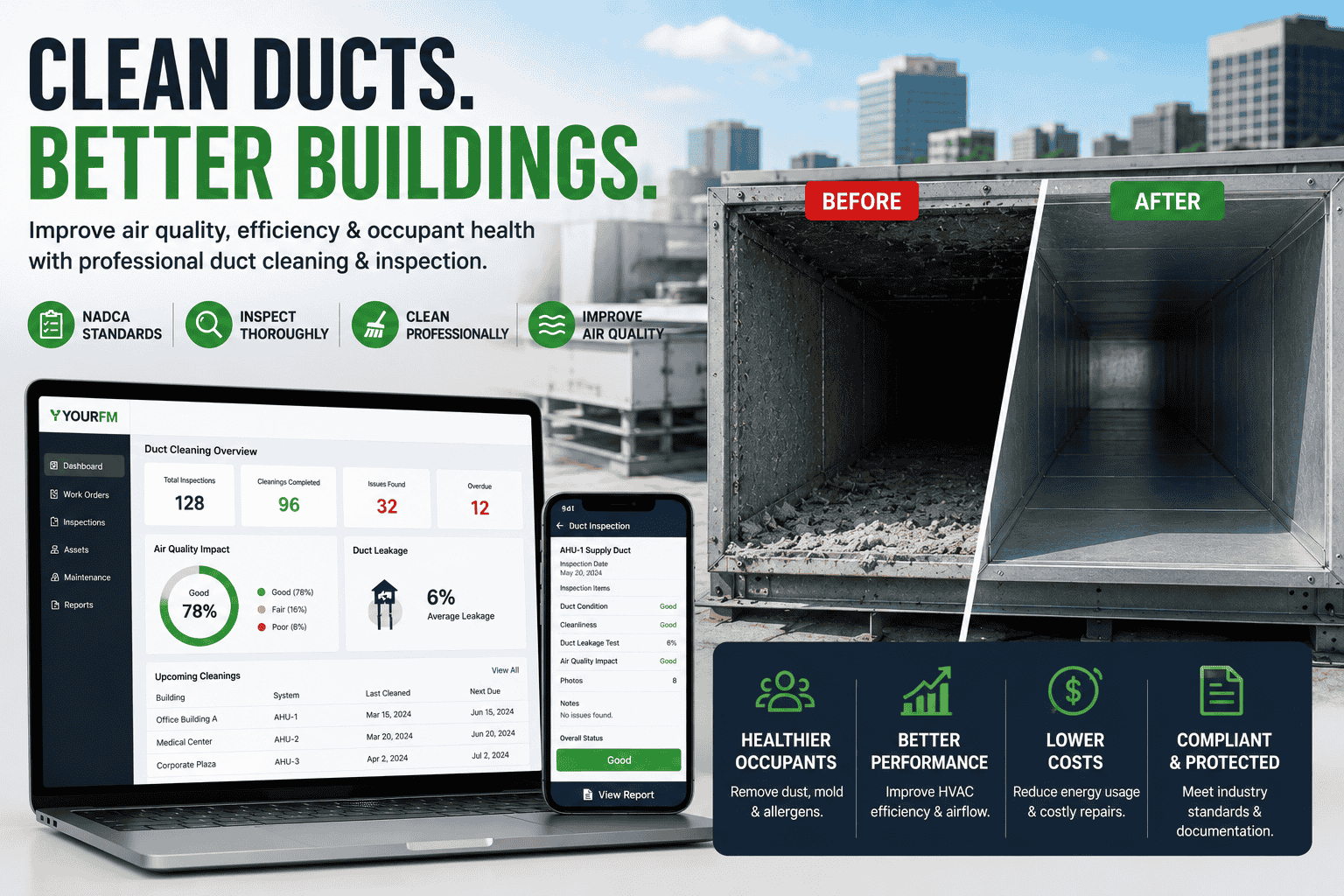
Neglected ductwork doesn't just look bad — it cuts HVAC efficiency by 20-30%, drives up energy bills, and pushes contaminants directly into the air your tenants breathe. Yet duct cleaning is the maintenance task most commonly skipped, deferred, or treated as a one-time project rather than a recurring discipline. iFactory Duct Operations Intelligence brings NADCA-aligned inspection schedules, contractor management, and IAQ documentation across your building portfolio into one platform. Book a demo to walk through a complete duct cleaning program built for commercial properties.
The Complete Commercial Duct Cleaning Playbook
A practical guide to NADCA-aligned duct inspection, the building-specific cleaning frequencies that actually apply, and the warning signs that tell you a system needs attention — built for property managers who want defensible IAQ programs.
The Invisible Buildup That's Costing You Money
Commercial duct systems collect a remarkable mix of contaminants over time — and every category compounds the others. Dust restricts airflow. Moisture creates microbial harborage. Mold spores re-enter the airstream. The economic and health costs are real, even when nothing visible has gone wrong yet.
Dust & Debris
Construction residue, paper fibers, skin cells, and outdoor particulates accumulate continuously. The biggest single contributor to airflow restriction.
Condensation & Humidity
Cooling-cycle condensation pools at low points. Sustained dampness in fiberglass insulation creates ideal conditions for microbial colonization.
Mold & Bacteria
Mold spores, bacteria, and microbial colonies thrive in damp insulation. Once established, they shed continuously into the supply air.
Insect & Rodent Activity
Droppings, nesting material, and dead organisms in duct runs. Allergen sources that often go undetected without scheduled inspection.
Chemical Off-Gassing
Cleaning product residue, adhesives, and absorbed VOCs from materials. Releases slowly into circulated air over months and years.
Pollen & Dust Mites
Seasonal pollen accumulates and continues circulating long after outdoor exposure ends. Dust mite populations thrive in undisturbed duct linings.
How Often Your Building Actually Needs Duct Cleaning
A single year-round frequency doesn't work — building type drives the cleaning cadence. NADCA's ACR Standard recognizes that healthcare, food service, and high-occupancy facilities need more aggressive schedules than offices or industrial buildings. Match the frequency to the use.
Healthcare & Senior Living Facilities
Vulnerable occupants demand the most aggressive schedule. Hospitals, surgery centers, dialysis clinics, assisted living, and nursing homes. Infection control imperatives drive cleanliness verification at each cycle.
Restaurants & Food Service
Grease vapors and cooking residue accumulate aggressively. Exhaust ducts have their own NFPA 96 schedule (often quarterly), but supply and return ductwork also need short cycles in food-service environments.
Schools, Universities & Daycare
High occupancy density and vulnerable populations. Summer breaks provide natural service windows. Many school districts now align cycles with summer maintenance shutdowns for minimal disruption.
Office Buildings & Multi-Tenant Commercial
Standard 3-5 year cycles cover most Class A and Class B office buildings. Multi-tenant properties often coordinate cleaning with HVAC system upgrades or tenant build-outs to reduce service disruption.
Warehouse & Light Industrial
Lower occupancy and process-driven environments. Frequency driven more by visual contamination than calendar schedule. Inspection-driven cleaning makes more sense than fixed cycles for these properties.
Six Signs Your Ducts Need Cleaning Right Now
Beyond scheduled frequencies, certain conditions demand immediate inspection regardless of calendar. These are the signals NADCA-certified inspectors look for first — and the ones property managers should treat as triggers for service rather than routine observations.
Visible Dust at Supply Vents
Dust streaks around register grilles indicate buildup making its way through the system. Visible accumulation means the duct interior is well past acceptable.
Musty Odors During Operation
Damp, earthy, or musty smells when HVAC runs typically signal microbial growth somewhere in the system. Cleaning combined with moisture source repair is essential.
Cluster of Occupant Complaints
Multiple tenants reporting allergies, headaches, or respiratory irritation in the same zones often trace back to duct issues — particularly when complaints concentrate after HVAC operation.
Reduced Airflow at Diffusers
Noticeably weaker airflow at supply diffusers means restriction somewhere upstream — accumulated debris, collapsed flex duct, or damper failure are the usual suspects.
Recent Renovation or Construction
Construction generates massive quantities of fine particulate. Post-renovation duct cleaning prevents months of recirculated dust through occupied spaces.
Water Intrusion or HVAC Flood
Any moisture event in the duct system requires immediate inspection. Wet insulation that goes unaddressed becomes a mold colonization event within days.
Build a Defensible Duct Cleaning Schedule in 30 Minutes
Our team takes your building inventory, occupancy type, and current IAQ records — and configures a NADCA-aligned inspection and cleaning schedule that holds up under tenant questions, insurance audits, and indoor air quality scrutiny.
How a Proper Duct Inspection Actually Works
A NADCA-aligned inspection follows a defined process — not a quick walk-through with a flashlight. Each step produces documentation that matters for both operational decisions and any future IAQ inquiry. This is what a credible inspection looks like in practice.
Preliminary Assessment
Certified Ventilation Inspector (CVI) reviews HVAC drawings, identifies system zones, and develops the inspection scope. Occupant complaints, IAQ history, and any prior service records inform priority areas.
Access Point Identification
Existing inspection panels mapped, new access points planned where needed. Critical for thorough inspection — many older systems lack adequate access for visual confirmation of duct interior conditions.
Visual Inspection & Documentation
Borescope and visual inspection of accessible duct surfaces. Photographs at each access point. Identification of dust accumulation, insulation condition, moisture stains, and any visible biological growth.
Sampling & Testing (As Required)
Surface sampling for microbial analysis when active growth is suspected. Particle counts and airflow measurements at registers. NADCA Vacuum Test method when verification of cleanliness is required.
Recommendations & Documentation Package
Written report with photographs, findings, and recommended scope of work. Cleaning recommendations specify mechanical agitation, source removal collection, and verification methods aligned with the ACR Standard.
What Duct Cleaning Actually Pays Back
"How much does it cost?" is the wrong first question. The right question is "What's the return on a structured cleaning program?" — and the answer typically surprises property managers in the right way. The benefits compound across energy, IAQ, equipment, and tenant satisfaction.
HVAC Efficiency Recovery
Clean ductwork restores airflow design specifications. Fan motors work less, blowers run shorter cycles, and conditioned air actually reaches the spaces it was meant for.
Extended Equipment Life
Restricted airflow strains compressors, fan motors, and bearings. Removing the obstruction protects every downstream component from premature wear and failure.
Particulate Reduction
Post-cleaning particle count drops typically run 30-50% lower than baseline. Combined with HEPA filter upgrades, the reduction can transform tenant comfort and complaint volume.
Liability Protection
When tenant health complaints arise, a documented NADCA-aligned cleaning program is the property manager's best legal defense. Records matter as much as the cleaning itself.
Frequently Asked Questions
How can I tell if my ductwork actually needs cleaning?
Visible signs include dust streaks around supply registers, musty odors during HVAC operation, clusters of occupant respiratory complaints, and reduced airflow at diffusers. NADCA's ACR Standard recommends inspection-driven cleaning — meaning a Certified Ventilation Inspector (CVI) performs visual inspection through access points before any cleaning decision is made.
Is there a standard frequency for commercial duct cleaning?
NADCA recommends frequencies based on building use rather than a single calendar. Healthcare and food service facilities typically need 1-2 year cycles. Schools and high-occupancy buildings benefit from 2-3 year cycles. Standard commercial offices typically operate on 3-5 year cycles. Warehouse and light industrial environments can extend to 5-7 years with inspection-driven verification.
What credentials should a duct cleaning contractor have?
Look for NADCA membership, certified Air Systems Cleaning Specialist (ASCS) staff, certified Ventilation Inspector (CVI) credentials for assessment work, general liability insurance, and commitment to the ACR Standard for cleaning procedures. Membership requires at least one ASCS-certified staff member and adherence to NADCA's Code of Ethics — a meaningful baseline for service quality.
How disruptive is commercial duct cleaning for tenants?
Modern source-removal cleaning typically operates with negative-pressure containment, meaning tenants experience minimal noise or disruption beyond the immediate work zone. Most commercial cleaning projects are scheduled during off-hours, weekends, or in zones rotated across tenant spaces to keep operational impact minimal. Full HVAC shutdown is rarely necessary.
How does iFactory track NADCA-aligned cleaning programs?
Each building is registered as an asset with occupancy type, square footage, system zones, and applicable cleaning frequency. Inspection and cleaning cycles auto-generate as work orders aligned to NADCA recommendations. Contractor credentials, inspection reports, photographs, and verification documents attach to each completed work order — creating an audit-ready history of every IAQ-related action across the portfolio.
Bring Every Duct System Into One Documented Program
Stop running duct cleaning as a reactive project triggered by complaints. Build NADCA-aligned inspection schedules, contractor management, and IAQ documentation into a single platform built for commercial portfolios.