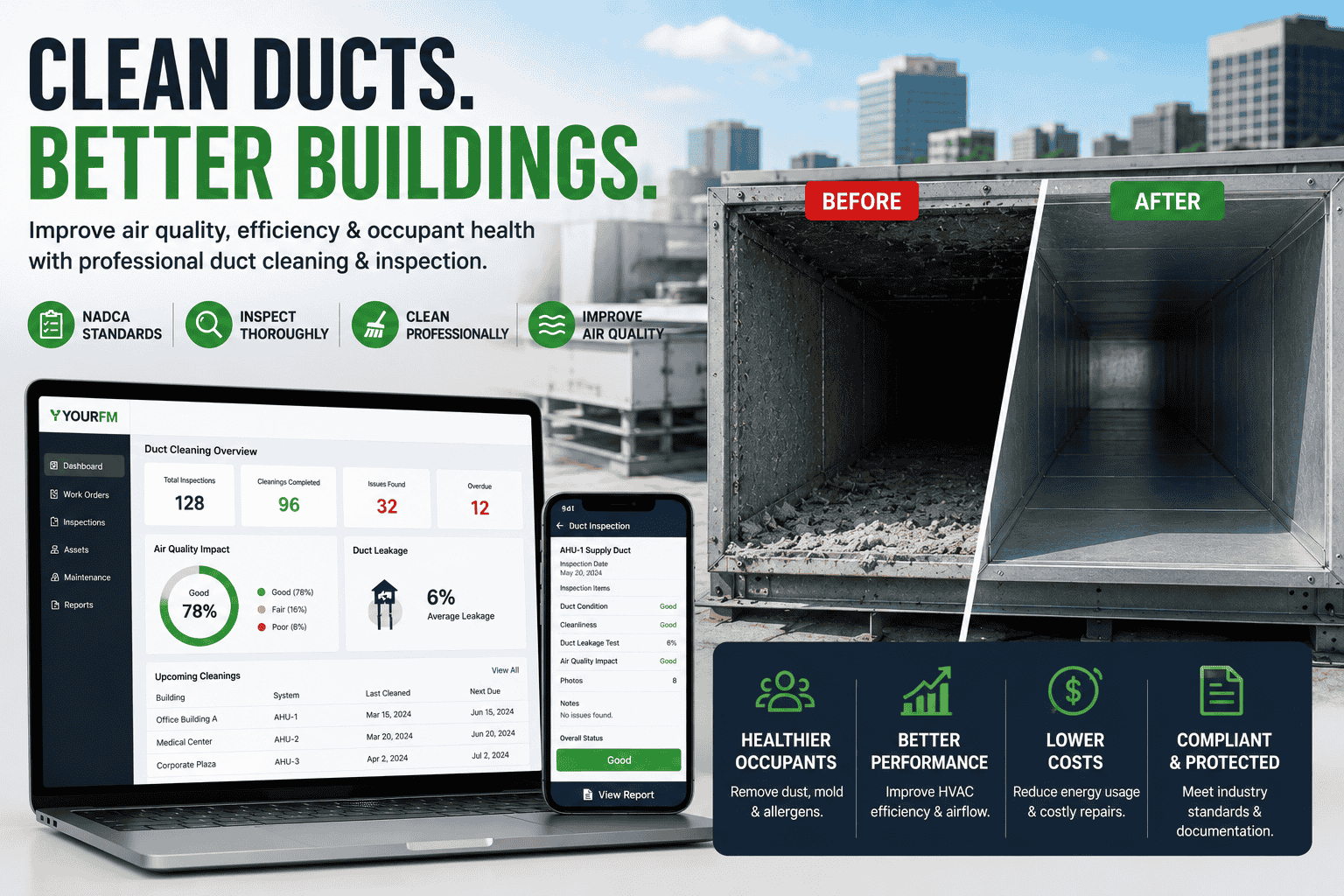
Ductwork is the circulatory system of any HVAC installation, responsible for delivering conditioned air to every occupied space. Over time, ducts accumulate dust, microbial growth, debris, and physical damage that restrict airflow, degrade indoor air quality, increase energy consumption, and create health risks. This guide covers ductwork inspection methods, cleaning standards, leak testing procedures, insulation assessment, and maintenance schedules based on NADCA ACR standards and ASHRAE guidelines for commercial, industrial, and residential duct systems.
Maintain Airflow & IAQ With Ductwork Analytics
iFactory's Preventive analytics module provides duct inspection scheduling, maintenance tracking, airflow performance monitoring, and compliance documentation. Book a demo to see how systematic duct management improves IAQ and reduces energy waste.
Ductwork Inspection Categories: What to Check and Why
A thorough ductwork inspection covers four primary categories: physical condition, airflow performance, microbial contamination, and thermal integrity.
Physical Condition
Check with borescope for disconnected sections, crushed ducts, punctures, loose fasteners, and corrosion. Physical damage can reduce airflow 20-40% and create contaminant pathways.
Airflow Performance
Measure static pressure before/after filters and coils. Compare to design. High static indicates debris, undersized ducts, or closed dampers. 15-25% airflow reduction common in uncleaned ducts.
Microbial Contamination
Inspect for visible mold, moisture stains, musty odors. Test for spores if occupants report respiratory issues. NADCA recommends cleaning if visible growth exceeds 1 sq ft per 100 linear ft.
Thermal Integrity
Inspect insulation for gaps, compression, moisture damage. Check for condensation on duct surfaces. Damaged insulation reduces efficiency 5-15% and can lead to mold growth.
Duct Leakage Testing: Standards, Methods & Acceptable Rates
Duct leakage is one of the largest sources of HVAC energy waste, with typical systems losing 15-25% of conditioned air.
| Standard | Application | Test Method | Max Leakage | Duct Pressure |
|---|---|---|---|---|
| SMACNA Class A | Hospital ORs, clean rooms, labs | Static pressure decay | 3% of flow | 4-6 in. w.g. |
| SMACNA Class B | Office, schools, hotels | Static pressure decay | 6% of flow | 2-4 in. w.g. |
| SMACNA Class C | Industrial, warehouses | Static pressure decay | 12% of flow | 1-2 in. w.g. |
| ASHRAE 90.1 | New commercial construction | Per SMACNA | Class 6 supply outside conditioned | Per SMACNA |
| Residential | Single-family, multifamily | Duct blaster | <8% of fan flow | 0.1-0.5 in. w.g. |
Duct Cleaning Decision Criteria: When Cleaning Is Necessary
NADCA recommends cleaning based on visual inspection evidence rather than fixed calendar intervals.
Visible Contamination
>1/4 inch debris on any interior surface, visible mold growth, vermin infestation, or debris from registers during operation. Each warrants immediate cleaning regardless of age.
Health Indicators
Occupants report respiratory symptoms that improve away from building, musty odors persist after filter changes, or IAQ testing shows elevated particle counts attributable to duct contamination.
Performance Loss
Static pressure drop across duct system exceeds design by 25%+, supply airflow at diffusers is 15%+ below design, or energy consumption increased >10% without other system changes.
Post-Construction
After any renovation generating dust. Even with temporary filtration, 30-50% of construction dust bypasses standard filters and accumulates in ductwork. Clean before reoccupying.
Detect Duct Problems Before They Affect Occupants
iFactory's platform integrates with airflow sensors to detect duct restrictions, leakage increases, and fan performance changes in real time. Book a demo to see how continuous duct analytics alerts you to developing problems.
Duct Cleaning Methods: Techniques, Effectiveness & Applications
NADCA recognizes several duct cleaning methods suited to different configurations and contamination types.
| Method | How It Works | Best For | Effectiveness | Cost |
|---|---|---|---|---|
| Source Removal (HEPA) | HEPA vacuum with agitation at each access point | All duct types, preferred for commercial | 90-98% debris removal | $$$ |
| Air Whip + Vacuum | Pneumatic whip vibrates while vacuum captures | Flexible ducts, fiberglass-lined | 80-90% removal | $$ |
| Brush + Vacuum | Rotating brush with simultaneous vacuum | Rigid metal ducts, large rectangular | 85-95% removal | $$$ |
| Chemical Biocide | EPA-registered antimicrobial after cleaning | Mold-contaminated ducts only | 99% microbial reduction | $$ |
| Dryer Vent Rotary | Rotary brush for small diameter ducts | Dryer exhaust, small branch | 95-99% removal | $ |
Duct Maintenance Schedule: Inspection & Cleaning Frequency
Appropriate frequency varies by building type, occupancy density, filter efficiency, and outdoor air quality.
Commercial Offices
Annual visual inspection. Clean when >1/4 inch debris or 25%+ surface contamination.
Healthcare Facilities
Annual borescope inspection. Clean when microbial sampling indicates elevated counts.
Restaurants/Kitchens
Grease-laden ducts per NFPA 96. Inspect exhaust quarterly. Clean every 3-6 months.
Schools/Universities
Inspect during summer break. Clean during renovation cycles.
Industrial Facilities
Inspect every 2 years. Clean when debris reaches 10% of cross-sectional area.
Residential
Inspect during annual HVAC service. Clean if allergies, pets, or recent renovations.
Frequently Asked Questions
How often should commercial ductwork be inspected and cleaned?
NADCA recommends visual inspection every 1-2 years and cleaning every 3-5 years for most commercial offices, with actual cleaning intervals determined by inspection findings. Buildings near construction sites, highways, or industrial areas may need cleaning every 2-3 years. Healthcare facilities should inspect annually and clean every 1-2 years. Restaurants require the most frequent maintenance under NFPA 96. Schools should inspect during summer breaks and clean every 3-5 years. The most reliable indicator is visual: if >1/4 inch debris covers any interior surface, if visible mold is present, or if debris exits registers, cleaning is warranted regardless of schedule.
What are the signs that ductwork needs cleaning?
Visible debris accumulation exceeding 1/4 inch depth on interior surfaces, visible mold growth, musty odors that persist after filter changes, debris exiting supply registers during operation, occupant health symptoms (allergies, respiratory issues) that improve away from the building, supply airflow dropping 15%+ below design, static pressure increasing 25%+ above baseline, energy consumption rising 10%+ without other changes, and visible pest activity in or near ductwork. NADCA recommends that any single indicator warrants formal inspection, and two or more indicators should trigger immediate cleaning.
How much energy is wasted by dirty or leaking ductwork?
Duct leakage typically accounts for 15-25% of HVAC energy consumption in commercial buildings, reaching 30-40% in poorly sealed systems. For a 100,000 sq ft office with $150,000 annual HVAC costs, duct leakage wastes $22,500-$37,500 per year. Debris accumulation increases static pressure by 15-25% and reduces airflow by 10-20%, adding $10,000-$20,000 more. The combined impact of leakage and debris is typically 20-35% higher energy consumption. Duct sealing costs $0.50-$2.00/sq ft with 6-18 month payback, while cleaning costs $0.15-$0.50/sq ft with 3-12 month payback.
What standards and certifications apply to duct cleaning?
NADCA publishes the ACR 2024 standard (Assessment, Cleaning, and Restoration of HVAC Systems). Certified professionals follow protocols including negative pressure containment, mechanical agitation, HEPA filtration at 99.97%, and post-cleaning visual inspection with video documentation. For microbial contamination, IICRC S520 governs mold remediation. ACGIH provides bioaerosol assessment guidelines. ASHRAE 62.1 specifies minimum ventilation rates. Building owners should verify NADCA certification, liability insurance, and detailed scope of work with before/after documentation.
Can dirty ductwork cause health problems?
Dirty ductwork can contribute to allergic reactions (sneezing, itchy eyes, skin irritation), respiratory symptoms (coughing, wheezing, asthma exacerbation), and mucous membrane irritation from VOCs. In moisture-damaged ducts, mold can produce mycotoxins causing neurological effects in susceptible individuals. The WHO estimates 10-30% of building-related health symptoms are attributable to HVAC contamination. Regular duct inspection and cleaning reduces occupant symptom reports by 30-50% where duct contamination was a contributing factor while also reducing absenteeism and improving productivity.
Schedule, Track, and Document Duct Maintenance
iFactory's Preventive analytics module provides duct inspection checklists, cleaning frequency scheduling, contractor management, and IAQ documentation. Book a demo to see how structured duct management protects occupant health.