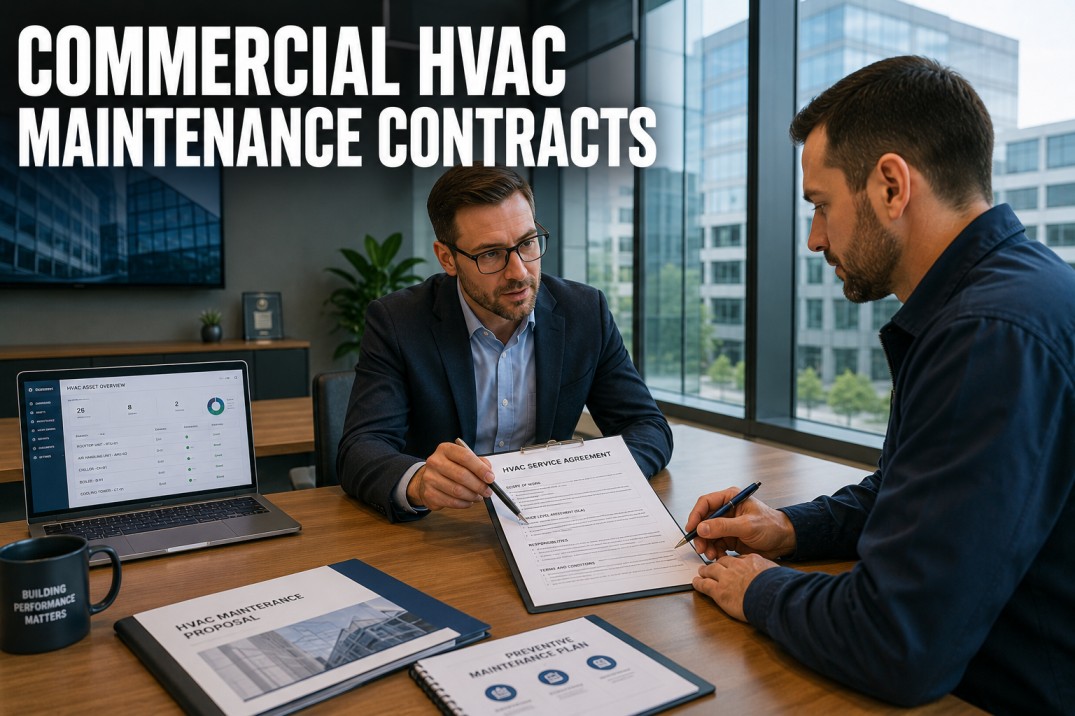
An HVAC analytics contract is the single most important document governing your relationship with service providers, defining what you pay, what you get, and what happens when things go wrong. Yet most facility managers sign standard contracts without negotiating terms that directly impact cost, coverage, and service quality. This guide covers every element of a commercial HVAC analytics contract: service level agreements, response times, parts and labor coverage, exclusions, performance guarantees, renewal terms, and negotiation strategies that save 15% to 25% while improving service outcomes.
Negotiate Smarter HVAC Contracts With Vendor Management Analytics
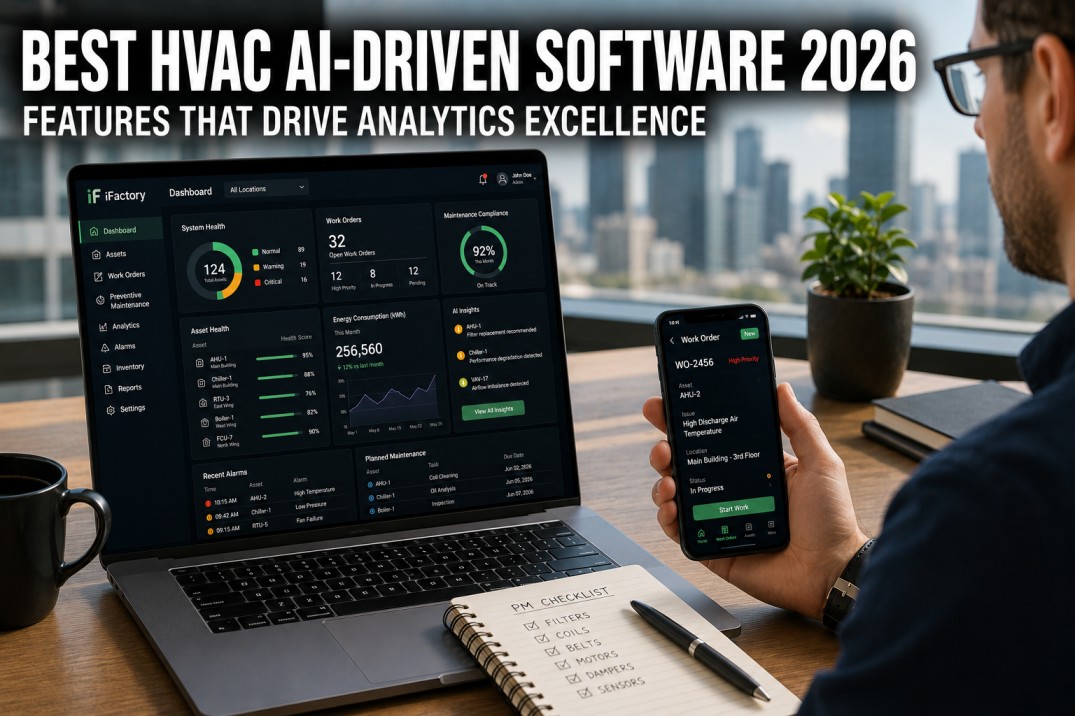
iFactory's Vendor Management module provides contract comparison tools, SLA tracking, cost benchmarking, and automated compliance monitoring. Book a demo to see how data-driven contract management saves 15-25% on service costs.
HVAC analytics Contract Types: Structure, Scope & Cost
Commercial HVAC analytics contracts fall into several categories, each with different coverage levels, pricing models, and risk allocation.
Full-Service (Comprehensive)
Includes all labor, parts, refrigerant, and emergency repairs for a fixed annual fee. Typical cost $8-15/ton/yr for RTUs, $12-20/ton/yr for chillers. Best for buildings without in-house maintenance staff. Covers 90-95% of repair costs but excludes code upgrades and modifications.
Labor-Only (Time & Materials)
Covers labor only; parts and refrigerant billed at markup. Annual fee $4-7/ton/yr plus T&M at $125-200/hr + 15-40% parts markup. Best when owner wants parts procurement control. Total annual cost varies 30-50% year to year depending on equipment age and condition.
Preventive-Only (Inspection Plans)
Covers scheduled inspections and basic PM tasks only. No emergency repairs or parts included. Cost $3-6/ton/yr. Best as base layer supplemented by T&M for repairs. Most common contract type covering 60% of commercial buildings.
Service Level Agreement Terms: Response Times, Penalties & Guarantees
SLA terms define the service quality you can expect and the remedies available when provider fails to meet commitments.
| SLA Element | Standard | Premium | Critical | Typical Penalty |
|---|---|---|---|---|
| Emergency Response | 4-8 hours | 2-4 hours | 1-2 hours | 25-50% credit per missed target |
| Standard Service | Next business day | Same day (by 5pm) | 4-hour window | No charge for trip |
| Parts Availability | Next day (<50 mi) | Same day | 4-hour expedite | Free expedite shipping |
| System Uptime Guarantee | 95% | 97% | 99% | 5-15% monthly credit per % below |
| First-Time Fix Rate | 75% | 85% | 90% | Credit equal to revisit cost |
| Reporting Frequency | Quarterly | Monthly | Weekly + real-time dashboard | 10% annual credit if delayed |
Track SLA Compliance and Avoid Hidden Costs
iFactory's platform monitors provider response times, first-time fix rates, and parts markup automatically. Catch SLA misses and billing errors before they cost you. Book a demo to see how automated vendor oversight protects your service investment.
Contract Negotiation: 10 Key Terms to Negotiate Before Signing
Standard contracts favor the provider. Negotiating these ten terms shifts the balance toward fair value.
1. Exclusions List
Every contract excludes something. Negotiate a complete list upfront, not discovered during a breakdown. Common hidden exclusions: code upgrades, equipment modifications, permits, duct repair, and controls programming.
2. Parts Markup Cap
Labor-only contracts allow 15-40% parts markup. Negotiate a hard cap at 20% or cost+10%. Verify markup applies to provider cost, not list price. Save $500-2K annually per 100K sq ft.
3. Overtime Waiver
Emergency after-hours rates: time-and-a-half or double time. Negotiate flat emergency rate 1.3x standard instead of 1.5-2x. Cap overtime at 1.5x and require pre-approval above that.
4. Annual Price Escalation
Most contracts auto-escalate 3-5%/yr. Negotiate fixed 2-3% cap or CPI-linked increase. Over 5 years, this saves 8-15% vs standard escalation. Lock in for multi-year term.
5. Material Change Clause
If codes, refrigerant regulations, or equipment configuration changes materially, contract should allow renegotiation rather than automatic pass-through. Protects against unexpected cost shifts.
6. Early Termination
Standard: 30-60 day notice without penalty. Negotiate 30-day for cause termination if SLA misses exceed 3 in 12 months. Avoid 12-month minimum term without performance-out clause.
7. Parts Inclusions
Negotiate major component list included: compressors, motors, VFDs, control boards, heat exchangers, coils. Exclusions should be only: ductwork, piping, building structure, and code upgrades.
8. Refrigerant Pricing
Most contracts exclude refrigerant or bill at market rate. Negotiate fixed $/lb for R-32/R-454B with annual adjustment capped at 10%. Avoid R-22 exposure entirely.
9. Documentation Rights
Contract should guarantee you own all inspection reports, diagnostic data, and equipment history generated during service. Data portability protects you when switching providers.
10. Renewal Notice
Standard: 60-90 day auto-renewal. Negotiate 30-day notice and automatic renegotiation at year 3 for multi-year terms. Prevents lock-in to outdated pricing or scope.
Contract Cost Benchmarks: What You Should Pay by Equipment Type
Understanding market rates for different equipment types and service levels prevents overpaying 20-40% on standard contracts.
Rooftop Units (RTU)
Full-service contract. Range depends on unit age, accessibility, and refrigerant type. Units under 10 tons at low end, over 50 tons at high end. Negotiate volume discounts at 20+ units.
Chillers
Full-service including eddy current tube testing, water treatment coordination, and purge unit maintenance. Centrifugal chillers at high end, screw/scroll at low end.
Air Handlers
Full-service per AHU. Includes filter changes, coil cleaning, belt replacement, motor maintenance, and controls verification. VAV boxes add $75-150/box/yr for damper service.
Boilers
Full-service including combustion analysis, heat exchanger inspection, burner maintenance, and safety device testing. Condensing boilers at high end due to condensate system maintenance.
Contract Red Flags: Terms That Signal Trouble
Certain contract terms indicate the provider is prioritizing their protection over your service outcomes.
Exclusions Hidden in Fine Print
If the contract says "all standard exclusions apply" without listing them, hidden costs will appear during breakdowns. Require explicit exclusion list. Common red flag phrases: "normal wear and tear excluded," "pre-existing conditions excluded," "code compliance excluded."
Vague Response Time Language
"Reasonable efforts," "best efforts," "as soon as practicable" are not measurable SLA commitments. Require defined hours: "4-hour response means technician on-site within 4 hours of call logged during business hours."
Automatic Renewal With Escalation
Contracts that auto-renew at 4-5% annual increase without performance review create 20-25% premium over 5 years. Negotiate renewal tied to CPI + 1% max with documented 95%+ SLA compliance required for any increase.
Frequently Asked Questions
What should be included in an HVAC analytics contract?
Every HVAC analytics contract should clearly define: covered equipment list with make, model, serial number, and location; scope of work including specific tasks per visit with frequencies; service level agreements with measurable response times and uptime guarantees; parts and labor coverage with explicit inclusion and exclusion lists; refrigerant pricing structure; overtime and emergency service rates; annual price escalation terms; termination and renewal conditions; reporting requirements; and data ownership provisions. Contracts lacking any of these elements leave room for disputes and unexpected costs during breakdowns. A well-structured contract covers 90-95% of expected service needs with transparent pricing.
How do I negotiate a better HVAC analytics contract?
Start by getting competitive quotes from 3-4 providers with identical scope of work to establish market pricing. Key negotiation leverage points: multi-year commitments (3-5 year terms typically get 10-15% discount), bundled equipment count (20+ units commands volume pricing), off-peak start dates (contracts starting in spring rather than summer get better rates), and reference to competitive bids. Specific terms to negotiate: parts markup cap at 20%, overtime rate at 1.3x instead of 1.5-2x, annual escalation capped at 3%, 30-day termination for cause, refrigerant pricing locked for first year, and ownership of all service documentation and diagnostic data.
What is a fair price for an HVAC analytics contract?
Fair pricing varies by equipment type, geographic region, and service level. National benchmarks: preventive-only contracts $3-6/ton/yr, labor-only $4-7/ton/yr, full-service $8-15/ton/yr for RTUs and $12-20/ton/yr for chillers. Pricing should decrease per ton as total tonnage increases: 50+ ton buildings should be at low end, under 20 ton at high end. Geographic adjustments: Northeast and West Coast 10-20% above national average, Southeast and Midwest 5-15% below. Always request line-item pricing separating PM labor, emergency labor rate, parts markup, and refrigerant to compare apples-to-apples across bids.
What are common hidden exclusions in HVAC contracts?
Hidden exclusions are the most common source of unexpected costs. Typical exclusions not listed on page one: duct cleaning and repair, piping and insulation, building management system controls programming, electrical panels and breakers, code-required upgrades, permits and inspections, crane or rigging for rooftop equipment, after-hours access fees if building requires escort, refrigerant disposal and recovery, and equipment modifications or retrofits. Request a complete exclusion list in writing before signing. Total uncovered costs from hidden exclusions average 15-25% of contract value annually.
How do I evaluate HVAC analytics contract quality?
Evaluate contracts against five criteria: completeness (covers all equipment and all expected failure modes), clarity (measurable SLAs with specific timeframes and penalties), fairness (balanced termination, escalation, and exclusion terms), transparency (line-item pricing, explicit parts markup, no hidden fees), and alignment (provider incentives match your outcomes through performance bonuses or guarantees). Request references from buildings of similar size and type, and ask those references specifically about contract disputes, hidden costs, and SLA compliance.
Compare, Negotiate, and Manage HVAC Contracts in One Platform
iFactory's Vendor Management delivers complete contract lifecycle management from RFP and bid comparison through SLA monitoring and renewal optimization. Book a demo to see how structured vendor management transforms service outcomes.