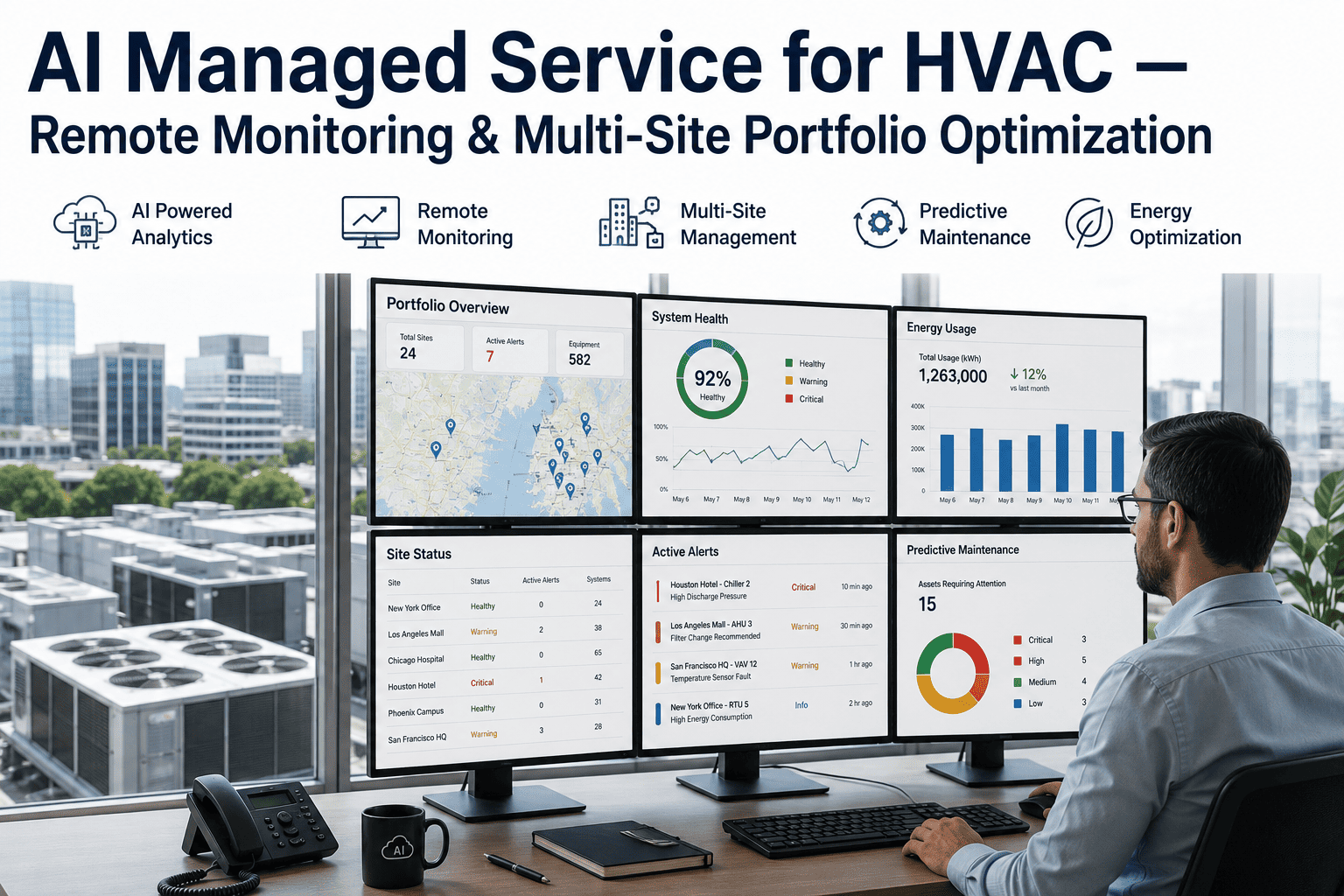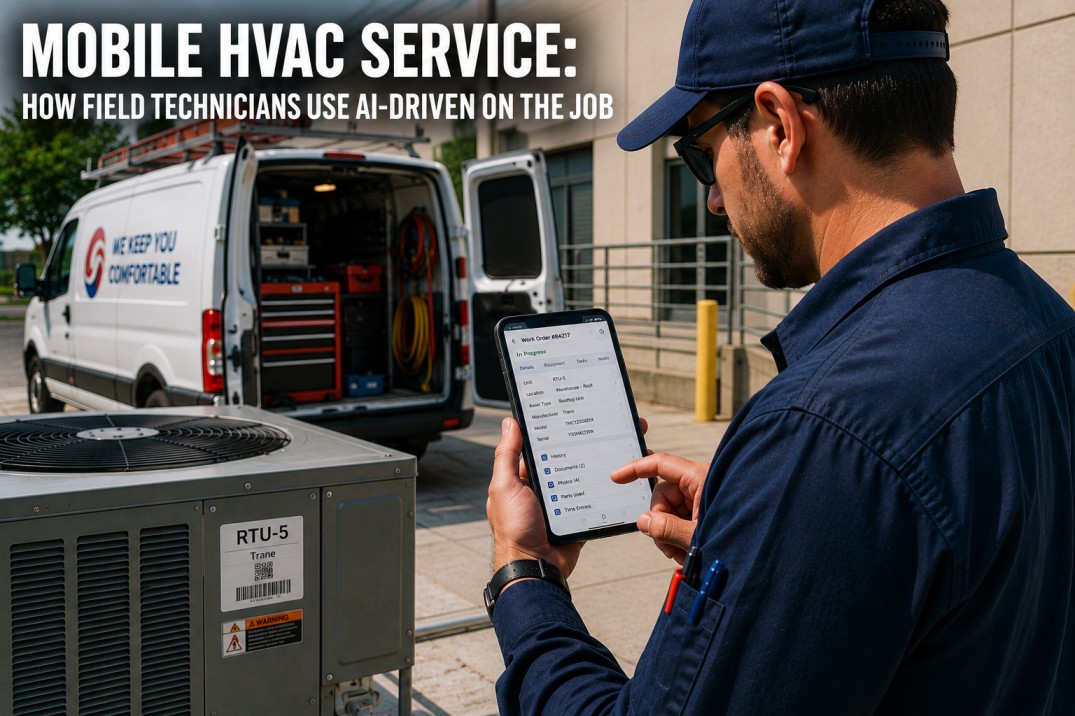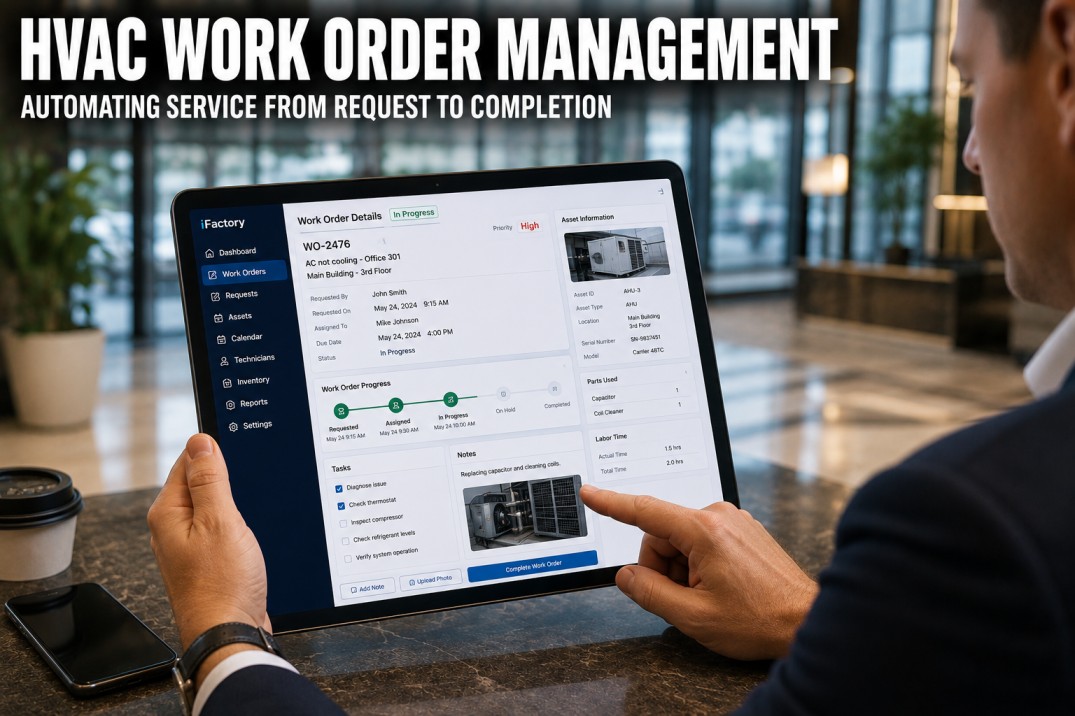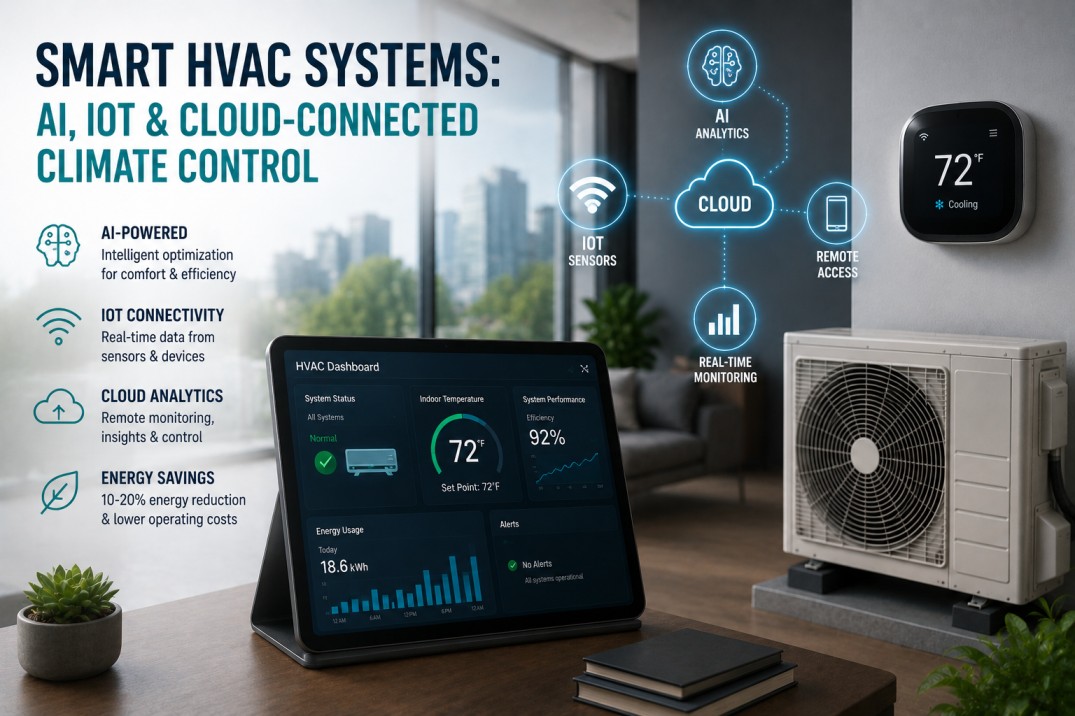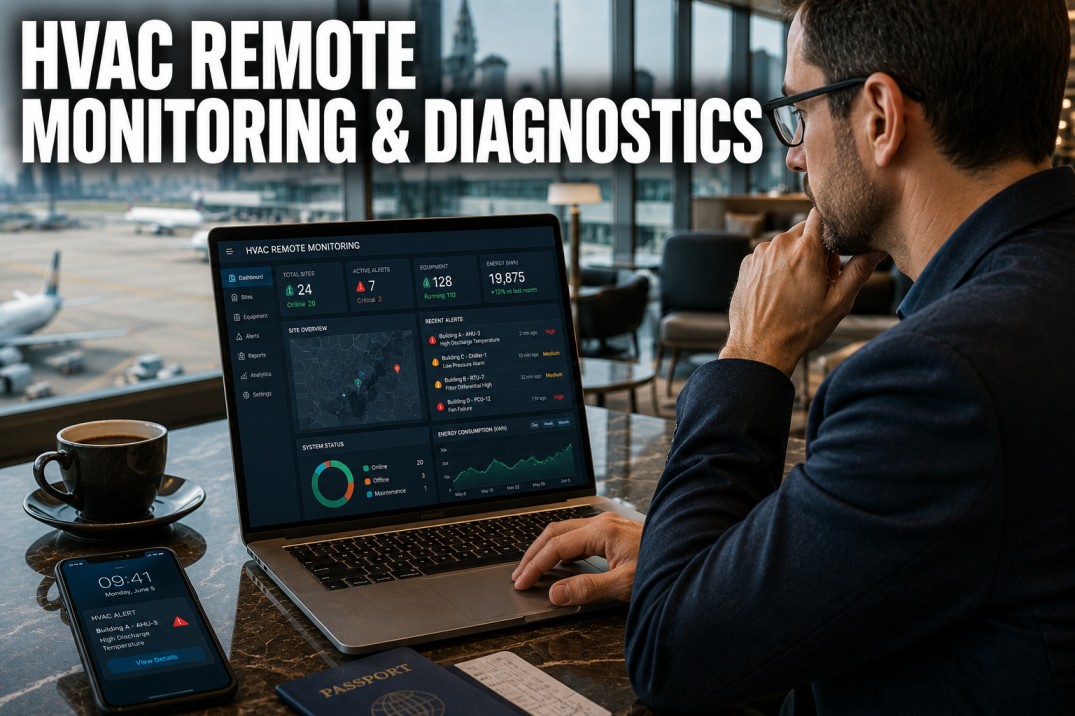
Remote HVAC monitoring and diagnostics transforms facilities management from a reactive, onsite operation into a proactive, data-driven function that operates from anywhere. By connecting HVAC equipment temperature sensors, vibration probes, pressure transmitters, current meters, and other IoT devices to a cloud-based analytics platform, facility teams can monitor equipment status in real time, receive automated alerts at the first sign of trouble, diagnose problems remotely without truck rolls, and optimize performance across an entire portfolio from a single dashboard.
Monitor All HVAC Assets Remotely From One Dashboard
iFactory's Remote Monitoring module provides comprehensive equipment monitoring with real-time dashboards, automated alerts, and remote diagnostics. Book a demo to see how remote visibility transforms facilities management.
Remote HVAC Monitoring Capabilities: What Modern Platforms Deliver
A comprehensive remote monitoring platform provides five core capabilities that replace manual inspection.
Real-Time Equipment Status
Live dashboard showing operating status (on/off/standby/fault), key readings (temp, pressure, amps), runtime, cycling count, and alarm status for every connected asset. Refresh rate: 30 seconds to 5 minutes.
Automated Alerting & Escalation
Configurable alerts based on thresholds, rates of change, and patterns. Multi-channel delivery: email, SMS, app push, API. Escalation chain: first responder, supervisor, manager at 15/30/60 min intervals.
Remote Diagnostics & Troubleshooting
Full access to live and historical trend data enabling remote root cause analysis. Compare current operation to baseline. Fewer than 30% of FDD alerts require onsite inspection.
Performance Analytics & Reporting
Daily/Weekly/Monthly automated reports: efficiency trends, fault history, runtime analysis, energy consumption, savings. Benchmark against similar equipment and buildings.
Technology Stack: Sensors, Gateways, Cloud & Dashboard
End-to-end remote monitoring requires reliably connected hardware and software components.
| Component | Function | Options | Cost Range | Key Consideration |
|---|---|---|---|---|
| IoT Sensors | Measure equipment parameters | Temp, vibration, pressure, current | $50-500/point | Accuracy vs cost tradeoff |
| Gateway | Collect sensor data, transmit to cloud | Cellular, Ethernet, WiFi, LoRaWAN | $200-2,000 | Site connectivity availability |
| Cloud Platform | Store, process, analyze sensor data | AWS, Azure, private; monthly per-sensor or sq ft | $0.02-0.10/sq ft/yr | Data retention, security certs |
| Dashboard UI | Visualize data, alerts, analytics | Web + mobile app | Included in platform | Mobile critical for remote response |
Stop HVAC Emergencies With Remote Monitoring
iFactory's platform catches developing faults 4-12 weeks before failure, enabling planned repairs instead of emergency breakdowns. Book a demo to see how remote monitoring prevents the most expensive HVAC problems.
Remote Monitoring Use Cases: Solving Real HVAC Problems
Each use case addresses a specific operational challenge with measurable outcomes.
Multi-Site Portfolio Management
Chains of retail, restaurants, banks with 50-5,000 small HVAC units. Challenge: no onsite engineers. Solution: remote monitoring of all units with automated alerts. Result: 40-60% fewer emergency calls, 20-30% energy reduction.
Critical Environment Monitoring
Server rooms, labs, clean rooms, data centers. Challenge: any temperature excursion damages operations. Solution: multi-layer redundant temp/humidity sensors with immediate alerting. Result: 99.99% uptime, zero excursions.
Seasonal Equipment Readiness
Chillers and cooling towers started after winter. Challenge: shutdown failures discovered during commissioning. Solution: remote monitoring year-round with automated readiness checks. Result: 90% fewer startup failures.
Remote Monitoring Deployment: Step-by-Step Implementation
Phased deployment minimizes disruption and builds operational confidence.
Remote Monitoring Deployment Checklist
- Audit equipment inventory: identify critical HVAC assets to monitor
- Assess connectivity: verify cellular/WiFi/Ethernet coverage at each site
- Select sensor package: minimum viable sensors for each equipment type
- Order and stage hardware: pre-configure gateways and sensors before site visit
- Install sensors on critical equipment during one intensive site visit per facility
- Configure cloud platform: set up points, thresholds, alerts, escalation chains
- Calibrate alert thresholds: adjust from defaults to site-specific values over 2 weeks
- Train facility team: dashboard navigation, alert response, remote diagnostic procedures
- Go-live with 2-week shadow period: remote monitoring operational but maintenance team still does rounds
- Measure baseline: track alerts, response times, truck rolls, energy for month one
Remote Monitoring ROI: Measurable Savings and Benefits
ROI comes from reduced truck rolls, faster response, energy savings, and avoided failures.
Truck Roll Reduction
Remote diagnostics resolves 40-70% of issues without onsite visit. Average truck roll cost: $150-400. Labor saved: 2-6 hours per avoided dispatch. Annual savings: $5K-30K per 100K sq ft.
Faster Response Time
From 24-72 hours for manual discovery to 15-60 minutes for automated alert. Mission-critical: under 5 minutes. Impact: 50-70% reduction in complaint duration, 80% fewer escalation incidents.
Energy Optimization
Continuous monitoring enables: schedule optimization 5-12%, setpoint reset 3-7%, fault correction 5-10%. Combined: $0.10-0.40/sq ft/yr.
Equipment Life Extension
Early detection of abnormal operation (compressor short-cycling, high discharge temp, vibration spikes) enables intervention before major damage. Deferred capital expenditure: $50K-200K per 250K sq ft.
Frequently Asked Questions
What is remote HVAC monitoring?
Remote HVAC monitoring uses IoT sensors, gateways, and cloud software to continuously track equipment operation without requiring onsite presence. Sensors measure temperature, pressure, vibration, current, and other parameters, transmitting data to a cloud dashboard accessible via web or mobile. Alerts notify staff of developing problems. Remote diagnostics enable troubleshooting without truck rolls.
What equipment can be remotely monitored for HVAC?
Any with measurable parameters: RTUs, air handlers, chillers, boilers, cooling towers, VAV boxes, heat pumps, split systems, mini-splits, CRAC units, exhaust fans, pumps, compressors. Required sensors per equipment: temperature (all), pressure (chillers, filters, ductwork), vibration (rotating), current (compressors, fans), flow (water systems).
How much does remote HVAC monitoring cost?
Sensor + installation: $200-1,000 per point. Gateway: $500-2,000 one-time. Cloud platform: $0.02-0.10/sq ft/yr or $10-50/asset/mo. Total year-1 for 100K sq ft: $15K-50K. Annual recurring: $3K-10K. Payback: 8-16 months from reduced truck rolls and energy savings.
Can remote monitoring integrate with my existing systems?
Yes, through BACnet/IP, Modbus, API, or IoT gateways bridging any protocol. Existing BMS data can supplement dedicated IoT sensors. Most platforms offer: direct BMS connection for trend data, add-on IoT sensors for coverage gaps, combined approach for optimal coverage at lowest cost.
How do I start with remote HVAC monitoring?
Start small: select 5 critical units, deploy minimum sensor package (temp + current), connect to cloud, configure basic alerts. Run 4-8 week pilot. Measure: alerts generated, issues caught before failure, energy changes. Expand to remaining assets. Annual contract preferred to month-to-month.
Monitor, Diagnose, and Optimize HVAC Remotely
iFactory's Remote Monitoring delivers end-to-end IoT sensor connectivity, cloud analytics, and mobile dashboard access. Book a demo to see how remote HVAC management saves time and money.