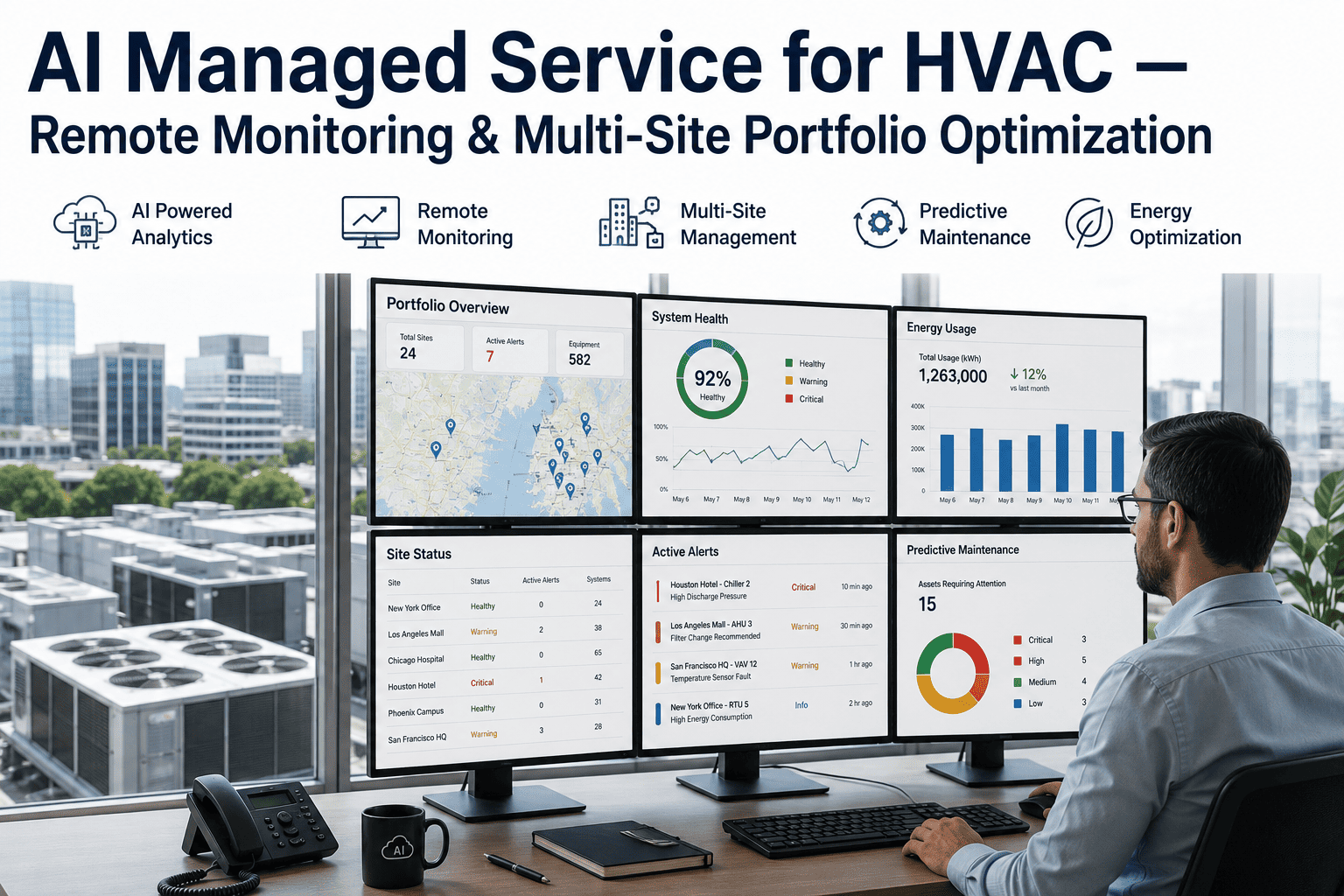
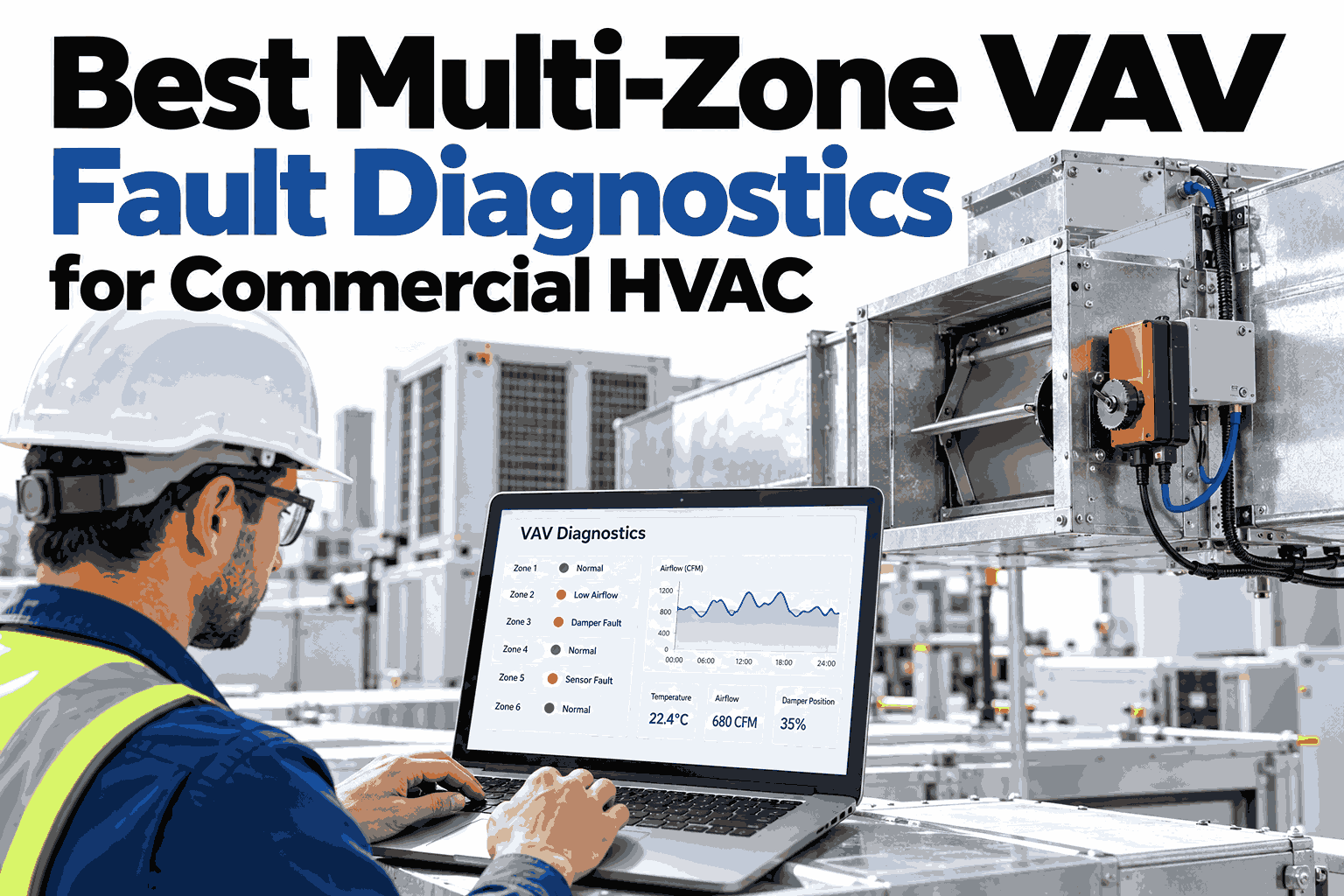
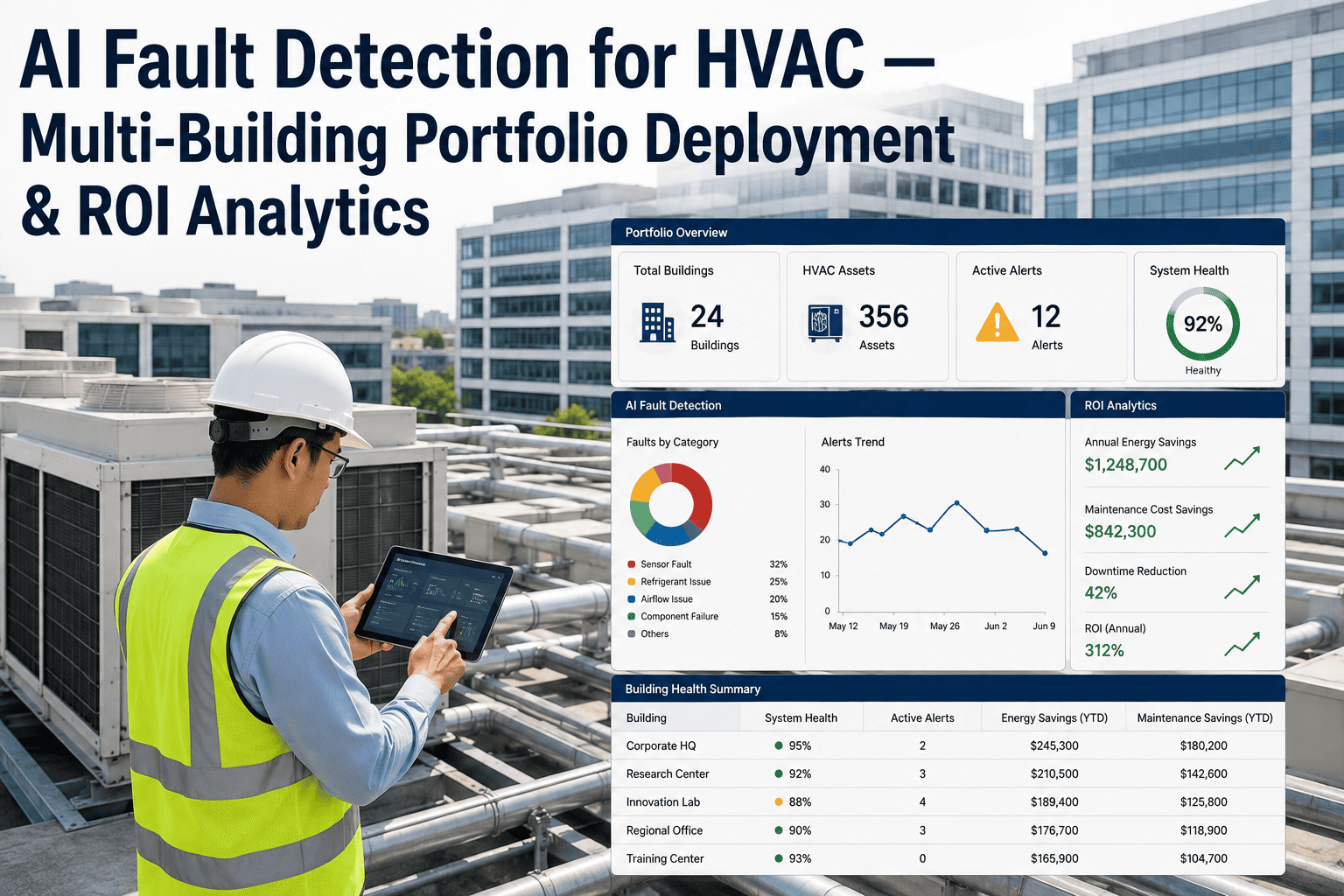
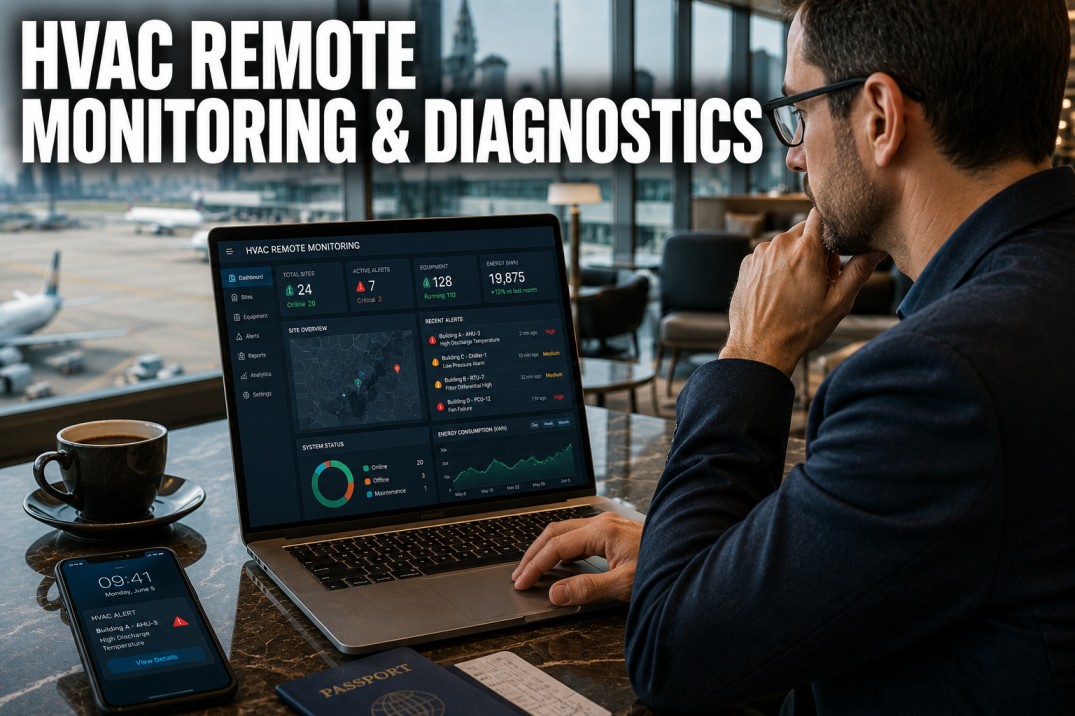
Most operations directors managing a multi-site HVAC portfolio did not sign up to run a data science team. Yet that is effectively what building an in-house predictive maintenance program requires — sensor selection, model training, alert tuning, and a dashboard someone has to watch at 2 a.m. when a chiller trips at a facility four time zones away. AI as a managed service exists precisely to remove that burden, giving a portfolio the same fault-detection intelligence without the headcount, without the model-building, and without the 24/7 monitoring desk a facilities team would otherwise have to staff itself. To see how a managed deployment would map onto your own site count, book a demo.
MANAGED AI · PORTFOLIO-WIDE COVERAGE
AI Managed Service for HVAC: Remote Monitoring Without the Analytics Team
Continuous fault detection, remote diagnostics, and portfolio-wide optimization delivered as a managed service — so operations directors get predictive HVAC intelligence without hiring data scientists or building an internal monitoring desk.
WHY "MANAGED" CHANGES THE ECONOMICS
Owning the Model vs. Renting the Outcome
A portfolio that tries to build predictive maintenance in-house typically underestimates three costs at once: the engineering time to instrument every site consistently, the ongoing tuning a fault-detection model needs as equipment ages, and the staffing required to actually respond when an alert fires outside business hours. A managed service absorbs all three, and the operations director's team is left doing what it does best — deciding what to fix, not building the system that tells them what needs fixing.
Build In-House
SlowMonths of sensor deployment and model training before the first useful alert
FragileModel accuracy depends on internal expertise that may leave with the analyst
UnstaffedNights, weekends, and holidays typically go unmonitored unless a rotation is built
AI Managed Service
FastSites onboard in weeks using standardized retrofit sensor kits, not custom builds
MaintainedModels are retrained and tuned continuously by the service provider, not your team
Always On24/7 remote monitoring desk triages alerts before they ever reach your team's inbox
HOW THE MANAGED LAYER WORKS
From Sensor Signal to Site-Level Action
The managed model works because the heavy lifting happens once, centrally, and gets applied consistently across every site in the portfolio rather than reinvented site by site. A signal generated by a rooftop unit in one region is evaluated against the same fault library as a signal from a chiller plant three states away, which is exactly the consistency an internal, site-by-site approach struggles to maintain.
1
Continuous Signal Collection
Vibration, current draw, refrigerant pressure, and temperature differential data streams continuously from retrofit sensors at each site.
2
Centralized Fault Detection
A shared fault-detection model, trained across the provider's full customer base, scores anomalies against known failure signatures.
3
Remote Triage Desk
A monitoring desk reviews flagged anomalies, filters false positives, and escalates only what genuinely needs a technician's attention.
4
Site-Level Work Order
A prioritized, diagnosed work order reaches the local facilities team or contracted technician, with the suspected root cause attached.
See the Managed Model Applied to Your Portfolio
Bring your site count, equipment mix, and current maintenance spend — we'll map what a managed deployment would look like before you commit to anything.
PORTFOLIO SCALE COMPARISON
What Changes as a Portfolio Grows Past a Single Site
The value of a managed layer compounds with portfolio size, because the fixed cost of building and maintaining a monitoring capability gets spread across every additional site rather than duplicated at each one.
| Portfolio Size | Single-Site DIY Monitoring | Managed Service Approach | Typical Onboarding Time |
|---|
| 1–5 sites | Feasible but labor-heavy per site | Standardized sensor kit, shared dashboard | 2–4 weeks |
| 6–20 sites | Requires a dedicated internal analyst | Central triage desk absorbs alert volume | 4–8 weeks phased |
| 21–75 sites | Typically breaks down without added headcount | Regional rollout with portfolio-wide benchmarking | 2–4 months phased |
| 75+ sites | Rarely sustained without a dedicated team | Enterprise account structure with SLA-backed response | Ongoing rolling rollout |
WHAT REMOTE MONITORING ACTUALLY CATCHES
The Fault Categories a 24/7 Desk Is Built to Find
Remote monitoring is only as useful as the specific failure modes it is tuned to catch. A managed service worth paying for should be explicit about what it covers, since generic anomaly detection without fault-specific tuning tends to produce alert fatigue rather than useful diagnosis.
Compressor Short-Cycling
Detected through current draw and cycle-frequency patterns before it shortens compressor lifespan.
Refrigerant Undercharge
Pressure and superheat deviations flagged well before efficiency loss becomes visible on a utility bill.
Airflow Restriction
Static pressure trends catch clogged filters or coil fouling before comfort complaints start.
Sensor and Control Drift
Thermostat and sensor calibration drift identified before it drives simultaneous heating and cooling.
Belt and Bearing Wear
Vibration signatures flag mechanical wear on fans and motors ahead of a failure event.
Economizer Malfunction
Damper position versus outdoor air conditions reveals economizers stuck open or closed, a common silent energy loss.
WHAT A MANAGED CONTRACT SHOULD INCLUDE
Questions Worth Asking Before You Sign
Not every "AI managed service" offer covers the same scope, and the gaps tend to surface only after a portfolio is already dependent on the service. Operations directors evaluating vendors should treat the following as a minimum checklist rather than nice-to-haves.
✓Is monitoring genuinely 24/7, or does coverage narrow to business hours after onboarding?
✓Are alerts triaged by a human before reaching your team, or is it raw model output?
✓Does the contract include model retraining as equipment ages, or is that a separate fee?
✓Can the provider benchmark your sites against comparable buildings in their broader customer base?
✓What is the guaranteed response time from alert to work order, in writing?
FREQUENTLY ASKED QUESTIONS
What Operations Directors Ask Before Switching to a Managed Model
Do we lose visibility into our own equipment if monitoring is handled by a third party?
No, a properly structured managed service gives your team a live dashboard with the same underlying data the monitoring desk sees, plus the diagnosed work orders once an issue is triaged. The difference is that your team is no longer responsible for staffing the 2 a.m. shift or tuning the detection models yourself.
Contact our support team to see what the portfolio dashboard actually looks like.
How long does onboarding take for a portfolio with sites in different regions?
As the scale comparison above shows, a small portfolio of a handful of sites can onboard in two to four weeks, while a larger multi-region portfolio is typically rolled out in phases over several months so each site's sensor kit and baseline can be validated before the next batch begins.
Book a demo to get a phased rollout timeline specific to your site list.
What happens if the AI flags something and it turns out to be a false alarm?
False positives are filtered by the remote triage desk before they ever become a work order, and every flagged-but-dismissed anomaly still feeds back into the model to improve future accuracy for your specific equipment. This human-in-the-loop step is exactly what separates a managed service from raw automated alerting that floods a team's inbox.
Reach out to support for details on the triage process.
Can the managed service integrate with our existing building management system?
Retrofit sensor kits are engineered to layer on top of existing BMS infrastructure rather than replace it, pulling additional signal where the existing system lacks resolution and cross-referencing setpoint data the BMS already tracks. This means a managed rollout rarely requires ripping out or replacing controls infrastructure already in place.
Book a demo to check compatibility with your current BMS platform.
READY WHEN YOUR PORTFOLIO IS
Get Portfolio-Wide HVAC Intelligence Without Building the Team Yourself
iFactory's managed AI layer handles the monitoring, the triage, and the model tuning — your team gets the diagnosed work order, not the 2 a.m. pager.