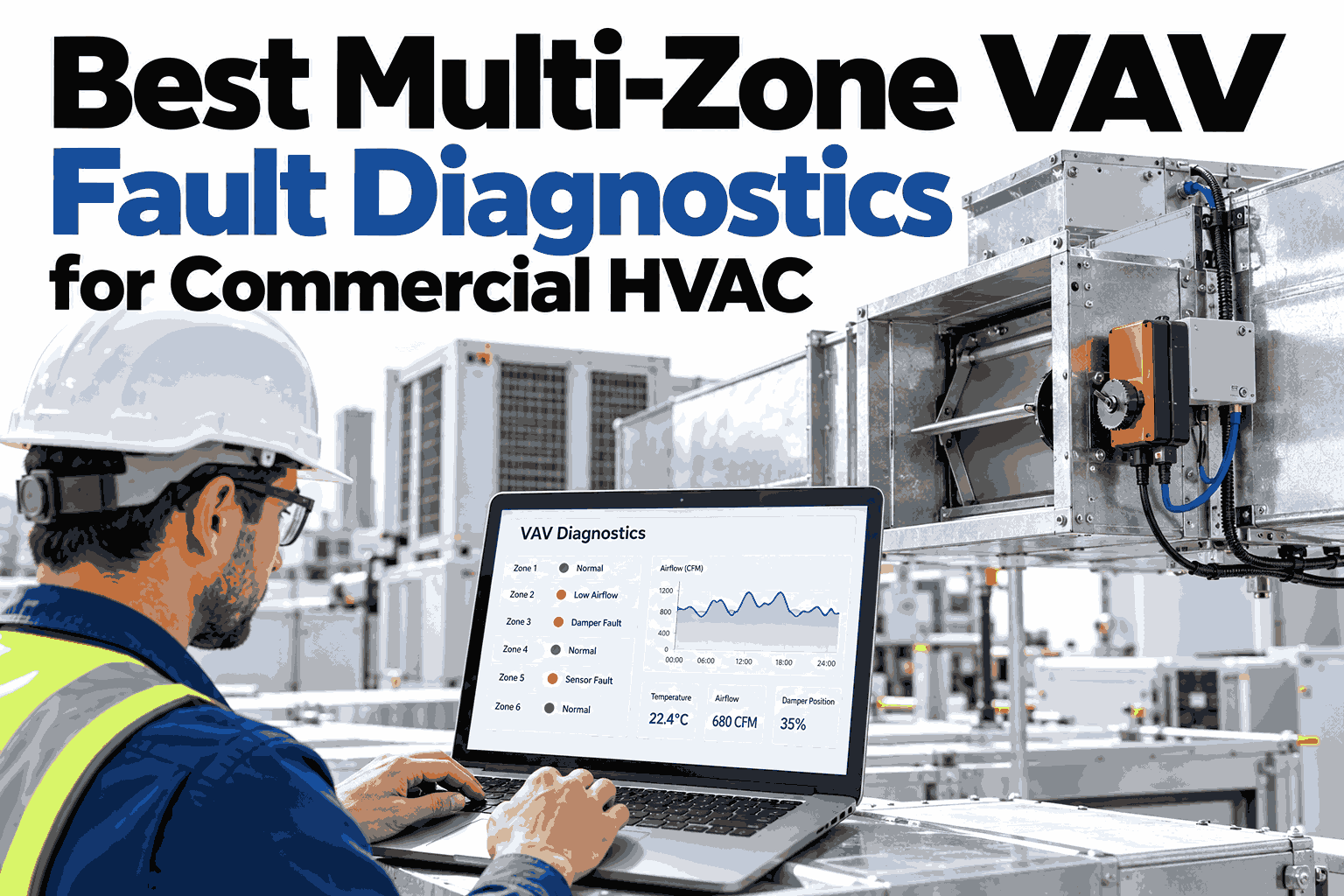
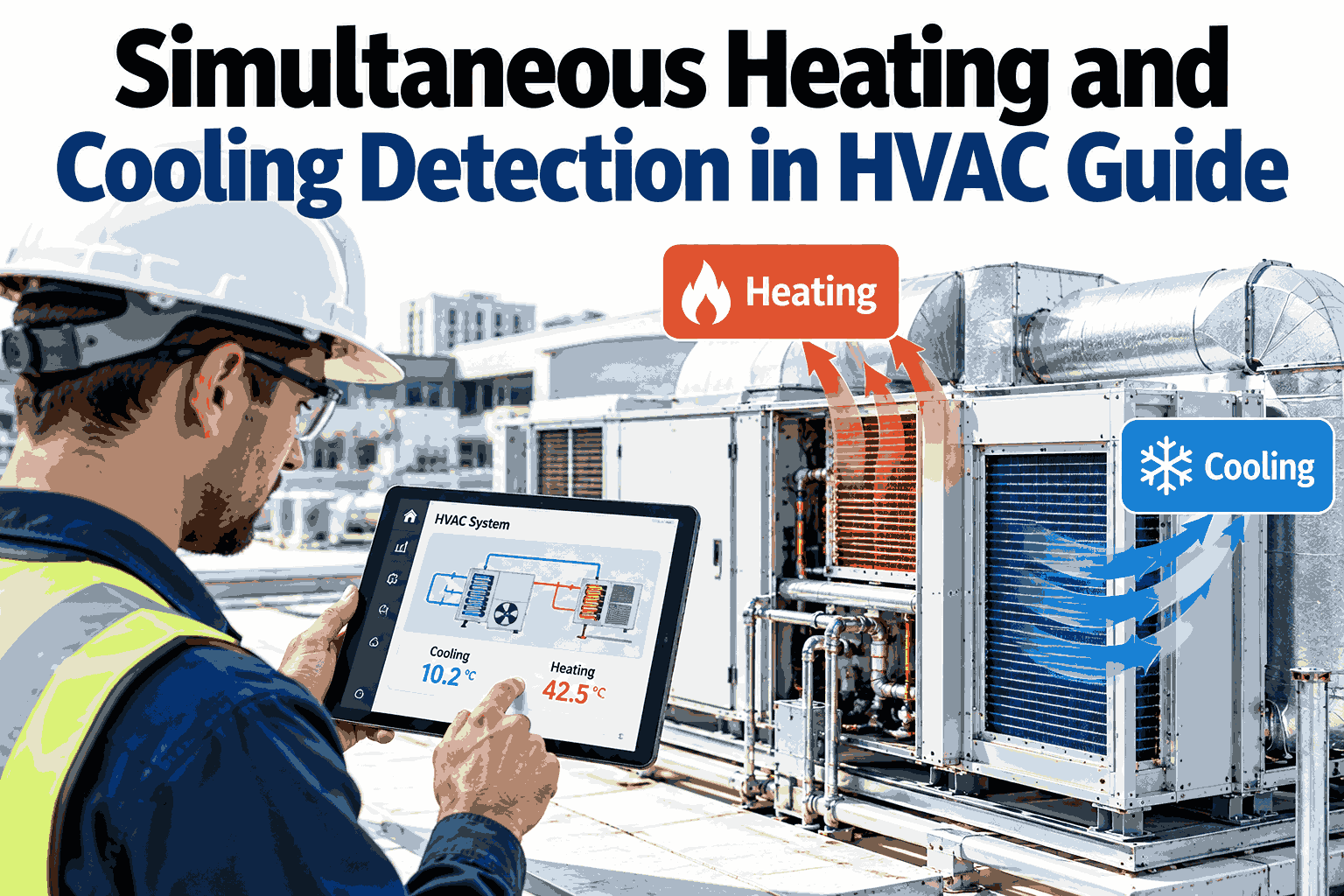
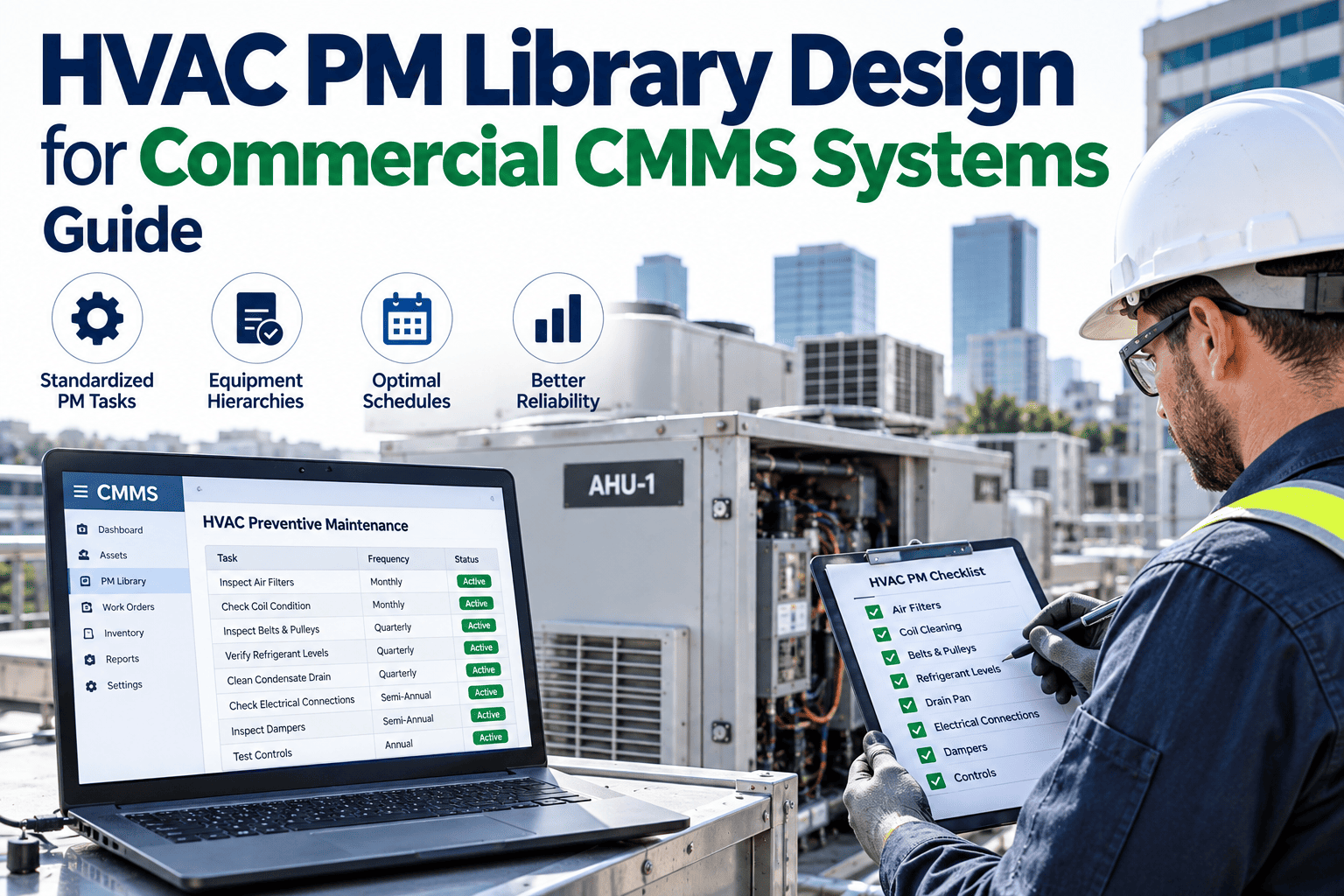
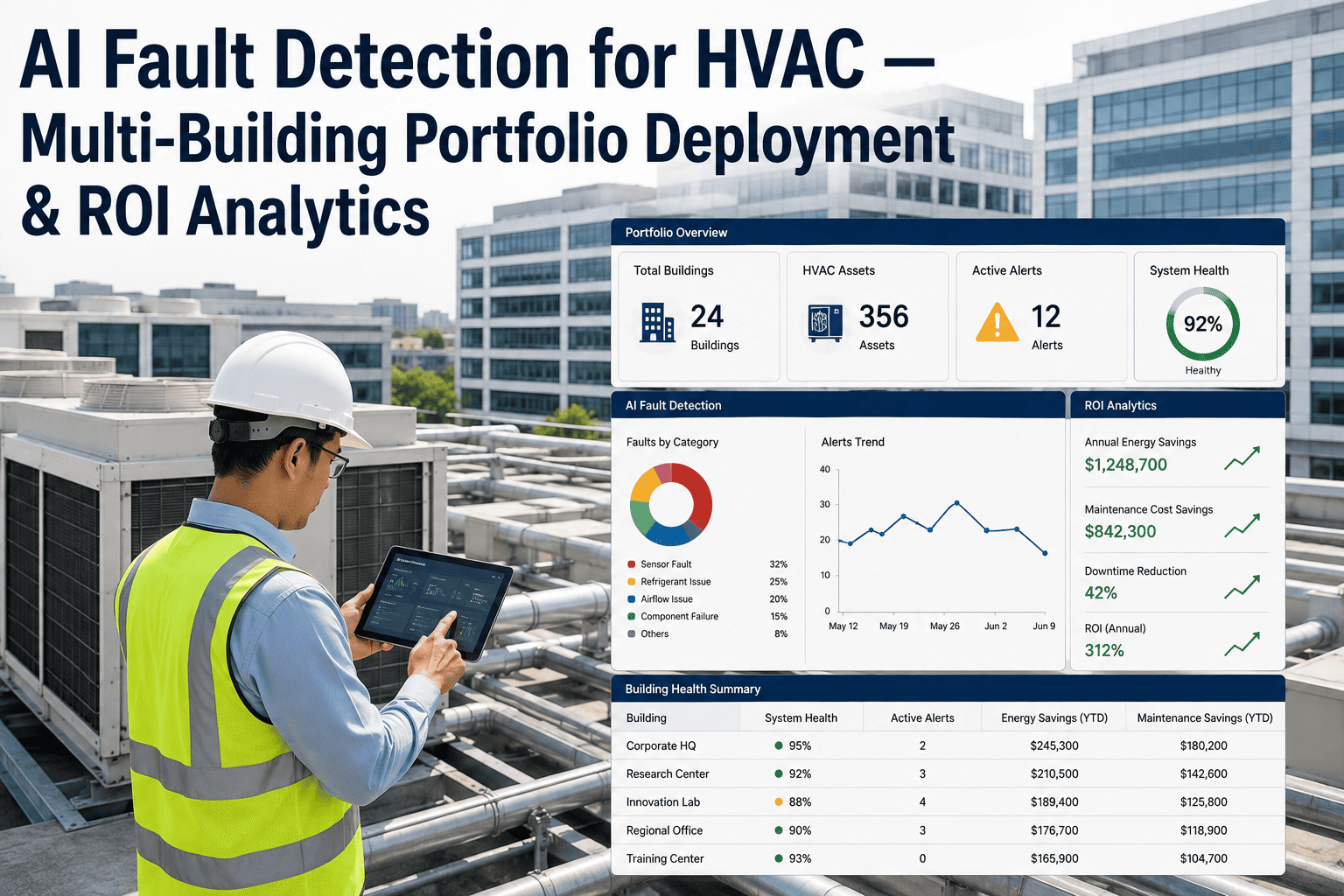
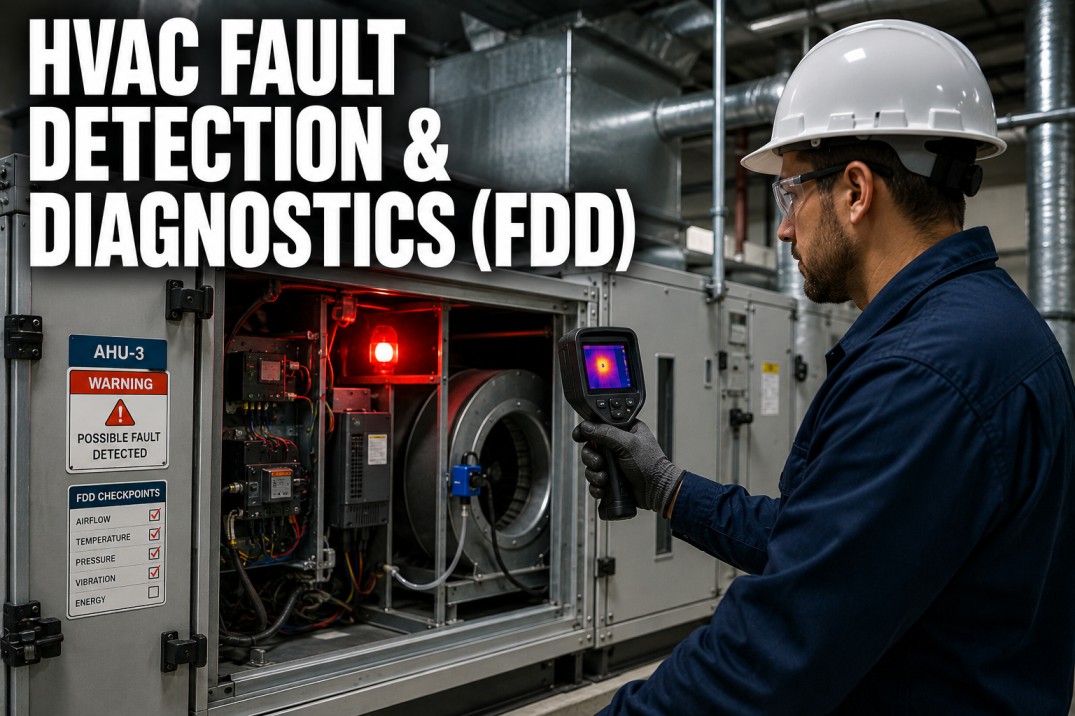
Commercial HVAC systems account for over 40% of total building energy consumption — and up to 30% of that energy is wasted due to operational faults that go undetected for months or years. Stuck dampers, simultaneous heating and cooling, drifting sensors, overridden controls, and inefficient scheduling silently drain budgets while degrading occupant comfort and accelerating equipment failure. Research across 60,000+ pieces of commercial HVAC equipment found that 21 distinct air handling unit faults were present in 20% or more of systems studied — proving that faults are not edge cases but the norm. In 2026, AI-powered Fault Detection and Diagnostics (FDD) platforms using machine learning, IoT sensor analytics, and BAS integration are transforming how commercial buildings identify, diagnose, and eliminate HVAC inefficiencies — delivering 10–30% energy savings with two-year payback periods. iFactory's AI-powered FDD platform brings this intelligence to your building portfolio. Book a free FDD consultation and discover how AI diagnostics can cut your HVAC energy waste, reduce maintenance costs, and protect occupant comfort.
AI Fault Detection and Diagnostics (FDD) for Commercial HVAC Systems
Detect. Diagnose. Optimize.
Commercial buildings waste billions annually on HVAC faults invisible to traditional maintenance — stuck dampers, sensor drift, simultaneous heating and cooling, control overrides, and scheduling errors that compound into massive energy losses. iFactory's AI-powered FDD platform continuously analyzes your Building Automation System data, applies machine learning models trained on real-world fault patterns, and delivers prioritized, actionable diagnostics that quantify the energy and cost impact of every fault — transforming reactive maintenance into proactive building intelligence.
Commercial Buildings
AI-Powered FDD
for FDD Investment
The Faults Silently Draining Your HVAC Budget
Most commercial HVAC faults are invisible to building operators — they don't trigger alarms, don't cause immediate breakdowns, but compound into massive energy waste, accelerated equipment degradation, and occupant comfort complaints.
How iFactory's AI-Powered FDD Platform Works
A continuous monitoring and diagnostics engine that connects to your Building Automation System, applies machine learning to real-time operational data, and delivers prioritized, cost-quantified fault alerts with actionable repair guidance.
Deploying AI-Powered FDD — Phase by Phase
Our proven 6-phase deployment framework transforms your HVAC operations from reactive service calls to continuous, AI-driven fault intelligence. Schedule a demo to get a rollout plan tailored to your building portfolio.
Building Systems Audit & BAS Assessment
We inventory every AHU, RTU, chiller, boiler, VAV box, fan coil unit, and control system across your portfolio — mapping BAS protocols, available data points, sensor coverage, and existing control sequences. This audit establishes the data foundation for accurate AI fault models and identifies immediate quick-win opportunities.
BAS Connection, Data Pipeline & Cleansing
Connect iFactory to your Building Automation System through BACnet, Modbus, Niagara, or API protocols. Establish continuous data feeds from all HVAC equipment points — temperatures, pressures, valve positions, damper states, VFD speeds, occupancy signals, and energy meters. Automated data cleansing handles missing values, outliers, and sensor inconsistencies.
Normal Operation Learning & Fault Library Configuration
AI models learn the normal operating patterns of every piece of equipment — accounting for weather, occupancy, scheduling, and seasonal variations. Simultaneously configure the fault library covering 90+ HVAC fault types including simultaneous heating/cooling, stuck dampers, sensor drift, VFD faults, economizer failures, and control sequence deviations from ASHRAE Guideline 36.
Continuous Monitoring, Anomaly Detection & Root Cause AI
The FDD engine goes live — continuously scanning thousands of data points across your HVAC systems, detecting operational anomalies, classifying fault types, identifying root causes, and quantifying the energy and cost impact of every fault. Each diagnostic includes severity rating, affected equipment, estimated annual energy waste, and recommended corrective action.
Alert Tuning, False Alarm Reduction & CMMS Integration
Calibrate alert thresholds to eliminate false positives while ensuring no genuine fault goes undetected. Integrate with your CMMS for automated work order generation. Train facilities teams on dashboard navigation, fault prioritization, and the diagnostic workflow that transforms raw alerts into resolved efficiency gains.
Portfolio Expansion, Benchmarking & Continuous Improvement
Roll out FDD across additional buildings and sites with standardized fault libraries and performance benchmarks. Portfolio-level dashboards compare fault rates, energy performance, and resolution metrics across all properties — enabling data-driven capital planning, vendor accountability, and continuous commissioning at scale.
The Business Case for AI-Powered HVAC FDD
Research across thousands of commercial buildings proves that FDD is one of the most cost-effective energy efficiency investments available — delivering measurable savings with rapid payback.
| Performance Metric | Without FDD | With AI FDD | Improvement |
|---|---|---|---|
| Energy Waste | Up to 30% of building energy wasted | 10–30% energy savings achieved | 10–30% reduction |
| Fault Detection | Manual — faults persist for months | Continuous — detected within hours | Real-time awareness |
| Diagnostics | On-site troubleshooting required | AI root cause + repair guidance | Faster resolution |
| Maintenance Approach | Reactive service calls | Proactive, prioritized by cost impact | Proactive operations |
| Occupant Comfort | Complaints drive awareness | Issues detected before complaints | Fewer complaints |
| Investment Payback | N/A | 2-year median simple payback | Rapid ROI |
With two-year payback periods and immediate comfort improvements, the question isn't whether to deploy FDD — it's how fast. Schedule your free FDD assessment now
From BAS Connection to Continuous Intelligence — Phases & Deliverables
A commercial HVAC FDD deployment runs 4–8 weeks from initial BAS assessment to full fault monitoring. Book a consultation to scope a timeline for your portfolio.
| Phase | Focus Area | Timeline | Key Deliverables | Value Unlocked |
|---|---|---|---|---|
| 01 Discovery | BAS audit, data point mapping | 3–5 days | System inventory, data assessment | Data foundation |
| 02 Integration | BAS connection, data pipeline | 1–2 weeks | Live data feeds, clean pipeline | Visibility |
| 03 Baseline | Normal operation learning | 2–3 weeks | Trained models, fault library | Intelligence foundation |
| 04 Detection | Continuous monitoring, AI FDD | Ongoing | Prioritized fault alerts | Energy savings |
| 05 Optimization | Alert tuning, CMMS integration | 1–2 weeks | Tuned thresholds, workflows | Team adoption |
| 06 Scale | Portfolio expansion | Ongoing | Multi-site dashboards | Portfolio intelligence |
Traditional Maintenance vs. AI-Powered HVAC FDD
Built for Commercial HVAC — Not Retrofitted From Industrial
iFactory's FDD platform is purpose-built for the complexity of commercial building HVAC — where dozens of interdependent systems, varying occupancy, and seasonal dynamics create unique diagnostic challenges. See it in action
90+ Fault Type Library
Pre-configured detection rules and ML models covering every common HVAC fault — simultaneous heating/cooling, stuck or hunting dampers, sensor drift and failure, VFD faults, economizer failures, valve leakage, coil fouling, control sequence deviations, scheduling errors, and override detection. Each fault type includes energy impact quantification and repair guidance.
Self-Training AI Models
Adaptable machine learning models that learn the unique operating patterns of each building — automatically accounting for weather, occupancy, equipment age, and seasonal variations without requiring manual configuration. Models improve continuously with every data point, reducing false alarms while increasing detection accuracy over time.
Cost-Quantified Diagnostics
Every fault alert includes the estimated annual energy cost — not just a description of the problem. Facilities teams can prioritize repairs by financial impact, build data-driven business cases for corrective action, and track cumulative savings as faults are resolved. This transforms FDD from a technical tool into a financial management platform.
Multi-Site Portfolio Intelligence
Manage dozens or hundreds of buildings from a single dashboard — comparing fault rates, energy performance, resolution metrics, and technician productivity across your entire portfolio. Standardize fault libraries and KPIs across properties, benchmark performance between buildings, and identify systemic issues affecting multiple sites simultaneously.
HVAC Systems & Equipment Monitored by iFactory FDD
iFactory monitors every HVAC system type found in commercial buildings — from rooftop units to complex chiller plants. Schedule a demo to see coverage mapped to your building types.
The HVAC Faults AI-Powered FDD Detects and Resolves
Each fault type has unique signatures, energy impacts, and root causes. Here's how iFactory's AI addresses the most prevalent and costly commercial HVAC faults.
The Financial Impact of AI-Powered HVAC FDD
FDD has been demonstrated as one of the most cost-effective energy efficiency investments in commercial buildings — with documented savings and rapid payback periods across multiple building types.
| Savings Category | Without FDD | With iFactory FDD | Annual Impact |
|---|---|---|---|
| HVAC Energy Savings | Baseline consumption with hidden waste | 10–30% reduction from fault resolution | 10–30% energy savings |
| Maintenance Efficiency | Reactive truck rolls, wasted labor | Targeted repairs with AI diagnostics | 20–40% fewer service calls |
| Equipment Lifespan | Accelerated wear from running faults | Faults resolved before damage compounds | 15–25% extended life |
| Occupant Comfort | Complaints drive awareness of issues | Issues detected before occupants notice | Fewer complaints |
| Compliance & Reporting | Periodic manual audits | Continuous ASHRAE 36 verification | Audit-ready data |
For a 500-location portfolio, even a 5% energy reduction delivers a seven-figure annual impact. Get your custom FDD ROI analysis
AI-Powered HVAC FDD — Questions Answered
What is Fault Detection and Diagnostics (FDD) for HVAC?
FDD is an automated system that continuously monitors HVAC operational data, identifies equipment faults and control problems, diagnoses root causes, and provides actionable guidance for correction. Unlike traditional BAS alarms that only flag gross failures, AI-powered FDD detects the subtle operational anomalies — sensor drift, stuck dampers, simultaneous heating/cooling, scheduling errors — that waste enormous energy without triggering alarms. Research shows FDD users achieve 10% median annual energy savings with a two-year payback period. Book a free demo to see how AI FDD transforms your HVAC operations.
How does AI-powered FDD differ from rule-based FDD?
Traditional rule-based FDD uses static expert rules (if/then logic) that require extensive manual configuration and often miss complex multi-fault scenarios. AI-powered FDD uses machine learning to automatically learn each building's unique operating patterns, detect subtle anomalies invisible to rule-based systems, and improve accuracy continuously over time. AI models also require less a priori expert knowledge, scale more easily across diverse building types, and achieve higher detection accuracy at lower cost. Schedule a demo to see the AI advantage.
What types of HVAC faults does the system detect?
iFactory's fault library covers 90+ fault types across all major commercial HVAC systems, including simultaneous heating/cooling, stuck or hunting dampers, sensor drift and failure, VFD faults, economizer failures, valve leakage, coil fouling, control sequence deviations from ASHRAE Guideline 36, scheduling errors, override detection, refrigerant charge issues, and supply/return temperature anomalies. Each fault includes energy impact quantification and recommended corrective action.
Does it work with our existing Building Automation System?
Yes. iFactory integrates with all major BAS platforms through standard protocols — BACnet IP/MSTP, Modbus TCP/RTU, Niagara/Tridium, LON, and custom APIs. The system connects to your existing data infrastructure without requiring hardware replacement or BAS modifications. If your building has a BAS generating time-series data, iFactory can connect to it and begin detecting faults. Book a consultation to verify compatibility.
How quickly can we deploy FDD?
A single-building deployment runs 4–8 weeks: BAS assessment (3–5 days), data integration (1–2 weeks), baseline learning (2–3 weeks), and optimization (1–2 weeks). Initial fault alerts typically begin appearing within 2–3 weeks as AI models learn normal operation patterns. Multi-site portfolios can run parallel deployments to accelerate rollout. Most organizations see actionable insights and energy savings within the first month.
What ROI can we expect from HVAC FDD?
Documented studies show 10% median annual energy savings with a two-year simple payback period across office and higher education buildings. Some facilities report up to 30% savings depending on fault severity and building type. Additional ROI comes from reduced maintenance costs (20–40% fewer reactive service calls), extended equipment lifespan (15–25%), improved occupant comfort scores, and compliance readiness. Visit our Support Center for detailed case studies.
How does FDD handle multi-site building portfolios?
iFactory provides portfolio-level dashboards that aggregate fault data, energy performance, and resolution metrics across all connected buildings. Standardized fault libraries ensure consistent detection across properties, while benchmarking tools compare performance between buildings. This enables portfolio managers to identify systemic issues, prioritize capital investment, hold service providers accountable, and track continuous improvement across the entire portfolio. Schedule a consultation to discuss your portfolio needs.
Does it support ASHRAE Guideline 36 compliance?
Yes. iFactory includes built-in ASHRAE Guideline 36 sequence verification — continuously checking that your HVAC control sequences match the standardized sequences of operation defined by ASHRAE 36. Any deviations are flagged with specific guidance on which sequence elements are non-compliant. This supports energy efficiency goals, simplifies operations, and creates consistency across multi-site portfolios.
Stop Paying for HVAC Faults You Can't See
Up to 30% of your commercial building energy is being wasted by HVAC faults that are invisible to traditional maintenance — stuck dampers, sensor drift, simultaneous heating and cooling, and control errors that compound silently for months. Let our building analytics specialists show you exactly which faults are running in your portfolio and what they're costing — in a free, no-obligation 30-minute FDD assessment.