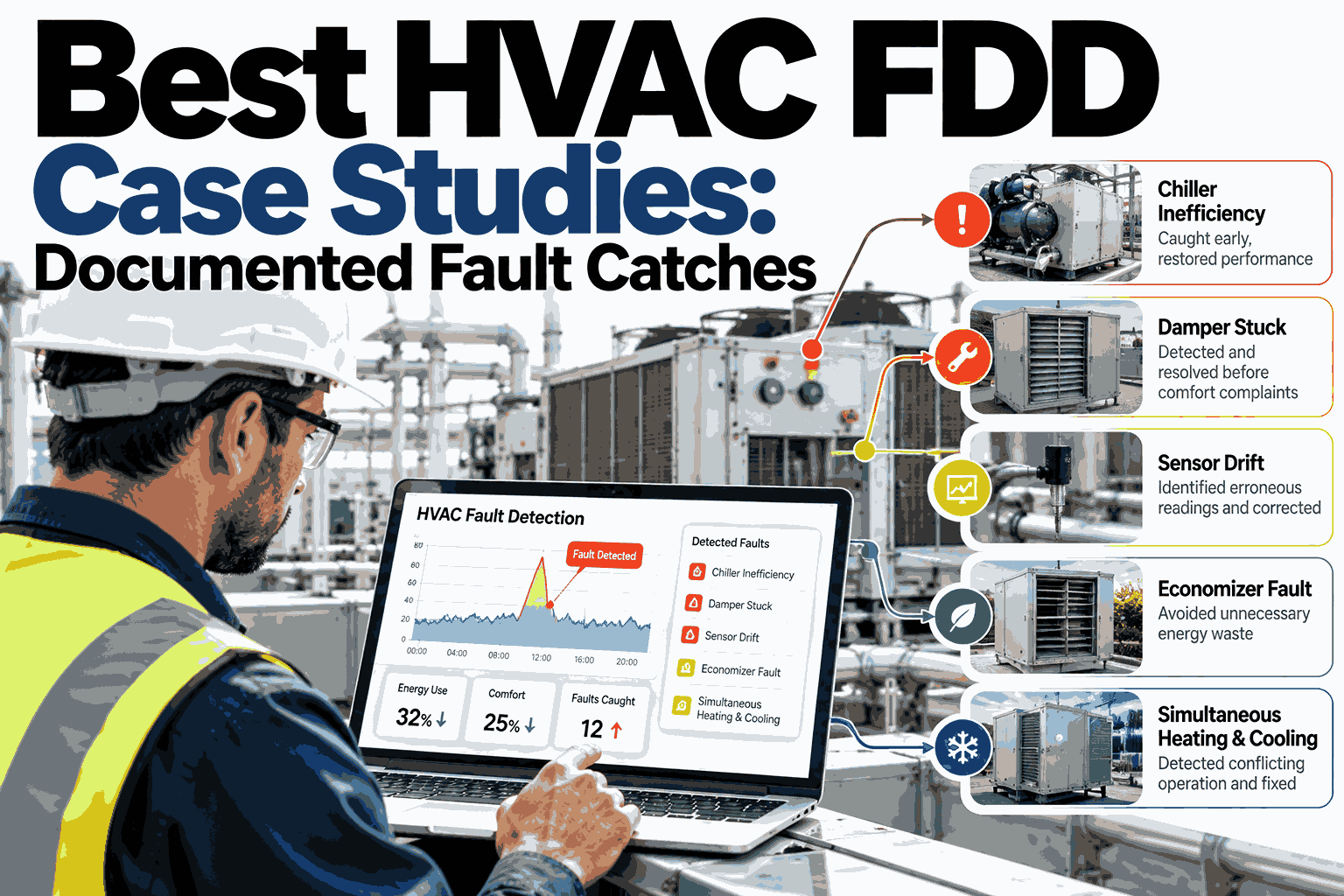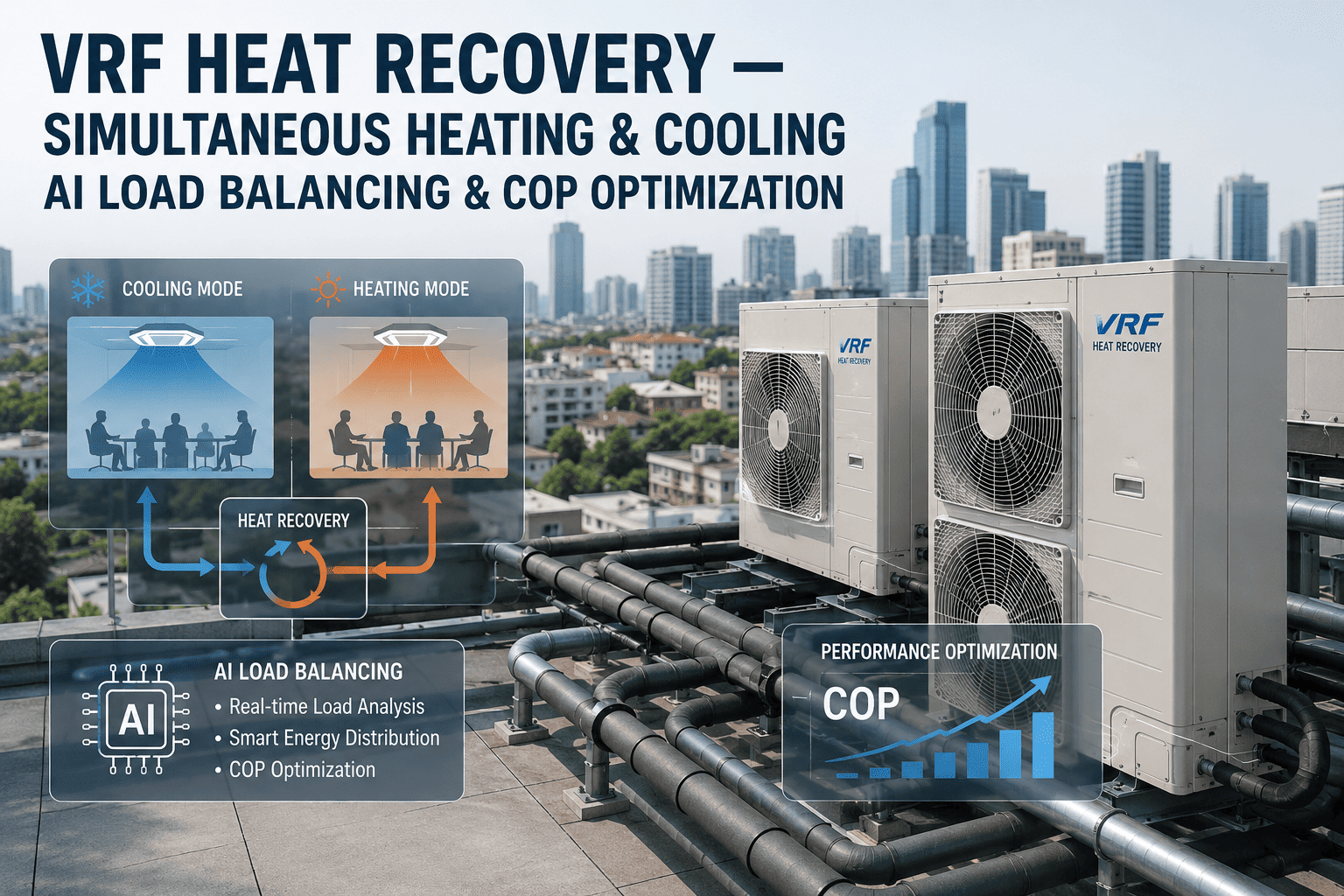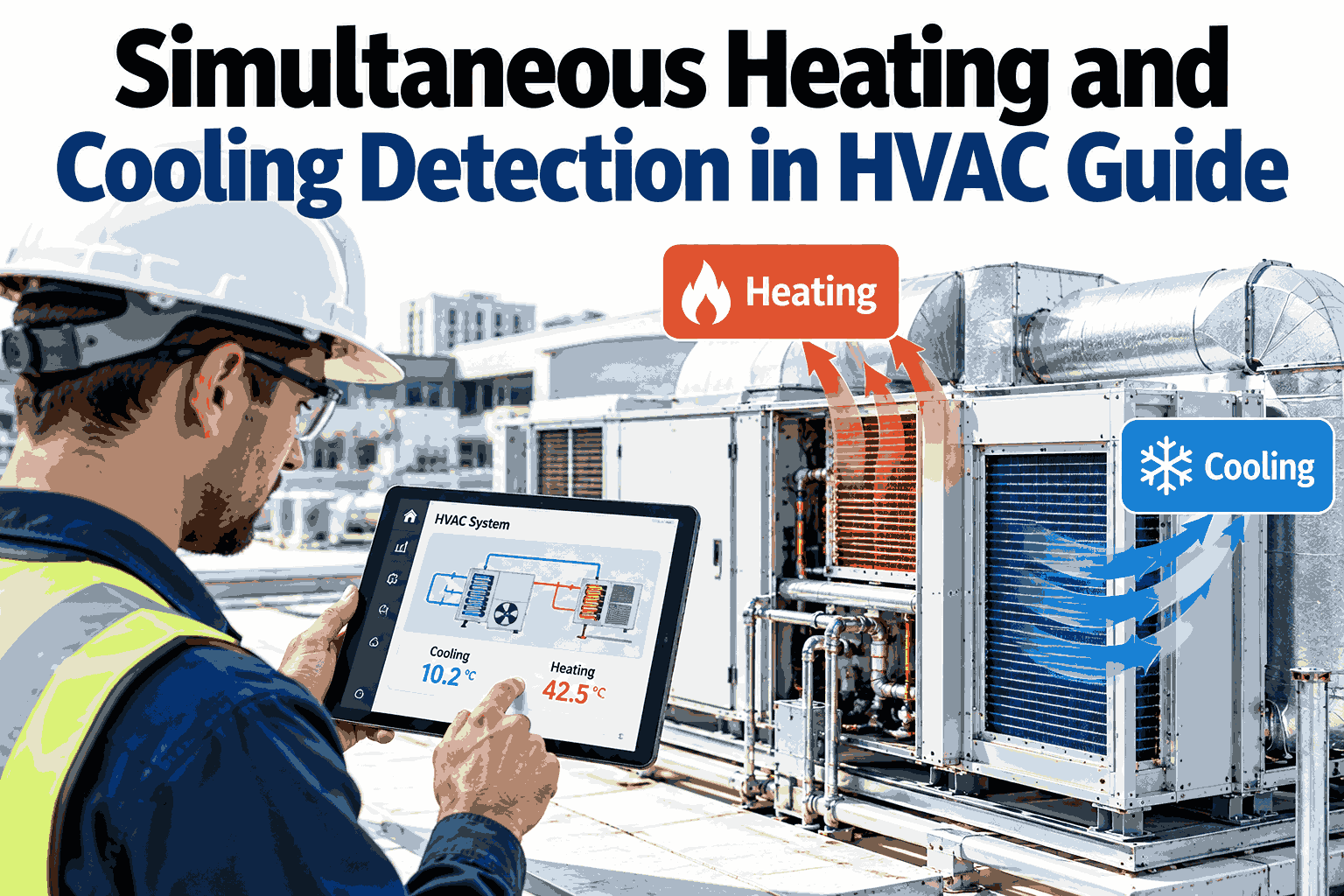
Simultaneous heating and cooling is one of the costliest faults in commercial HVAC because it hides in plain sight. The room stays comfortable, so nobody complains, while a cooling coil and a heating coil quietly cancel each other out and the energy meter keeps climbing. ASHRAE Guideline 36 treats this overlap as a core fault for automated detection. Facility teams can watch iFactory AI catch coil overlap on real BAS trend data before deciding how to monitor it.
Simultaneous Heating and Cooling Detection in HVAC
A practical guide to finding the energy-waste fault that comfort complaints never reveal, and fixing it for good.
What the Fault Actually Is
A building should heat or cool a zone, not both at once. When both coils work against each other, the energy is pure waste with no comfort benefit.
Normal state
Normal state
Normal state
Fault state
Guideline 36 fault logic starts by reading heating and cooling valve positions to classify the operating state. The bottom-right cell is the one that should never persist.
Where the Waste Hides
The fault shows up at several levels of the system. Published FDD benchmarks give a rough sense of how costly each one can be.
These ranges vary by climate, building type and control design, so treat them as a screening guide and confirm with your own trend data.
How the Fault Starts
Most overlap is not a dramatic failure. It begins with a small, ordinary decision that nobody revisits.
Commissioning shortcut
A deadband is set to zero to get a zone stable during startup and never restored.
Narrow or missing deadband
Setpoints for heating and cooling sit too close together, so the zone flips between modes.
Leaking or stuck valve
A valve that never fully closes feeds a coil that no one is commanding.
Sensor drift
A supply or discharge sensor reads wrong, and the control loop corrects a problem that does not exist.
Overlapping schedules
Heating and cooling enable windows overlap during shoulder seasons or after a schedule edit.
Find Coil Overlap Before It Becomes a Habit
Book a 30-minute session and iFactory AI will show how heating and cooling valve behavior is compared, ranked and costed across your zones.
Why Your BAS Stays Quiet
A building automation system checks each control loop on its own. The fault only appears when two loops are read together.
How Detection Works
Good detection follows a simple chain, so every flag can be explained to a technician and a finance lead.
The Cost Clock
Every unnoticed week adds to the bill. The chart below is an illustrative index, with one unit of waste added per week.
A fault found in week one costs a fraction of one found at week twelve, which is why detection speed matters as much as detection accuracy.
How to Evaluate Detection Tools
Use this table as a shortlist filter, and bring any finalist to a live test on your own building data.
| Criterion | What Good Looks Like | Warning Sign |
|---|---|---|
| Cross-loop logic | Reads heating and cooling signals together | Checks each loop on its own |
| Persistence rules | Flags sustained overlap, ignores brief transitions | Alarms on every momentary blip |
| Root cause | Points to deadband, valve, sensor or schedule | Shows a fault with no explanation |
| Cost estimate | Converts each fault to kWh and dollars | Reports counts only |
| Existing BAS | Works from current trend data | Requires a controls replacement |
Fix Playbook by Cause
Once a fault is traced to its cause, the remedy is usually small and permanent.
Dual-max VAV control
Separate airflow limits for heating and cooling stop reheat from running against full cooling airflow.
Deadband review
Restore a sensible gap between heating and cooling setpoints so zones stop switching modes.
Valve and actuator repair
Replace or recalibrate valves that do not seat fully, then confirm with a trend check.
Schedule cleanup
Remove overlapping enable windows and add interlocks so both coils cannot be enabled at once.
Where iFactory AI Fits
iFactory AI reads your existing BAS data, checks sequences against Guideline 36 logic and explains each overlap in plain terms.
Cross-coil detection
Heating and cooling signals are compared together, so overlap is caught even when each loop looks healthy.
Ranked by cost
Faults are prioritized by estimated energy and cost, so crews fix the biggest losses first.
Likely cause
Each flag points to the probable driver, such as a deadband, valve, sensor or schedule.
Ask in plain language
Managers can ask why a zone is wasting energy and receive a ranked list of causes.
Frequently Asked Questions
What is simultaneous heating and cooling?
It is a fault where a heating coil and a cooling coil operate at the same time on the same air stream or zone. The space stays comfortable, but energy is spent twice. It is common in VAV reheat systems and air handlers. You can see how overlap is flagged in a live session.
How much energy can it waste?
Published FDD benchmarks suggest a wide range, from a few thousand dollars per zone or air handler each year to double-digit shares of AHU energy. The real figure depends on climate, hours and design. A short walkthrough on your own trends gives a more grounded estimate.
Why does the BAS not raise an alarm?
Each loop meets its own setpoint, so no single check fails. The problem appears only when heating and cooling outputs are read together over time. That cross-check is what fault detection adds. Ask the support team about BAS data connections to see what is needed.
Is a brief overlap ever acceptable?
Short transitions during mode changes are normal, and good detection ignores them. The concern is overlap that repeats or lasts for hours. Persistence rules separate the two. To see how thresholds are tuned, request a guided look at persistence settings.
Do we need new controls to start?
Not usually. Detection works from the valve, temperature and status points your BAS already trends. Gaps can be marked and prioritized for later. Starting with existing data is often better than waiting for a retrofit. Schedule a point-mapping review to check your coverage.
Stop Paying for Heating and Cooling at the Same Time
iFactory AI detects, ranks and explains coil overlap across your buildings. Book a walkthrough to see it on your own data.