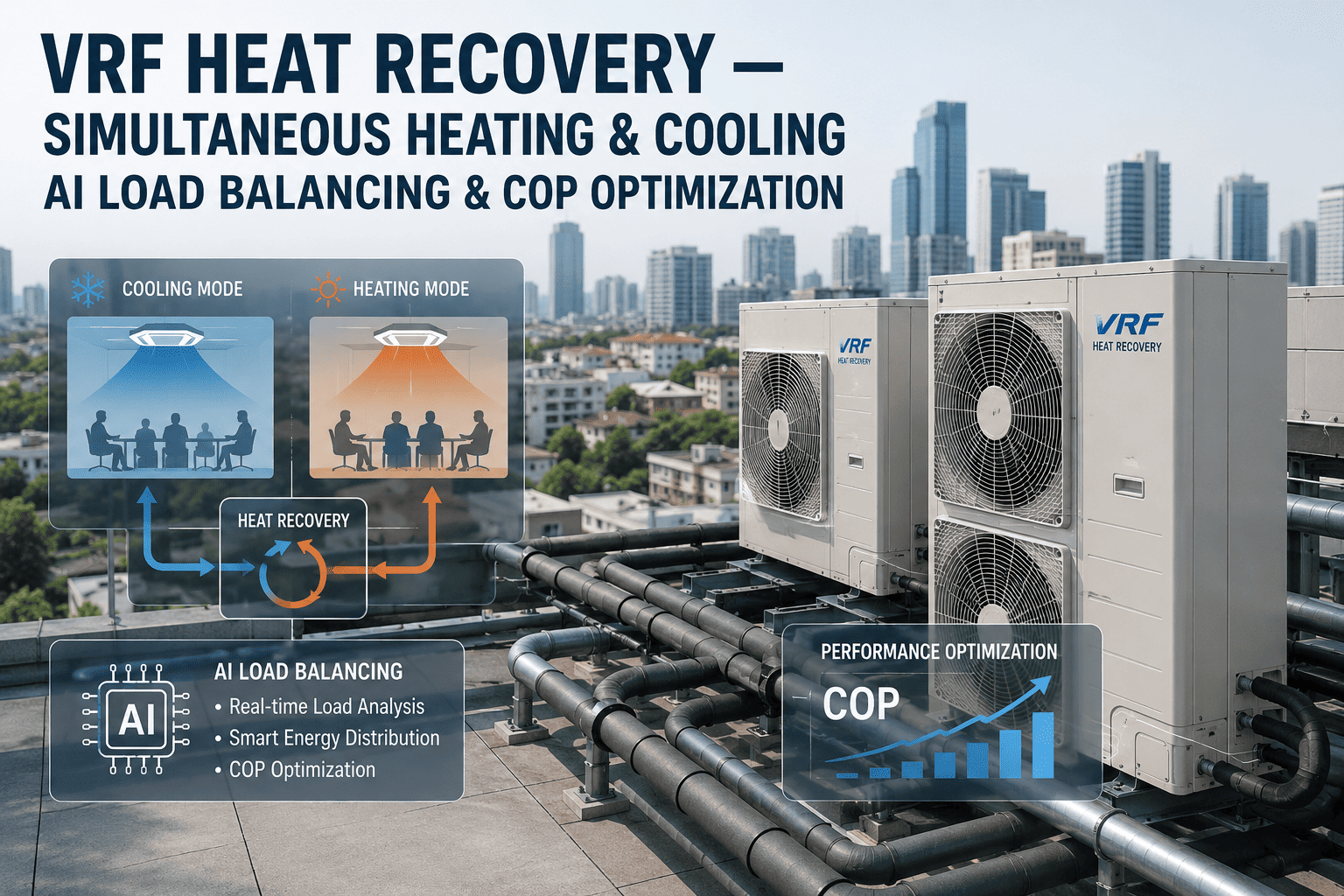
VRF and VRV systems installed with simultaneous heating and cooling capability rarely deliver the coefficient of performance their design promised, because most branch controllers balance zones on fixed setpoints instead of live thermal load data. A building with interior zones rejecting heat while perimeter zones call for warmth should recover that rejected energy automatically, yet outdated controller logic leaves compressors fighting each other instead of working together. Facility teams usually discover the gap only when utility bills arrive higher than modeled, with no easy way to trace which zones competed for capacity on any given hour. AI-driven load balancing reads every zone's real-time demand and redirects rejected heat before it is wasted, restoring the COP advantage VRF heat recovery was designed to deliver in the first place. Book a demo to see AI load balancing mapped onto your branch controllers within weeks.
AI Load Balancing for VRF Heat Recovery
Stop Rejecting Heat Your Perimeter Zones Are Asking For
iFactory reads live demand signals from every indoor unit and rebalances your VRF heat recovery system in real time, redirecting rejected heat to zones that need it and raising COP without touching a single branch controller's factory logic.
Cooling Zone
Rejecting heat
AI Balancer
Live redirection
Heating Zone
Receiving heat
15-25%
Typical COP improvement after rebalancing
4-6 wks
Time to full building deployment
60-70%
Reduction in simultaneous compressor cycling
Zero
Branch controller reprogramming required
Why VRF Heat Recovery Underperforms Its Design COP
Heat recovery VRF systems were engineered so that heat rejected from cooling zones could satisfy heating demand elsewhere in the same refrigerant loop, cutting the energy the outdoor unit would otherwise spend generating that heat from scratch. In practice, most branch selector boxes make routing decisions off simple thermostat setpoints rather than the actual thermal load each zone is carrying, so the system frequently defaults to rejecting heat outdoors even while another zone is actively calling for it. See how load-aware routing differs from your current controller logic. Over a heating season, that mismatch compounds into thousands of dollars in avoidable outdoor unit run time, and most facility teams have no visibility into how often it happens because branch controllers rarely log routing decisions in a form anyone reviews.
How AI Load Balancing Reads and Routes Zone Demand
iFactory's AI layer sits on top of your existing VRF network, listening to indoor unit demand signals, refrigerant temperatures and branch selector states without replacing any factory-installed controller. The model continuously scores every zone's real thermal load, not just its setpoint deviation, then recommends routing adjustments that the branch selector boxes execute through their standard control interface.
01
Demand Signal Capture
Indoor unit call signals, discharge air temperatures and valve positions are read continuously across every zone on the refrigerant loop.
02
Thermal Load Scoring
Each zone's true heating or cooling load is scored against outdoor conditions and occupancy trends rather than setpoint alone.
03
Recovery Path Selection
The model identifies which cooling zones can supply rejected heat to which heating zones within the branch selector's routing limits.
04
Routing Execution
Adjustments are pushed through the existing branch selector interface, with no firmware changes or new field wiring required.
05
COP Verification
Outdoor unit run time and compressor cycling are tracked continuously to confirm each rebalancing decision actually improved COP.
Fixed-Setpoint Control vs. AI-Balanced Heat Recovery
The difference between factory branch controller logic and AI-balanced routing shows up most clearly in shoulder seasons, when a building commonly carries both heating and cooling zones on the same day. Request a shoulder-season load comparison for your building.
| Behavior |
Fixed-Setpoint Branch Control |
iFactory AI Load Balancing |
| Routing Decision Basis |
Zone thermostat setpoint deviation only |
Live thermal load, occupancy and outdoor conditions |
| Heat Recovery Utilization |
Frequently rejects heat outdoors despite active heating demand |
Redirects rejected heat to eligible zones automatically |
| Compressor Cycling |
Zones compete, causing frequent short-cycling |
Cycling reduced 60-70% through coordinated routing |
| Visibility Into Decisions |
Routing logic is a factory black box with no logs |
Every routing decision is logged and reviewable |
| Seasonal COP |
Falls well short of manufacturer-rated design COP |
15-25% improvement toward rated design COP |
| Deployment Effort |
No change required, but inefficiency compounds |
Overlay deployment, no branch controller replacement |
See Your Building's Rejected Heat Mapped in Two Weeks
iFactory overlays your existing VRF branch controllers with an AI routing layer, showing exactly how much rejected heat your building is wasting before any changes go live.
Deployment Timeline for AI-Balanced Heat Recovery
Deployment follows a fixed four-phase path built around minimal disruption to occupied buildings, with the first live routing recommendations appearing inside the second week.
Week 1
Signal Mapping
Indoor unit demand points, branch selector states and outdoor unit telemetry are catalogued across every zone on the loop.
Week 2
Baseline Load Model
A baseline thermal load model runs in observation mode, surfacing rejected-heat events without altering any routing yet.
Weeks 3-4
Routing Activation
AI routing recommendations activate on the branch selector network, with COP and cycling tracked against the baseline.
Weeks 5-6
Full Building Tuning
Routing thresholds are tuned per zone using real occupancy patterns, with ongoing COP verification reporting.
Where AI Load Balancing Pays Off Fastest
These results reflect buildings currently running iFactory's AI load balancing layer on their VRF heat recovery systems.
Mixed-Use Office Tower
COP Improved 22% Across Shoulder Season
A 28-story tower with core zones cooling year-round while perimeter zones needed heating through spring and fall was routinely rejecting recoverable heat outdoors. AI routing raised recovered heat utilization from roughly 40% to over 85% within six weeks of activation.
Hotel Portfolio
Compressor Cycling Cut Nearly in Half
Guest room zones with independent occupancy patterns caused constant short-cycling under fixed-setpoint control. Coordinated routing reduced cycling events 58% and extended expected compressor service intervals.
University Research Building
Rejected Heat Recovery Doubled
Lab zones with constant cooling loads sat adjacent to office zones needing heat for most of the year, yet recovery utilization stayed below design targets until AI routing closed the gap between the two load profiles.
Frequently Asked Questions
Does AI load balancing replace our existing VRF branch selector boxes?
No. iFactory reads demand and telemetry data from your existing branch selector boxes and pushes routing recommendations back through their standard control interface, so no hardware is replaced or rewired. The branch selectors continue executing routing exactly the way the manufacturer designed them to, only now guided by live thermal load data instead of setpoint deviation alone. This keeps your equipment warranty intact throughout deployment.
Which VRF and VRV manufacturers does this work with?
iFactory's demand-signal layer works across the major VRF and VRV platforms used in commercial buildings, reading standard BACnet, Modbus or manufacturer-specific gateway data depending on what your installed system already exposes. Compatibility is confirmed during the signal mapping phase in week one, before any routing changes are proposed for your specific equipment configuration.
How much COP improvement is realistic for our building?
Buildings with a genuine mix of simultaneous heating and cooling zones typically see 15-25% COP improvement, while buildings with mostly single-mode operation see smaller gains since there is less rejected heat to recover in the first place.
Book a demo to get a load-profile-specific estimate before committing to deployment.
Will occupants notice any change in comfort during rebalancing?
Routing changes are constrained to stay within each zone's comfort band, so occupants generally do not notice anything beyond faster, more consistent temperature recovery after setpoint changes. The baseline observation week is specifically designed to confirm this before any live routing activates on occupied floors.
How is COP improvement actually measured and verified?
Outdoor unit run time, compressor cycling frequency and recovered heat utilization are logged continuously before and after routing activation, giving a direct before-and-after comparison rather than a modeled estimate.
Ask support for a sample verification report from a comparable building type.
Your VRF System Is Rejecting Heat It Could Be Recovering
iFactory overlays AI-driven load balancing onto your existing branch controllers, recovering rejected heat and raising COP without a hardware replacement project.
15-25% typical COP improvement
No branch controller replacement required
Live routing recommendations within two weeks
Continuous COP verification reporting