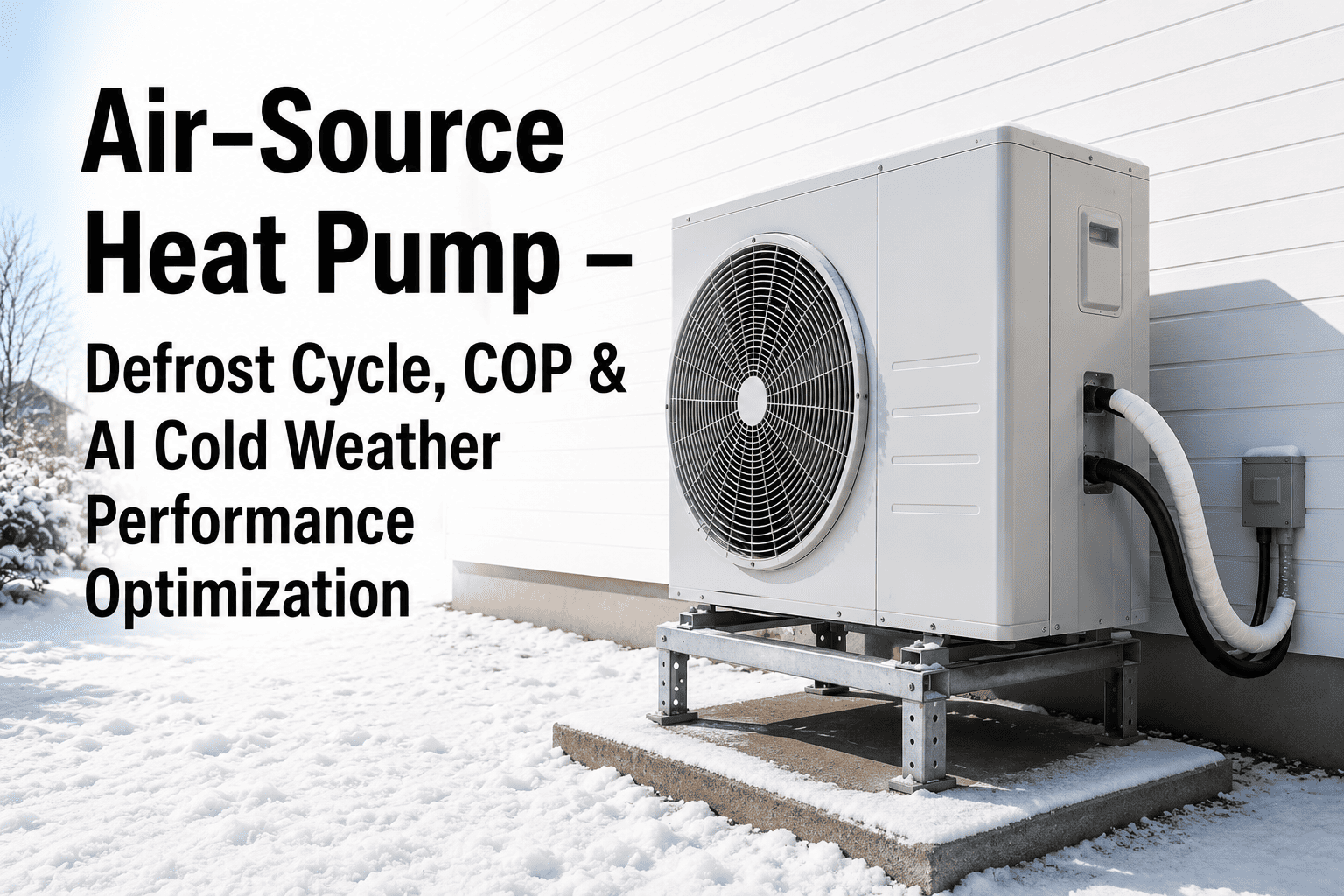
Air-source heat pumps lose the most efficiency exactly when buildings need heat the most, because frost accumulating on the outdoor coil below freezing forces the unit into defrost cycles that temporarily reverse operation and dump heat outdoors instead of indoors. A defrost cycle triggered too early wastes energy clearing a coil that barely needed it, while one triggered too late lets ice buildup choke airflow and crater capacity right when a cold snap demands full output. Most factory defrost controllers rely on simple time-and-temperature timers that cannot tell the difference between light frost and heavy icing, so they default to a fixed schedule that is wrong for actual conditions more often than it is right. AI-driven defrost management reads real coil conditions and adjusts cycle timing dynamically, protecting COP through the exact temperature range where heat pumps are usually weakest. Book a demo to see defrost optimization modeled against your climate zone.
AI Defrost Cycle & Cold Weather Optimization
Stop Losing Capacity Exactly When You Need It Most
iFactory reads real outdoor coil conditions instead of relying on a fixed timer, triggering defrost only when frost actually warrants it and protecting COP as temperatures approach your heat pump's balance point.
Unnecessary Defrost Cycles Eliminated
65-75%
COP Retained Near Balance Point
10-15% higher
Auxiliary Heat Runtime Reduction
20-30%
Why Fixed-Timer Defrost Wastes Energy and Capacity
Most air-source heat pump controllers initiate defrost purely on elapsed run time combined with a single coil temperature threshold, a method chosen decades ago because it was cheap to implement in analog control boards, not because it matches how frost actually forms. See how much of your unit's defrost activity is unnecessary today. Frost accumulation depends on outdoor humidity, wind exposure and coil surface temperature together, conditions that shift hour to hour, so a timer calibrated for average conditions triggers far too often on dry days and not often enough during heavy freezing fog, either wasting heating capacity or letting ice choke airflow before the next scheduled cycle arrives.
How AI Defrost Management Reads Real Coil Conditions
Above 40°F
Defrost Rarely Needed
The model suppresses unnecessary cycles almost entirely, since frost formation risk is minimal and every skipped cycle preserves indoor comfort and COP.
25°F to 40°F
Conditional Frost Monitoring
Coil temperature and humidity are tracked continuously, triggering defrost only when actual frost accumulation crosses a capacity-impacting threshold.
Below 25°F
Active Frost Risk Zone
This is where most units are near their balance point and auxiliary heat is most likely to engage, so defrost timing is optimized to minimize both ice risk and aux heat runtime together.
Near Balance Point
Aux Heat Coordination
Defrost cycles are scheduled to avoid overlapping with auxiliary heat engagement whenever possible, since simultaneous defrost and aux heat produce the steepest COP drop of any operating condition.
Fixed-Timer Defrost vs. AI Condition-Based Defrost
The performance gap between the two approaches widens as outdoor temperatures drop and defrost frequency increases. Request a side-by-side comparison for your specific unit model.
| Behavior |
Fixed-Timer Defrost |
iFactory AI Defrost |
| Trigger Basis |
Elapsed run time plus a single temperature threshold |
Real-time coil frost accumulation modeling |
| Unnecessary Cycles |
Frequent, especially in dry cold conditions |
65-75% reduction in cycles that were not needed |
| Aux Heat Coordination |
No awareness of auxiliary heat state |
Defrost timing avoids overlapping aux heat engagement |
| Cold Snap Performance |
Fixed schedule cannot adapt to heavy icing events |
Cycle frequency increases automatically under heavy frost |
| Capacity Near Balance Point |
Significant capacity loss from over-defrosting |
10-15% higher effective COP retained |
See Your Unit's Wasted Defrost Cycles This Season
iFactory analyzes your heat pump's current defrost pattern against real coil conditions and shows exactly how much capacity a fixed timer is costing you.
Deployment Across a Heating Season
1
Coil & Sensor Baseline
Outdoor coil temperature, humidity and existing defrost trigger points are catalogued against your unit's factory control sequence.
2
Frost Model Calibration
The frost accumulation model calibrates to your specific climate zone and unit model over the first two to three weeks of monitoring.
3
Condition-Based Activation
Defrost triggering switches from the factory timer to condition-based control, with every cycle logged and compared to baseline.
4
Cold Snap Validation
Performance is validated through the season's coldest weather events, confirming ice protection holds under worst-case conditions.
Results From Buildings Running AI Defrost Optimization
Multi-Family Residential, Northeast US
Auxiliary Heat Runtime Cut by a Quarter
A 60-unit multi-family property running ducted air-source heat pumps saw auxiliary electric resistance heat engage far more often than the unit's rated balance point suggested it should, traced to defrost cycles overlapping with cold-morning demand peaks. Condition-based defrost timing reduced aux heat runtime by 26% over a full heating season while maintaining identical indoor comfort logs.
Light Commercial Retrofit, Pacific Northwest
Defrost Cycles Reduced by Two-Thirds in Mild Winters
A retrofit heat pump installation in a climate with frequent damp, cool conditions but rarely deep freezing found the factory timer running defrost far more than the coil actually needed. AI-based triggering cut unnecessary cycles by 68%, directly improving measured seasonal COP.
Frequently Asked Questions
Does this replace our heat pump's factory defrost control board?
No. iFactory overlays the existing control sequence with condition-based triggering logic, working through the same defrost initiation interface the factory controller already uses rather than replacing the board itself. This keeps the manufacturer's safety limits and failsafe defrost termination logic fully intact throughout operation.
Will this affect our equipment warranty?
How does the system handle sudden cold snaps or freezing fog?
The frost accumulation model responds to real humidity and coil temperature readings rather than a fixed schedule, so defrost frequency increases automatically the moment conditions shift toward heavier icing rather than waiting for the next scheduled timer interval. This is precisely the scenario where fixed-timer control is most likely to under-defrost and risk capacity loss.
How much COP improvement should we realistically expect?
Buildings operating in climates with frequent temperature swings through the 25-40°F range typically see the largest gains, in the range of 10-15% higher effective COP near the balance point, while consistently cold or consistently mild climates see comparatively smaller improvement.
Book a demo for an estimate specific to your climate zone and unit model.
Can this reduce our auxiliary electric heat costs?
Yes, since a significant share of auxiliary heat engagement is triggered by capacity loss during unnecessary or poorly timed defrost cycles rather than genuine outdoor temperature demand. Coordinating defrost timing to avoid overlapping with aux heat calls has reduced auxiliary runtime by 20-30% in monitored deployments to date.
Protect COP Through the Temperature Range Where It Matters Most
iFactory reads real coil conditions to trigger defrost only when it's needed, cutting unnecessary cycles and reducing auxiliary heat runtime through the coldest part of your season.
65-75% fewer unnecessary defrost cycles
10-15% higher COP near balance point
20-30% less auxiliary heat runtime
No control board replacement required