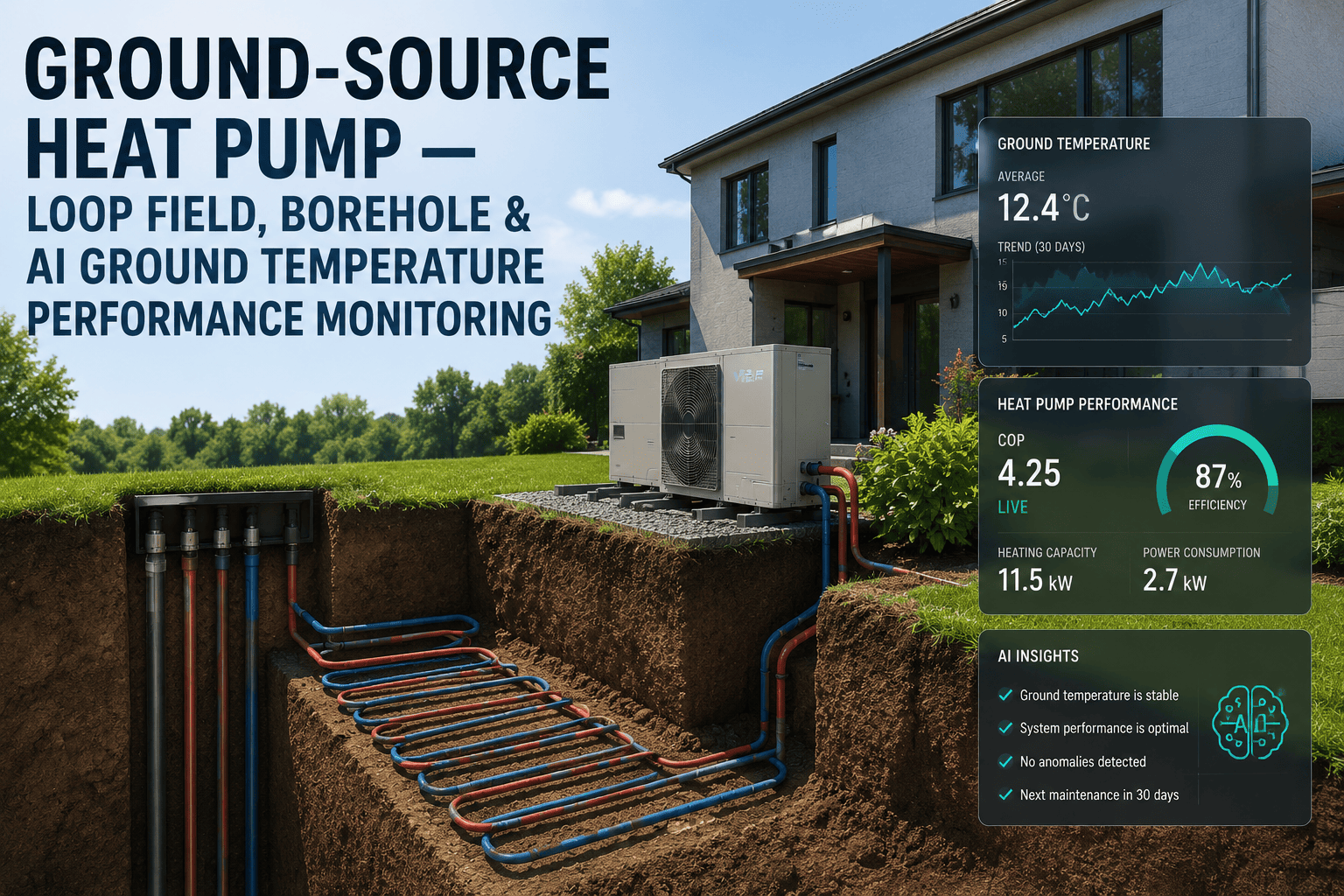
Ground-source heat pump systems are sold on decades of stable performance, yet the loop field that makes that promise possible is buried out of sight and almost never monitored until efficiency has already dropped enough for someone to notice higher bills. Ground thermal depletion happens slowly, over multiple heating seasons, as heat extracted from the earth each winter fails to fully recharge before the next season begins, gradually lowering the loop's entering water temperature and dragging COP down with it. Loop circulation problems, from air binding to a partially blocked header, produce the same symptom of declining performance but require a completely different fix, and without borehole-level data most facility teams cannot tell which cause they are dealing with. AI monitoring trends ground temperature and loop circulation continuously across seasons, catching depletion or circulation issues years before they become a full system replacement conversation. Book a demo to see loop field trending applied to your borehole configuration.
Ground Temperature & Loop Field AI Monitoring
See What's Happening 200 Feet Below Your Building
iFactory trends ground temperature, loop circulation and borehole performance season over season, catching thermal depletion and circulation issues years before they show up as a comfort or efficiency complaint.
Surface / Header Trench
Circulation pumps, headers and flow balancing valves monitored for pressure drop and air binding
Mid-Depth Loop Field
Individual borehole flow and return temperature compared across the field to isolate underperforming loops
Deep Ground Thermal Mass
Seasonal entering water temperature trended year over year to detect gradual thermal depletion
Why Loop Field Problems Go Unnoticed for Years
A ground-source system's loop field has no moving parts and no obvious failure indicator, so most buildings only look at it after entering water temperature has drifted enough to noticeably raise compressor run time and energy use. See how your current entering water temperature compares to design baseline. Because the decline happens gradually across several heating and cooling seasons, staff turnover and normal seasonal variation both mask the trend, and by the time it is obvious the loop field has already been operating below design performance for years, quietly inflating utility costs the entire time.
Ground Thermal Depletion vs. Loop Circulation Issues
These two failure modes produce similar symptoms at the heat pump but require entirely different remediation, which is why isolating the cause with borehole-level data matters before any corrective action is taken.
Ground Thermal Depletion
Entering water temperature trends downward across multiple heating seasons rather than within a single season
Typically caused by heating-dominant load imbalance without enough cooling-season recharge
Remediation may involve load rebalancing or supplemental loop capacity
Loop Circulation Problems
Flow rate or pressure drop changes abruptly rather than gradually over seasons
Often caused by air binding, a partially blocked header, or a failing circulation pump
Remediation is a mechanical fix, typically resolved in a single service visit
Find Out Which Loops Are Underperforming
iFactory compares individual borehole flow and temperature data across your entire field, isolating the specific loops dragging system performance down.
Manual Loop Field Assessment vs. Continuous AI Trending
| Assessment Method |
Periodic Manual Testing |
iFactory AI Trending |
| Data Frequency |
Snapshot testing every few years at best |
Continuous seasonal trending of every borehole |
| Depletion Detection |
Confirmed only after COP has visibly degraded |
Flagged years before it affects daily performance |
| Loop-Level Isolation |
Field-wide average only, individual loops untested |
Individual borehole comparison across the field |
| Circulation Diagnosis |
Requires a dedicated service call to investigate |
Abrupt flow changes flagged automatically |
| Historical Record |
Sparse data points, difficult to trend accurately |
Continuous multi-season record for every loop |
How Loop Field Monitoring Deploys
1
Loop Field Mapping
Existing header sensors, flow meters and entering/leaving water temperature points are catalogued against the as-built loop field layout.
2
Seasonal Baseline Establishment
A full heating and cooling season of data establishes each loop's normal seasonal temperature swing as its individual baseline.
3
Cross-Loop Comparison Activation
Individual boreholes are compared against field-wide averages continuously, isolating underperforming loops automatically.
4
Multi-Season Trend Reporting
Year-over-year entering water temperature trending provides the long-term view needed to plan for depletion well ahead of a capacity shortfall.
Results From Loop Fields Under AI Monitoring
University Campus District System
A 400-borehole campus loop field serving a heating-dominant building mix showed entering water temperature trending downward across three consecutive winters, flagged two full seasons before it would have triggered a noticeable capacity shortfall, giving the facilities team time to plan supplemental cooling-season recharge.
Commercial Office Complex
Isolated flow data identified six boreholes in one section of the field running well below the field average, traced to a partially blocked header rather than ground depletion, resolved in a single service visit instead of an unnecessary loop field investigation.
Frequently Asked Questions
Do we need new sensors installed in the boreholes themselves?
In most cases, monitoring works from existing header-level flow and temperature sensors combined with heat pump entering and leaving water temperature data, without needing new instrumentation placed inside individual boreholes. Systems with limited existing instrumentation may need a small number of additional header sensors, assessed during the loop field mapping step.
How long does it take to detect ground thermal depletion?
Because depletion trends develop across multiple seasons rather than weeks, meaningful detection typically requires at least one full heating and cooling season of baseline data, after which year-over-year comparison can flag a developing trend with confidence. Systems with several years of existing temperature logs can sometimes establish a baseline faster using that historical data.
Can this diagnose a specific failing borehole in a large field?
What causes ground thermal depletion in the first place?
Depletion typically results from a persistent imbalance between heating-season heat extraction and cooling-season heat rejection, common in heating-dominant climates or buildings where the loop field was undersized relative to actual heating load. Left unaddressed across several seasons, this imbalance gradually lowers ground temperature and, with it, achievable COP.
What happens after depletion or circulation issues are flagged?
Ground thermal depletion findings typically inform longer-term planning around load rebalancing or supplemental loop capacity, while circulation issues usually point to a specific, quickly resolved mechanical fix.
Book a demo to see how findings translate into a remediation plan for your system.
Protect Decades of Loop Field Performance Before It Declines
iFactory trends ground temperature and loop circulation continuously, catching depletion and circulation problems years before they threaten system performance.
Multi-season ground temperature trending
Individual borehole comparison across the field
Depletion flagged years ahead of capacity loss
Works with most existing header instrumentation