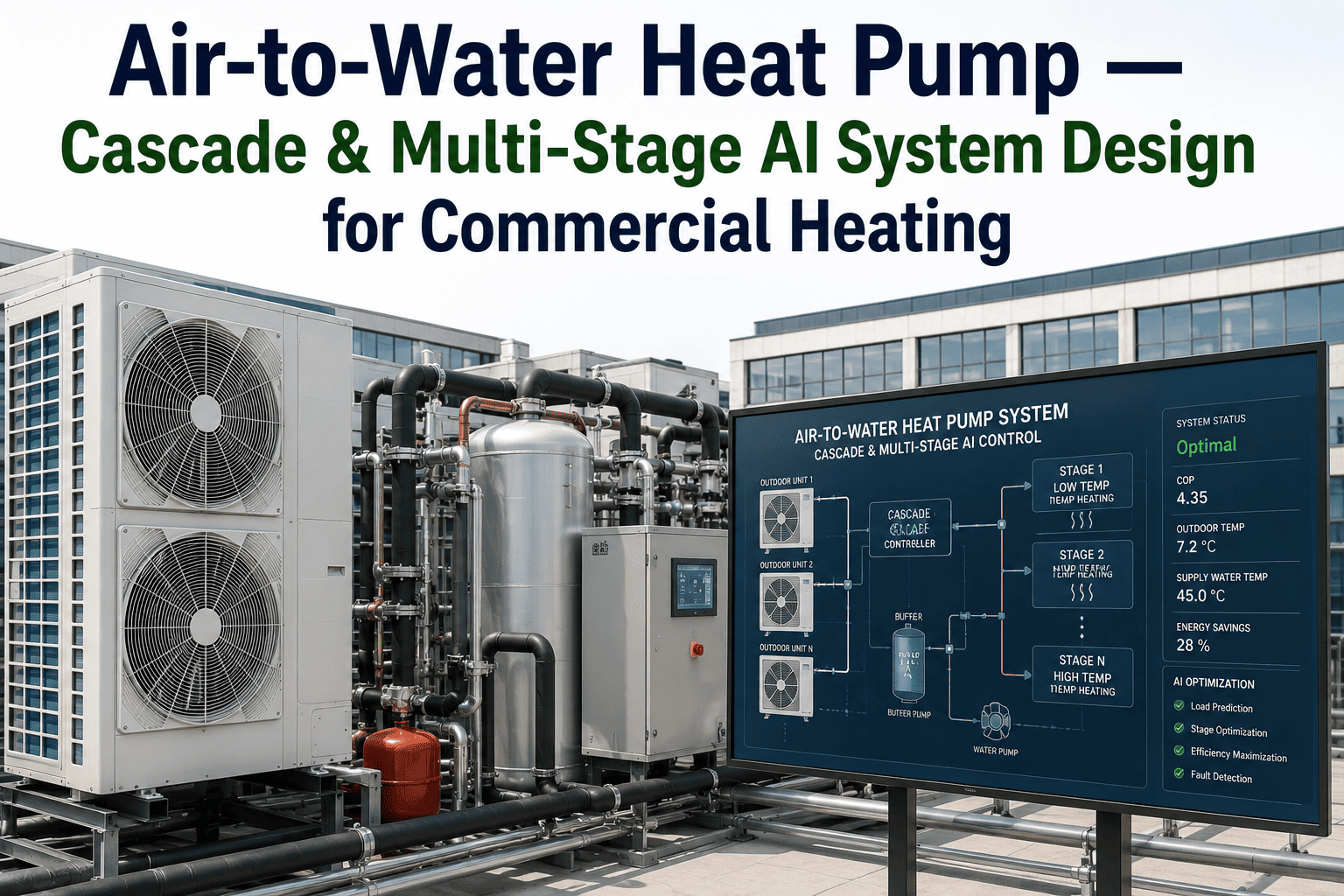
Ask any facility manager who inherited an oversized single-stage heat pump system what the biggest daily frustration is, and the answer is almost always the same: constant short-cycling, uneven buffer tank temperatures, and a compressor that seems to run flat out on a mild fifty-degree morning and struggle on a genuinely cold night. Commercial heating load doesn't sit still, and a heat pump system designed around one compressor stage forces every hour of the year through the same operating point regardless of what the building actually needs. Cascade and multi-stage system design solves this by breaking heating capacity into coordinated stages that AI can sequence intelligently, matching output to load in real time instead of cycling one oversized unit on and off. iFactory's commercial HVAC systems team designs and commissions AI-coordinated cascade heat pump systems for cold-climate commercial buildings.
Heat Pump Systems · Cascade AI Design
Air-to-Water Heat Pump Cascade and Multi-Stage AI System Design
AI-coordinated staging across cascade heat pump systems, matching compressor output to real-time building load, managing buffer tank temperature stratification, and maintaining commercial heating performance through the coldest days of the season.
Cascade System Design
2–6
Typical staging modules
-15°F
Cold-climate operating range
AI
Real-time stage sequencing
Buffer
Tank stratification control
Why Cascade Design Matters
The Problem With Sizing a Single Heat Pump to Peak Load
Traditional commercial heating design starts with peak load — the coldest expected day of the year — and sizes equipment to meet it. Applied to a single heat pump, this produces a unit that is dramatically oversized for the vast majority of the heating season, which for most commercial buildings sits well above the design temperature more than ninety percent of operating hours. An oversized single-stage heat pump running against a mild load spends most of its life short-cycling, turning on, satisfying the load almost immediately, and shutting down again, which is both energy-inefficient and mechanically hard on the compressor.
Cascade and multi-stage design breaks that single large unit into two or more smaller modules that can be sequenced independently. On a mild day, one module carries the entire load efficiently at a high part-load ratio. As outdoor temperature drops and building load increases, additional modules stage on in sequence, each one operating near its efficient sweet spot rather than the whole system running one oversized compressor at a fraction of its capacity. The result is a system that matches capacity to load across the full range of outdoor conditions instead of forcing every condition through the same operating point.
The complexity this introduces is coordination. Multiple compressors, multiple refrigerant circuits, and a buffer tank that has to manage thermal stratification while staged units cycle independently create a control problem that a basic staging controller handles crudely at best — typically with simple lead-lag logic that doesn't account for actual efficiency curves, defrost cycles, or buffer tank temperature profile. AI-coordinated sequencing is what turns a mechanically sound cascade design into a system that actually delivers its designed efficiency in daily operation.
Staging Control Comparison
Basic Lead-Lag Control vs. AI-Coordinated Staging
Cascade hardware alone doesn't guarantee cascade-level efficiency. The staging control logic determines whether the system actually operates each module near its efficient point, or simply cycles units on a basic first-on-first-off rotation that leaves real efficiency on the table.
| Capability |
Basic Lead-Lag Control |
AI-Coordinated Staging |
| Stage sequencing logic |
Fixed rotation, first-on-first-off |
Real-time efficiency-optimized sequencing |
| Buffer tank management |
Single setpoint, no stratification control |
Stratification-aware charge and discharge control |
| Defrost coordination |
Independent per-unit defrost, capacity gaps |
Coordinated defrost scheduling to maintain output |
| Compressor wear balancing |
Uneven run-hours across modules |
Run-hour equalization across staged units |
| Load prediction |
Reactive to current temperature only |
Predictive staging ahead of anticipated load change |
The defrost coordination gap deserves particular attention because it's one of the least visible causes of underperformance in cold-climate cascade systems. When multiple modules defrost independently without coordination, the system can lose capacity from several units simultaneously during the coldest, highest-load conditions of the year — exactly when the building can least afford a capacity gap. AI-coordinated staging schedules defrost cycles to stagger across modules, maintaining minimum output capacity throughout.
See Cascade Staging in Action
Watch AI Sequence a Multi-Stage Heat Pump System Through a Cold Snap
Book a walkthrough with iFactory's systems engineering team and see AI-coordinated cascade staging running against real cold-climate load data — stage sequencing, buffer tank stratification control, and coordinated defrost scheduling.
System Architecture
How a Coordinated Cascade System Is Structured
A well-designed cascade system is built from a small number of coordinated elements, each contributing to the system's ability to match capacity to load across the full seasonal operating range.
Element 1
Staged Compressor Modules
Two to six individually sequenced heat pump modules, each capable of independent operation. Smaller module count simplifies control but produces coarser capacity steps; more modules give finer capacity resolution at added coordination complexity.
Element 2
Thermally Stratified Buffer Tank
Central buffer tank managing the difference between staged, intermittent heat pump output and continuous building load. Proper stratification keeps the hottest water available at the top for distribution while cooler return water stays segregated at the bottom.
Element 3
Coordinated Defrost Sequencing
Logic that staggers defrost cycles across modules rather than allowing them to occur simultaneously, maintaining a minimum guaranteed output capacity even during the frost-prone conditions where defrost demand is highest.
Element 4
Predictive Load Sequencing
AI models building load against outdoor temperature trend and occupancy pattern to stage modules ahead of anticipated demand change, avoiding the lag and short-term capacity shortfall of purely reactive staging control.
Staging Logic in Practice
How AI Sequences Stages Across a Typical Winter Day
The value of AI-coordinated staging is easiest to see across a realistic operating day, where outdoor temperature, building load, and defrost demand all shift continuously and the control system has to respond to all three simultaneously.
T1
Overnight Low Load — Single Module Operation
With minimal building load and mild overnight temperatures, a single module carries the full load at high part-load efficiency, while remaining modules stay in standby to minimize unnecessary run-hours and wear.
T2
Morning Warm-Up — Predictive Stage Addition
As occupancy schedule and outdoor temperature trend signal an anticipated load increase, AI stages additional modules ahead of the actual demand spike, avoiding the temperature lag that reactive-only control would produce.
T3
Cold Snap Peak — Full Cascade With Coordinated Defrost
During the coldest conditions of the day, most or all modules are staged on, with defrost cycles scheduled to stagger across units so that at least the minimum required capacity remains online at all times.
T4
Afternoon Moderation — Stage Reduction With Run-Hour Balancing
As load eases, modules stage off in an order that balances accumulated run-hours across the fleet, rather than always shedding the same unit last, extending the service interval consistency across all compressors.
Deployment Roadmap
From System Design to Commissioned Cascade Operation
Whether designing a new cascade system or retrofitting AI staging control onto an existing multi-unit installation, deployment typically runs eight to twelve weeks depending on system complexity and integration requirements.
Phase 1
Load Profile and Module Sizing
Building heating load is modeled across the full seasonal range to determine the optimal number and sizing of staged modules, balancing capacity resolution against system complexity.
Phase 2
Buffer Tank and Piping Design
Buffer tank sizing and piping configuration are designed to support proper thermal stratification, ensuring staged, intermittent module output translates into stable, continuous distribution temperature.
Phase 3
AI Staging Model Configuration
The staging model is configured with module efficiency curves, defrost characteristics, and building-specific load patterns to build the predictive sequencing logic for the specific installation.
Phase 4
Commissioning and Cold-Weather Validation
System performance is validated across a range of operating conditions where possible, including cold-weather testing to confirm coordinated defrost sequencing maintains minimum capacity as designed.
Phase 5
Seasonal Tuning
Staging thresholds and predictive model parameters are refined across the first full heating season as actual building load and occupancy patterns provide real operating data beyond initial design assumptions.
Phase 6
Ongoing Performance Optimization
Run-hour balancing, efficiency tracking, and predictive maintenance flagging continue year over year, keeping the cascade system operating near its designed efficiency as equipment ages and building use patterns evolve.
Field Perspective
"
The single biggest mistake I see in commercial heat pump retrofits is treating cascade design as purely a mechanical sizing exercise — pick the right number of modules, plumb them together, done. The mechanical sizing is necessary but it's maybe forty percent of the actual performance outcome. The other sixty percent comes from how well the staging control coordinates those modules across real operating conditions, and that's exactly where basic lead-lag controllers fall short. I've seen mechanically identical cascade installations perform completely differently in the field purely because one had intelligent staging and the other had a controller that just rotated units on a timer. Getting the coordination right is what actually delivers the efficiency the mechanical design promised on paper.
Soren Kaplinsky-Adeyemi
Commercial Heat Pump Systems Engineer · 14 years in cold-climate cascade design and multi-stage control commissioning
Common Questions
Frequently Asked Questions
How cold can an air-to-water heat pump cascade system operate before losing meaningful capacity?
Modern cold-climate air-to-water heat pump modules are rated to maintain significant heating capacity down to outdoor temperatures well below zero degrees Fahrenheit, though the exact rating depends on the specific compressor technology and refrigerant used in the module. Cascade design partially compensates for individual module capacity loss in extreme cold by bringing additional modules online, though the overall system's cold-weather performance still depends on the coldest-rated component in the design. Site-specific design should always be validated against the local design temperature and the manufacturer's published capacity curves for the selected equipment.
Talk to systems engineering about cold-climate performance for your specific location.
Can AI staging control be retrofitted onto an existing multi-unit heat pump installation?
In most cases, yes. If the existing installation already has multiple heat pump modules feeding a common buffer tank or distribution system, AI-coordinated staging can typically be layered on top of the existing hardware without requiring mechanical modification, replacing or supplementing the basic lead-lag controller with predictive, efficiency-aware sequencing logic. The retrofit assessment during onboarding evaluates the existing control points, communication protocol compatibility, and buffer tank instrumentation to confirm what's achievable without additional hardware.
How does buffer tank stratification actually affect system efficiency?
A properly stratified buffer tank keeps the hottest water produced by staged modules available at the top of the tank for immediate distribution, while cooler return water remains segregated at the bottom where it can be reheated efficiently. A tank that mixes rather than stratifies effectively averages hot supply water with cool return water, forcing the system to work harder to reach distribution temperature and reducing the effective capacity of every staged module. AI-coordinated control manages charge and discharge flow rates specifically to preserve stratification rather than treating the tank as a simple mixed reservoir.
Book a demo to see stratification management in a live system.
Does coordinated defrost scheduling actually prevent a capacity shortfall during extreme cold?
Coordinated defrost scheduling significantly reduces the risk of a simultaneous multi-unit capacity gap by staggering defrost timing across modules rather than allowing frost accumulation to trigger defrost on multiple units at once. It cannot eliminate defrost demand entirely, since defrost is a physical requirement of outdoor coil operation in cold, humid conditions, but it does ensure the system maintains a guaranteed minimum output capacity throughout the defrost cycle rotation, which is the specific failure mode uncoordinated systems are most exposed to during the coldest, highest-demand hours of the season.
How many staged modules should a typical commercial building use?
Module count is a tradeoff between capacity resolution and system complexity, and the right number depends on the building's load profile, budget, and redundancy requirements. Two to three modules is common for smaller commercial buildings seeking basic staging benefit and redundancy, while larger buildings with wide seasonal load swings often benefit from four to six modules for finer capacity matching. The load profile analysis performed during design is what determines the specific recommendation for a given building rather than a generic rule of thumb.
Cascade Systems Ready for Intelligent Staging
Match Heating Capacity to Real Load, Stage by Stage, All Season
iFactory's AI-coordinated cascade design and staging platform turns a mechanically sound multi-stage heat pump system into one that actually delivers its designed efficiency — predictive sequencing, stratification-aware buffer control, and coordinated defrost scheduling built for cold-climate commercial heating.
.jpg)