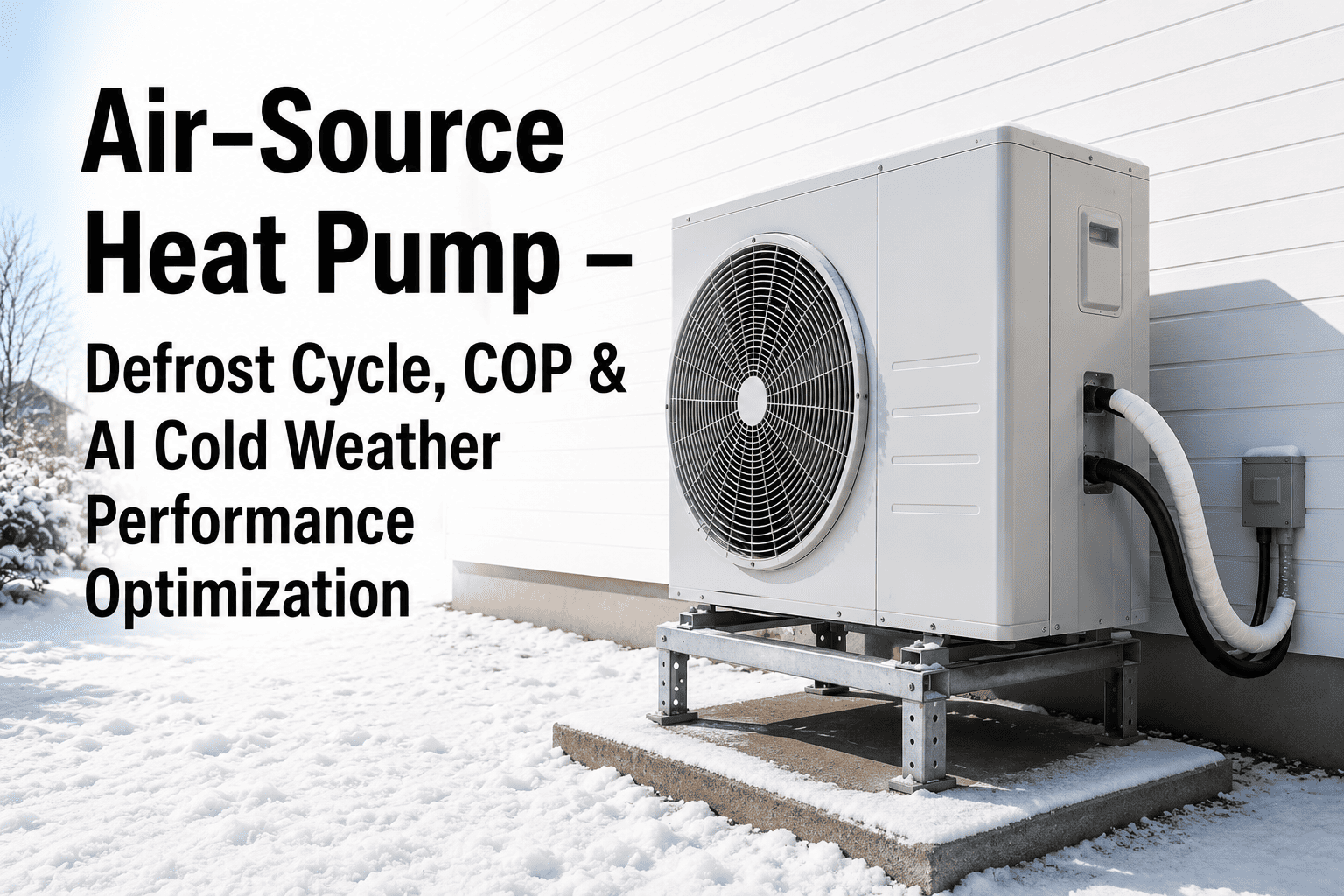
Commercial heat pumps do the work of two systems with one unit — heating in winter, cooling in summer, all controlled by a reversing valve that flips refrigerant flow direction. That dual-mode design makes them extraordinarily efficient when maintained well, and extraordinarily problematic when neglected. A heat pump that struggles in February isn't broken — it's been telling you for months that something was off. iFactory Heat Pump Operations Intelligence tracks every defrost cycle, reversing valve switch, and auxiliary heat call across your portfolio. Book a demo to walk through a complete commercial heat pump program.
The Complete Commercial Heat Pump Playbook
A practical guide to keeping commercial heat pumps efficient year-round — from defrost cycle integrity and reversing valve health to auxiliary heat governance and seasonal changeover discipline.
Valve
Where Heat Pump Maintenance Earns Its Keep
Heat pumps share components with conventional HVAC, but five subsystems are unique to their dual-mode operation. Each one has its own failure signature, its own inspection rhythm, and its own consequences when ignored. These are the areas a credible PM program touches every cycle.
Refrigerant Charge Integrity
Even a 10% undercharge drops system COP measurably and accelerates compressor wear. Every PM should include suction/discharge pressure logging, superheat and subcooling, and accessible joint leak checks.
Reversing Valve Operation
The valve that flips refrigerant flow between heating and cooling. Should produce an audible click on changeover. Partial failures cause mid-mode confusion — the system can't fully heat or fully cool.
Defrost Cycle Logic
Defrost control board, outdoor coil sensors, and reversing valve coordinate to clear ice off the outdoor coil. Test boards, verify sensor resistance, and confirm cycle initiation through control jumpers.
Auxiliary Heat Governance
Electric resistance strips or gas furnace backup. Lockout setpoint critical — too low and the system runs aux heat continuously; too high and indoor comfort suffers during defrost or extreme cold.
Controls & Sensors
Outdoor air temperature sensor, indoor air sensor, defrost sensors, and balance-point logic. Sensor drift creates phantom problems that look like equipment failures but are actually calibration issues.
Reading the Defrost Cycle Like a Technician
A healthy defrost cycle has a specific signature — sounds, visuals, and sensor patterns that experienced technicians can read instantly. The signals below separate normal operation from emerging trouble, and they're observable without opening any panels.
Normal Defrost Signals
Defrost Failures to Catch Early
Switching Modes Without Performance Loss
Spring and fall are the strategic service windows for heat pumps. The system transitions between cooling and heating roles, and the prep work done in these shoulder seasons determines how well the unit performs through the next extreme. Here's what each changeover actually requires.
Cooling → Heating
The most critical service window. Validates the heating side before the first cold snap reveals problems.
Heating → Cooling
Inspect what winter damaged. Restore cooling capacity before first warm days reveal hidden issues.
See Every Heat Pump in Your Portfolio on One Live Schedule
Our team maps your heat pump inventory, balance-point setpoints, and aux heat strategies — and configures the full year-round PM calendar in iFactory with mobile workflows for every technician.
The Readings That Tell You a Heat Pump Is Healthy
Every visit should produce documented measurements, not just visual checks. The benchmarks below are the readings credible PM programs capture every cycle — and the ranges that separate healthy operation from emerging trouble.
| Measurement | Healthy Range | What It Signals | Mode |
|---|---|---|---|
| Suction Pressure | Within mfr spec for OAT | Charge level, evap performance | Both |
| Discharge Pressure | Within mfr spec for OAT | Condenser performance, charge | Both |
| Superheat | 8–15°F typical | Charge sufficiency | Both |
| Subcooling | 10–15°F at condenser | Refrigerant flow & charge | Both |
| Defrost Frequency | 60–90 min in moderate cold | Coil condition, sensor health | Heating |
| Reversing Valve Click | Audible at mode change | Valve solenoid & mechanical | Both |
| Aux Heat Lockout OAT | 25–35°F (varies by climate) | Balance-point governance | Heating |
From Complaint Symptom to Root Cause
Heat pump complaints follow predictable patterns. Each symptom maps to a small handful of likely root causes — and knowing the map shortens diagnostic time dramatically. The translation table below is the technician's shortcut.
Frequently Asked Questions
How often should commercial heat pumps receive professional service?
Commercial heat pumps benefit from bi-annual professional service — one in spring during cooling-to-heating transition prep, and one in fall before heating season. Quarterly visits are recommended for high-demand environments, severe climates, or systems with mission-critical loads. Monthly visual checks of filters, drain pans, and outdoor coil debris should occur throughout the year regardless of service contract frequency.
Why does my heat pump's defrost cycle blow cold air briefly?
During defrost, the reversing valve temporarily flips the system into cooling mode to send hot refrigerant to the outdoor coil and melt accumulated ice. Auxiliary heat usually kicks in to maintain indoor comfort, but if it's locked out or lagging, occupants may feel a brief cool draft. Cycles lasting more than 10 minutes or recurring more than once an hour signal a problem worth investigating.
What's the role of auxiliary heat in a commercial heat pump?
Auxiliary heat (electric resistance strips or gas furnace backup) supports the heat pump when outdoor temperatures fall below the system's balance point, when defrost cycles temporarily reduce capacity, and during morning warmup recovery. The lockout setpoint must be calibrated correctly — too aggressive and aux heat runs continuously, driving up energy costs; too conservative and indoor comfort suffers during demand peaks.
How do I know if the reversing valve is failing?
Listen for the audible click when the system changes modes (calling heat versus calling cool). No click usually indicates a solenoid coil failure. Other warning signs include reduced capacity in one mode but normal in the other, mid-position stuck conditions where the system can't fully heat or cool, and unusual differential pressures in heating versus cooling. A failing reversing valve is one of the more expensive repairs — early detection is essential.
How does iFactory help manage commercial heat pump fleets?
Each heat pump is registered as an asset with model, refrigerant type, balance-point setpoint, and aux heat configuration. Seasonal changeover PM templates auto-generate as work orders in spring and fall. Technicians complete checklists on mobile devices, capture pressure readings and reversing valve test results, and photo-document outdoor coil condition. Property managers see fleet-wide compliance, defrost cycle trends, and aux heat usage anomalies from one dashboard.
Run Every Heat Pump Like an Engineering Discipline
Stop discovering heat pump problems through tenant complaints and January emergency calls. Combine seasonal PM, defrost cycle monitoring, and reversing valve diagnostics into one platform built for commercial portfolios.