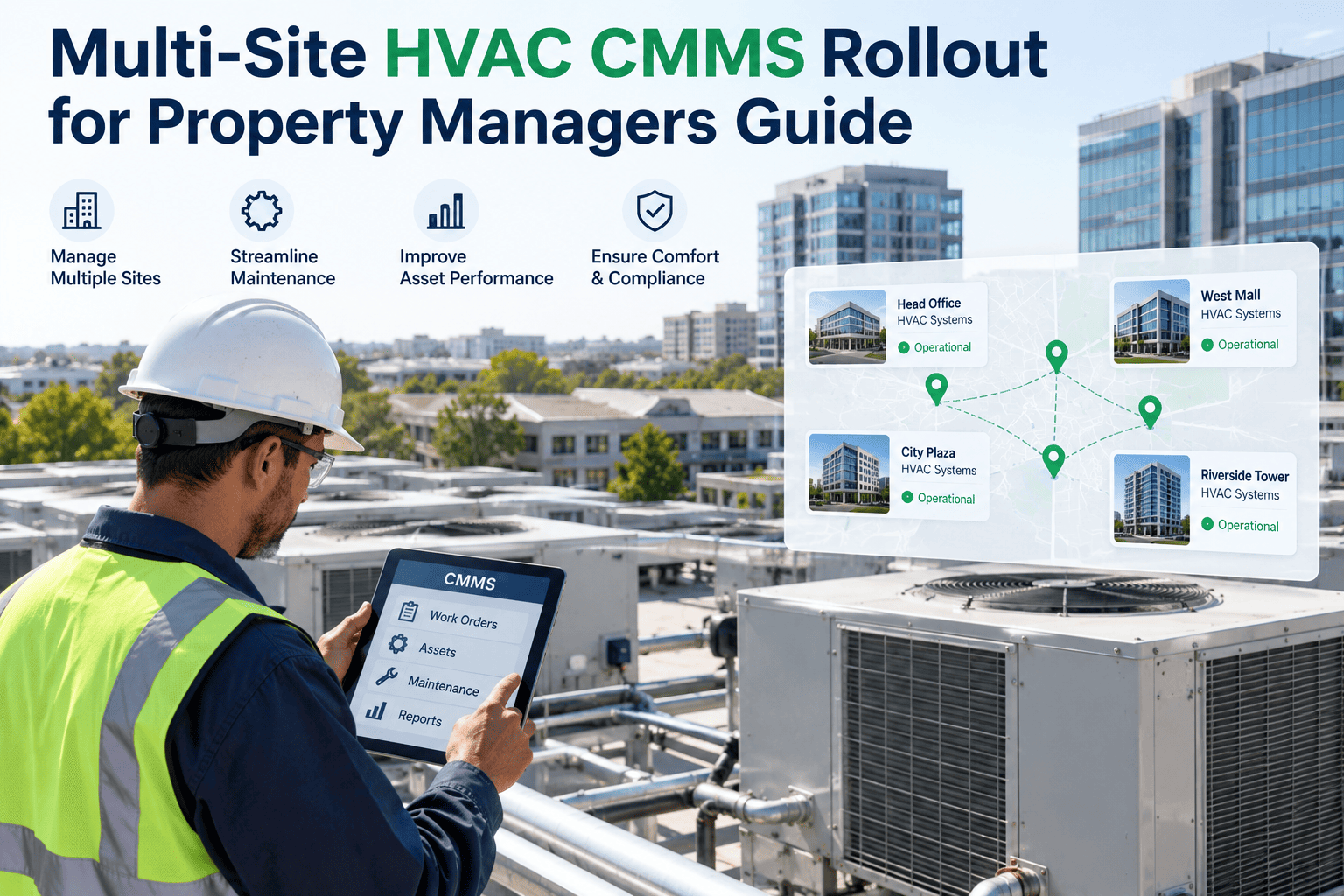
Running a commercial property requires strict oversight of HVAC equipment to avoid costly tenant disruptions and capital replacements. Commercial HVAC systems typically consume 40–60% of a building's total energy, making them the largest operational expenditure for facility managers. A comprehensive commercial HVAC Analytics checklist replaces reactive repairs with proactive health monitoring. By integrating asset data directly into SAP PM workflows, facility managers track baseline performance across chillers, split systems, and rooftop units. Modern HVAC preventive maintenance strategies leverage an AI digital twin, PLC sensor networks, and OBD diagnostics to automate HVAC service schedules entirely. Employing AI camera vision for thermal imaging ensures that developing anomalies—such as refrigerant leaks or condenser fouling—are documented and resolved well before they compromise your building's HVAC schedule.
Commercial HVAC Analytics Checklist for Property Managers
Transition your building from calendar schedules to AI-assisted preventive frameworks. Automate your property manager HVAC inspections and drastically cut costs by tracking equipment runtime logs and approach temperature trending.
The 4-Layer Analytics Ecosystem Check
An enterprise-scale HVAC environment relies on decentralized, cross-talking components to surface failure points automatically. Building HVAC Analytics shifts maintenance from "fix-on-fail" to predictive intelligence. Moving beyond standard visual inspections, our 4-layer integration monitors filter differential pressure, energy consumption, and high-pressure cutouts in real-time.
Optical Thermal Logic & IAQ
Facility-wide AI Camera Vision scanning ensures thermal overload is caught actively. Integrated IAQ (Indoor Air Quality) sensors measure CO2 and humidity to detect faulty ventilation before tenants complain.
Live Equipment Metrics via IoT
High-frequency PLC data combined with OBD gateway analysis sets a digital baseline for energy consumption. This highlights combustion efficiency issues and prevents redundant equipment wear.
Predictive Digital Twin Models
AI digital twin staging continuously runs fault simulation on live operational metrics. System calibration models detect approach temperature deviations in cooling towers immediately.
CMMS & Work Order Automation
Replaces the traditional paper-based HVAC inspection form. Automated SAP PM generation instantly deploys technicians—maintaining perfect compliance logs for EPA refrigerant tracking without human error.
Condition-Based Asset Inspection Matrix
Standard checks often miss microscopic scale buildup in chillers or loose combustion connections. Use this rooftop unit checklist and chiller analytics checklist breakdown to understand exactly what parameters are dynamically monitored.
| Commercial Equipment | Primary Subsystem | Digital Analytics Checkpoint |
|---|---|---|
| Rooftop Units (RTU) | Economizers & Belts | Track massive airflow impedance via differential pressure drops. |
| Split Systems | Condensers & Fans | Monitor tight OBD error codes targeting cooling fade and refrigerant charge. |
| Central Chillers | Evaporation Units | Gauge AI camera thermal deviation immediately for compressor longevity. |
| Cooling Towers | Float & Media Fill | Log PLC current draw vibration across standard loads to prevent fan motor failure. |
Monthly to Annual Execution Modules
Aligning your HVAC schedule directly with analytical insights guarantees you are meeting your expected equipment runtime hours without burning through budgets.
Verify PLC sensor telemetry. Address high filter pressure-drops to ensure massive energy spikes aren't triggered by blocked airflows. Check condensate pans automatically.
Run thermal scan via AI camera vision. Check split system pressure lines specifically. Prevent mold development and confirm setpoint overrides are removed from the BAS.
Process AI digital twin forecasting loops. Optimize auto-work orders deployed by SAP integration. Examine seasonal combustion efficiency logs.
Utilize detailed CMMS reports for comprehensive insurance and compliance auditing. Ensure all refrigerant tracking documentation perfectly matches environmental standards.
120-Day Dashboard Rollout
Facility Hardware Install
Deploy heavy duty thermal cameras rapidly alongside PLC module integrations to capture fundamental building HVAC analytics.
Digital Twin Blueprinting
Twin software learns baseline performance models straight from direct mechanical behavior, logging specific chiller analytics.
Predictive Anomaly Tuning
OBD alerts refine prediction accuracy, cross-referencing your HVAC inspection checklist logic continually.
SAP Automated Dispatch Live
Service tickets materialize seamlessly within SAP PM the moment anomaly failure shifts into a mathematical probability.
What a Facility Director Said
Since executing this checklist connected with PLC streams, we totally eliminated reactive emergency disruptions. The digital twin precisely highlights which specific RTU components demand servicing well before clients start sweating upstairs.
Property Manager Diagnostic Queries
What precisely is an AI digital twin representation?
A highly focused responsive simulation directly mirroring mechanical behavior to predict specific hardware deterioration successfully.
Does PLC sensor equipment communicate nicely with SAP?
Absolutely. Properly configured gateways interpret telemetry translating them into comprehensive preventative tickets, keeping records pristine.
Why is keeping a thorough commercial HVAC checklist necessary?
It actively serves to monitor equipment trends like refrigerant leaks and evaporator coil conditions, saving property managers heavily.
Why mandate embedded OBD modules?
It safely provides fault specifics completely aligned with production standards shrinking manual diagnostic efforts massively.
Automate Your Building Strategy
Integrate advanced analytics streams directly into commercial maintenance routines.