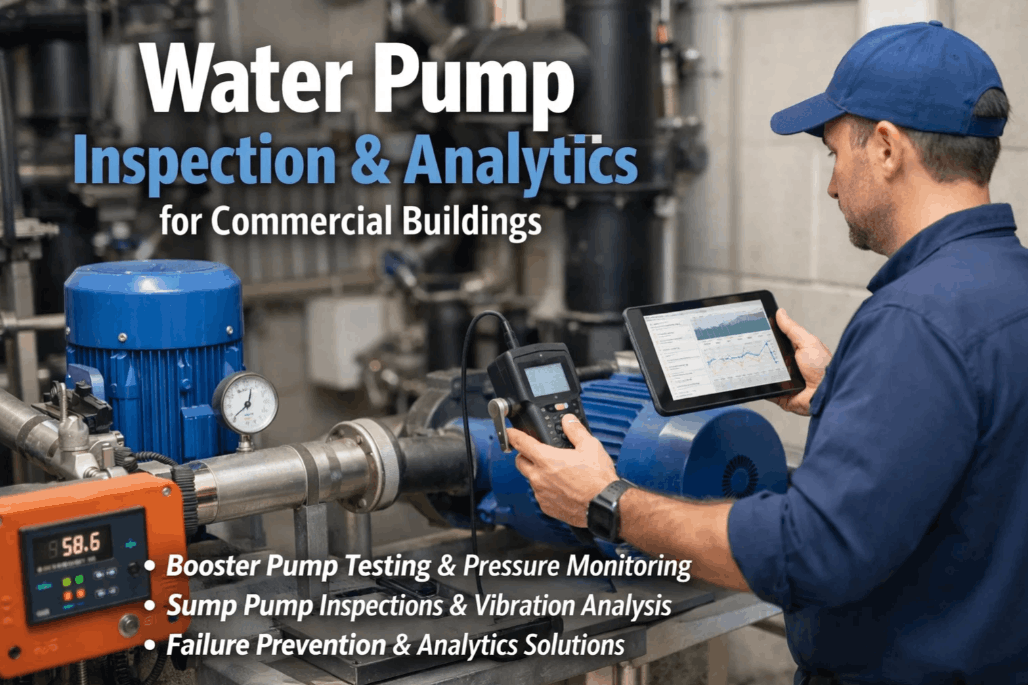
Water pump failure in a commercial building doesn't announce itself — it silently escalates from a minor pressure drop to a complete water supply interruption, a flooded basement, or a fire suppression system that fails its weekly flow test. Commercial properties depend on a layered pump infrastructure: domestic booster systems pressurizing upper floors, sump and ejector pumps managing groundwater and sewage, cooling tower circulation pumps, fire pump assemblies, and irrigation booster systems — each with its own inspection schedule, failure mode profile, and compliance obligation. A structured water pump inspection and analytics program for commercial buildings replaces reactive emergency calls with predictive, data-driven maintenance that catches failing seals, worn impellers, cavitation damage, and motor bearing degradation weeks before catastrophic failure. Book a demo to see how iFactory's building maintenance platform automates your entire pump inspection and analytics workflow.
Automate Commercial Building Pump Inspections — From Booster Systems to Sump Pumps, One Platform
iFactory's building maintenance platform delivers digital pump inspection checklists, automated PM scheduling, vibration baseline tracking, pressure trend monitoring, and one-click compliance documentation — purpose-built for commercial property maintenance teams.
Why Commercial Building Pump Programs Fail Before Failure Occurs
The fundamental problem with pump maintenance in commercial buildings is that failure symptoms are invisible to routine visual inspection until the failure is imminent. Impeller wear reduces pump efficiency by 8–15% before any pressure drop is noticeable at fixture level. Mechanical seal degradation allows water intrusion into motor windings for months before electrical failure. Bearing wear produces vibration signatures detectable by sensor weeks before the bearing seizes — yet most building maintenance programs rely on monthly visual checks and reactive work orders when tenants report low water pressure or flooding.
Buildings with five or more pump assets operating without a structured analytics and inspection program spend 3–4x more on emergency pump replacement than properties using preventive maintenance schedules with baseline performance tracking. More critically, a domestic booster pump failure in a mid-rise office building can affect water service to hundreds of occupants simultaneously — a tenant-facing failure that directly impacts lease renewals and property reputation. Schedule a pump program assessment to benchmark your current maintenance approach.
Commercial buildings with structured pump PM programs and pressure/vibration baseline tracking report 67% fewer emergency pump failures and 45% lower annual pump maintenance costs compared to reactive-only maintenance programs. For a mid-rise office property with 8–12 pump assets, this translates to $18,000–$40,000 in avoided emergency service and replacement costs annually.
Commercial Building Pump Types: What You're Actually Maintaining
A complete pump analytics program for a commercial building must address each pump type's unique failure profile, inspection interval, and performance baseline. Generic PM checklists that treat all pumps identically miss the failure modes that matter most for each application.
Domestic Water Booster Pumps
Pressurize water supply to upper floors in mid-rise and high-rise buildings. Key failure modes: impeller wear reducing flow rate, pressure tank bladder failure, pressure switch drift, and motor thermal overload from continuous duty cycling. Inspect pressure differential, amp draw, and cycle frequency monthly.
Sump Pumps & Ejector Pumps
Critical for below-grade areas — pump pits, parking structures, elevator shafts, and mechanical rooms. Failure during heavy rain events causes rapid flooding and infrastructure damage. Test float switch operation and pump activation monthly; full flow test quarterly. Backup pump operation verification is mandatory.
Fire Pump Assemblies
NFPA 25 mandates weekly churn test, monthly flow test records, and annual full-flow acceptance test for fire pump systems. Diesel-driven and electric fire pumps have distinct inspection protocols. Any deficiency must be corrected immediately or documented with an impairment procedure — no deferral permitted.
Cooling Tower & HVAC Circulation Pumps
Chiller plant primary/secondary pumps, condenser water pumps, and cooling tower fill pumps operate continuously during cooling season. Vibration analysis, bearing temperature, and flow rate trending detect wear before efficiency degrades to a point affecting cooling capacity and energy consumption.
Sewage Ejector & Greywater Pumps
Lift below-grade plumbing fixtures above the sewer main invert. Failure results in sewage backup into occupied spaces — the most urgent and damaging pump failure scenario. Float switch fouling, impeller clogging, and check valve failure are primary failure modes requiring quarterly inspection.
Irrigation & Landscape Booster Pumps
Seasonal pump systems with distinct startup, mid-season, and winterization inspection protocols. Common failures: strainer clogging reducing flow, pressure switch corrosion, and seal damage from dry-running during irrigation system startup without prime verification.
Complete Water Pump Inspection Schedule for Commercial Buildings
A compliant and effective pump analytics program requires four inspection frequencies, each targeting the failure modes most likely to develop at that interval. The table below defines the industry-standard inspection schedule for each pump type in a commercial property — the framework that iFactory digitizes, schedules automatically, and documents for audit review. Book a demo to see how this schedule activates for your building's specific pump inventory.
| Inspection Item | Weekly | Monthly | Quarterly | Annual | Reference Standard |
|---|---|---|---|---|---|
| Fire Pump Churn Test | Required | Flow test | — | Full-flow acceptance | NFPA 25, Sec. 8.3 |
| Booster Pump Pressure Check | — | Required | Full PM | Overhaul assessment | ASHRAE O&M Guidelines |
| Sump Pump Float Test | — | Required | Full flow test | Pit cleaning + pump inspection | IPC Section 1113 |
| Vibration Baseline Check | — | — | Required | Trend analysis | ISO 10816-3 |
| Motor Amp Draw Measurement | — | Required | Full PM | Motor inspection | NEMA MG 1 |
| Mechanical Seal Inspection | — | Visual check | Leak rate assessment | Seal replacement eval. | HI Standard 1.4 |
| Coupling & Alignment Check | — | — | Required | Precision laser alignment | HI 1.5, ANSI standards |
| Pressure Tank Bladder Test | — | — | Required | Full pressure test | ASME Boiler & Pressure |
iFactory Pump Analytics Platform: Measured Building Outcomes
Commercial properties deploying iFactory's pump inspection and analytics module report consistent improvements in pump reliability, compliance documentation, and maintenance cost control. Book a demo to see these results demonstrated on a building maintenance platform live.
Pump Vibration Analysis: The Most Powerful Early Warning Tool
Vibration analysis is the single most effective predictive maintenance tool for rotating pump equipment — capable of detecting bearing defects 4–8 weeks before failure, impeller imbalance within one inspection cycle, and misalignment that increases seal wear and bearing load with every operating hour. ISO 10816-3 defines vibration severity zones for pumps over 15 kW, providing objective acceptance criteria that remove subjectivity from condition assessment.
What Vibration Signatures Reveal
Each pump failure mode produces a characteristic vibration frequency signature that trained analysis can identify in the early stages — long before mechanical damage is visible or audible. iFactory's vibration tracking module captures baseline readings at commissioning and trends deviations at each quarterly inspection, flagging signatures that indicate specific developing failure modes. Schedule a demo to see the vibration trending dashboard in action.
Vibration Fault Signatures — What iFactory Detects
- 1× RPM dominant frequency: Impeller imbalance or bent shaft — requires balance correction before bearing damage escalates
- 2× RPM dominant frequency: Misalignment between pump and motor — realignment required, seal wear accelerating
- Bearing defect frequencies (BPFO/BPFI): Inner or outer race bearing defect — predictive replacement window typically 4–8 weeks before catastrophic failure
- Blade pass frequency (BPF × impeller vanes): Cavitation, excessive wear ring clearance, or recirculation — impeller assessment required
- Sub-synchronous frequencies: Fluid instability, surge, or rotor rub — immediate operational review required to prevent rapid escalation
- High-frequency broadband noise floor rise: Early-stage bearing lubrication breakdown — relubrication or replacement depending on severity trend
ISO 10816-3 Vibration Severity Zones (Pumps 15–300 kW)
- Zone A (0–2.3 mm/s RMS): New or recently overhauled equipment — acceptable for long-term operation
- Zone B (2.3–4.5 mm/s RMS): Normal wear — suitable for continued operation with increased monitoring frequency
- Zone C (4.5–7.1 mm/s RMS): Alarm threshold — schedule corrective maintenance within 30–60 days
- Zone D (above 7.1 mm/s RMS): Danger zone — immediate maintenance required, risk of catastrophic failure during continued operation
Booster Pump Troubleshooting: Common Failures & Root Causes
Domestic water booster pump failures in commercial buildings follow predictable patterns that structured inspection data makes visible weeks before service interruption. Understanding the root cause chain behind each symptom is critical for selecting the correct corrective action — not just restarting the pump and waiting for the next failure.
Low Discharge Pressure
Root causes in order of frequency: worn impeller reducing flow capacity (check pump curve performance vs. design), pressure tank bladder failure causing rapid cycling and pressure loss, suction strainer partially blocked increasing NPSH requirements, or pump speed reduction from motor voltage issues. iFactory's pressure trend log distinguishes gradual decline (wear) from sudden drop (blockage or failure).
Frequent Short Cycling
Pump starting and stopping more than 6–8 times per hour indicates pressure tank pre-charge failure — typically bladder rupture allowing waterlogging. Continued short cycling causes motor winding overheating and contactor pitting that dramatically shortens motor life. Pressure tank replacement is required; continuing operation without correction accelerates motor failure within weeks.
Excessive Motor Amp Draw
Amp draw above nameplate FLA indicates mechanical restriction (bearing seizure, impeller rubbing), excessive head conditions from partially closed discharge valve, or motor winding degradation from previous thermal events. Compare to baseline amp draw recorded at commissioning — a 10–15% increase above baseline is the maintenance trigger threshold.
Mechanical Seal Leakage
Visible water dripping from the pump seal area indicates seal face wear or misalignment. A small amount of moisture at seal faces is normal — active dripping is not. Seal replacement deferred beyond initial detection allows water to track along the shaft into motor windings, converting a $200–400 seal job into a $2,000–8,000 motor rewind or replacement.
Pump Maintenance Implementation: Digital Program Deployment
Deploying a structured digital pump inspection and analytics program for a commercial building requires systematic pump asset registration, PM schedule configuration, and baseline performance data capture. iFactory's building maintenance platform guides this process with pre-built pump PM templates that activate within days — not weeks — of deployment.
Pump Asset Registry & Baseline Data Capture
Every pump in the building is registered as a digital asset — type, model, impeller size, design pressure, motor HP, and location. Nameplate data, last service date, and current performance baseline (pressure, amp draw, vibration reading) are captured and stored. For fire pumps, the most recent NFPA 25 test results are imported to establish compliance starting point.
PM Schedule Activation & Checklist Configuration
Inspection frequencies are configured per pump type — weekly for fire pumps, monthly for booster and sump pumps, quarterly for vibration and coupling checks. Each PM work order auto-generates the correct checklist for that pump type and inspection interval. Technicients receive mobile notifications with pre-populated forms and access to the pump's full history.
Performance Trend Establishment
Three to four inspection cycles establish the performance trend baselines — pressure curves, amp draw patterns, and vibration signatures — that make anomaly detection meaningful. iFactory flags deviations from established baselines rather than relying on generic alarm thresholds that don't account for building-specific pump configurations.
Predictive Analytics & Compliance Reporting
AI-powered trend analysis identifies pumps approaching failure based on performance degradation rates. NFPA 25 fire pump compliance reports are generated automatically after each test. Building owners receive monthly pump fleet health dashboards with upcoming PM schedules, open corrective actions, and lifecycle cost projections for aging assets.
Ready to Replace Reactive Pump Repairs with a Predictive Maintenance Program?
iFactory's pump PM module activates within days — delivering digital inspection checklists, pressure and vibration trending, and NFPA 25 compliance documentation for your entire building pump fleet.
Frequently Asked Questions: Commercial Building Water Pump Analytics
Booster Pumps. Sump Pumps. Fire Pumps. HVAC Circulation. All Automated.
Digital inspection checklists, NFPA 25 compliance documentation, vibration trending, and predictive failure alerts — activated for your building pump fleet in days, not weeks.