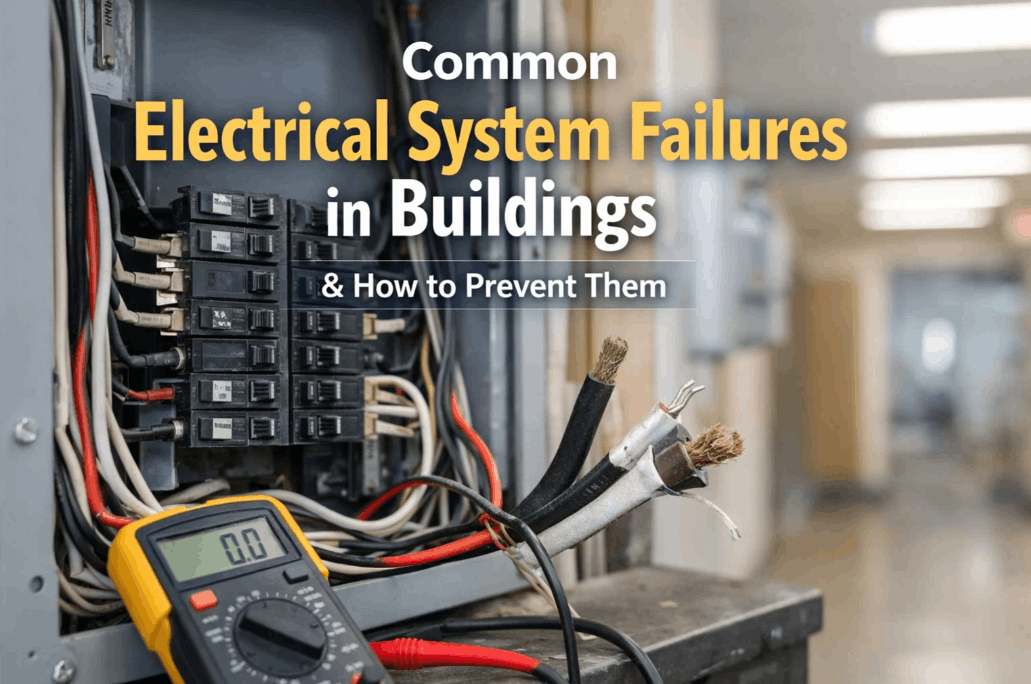
In the high-stakes environment of commercial real estate, electrical failure isn't just a maintenance headache—it's a critical business threat. Statistics reveal that over 30% of all electrical incidents in buildings stem from a single, often invisible root cause: loose connections. While legacy facilities rely on "scheduled" repairs, modern electrical system failure prevention utilizes high-density telemetry to identify thermal fatigue, harmonic resonance, and insulation decay weeks before they manifest as smoke or outages. With NFPA 70B now serving as a mandatory standard for electrical maintenance programs (EMP), identifying and mitigating common failure points like arc faults and phase imbalances is no longer optional. Book a Failure Risk Audit to immunize your building's power grid.
Eliminate Common Electrical Failures & High-Voltage Hazards
Deploy AI-driven failure analytics to seamlessly detect loose terminations, track harmonic distortion, and secure aging wiring infrastructure.
Why Traditional Monitoring Misses Catastrophic Faults
In standard commercial operations, 98% of companies report that a single hour of electrical downtime can cost exceed $100,000. Yet, traditional SCADA and BMS systems only track binary states: is the power on or off? True building electrical reliability demands spectral-level insights, detecting the millisecond arcing and 3,000°F hotspots occurring within sealed switchgear. Without interconnected failure analytics, maintenance teams are forced into "Condition 3" risks—operating aging infrastructure to the brink of destruction. Book a platform demo to see how iFactory provides 24/7 failure visibility.
Advanced Telemetry for Building Electrical Hazards
iFactory's failure analytics suite monitors the primary risk factors that lead to catastrophic infrastructure loss. The system identifies mechanical decay and insulation failure weeks before physical protection devices respond.
Failure Prevention: Securing the Continuity of Load
Tracking failures in an empty warehouse is simple; protecting a live finance-trading floor or surgical suite requires zero-tolerance analytics. Our deployment architecture is explicitly forged for top-tier mission-critical assets.
Scenario 1: Main Busbar Hotspot Intercept
Thermal AI identifies a 30°F Delta-T rise on the main A-Phase busbar joint. A specialized technician finds a corroded bolt assembly. Repair is scheduled for a Tuesday night, saving the building from a catastrophic 12-hour unplanned outage.
Scenario 2: Data Center Harmonic Thermal-Runaway
Power quality sensors detect a massive THD spike following a server upgrade. The AI identifies neutral-wire overheating in Sector 4. High-capacity harmonic filters are installed 24 hours later, preventing a multi-million dollar UPS fire.
Scenario 3: 40-Year Wiring Insulation Catch
iFactory monitors a legacy 1980s office riser. The AI identifies 'Ground Resistance Drift' during high-humidity days. A sections of crumbling asbestos-wrapped wiring is replaced, preventing a "Condition 3" catastrophic riser fault.
Scenario 4: Compliance ISO/NFPA Certification
A global insurance provider demands proof of arc-fault mitigation. The manager exports the iFactory spectral compliance logs, proving continuous 24/7 arc-hiss monitoring across all switches, reducing premiums by 18% instantly.
Legacy Risk Management vs. Integrated Failure AI
Maintaining high-complexity electrical assets via annual visual checks is an unacceptable liability. Compare the traditional methodology against a continuous intelligence network.
| Failure Category | Annual Visual Check | Baseline SCADA Alarms | iFactory Failure AI |
|---|---|---|---|
| Loose Lugs/Connections | Physical 'wrench' check (Risky) | Static Amp-overload alarms | Continuous load-normalized thermal AI |
| Arc Fault Detection | Odor/Smoke sightings only | AFCI hardware trips | High-frequency spectral acoustic mapping |
| Harmonic Overheating | Never verified unless failure | Voltage fluctuation logs | 24/7 THD Harmonic order tracking |
| Aging Riser Health | Physical jacket inspection | Nuisance ground trips | Continuous insulation resistance parity |
| Compliance Documentation | Outdated paper binders (70B) | CSV manual log exports | Automated real-time NFPA 70B dynamic cert |
| Financial Risk Exposure | High (Unplanned downtime likely) | Moderate (Reacting to alarms) | Zero (Predictive fault-intercept) |
How iFactory Isolates and Detects Electrical Hazards
Monitoring for millisecond glitches requires extremely high sampling rates and abrasive industrial-grade shielding. Our architecture thrives in high-EMF environments.
High-Freq Transient Harvesting
iFactory sensors sample at frequencies in the megahertz range, allowing the AI to "see" the sub-cycle electrical transients that indicate arcing or corona discharge before they generate heat.
Wireless MCSA Mesh
Motor Current Signature Analysis (MCSA) allows us to use your building's wiring as a stethoscope, identifying mechanical failure in connected assets like pumps and compressors remotely.
Thermal Digital Twin Arrays
Integrates fixed-mount IR gateways into main panels. As harmonics rise, the analytical grid maps exactly how heat is distributing across phase-conductors versus ground-paths.
Autonomous Work Order Sync
All identified health drifts bypass standard warning queues and fire specialized 'Condition-Based' work orders into SAP or Maximo, satisfying the enforceable NFPA 70B standard.
Securing Your Building Against Failure: A 4-Phase Plan
Equipping an active property development requires executing safety upgrades with zero facility impact. Transforming electrical system failure prevention happens predictably over 6–8 weeks.
Electrical Vulnerability Mapping
The primary electrical risers and critical distribution panels are mapped. We establish the 'Design Load' vs. 'Actual Load' to identify immediate overloading risks and harmonic bottlenecks.
Transient & Thermal Instrumenting
Non-invasive high-frequency sensors and thermal hubs are snap-mounted to critical switchgear during standard operating hours. Wireless industrial mesh initializes the broad-spectrum data stream.
Threshold Tuning & Arc Sensitivity
The system begins building site-specific baselines. The AI 'learns' the difference between standard motor startups and anomalous arc-hiss or high-resistance thermal transients.
Autonomous Health Lifecycle
The central command center provides 100% visibility. Managers conduct targeted maintenance strictly based on failure indicators, guaranteeing zero unplanned downtime across the portfolio lifecycle.
Frequently Asked Questions: Preventing Building Power Failure
Eliminate Catastrophic Safety Blind Spots in Your Facility.
iFactory's electrical system failure analytics protect hundreds of millions of dollars in real estate assets and, more importantly, human lives, by delivering impenetrable dynamic fault testing and automated compliance telemetry.