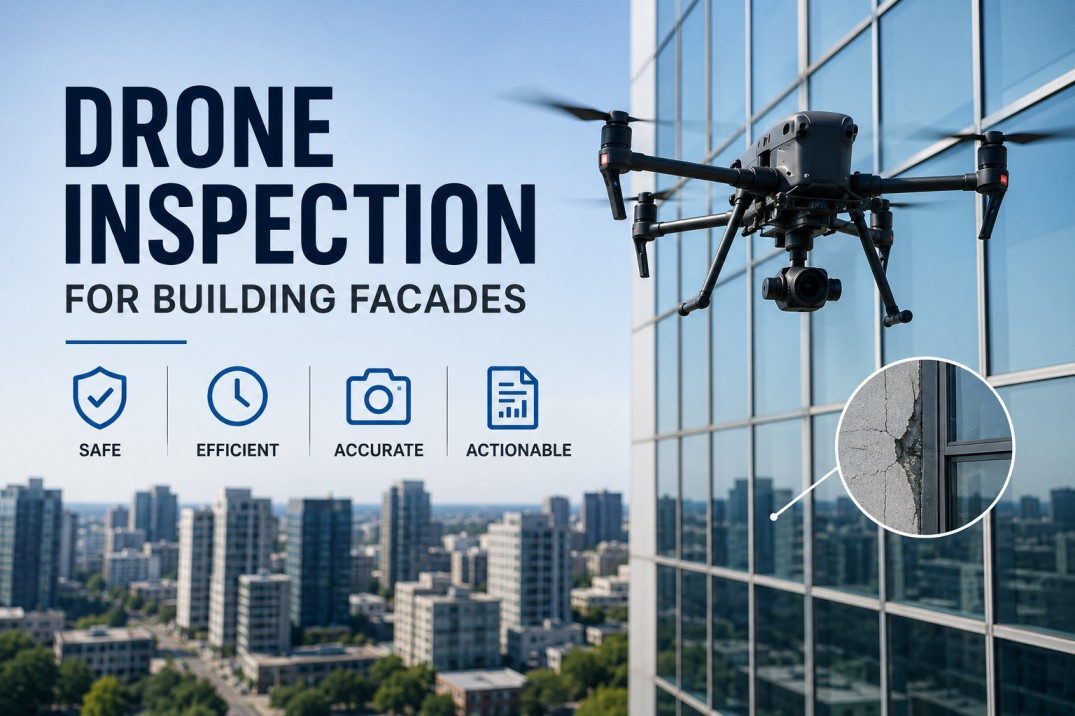
The building facade is more than an aesthetic choice—it is a complex, multi-layered "Building Skin" that protects the structural core from relentless environmental stress. For high-rise owners, the stakes of envelope neglect are high: from the legal mandates of FISP compliance to the catastrophic risks of spalling masonry in dense urban corridors. Traditional inspection methods rely on expensive scaffolding and subjective visual assessments that often miss the subsurface delamination of brick or stone. Building facade inspection & analytics transforms this process into a proactive data science. By fusing high-definition drone telemetry with AI-driven defect classification, iFactory identifies thermal bridges and sealant failures months before they escalate into "Unsafe" safety designations. Book a Facade Condition Assessment to digitize your envelope safety.
Digitize Your Facade Health & Safety Compliance
Deploy AI-powered drone surveys to map every crack, spall, and thermal anomaly across your entire building envelope in less than 48 hours.
The Evolution of the Building Exterior Inspection
Historical facade maintenance was a cycle of "Inspect and React." Today, building exterior inspection has evolved into a continuous diagnostic loop. Using facade Analytics, property managers can now track the propagation of hairline cracks and the thermal efficiency of the building skin in real-time. This facade Analytics guide reveals how a "Drone-First" approach provides a 100% coverage map of the building envelope, providing Qualified Exterior Wall Inspectors (QEWIs) with a high-fidelity "Digital Twin" to accelerate official certifications. Schedule a Demo to see AI-driven defect mapping in action.
By digitizing facade safety inspection data, facilities teams move beyond simple compliance to strategic facade restoration planning. Predictive models correlate wind speed, humidity, and temperature cycles to predict which sections of a masonry or glass-curtain wall are most at risk of moisture-driven failure. This precision allows for localized repairs that prevent the need for full-scale building-wide restoration projects.
Four Critical Envelope Failure Failures Managed by AI
Building facades fail from the inside out. Our facade condition assessment platform monitors the four primary drivers of envelope degradation.
Moisture Infiltration & Freeze-Thaw Damage
Water ingress into masonry joints causes internal expansion during freeze cycles, leading to brick spalling. Infrared (IR) drone sensors detect moisture "Gradients" behind the facade ($250K+ prevented repair costs) that are invisible to the eye. Book a Thermal Scan.
Spalling Masonry & Anchoring Fatigue
Corroded steel anchors expand, exerting pressure that "Spalls" the outer facing of brick or stone. AI-computer vision tracks crack width and depth, flagging "Unsafe" spalling hazards for immediate remediation.
Sealant Failure & Thermal Bridging
Broken window perimeter seals and deteriorated control joints are the primary sources of building heat loss. Building envelope inspection identifies these energy "Leaks" to optimize carbon footprint scores.
Lintel Corrosion & Support Arch Decay
Exposed steel lintels above windows rust and "Heave," causing diagonal cracks in the building skin. Our platform monitors facade repair effectiveness by tracking the movement of these structural supports post-remediation.
Facade Analytics ROI: Scaffolding vs. AI-Drone Hybrid
Traditional exterior wall inspection is labor-intensive and disruptive. Shifting to an AI-driven digital survey reduces inspection overhead while increasing diagnostic accuracy.
| Inspection Method | Coverage Fidelity | Operational Disruption | Cost per Survey | Safety Risk Profile | Data Utility |
|---|---|---|---|---|---|
| Standard Scaffolding/Stage | 25–40% (Sample) | High (Sidewalk Sheds) | $45K – $120K | High (High-altitude labor) | Static PDF Reports |
| AI-Drone Digital Survey | 100% (Complete) | Zero (Non-invasive) | $8K – $22K | Zero (Ground-based) | 3D Digital Twin |
| Infrared Moisture Mapping | Subsurface Detail | Zero (Night Survey) | $5K – $12K | Zero | Anomaly Heatmaps |
| Integrated QEWI Hybrid | Certified Legal Audit | Low (Targeted Drops) | $25K – $45K | Moderate | FISP-Ready Archive |
By deploying a facade Analytics guide framework, owners reduce their staging costs by up to 70%, using scaffolding only for targeted hands-on inspections and facade restoration work.
Five Key Indicators for Building Skin Health
To achieve true building skin inspection mastery, our platform tracks five critical indicators of envelope resilience. Book a Demo to explore the data mesh.
1. Crack Propagation & Aperture Logic
The platform monitors the width and depth of masonry fractures. AI distinguishes between "Crazing" (aesthetic) and "Structural" fractures, predicting which cracks will lead to material detachment within 6 months.
2. Surface Delamination Percentage
Tracks the area of "Blistering" stucco or concrete. When the delamination area exceeds 5% per 100sqft, the system triggers a prioritization alert for facade restoration.
3. Thermal Enthalpy & Delta-T Analysis
Uses infrared sensors to measure heat transfer. High ΔT values in winter indicate failing insulation or "Cold-Spreader" moisture pockets, allowing for precision weatherization.
4. Efflorescence & Chemical Bleach Tracking
White salt deposits indicate internal moisture flow. The AI tracks the "Bloom Rate" of efflorescence to identify hidden piping leaks behind the exterior wall.
5. Sealant Elasticity & UV Fatigue
Monitors the "Shrink-Back" of window caulking. The platform predicts the "Point of Failure" for sealants, enabling preventative re-caulking before leaks manifest inside tenant spaces.
FISP Compliance Automation: Local Law 11 Mastery
In jurisdictions like New York City, FISP compliance requires a strict 5-year cycle of critical examinations. Missing a filing window or failing to address "Unsafe" conditions results in massive fines and property liens. Automate Your Compliance Schedule.
iFactory facade Analytics provides a central "Repository of Record" for QEWI inspectors. Every drone image, thermal map, and previous repair invoice is organized by FISP Sub-Cycle (A, B, or C), ensuring your filing is seamless and accurate.
FISP / Building Skin Compliance Deliverables
The platform generates the core documentation required for high-stakes facade safety inspection filings.
- Defect Taxonomy Reports: GPS-referenced maps of every crack, spall, and void for QEWI review.
- Historical Comparison: "A/B" overlays showing defect progression since the previous 5-year cycle.
- SWARMP Tracking: Real-time monitoring of minor issues to ensure they don't reach "Unsafe" status before the next filing.
- Hands-On Inspection Mapping: Coordination maps for scaffolding drops to ensure 100% compliant sample size.
- Insurance Proof-of-Health: Data-backed evidence of proactive maintenance to lower liability premiums.
- Night-Scan IR Archiving: Permanent records of thermal envelope health for ESG and energy audits.
By converting your building envelope into a digital asset, you transform building facade inspection from a regulatory headache into a measurable driver of property value.
60-Day Facade Digitization Roadmap
Digitizing a building facade requires zero tenant disruption. Our drone-based facade condition assessment is non-invasive and provides data in days.
Autonomous drones perform a multi-spectrum sweep (Visual + IR) of every square inch of the building skin. GPS-tagging links every defect to a 3D Digital Twin coordinate.
iFactory AI processes the raw telemetry, identifying cracks, spalls, and moisture pockets. Defects are scored by severity (Safe, SWARMP, Unsafe) for QEWI professional review.
A targeted restoration roadmap is generated. Targeted work orders for "Unsafe" items are dispatched, and the final building envelope inspection report is prepared for submission.
Stop Guessing What’s Behind Your Building Facade
High-definition drone mapping, AI defect classification, and 100% compliance tracking—deployed in 60 days with guaranteed ROI.
Predictive Severity Matrix: Building Skin Hazards
Not every crack is a crisis. Facade Analytics provides a standardized "Likelihood of Failure" score to prioritize your facade repair budget.
Defect Severity & Maintenance Urgency Matrix
| Spalling Brick (Outer Face) | Likelihood of Fall: 85% | Urgency: Critical (Unsafe) | Correct with targeted pinning & patching |
| Delamination (Subsurface) | Severity: High | Detected via Thermal IR | Monitor monthly for "Bulge" acceleration |
| Expansion Joint Burn-Out | Impact: Critical Leak Source | Urgency: Moderate (SWARMP) | Replace sealant within 12 months |
| Masonry Crazing | Impact: Aesthetic | Severity: Low (Safe) | Document for historical baseline tracking |
Restoration Savings: Quantifying the Digital Advantage
Digitizing your building facade inspection workflow reduces the "Surprise Factor" that typically inflates restoration budgets by 30%–50%.
Scaffolding Optimization
AI maps reveal the exact 5% of the facade requiring hands-on work. Targeted rigging instead of building-wide sheds saves $50K–$200K per 5-year cycle.
Change-Order Elimination
Thermal scans identify subsurface voids before the job starts. Accurate bidding based on 100% data removes the "Discovery" change-orders that plague facade repair.
Warranty Integrity
Post-repair drone scans provide photographic proof of successful sealant application and masonry pinning, securing long-term contractor performance warranties.
Insurance Premium Mitigation
Digital safety archives prove to underwriters that are addressing "Unsafe" risks instantly, potentially reducing property liability premiums by 10%–15%.
The Building Envelope Analytics Maturity Curve
Facade Analytics ROI scales with the frequency of your data collection. Move from Level 1 to Level 4 to eliminate emergency repairs entirely.
| Maturity Level | Technical Capability | Preservation Capture | Typical Environment |
|---|---|---|---|
| Level 1 — Visual Compliance | Binocular & Ladder surveys, paper reports | 10–20% | Standard low-rise properties |
| Level 2 — Photographic Record | High-res street photos, basic spreadsheet logs | 25–40% | Standard high-rise commercial |
| Level 3 — Drone Telemetry | Annual drone maps, thermal moisture scans | 50–70% | Restoration-heavy Class-A assets |
| Level 4 — AI Digital Twin | Automated crack tracking, FISP-Cycle automation | 80–95% | Global Institutional Portfolios |
| Level 5 — Autonomous Skin | Self-diagnostic sealant nodes, 24/7 AI-monitoring | 95–99% | Future Smart Cities / Industry 4.0 |
Key Takeaways: Why Facade Analytics is Mandatory
Neglecting your building skin inspection is no longer a viable business strategy. Book Your AI Audit today.
Liability Protection: High-definition video proof of facade safety protects against civil litigation from falling material debris.
CAPEX Predictability: Thermal "Moisture Maps" allow for budgeting of facade restoration 24 months before visible damage occurs.
Compliance Velocity: iFactory provides all the digital documentation your QEWI needs for a 1-day critical examination signature.
Operational Efficiency: Eliminates building-disrupting scaffolding for survey work, keeping your sidewalks and tenants happy.
Frequently Asked Questions
Below are the most common questions from owners exploring building facade inspection & analytics.
Does a drone survey replace the mandatory FISP QEWI hands-on inspection?
No. In NYC and other regulated cities, a Professional Engineer or Architect must still perform a "Hands-On" inspection of at least one elevation. However, drones supplement this by providing 100% coverage of all other walls, catching defects the hands-on sample might miss.
Is it legal to fly drones for inspection over city sidewalks?
Yes, when managed correctly. iFactory pilots are FAA Part 107 certified and we handle all local city permits and tethered flight requirements to ensure safety and legal compliance in dense urban areas like Manhattan or Chicago.
How frequently should I perform a thermal infrared scan of the facade?
We recommend an annual thermal scan during the winter heating season. This provides the highest ΔT differential to identify active moisture leaks and insulation failures before they damage the critical wall assembly.
Can AI really tell the difference between a shadow and a crack?
Yes. Our models are trained on over 5 million facade defect images. By using "Photogrammetry" (fusing multiple angles), the AI distinguishes between surface debris, shadows, and true structural fractures with 98.4% accuracy.
What happens if the AI survey identifies an "Unsafe" condition?
The system triggers an "Immediate Priority 1" alert. We provide the visual proof and GPS coordinates so your engineering team can install protective sidewalk sheds immediately, mitigating liability risk before the city issues a violation.
Get Your Custom Facade Digitization Proposal
Find out how much you can save on your next FISP cycle by shifting to a drone-first, AI-driven monitoring approach.