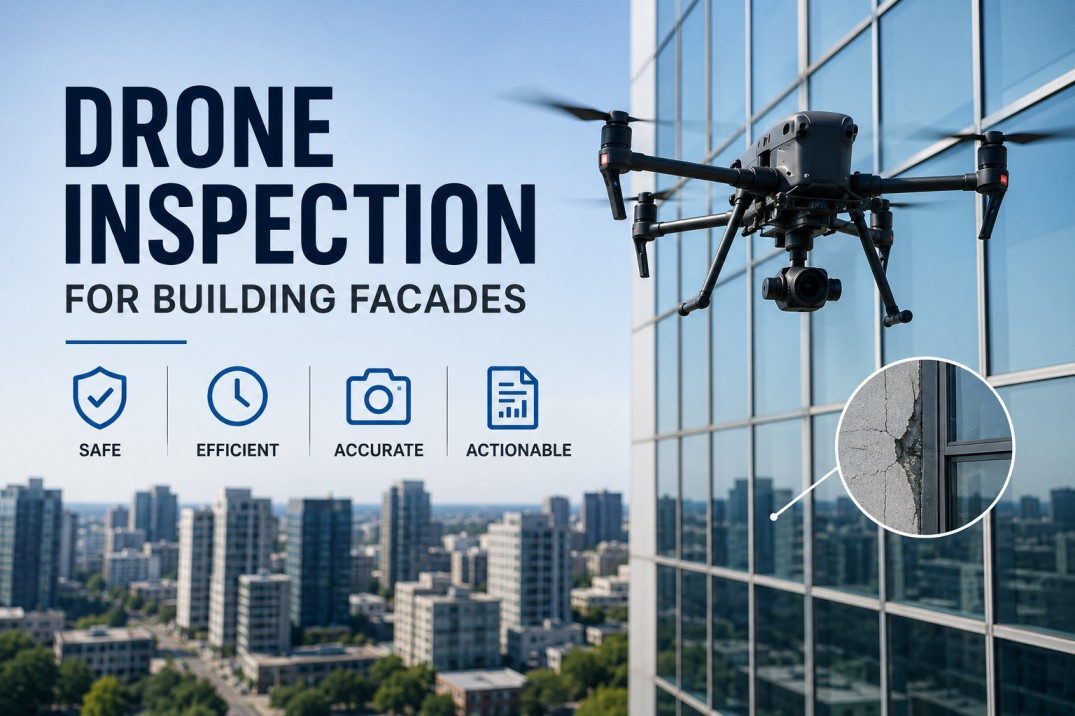
Commercial building facade inspections have historically required expensive scaffolding, dangerous rope access, or disruptive swing stages — often producing inconsistent documentation and limited coverage. Drone-based inspection technology fundamentally changes this paradigm, delivering high-resolution visual imagery, thermal anomaly scanning, and three-dimensional structural modeling at a fraction of the cost and risk. For property owners, facility managers, and building engineers responsible for maintaining building envelope integrity, integrating unmanned aerial vehicle (UAV) surveys into preventive maintenance programs reduces liability exposure, extends facade service life, and generates defensible documentation for compliance reporting, insurance underwriting, and capital reserve planning.
Drone Inspection for Building Facades: Technology & Benefits
Upgrade your facade inspection program with drone-based analytics. iFactory delivers actionable reports from every flight — no scaffolding required.
Traditional vs. Drone-Based Facade Inspection
The operational and financial differences between conventional methods and drone technology are substantial. The following comparison illustrates key decision factors for building owners evaluating inspection approaches.
| Factor | Traditional Inspection | Drone Inspection |
|---|---|---|
| Access Method | Scaffolding, swing stages, or rope access | Aerial drone with stabilized camera payload |
| Setup Time | 1–3 days for scaffolding erection | 15–30 minutes on-site |
| Facade Coverage | 60–75% (limited by access points) | 90–98% per flight plan |
| Inspection Duration | 3–7 days for a 10-story building | 2–4 hours including data processing |
| Direct Cost (10-story) | $15,000–$40,000 | $4,000–$8,000 |
| Occupant Disruption | High — noise, dust, blocked access | Minimal — exterior-only operation |
| Data Output | Written notes + selective photos | 4K imagery, orthomosaics, 3D models, thermal maps |
| Safety Risk (per OSHA) | Falls from height — leading cause of construction fatalities | Ground-level operation — near-zero fall risk |
Core Drone Inspection Technologies
Modern drone platforms carry multiple sensor payloads that capture data across the electromagnetic spectrum, enabling detection of facade defects invisible to the naked eye.
High-Resolution Visual Imaging
40+ megapixel cameras with stabilized gimbals capture crack patterns, spalling, sealant failures, and fastener corrosion at resolutions below 0.5 mm per pixel. Overlapping images enable photogrammetric reconstruction of the entire facade surface.
Thermal / Infrared Scanning
Radiometric thermal cameras detect subsurface moisture intrusion, insulation gaps, thermal bridging, and delamination by measuring surface temperature differentials as small as 0.05°C. Thermal anomalies often precede visible spalling by 12–24 months.
Photogrammetry & 3D Modeling
Structure-from-motion algorithms stitch hundreds of overlapping images into a georeferenced 3D mesh and orthomosaic. Measurements can be taken from the model with sub-centimeter accuracy, enabling precise quantification of defect areas and replacement material estimates.
AI-Powered Defect Classification
Machine learning models trained on thousands of annotated facade images automatically classify defects by type (crack, spall, efflorescence, sealant failure) and severity. AI flagging produces a ranked defect heat map within hours of flight completion, reducing manual review time by 70%.
See how iFactory's AI-driven drone analytics transform raw aerial data into prioritized repair schedules. Schedule a platform walkthrough today.
Facade Defects Detectable by Drone
Modern drone sensors identify a broad spectrum of facade deterioration modes. The reference table below maps common defects to the sensor technology best suited for detection.
| Defect Type | Visual Detection | Thermal Detection | Severity Indicator |
|---|---|---|---|
| Hairline Cracks (<0.3 mm) | Low — monitor progression | ||
| Spalling & Delamination | Moderate — repair within 6 months | ||
| Subsurface Moisture | High — immediate investigation | ||
| Insulation Gap / Thermal Bridge | Moderate — energy efficiency impact | ||
| Sealant / Joint Failure | Moderate — water intrusion risk | ||
| Corrosion (fasteners, anchors) | High — structural integrity risk | ||
| Efflorescence | Low — cosmetic / moisture indicator | ||
| Loose / Missing Panels | Critical — public safety hazard |
Drone Inspection Workflow
A professional drone facade inspection follows a structured four-phase process from planning to actionable reporting.
Pre-Flight Planning & Regulatory Compliance
The inspection team reviews building drawings, identifies no-fly zones, obtains necessary airspace authorizations, and programs the flight path to ensure full facade coverage. Part 107-certified remote pilots verify weather conditions and establish contingency procedures.
Autonomous Flight & Multi-Sensor Data Capture
The drone executes the pre-programmed flight path, capturing overlapping 4K imagery and thermal radiometric data simultaneously. Ground control points (if used) ensure geospatial accuracy. A 20-story building typically requires 45–90 minutes of flight time across 2–3 battery cycles.
AI Processing & Defect Analysis
Captured data is uploaded to iFactory's cloud platform where photogrammetry engines generate a 3D mesh and orthomosaic. AI models scan the model for defects, classify them by type and severity, and produce a ranked defect heat map with exact geolocation coordinates for each anomaly.
Reporting, Prioritization & Compliance Documentation
iFactory generates a comprehensive inspection report including annotated imagery, defect maps, severity rankings, estimated repair quantities, and a prioritized action plan. Reports satisfy ASTM E2270-14 documentation standards and provide defensible records for insurance, warranty claims, and capital reserve planning.
From flight to report in under 48 hours. iFactory's drone analytics platform keeps your facade maintenance program ahead of deterioration.
Frequently Asked Questions
Are drone facade inspections compliant with OSHA and FAA regulations?
Yes. Professional drone operators hold FAA Part 107 remote pilot certifications and secure airspace authorizations through the LAANC system before each flight. Drone inspections eliminate the need for workers at height, reducing OSHA recordable incidents. iFactory's protocols align with ASTM E2270-14 standard practice for periodic inspection of building facades.
How does weather affect drone inspection scheduling?
Ideal conditions are wind speeds below 25 mph, no precipitation, and ambient temperatures within the battery operating range (−10°C to 40°C). Overcast skies provide superior lighting for visual inspection by eliminating harsh shadows. Thermal scans are most effective during the building's pre-dawn thermal soak period when the delta between ambient and surface temperatures is greatest.
What is the minimum detectable crack width from a drone?
With a 40 MP camera and appropriate flight altitude (typically 15–25 feet from the facade), drones can reliably detect cracks as narrow as 0.2–0.3 mm. This exceeds the ASTM recommended minimum detectable crack width of 0.5 mm for routine facade surveys. Closer standoff distances yield even finer resolution for targeted investigations.
Can drones inspect complex facades with balconies, fins, or deep recesses?
Yes, through multi-angle flight planning. The drone is programmed to approach the facade at multiple yaw and pitch angles to capture recessed areas, soffits, and balcony undersides. For deep recesses or overhangs that create GPS-denied zones, skilled operators can fly manually in VLOS (visual line of sight) with obstacle avoidance sensors active. Typically 90–98% of the facade surface is documented; the remaining areas are noted in the report.
How does drone inspection data integrate with existing property management systems?
iFactory's platform exports inspection reports in multiple formats including PDF, CSV, and BIM-compatible IFC files. Defect data can be mapped to individual facade zones and tracked over successive inspection cycles to measure deterioration rates. Outputs integrate with CMMS platforms for automated work order generation and capital planning modules for reserve fund forecasting.
What is the typical turnaround time from flight to final report?
Standard turnaround is 48–72 hours from completion of on-site flight operations. AI processing of imagery and thermal data completes within 4–6 hours. The remaining time is allocated for quality assurance review, annotation verification, and report compilation by a licensed building enclosure consultant. Rush service with 24-hour turnaround is available for critical evaluations.
.jpg)