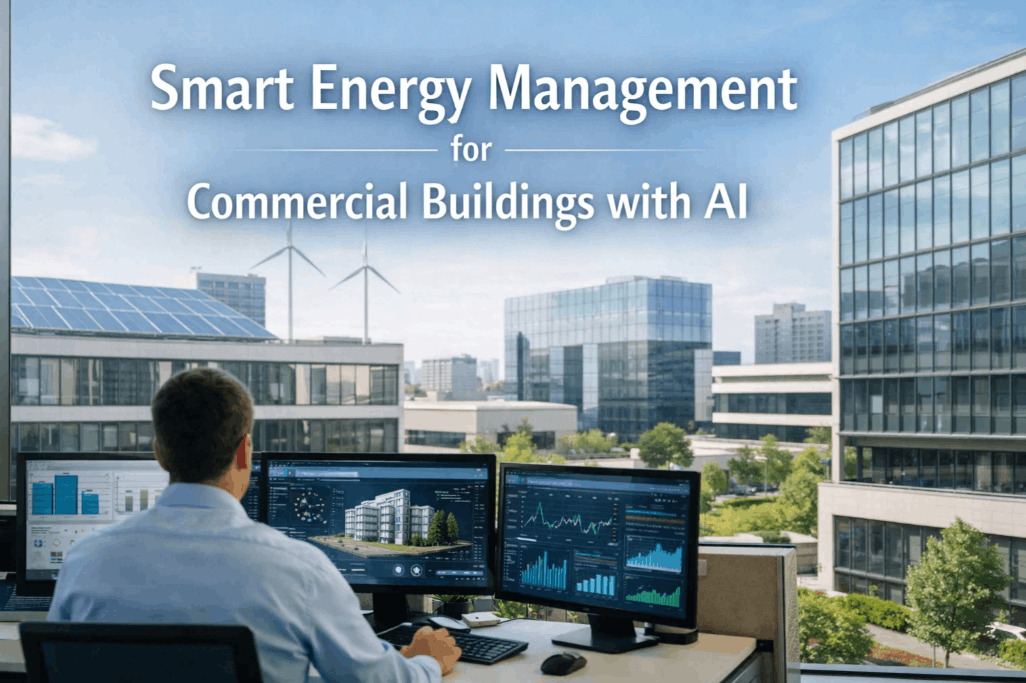
Smart building technology for commercial property management is fundamentally rewriting how REITs and property directors monitor, maintain, and optimize portfolio performance. By integrating a live virtual intelligence layer across every HVAC system, lighting controller, and occupancy sensor, a smart building analytics platform allows operations teams to automate energy bidding, predict mechanical failures, and fine-tune space utilization—without increasing headcount. For commercial property managers under pressure from rising utility costs, hybrid work shifts, and tightening ESG mandates, adopting AI-driven building optimization is no longer a future-state goal. It is the operational foundation that separates high-margin portfolios from those permanently playing catch-up. This complete guide explores how IoT infrastructure, BMS integration, and real-time operational analytics combine to deliver measurable intelligence across every layer of commercial real estate.
Transform Your Property into an Intelligent Asset
iFactory's smart building platform delivers real-time occupancy analytics, predictive alerts, and AI-driven energy optimization built for high-performance portfolios.
What Is Smart Building Technology and Why Is It Essential in 2026?
At the core of smart building technology is the convergence of IoT data streams, building management system (BMS) logic, and machine learning inference engines. When a floor's occupancy sensors detect a 40% drop in headcount on a Friday afternoon, the platform doesn't simply log the data—it automatically adjusts HVAC set-points, dims lighting in vacant zones, and simulates the energy savings for the monthly ESG report. This is the difference between simple building automation and genuine property intelligence software. Managers who book a demo with iFactory find that the transition from scheduled maintenance to condition-based intelligence is the moment operational ROI becomes undeniable.
Holistic BMS Integration
Break down data silos between HVAC, Access Control, and Fire Safety systems. Our platform fuses legacy BMS signals into a single unified dashboard for cross-system optimization.
Dynamic Occupancy Analytics
Track live density and traffic patterns across your floorplates. Use AI to predict peak usage times and optimize cleaning schedules and cafeteria staffing based on real human data.
AI-Powered Energy Governance
Automatically bid into smart grids and optimize battery storage loads. The AI monitors utility pricing in real-time, shifting non-critical building loads to low-cost intervals.
Predictive Mechanical Alerts
Monitor elevator motors, chiller bearings, and pump vibrations. The system identifies precursor failure signatures weeks before a breakdown occurs, protecting tenant uptime.
Predictive Maintenance for Properties: Eliminating Emergency Repair Costs
Traditional property management relies on reactive repairs or "worst-case" scheduled replacements. Smart building platforms resolve this by monitoring infrastructure health at the component level. Vibration signatures from air handler units, thermal gradients in electrical panels, and pressure deviations in water systems are analyzed continuously against historical failure data. When a pattern matches a precursor signature, the platform triggers a work order with enough lead time to plan the repair during off-hours. REITs that have deployed this approach with iFactory report that booking a demo led to a discovery that 45% of their emergency repair spend was entirely avoidable through early detection.
Asset Performance Management (APM): The Commercial Real Estate Framework
The financial impact of smart building technology compounds through better asset lifecycle management. A chiller running at 80% efficiency due to uncorrected scaling or sensor drift is invisible to standard BMS alarms but immediately surfaced in our APM layer. The platform quantifies the performance gap in real dollars per month, providing the granularity needed to approve CapEx reinvestment with confidence. Operations directors routinely request a demo to build their "Smarter Portfolio" business case for the upcoming fiscal year.
| Smart Building Capability | Traditional Property | Intelligent Property | Portfolio Impact |
|---|---|---|---|
| Energy Management | Manual bill tracking | Real-time per-zone optimization | $0.40 - $0.75 per sq. ft. saved |
| Maintenance Cycle | Calendar-based schedules | Condition-based alerts | +30% Equipment Lifespan |
| Space Management | Annual badge-swipe audits | Continuous live heatmapping | Optimized leasing strategies |
| Tenant Experience | Reactive complaint tickets | Proactive comfort management | +15% Tenant Retention rates |
| ESG Reporting | Weeks of manual data gathering | One-click automated reporting | 100% Audit accuracy |
Real-Time Operational Analytics: Moving Beyond Static Dashboards
Real-time operational analytics powered by smart building data transforms raw sensor streams into actionable intelligence. The architectural distinction between iFactory's platform and a conventional BMS is the addition of causal inference: not just that a boiler is running hot, but why it's doing so and how it will impact the building's peak demand charges for the next month.
Closed-Loop Building Control: Data to Autonomous Action
Process optimization within a smart building environment operates on a closed-loop principle. When occupancy drops on a specific wing, the platform detects the trend, calculates the optimal temperature setback, and executes the change autonomously within pre-set comfort boundaries. This moves "Smart Buildings" from a visualization tool into an active management system that pays for itself through autonomous waste reduction.
The ESG Imperative: Digital Foundations for Decarbonization
Commercial decarbonization requires more than just efficient bulbs; it requires a data infrastructure capable of tracking every watt-hour in context. Smart building platforms provide this by maintaining a persistent operational history—a searchable record of every energy state and equipment behavior. This contextual audit trail reduces Carbon Disclosure Project (CDP) preparation time from weeks to hours. For property teams still managing this work in spreadsheets, a tech walkthrough is the fastest path to quantifying the risk of manual data reporting.
Smart Building Implementation Roadmap for Commercial Portfolios
Deploying smart building technology follows a three-phase strategy designed to capture quick-win energy savings while building the long-term data foundation for AI-driven autonomous operations.
IoT Connectivity & BMS Data Ingestion
Establish secure edge connectivity, instrument main utility meters, and ingest data from existing HVAC and Access systems. This phase creates the "Source of Truth" for building health. Timeline: 6–10 weeks. Typical ROI: Energy visibility and waste identification.
Intelligence Layer & Predictive Module Activation
Activate AI-driven anomaly detection for critical mechanical systems and deploy occupancy-based lighting and HVAC logic. This is where the platform begins generating actionable energy savings and preventing downtime. Timeline: 4–8 weeks. Typical ROI: 15% reduction in OpEx.
Portfolio Orchestration & Autonomous Optimization
Scale intelligence across all properties, enabling cross-portfolio benchmarking and fully autonomous energy grid interaction. This phase transforms your properties into self-optimizing assets. Timeline: Ongoing. Typical ROI: ESG leadership and maximum asset value.
— Director of Asset Management, Tier-1 Commercial REIT
Impact Assessment: Smart Tech across Commercial KPIs
The performance gains from intelligent buildings are measurable from day one. Based on iFactory deployments across office towers, retail centers, and medical facilities, the chart below benchmarks the average improvement achieved within 12 months of full platform activation.
Smart Building Technology — Frequently Asked Questions
Can smart building tech integrate with legacy BMS systems?
Yes. Modern platforms use universal IoT gateways to translate legacy protocols (BACnet, LonWorks, Modbus) into secure cloud data. You don't need to rip and replace your existing HVAC or lighting controllers to achieve intelligent building status.
How does occupancy tracking protect tenant privacy?
iFactory uses "Privacy-by-Design" sensors that track headcount and traffic patterns without ever capturing personally identifiable information (PII). We use anonymized heatmapping and IR/ToF technology, ensuring 100% compliance with GDPR and local privacy laws.
What is the typical ROI timeline for a smart building deployment?
Most commercial properties see full payback within 12–18 months. Energy savings from occupancy setbacks usually provide the fastest ROI, followed by the significant reduction in emergency maintenance call-out fees.
Does the platform require an always-on internet connection?
While a connection is needed for cloud-based portfolio analytics, our edge gateways are designed for "Local Intelligence." If the internet goes down, your building's autonomous logic (setbacks, alerts) continues to run locally on-site.
Can smart building technology help with GRESB or LEED certification?
Absolutely. The platform provides verified, time-stamped energy and carbon data required for top-tier GRESB and LEED ratings. Automating this data collection eliminates the human error and labor costs associated with annual audit preparation.
How does AI predict elevator or chiller failures?
We install high-frequency vibration and current sensors on critical motors. The AI identifies specific "spectral patterns"—micro-tremors or current spikes—that match known fatigue curves, alerting you weeks before the asset actually stops working.
Is my building data secure from cyber threats?
Security is our top priority. We use end-to-end AES-256 encryption, secure boot hardware, and regular third-party penetration testing. Our IoT gateways act as a "One-Way Valve," sending data out without exposing your internal building network to the public web.
Stop Managing Your Buildings Blind. Start Optimizing with AI.
iFactory's smart building analytics platform delivers real-time asset intelligence, occupancy-driven energy setbacks, and AI predictive maintenance — purpose-built for commercial real estate.



.png)