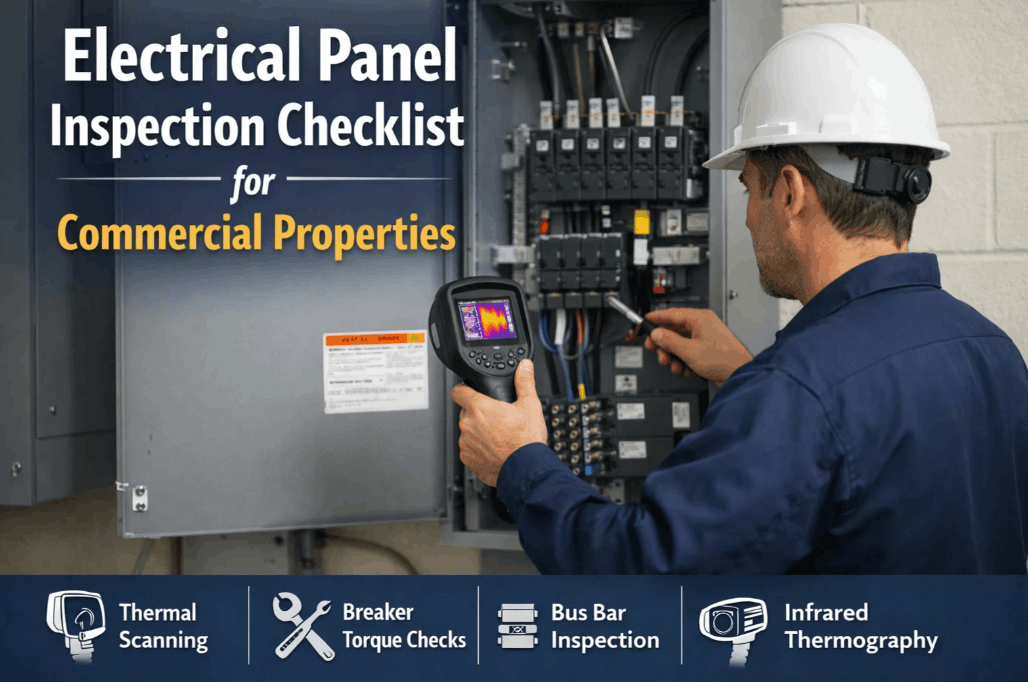
In the neurological system of a commercial facility, the electrical panelboard is the central synapse. A failure here doesn't just cut power—it triggers a chain reaction of life-safety risks, data loss, and localized thermal ignitions. While legacy maintenance relied on subjective visual audits once per year, modern electrical panel inspection is now a high-precision discipline dictated by the data-driven requirements of NFPA 70B. Today, a robust checklist must transcend simple physical "tightening" and integrate infrared thermography, ultrasonic arc detection, and real-time load analytics. By deploying a comprehensive panel board inspection framework, facility managers move from "guessing" to "knowing"—identifying high-resistance connections and breaker fatigue milliseconds before they breach safety envelopes. Book a Panel Health Audit to secure your building's Energetic hub.
Execute Precision Panel Board Safety Audits
Leverage AI-driven thermal scanning and ultrasonic telemetry to flawlessly track panel health, monitor breaker torque stability, and secure your distribution network.
Why Traditional Visual Checklists Fail Panel Safety
In standard property management, an electrical panel "looks clean" even while a loose terminal lug is generating 180°C of localized heat. Legacy checklists only track visible variables: whether the door is locked or if the labels are legible. True commercial panelboard analytics demands sub-visible insights, detecting the microscopic arcing and Delta-T anomalies occurring behind dead-front covers. Without interconnected thermography analytics, maintenance teams are blind to the phase imbalances and resonant vibrations that degrade breaker trip-curves over time. Book a platform demo to see how iFactory bridges this gap with uninterrupted wireless telemetry.
Comprehensive Asset Telemetry for Electrical Panelboards
iFactory's panelboard inspection suite connects the main bus, primary breakers, and branch terminations into a single overarching safety logic. The system identifies deadly thermal transients and mechanical decay weeks before physical failures manifest.
Panel Inspection Success: Catching the Invisible Fault
Tracking standard break-room panels is completely different from governing assets feeding critical life-safety risers or medical chillers. Our deployment architecture is explicitly forged for zero-failure risk scenarios.
Scenario 1: Defeating the "Invisible" Loose Lug
Thermal AI detects a 25°F Delta-T on an HVAC branch circuit breaker. Visual inspection shows zero discoloration. Ultrasonic auditing confirms a loose internal lug. The terminal is re-torqued, stopping a potential localized ignition event in a high-occupancy office tower.
Scenario 2: Identifying Phase Imbalance
Continuous amperage tracking identifies a persistent 20% unbalance on a secondary distribution panel. The AI traces it to a mis-mapped floor load. Corrective balancing prevents localized transformer overheating and extends its lifecycle by a projected 8 years.
Scenario 3: Sump Pump Readiness Audit
During a routine health scan, the AI detects 'high resistance vibration' on the sump pump breaker. The technician finds internal corrosion on the breaker contacts. The unit is replaced 4 hours before a major storm event, ensuring the pumps fire at peak load.
Scenario 4: 100% Code Compliance (NFPA 70B)
A corporate safety audit demands proof of electrical PM. Instead of manual binder logs, the manager exports the iFactory dynamic panel health maps proofs of continuous thermal and mechanical auditing, satisfying 70B requirements instantly.
Manual Checklist Intervals vs. Continuous Panel AI
Maintaining high-tonnage electrical panelboards via subjective visual audits and annual torque-checking is a severe liability. Compare the traditional methodology against an integrated continuous intelligence network.
| Inspection Layer | Manual Audit (Annual) | Static Sensor Alarms | iFactory Panel AI Copilot |
|---|---|---|---|
| Infrared Thermal Scan | Annual camera shoot only | Monthly surface temp checks | Continuous busbar-level Delta-T AI |
| Connection Torque | Manual 'wrench' disturb testing | Occasional visual lug check | Non-invasive ultrasonic connection auditing |
| Arcing/Tracking Detection | Visual smoke/pitting only | Static AFCI breaker trips | Continuous high-frequency acoustic emission mapping |
| Load Parity/Balancing | Manual 'clamp-meter' snapshots | PLC total breaker status | Autonomous real-time phase-unbalance analytics |
| Labeling & Compliance | Paper panel directories (Outdated) | Digital PDF exports | Automatic circuit-to-load digital twin mapping |
| Health Reporting | Subjective paper checklist | Datalogger CSV files | Automated NFPA 70B & 70E dynamic certification |
How iFactory Connects Mission-Critical Panel Layers
Deploying sensors into live panelboards involves navigating high-risk Arc Flash Zones and dense electrical interference. Our telemetry architecture is non-invasive and hardened for continuous loads.
Asset Digital Tagging (NFC/QR)
Every panel is mapped into the iFactory digital twin via NFC/QR tags, ensuring that manual inspection notes and AI sensor readings are synchronized into a single source of truth for the facility team.
Wireless Thermal Mesh Hubs
Snap-on thermal arrays and current transducers beam health diagnostics to the main cabinet gateway using industrial-mesh wireless, eliminating the need for complex internal panel wiring.
Edge-Acoustic Arc Detectors
Integrates fixed-mount ultrasonic sensors inside the cabinet. As the panel carries load, the analytical grid continuously updates a 3D acoustic twin showing exactly where hidden arcing is expanding.
Automated Compliance Fire-wall
All identified micro-anomalies bypass standard warning systems and fire specialized NFPA 70B work orders directly into the CMMS, enforcing that panels must be re-certified before insurance renewal.
Transforming Your Panel Inspection Workflow: A 4-Phase Path
Equipping an active property portfolio requires executing upgrades during standard operating hours. Transforming electrical panelboard analytics happens predictably over strategic phases.
Asset Inventory & Digital Ingestion
The primary panel assets are tagged and logged into the iFactory architecture. Exact circuit schedules and existing load baselines are mapped to establish the physical baseline for the building.
Thermal & Ultrasound Baseline Mapping
Non-invasive thermal sensors and ultrasonic arc-detectors are mounted to the main load paths (breakers, busbars, risers) during a standard maintenance window. Wireless mesh securely beams data to the edge.
Continuous Health Certification
The system begins building load profiles and thermal Delta-T matrices. The AI establishes the 'Safe Operating Band' for every critical circuit, initializing continuous NFPA 70B compliance reporting.
Predictive Portfolio Safety
The central command center begins receiving highly prioritized failure alerts. Operators have exact foreknowledge allowing them to conduct re-torquing and breaker swaps safely before any outage occurs.
Frequently Asked Questions: Panel Inspection Analytics
Eliminate Catastrophic Panel Blind Spots in Your Facility.
iFactory's electrical panelboard analytics protect hundreds of millions of dollars in real estate assets and, more importantly, human lives, by delivering impenetrable dynamic thermal testing and automated compliance telemetry.