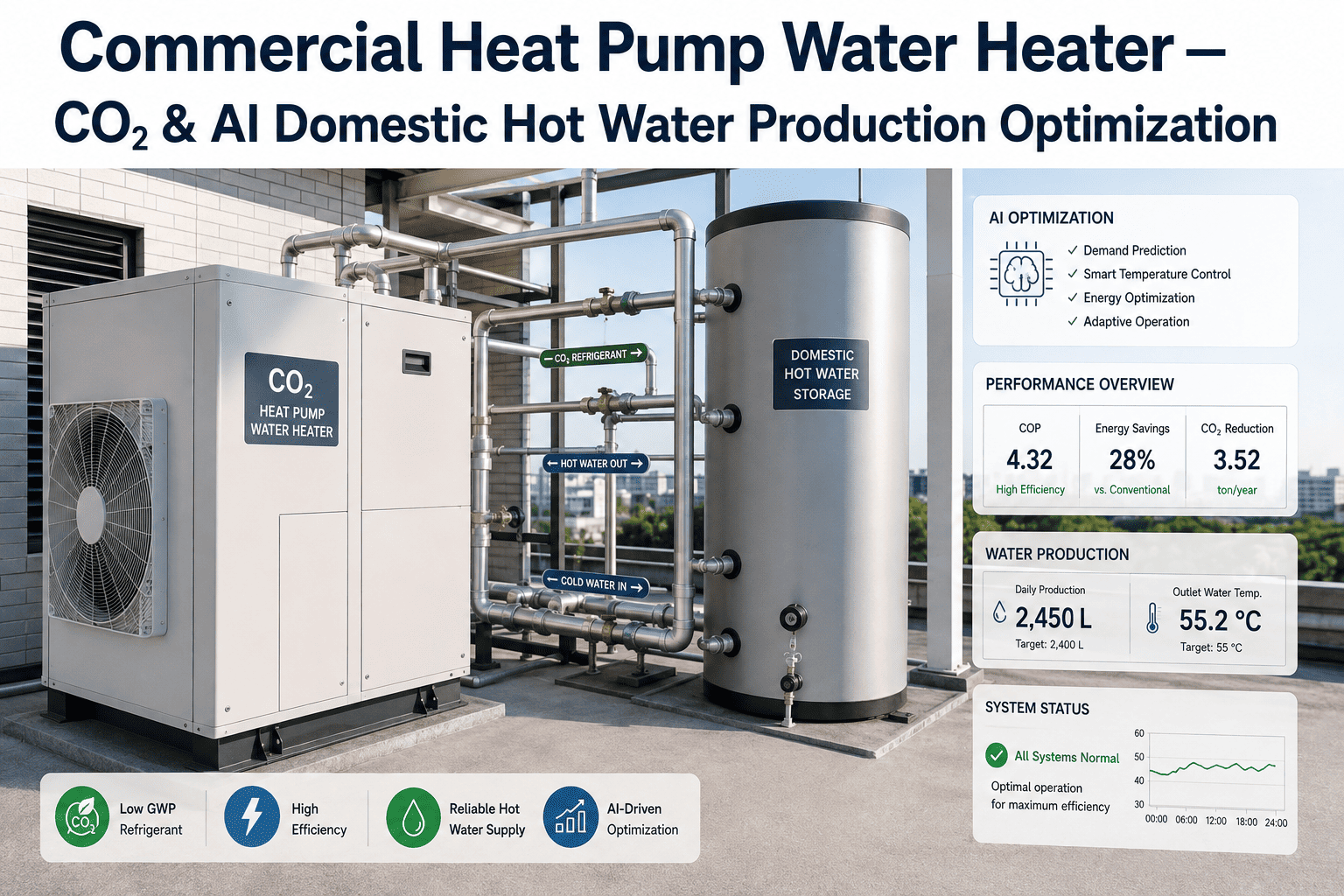
Commercial domestic hot water production sits at an awkward intersection of competing priorities, where legionella risk management pushes storage temperatures up while heat pump efficiency pushes toward lower lift, and most facilities resolve the conflict with a fixed high-temperature setpoint that sacrifices COP around the clock just to stay safe during the few hours demand actually peaks. CO2, or R-744, heat pump water heaters can produce genuinely high-temperature output efficiently thanks to their transcritical cycle, but only if production scheduling actually takes advantage of that capability instead of running the unit flat out on a static schedule regardless of demand. Legionella management adds its own complexity, requiring periodic thermal disinfection cycles that, done manually, either happen too infrequently to matter or too frequently to preserve efficiency. AI-driven production scheduling coordinates demand forecasting, COP optimization and legionella disinfection cycles together, extracting the efficiency CO2 heat pump systems were designed to deliver. Book a demo to see production scheduling modeled against your facility's demand profile.
AI Domestic Hot Water Production Optimization
High-Temperature Hot Water Without the Efficiency Penalty
iFactory schedules CO2 and conventional heat pump water heater production around real demand patterns, maximizing COP while keeping legionella disinfection cycles on schedule automatically.
Overnight
Low demand window used for efficient tank recovery at optimal lift temperature
Morning Peak
Storage pre-heated ahead of forecasted demand surge to avoid mid-peak recovery strain
Midday
Legionella thermal disinfection cycle scheduled during naturally low demand periods
Evening Peak
Second demand surge met from pre-built storage rather than real-time high-lift production
Why Fixed-Setpoint DHW Production Wastes CO2 Heat Pump Potential
Transcritical CO2 heat pump water heaters can lift water to high delivery temperatures far more efficiently than conventional refrigerant systems, which is exactly why they get specified for commercial kitchens, laundries and healthcare facilities with genuine high-temperature demand. See how your current production schedule compares to actual facility demand. Running that same unit on a static high-temperature setpoint around the clock, regardless of whether demand is at its morning peak or its overnight low, forces the compressor to work against a fixed high lift constantly instead of only when delivery temperature actually needs to be that high, discarding much of the efficiency advantage the CO2 cycle was chosen for.
Coordinating Production Scheduling, COP and Legionella Control
Demand Forecasting
Historical usage patterns by hour and day of week predict upcoming demand, allowing production to shift toward off-peak hours whenever storage capacity allows.
COP Maximization
Production lift temperature adjusts dynamically between forecasted demand windows, avoiding unnecessary high-lift operation during low-demand hours.
Legionella Management
Thermal disinfection cycles are scheduled automatically at required intervals during naturally low-demand windows, keeping compliance and efficiency from working against each other.
Fixed-Setpoint Production vs. AI-Scheduled Production
The gap between the two approaches is largest in facilities with sharp demand peaks, such as hotels, hospitals and commercial kitchens. Request a demand-profile comparison for your facility type.
| Production Approach |
Fixed High-Temperature Setpoint |
iFactory AI-Scheduled Production |
| Lift Temperature |
Constant high lift regardless of actual demand |
Dynamic lift matched to forecasted demand windows |
| Legionella Disinfection |
Manually scheduled, often inconsistent or excessive |
Automated scheduling during low-demand windows |
| Peak Demand Response |
Real-time recovery strain during demand spikes |
Storage pre-built ahead of forecasted peaks |
| Energy Use |
Elevated by unnecessary continuous high-lift operation |
Reduced through demand-matched scheduling |
| Compliance Documentation |
Manual logging, prone to gaps |
Automatic disinfection cycle logging |
Stop Running High-Lift Production Around the Clock
iFactory schedules your CO2 or conventional heat pump water heater around real demand, keeping legionella compliance on track without sacrificing efficiency.
Deployment for DHW Production Scheduling
1
Demand Profile Capture
Two to four weeks of existing consumption data establish hourly and day-of-week demand patterns for your facility.
2
Storage & Recovery Modeling
Tank storage capacity and compressor recovery rate are modeled against forecasted demand to define safe scheduling windows.
3
Legionella Cycle Integration
Required thermal disinfection intervals are programmed into the schedule at low-demand windows, with automatic compliance logging.
4
Live Schedule Activation
Production scheduling goes live with continuous COP tracking to confirm efficiency gains against the pre-deployment baseline.
Results From Facilities Running AI DHW Scheduling
Hotel Property, 220 Rooms
Morning Peak Recovery Strain Eliminated
A CO2 heat pump water heater system serving a full-service hotel struggled to keep pace with the sharp morning demand surge under fixed-setpoint control, occasionally dropping delivery temperature during peak shower hours. Demand-forecasted pre-heating eliminated the recovery gap entirely while reducing average daily lift-related energy use by 18%.
Commercial Kitchen, Multi-Unit Restaurant Group
Legionella Compliance Logging Fully Automated
A restaurant group managing DHW compliance across eleven locations replaced manual disinfection cycle logging, which had produced inconsistent records across sites, with automated scheduling and logging that satisfied health inspector documentation requirements at every location.
Frequently Asked Questions
Does this work with both CO2 and conventional refrigerant heat pump water heaters?
Yes. The scheduling logic adapts to the specific efficiency curve of the installed system, whether it is a transcritical CO2 unit or a conventional refrigerant heat pump water heater, since both benefit from demand-matched production rather than constant high-lift operation. The demand forecasting and legionella scheduling components work identically across both technologies.
How does automated scheduling handle legionella disinfection requirements?
Required thermal disinfection intervals are programmed based on your facility's compliance requirements and executed automatically during forecasted low-demand windows, with every cycle logged for inspection or audit purposes. This removes the inconsistency that comes with manually tracking disinfection schedules across multiple systems or locations.
What happens if actual demand exceeds the forecast on a given day?
How much energy savings is realistic for our facility?
Facilities with pronounced demand peaks, such as hotels, healthcare and commercial kitchens, typically see the largest gains since fixed-setpoint systems waste the most energy running constant high-lift production against uneven demand.
Book a demo for a savings estimate based on your specific demand profile.
Does this require replacing our existing tank or heat pump unit?
No. Production scheduling works through the existing heat pump water heater's control interface, adjusting setpoints and cycle timing rather than requiring new equipment. Deployment is designed to work with the storage tank and compressor capacity you already have installed.
Get Full Efficiency From Your Heat Pump Water Heater
iFactory schedules production around real demand, maximizing COP while keeping legionella disinfection cycles compliant and fully logged.
Demand-forecasted production scheduling
Automated legionella disinfection cycles
Works with CO2 and conventional systems
No tank or compressor replacement required
.jpg)