Every chilled water plant is designed around a number that almost never holds up in the field: the delta-T across the evaporator, the temperature difference between supply and return that the entire system's pump sizing, chiller staging, and energy budget were calculated against. In a healthy system running as designed, that number sits close to its design value, maybe ten degrees Fahrenheit, and stays there. In practice, coil valves that don't fully close, three-way bypass valves left over from an older control scheme, and simple wear across dozens of terminal units let return water mix with supply water, and the delta-T collapses to a fraction of what the design called for. When that happens, pumps run harder than they need to and chillers cycle more than they should just to move enough volume to compensate, and almost nobody notices because every individual reading still looks reasonable in isolation. If your plant's actual delta-T has drifted from its design value and nobody's tracking the gap, book a demo to see exactly how much that gap is costing you.
PIPING & HYDRONIC · CHILLED WATER LOOP OPTIMIZATION
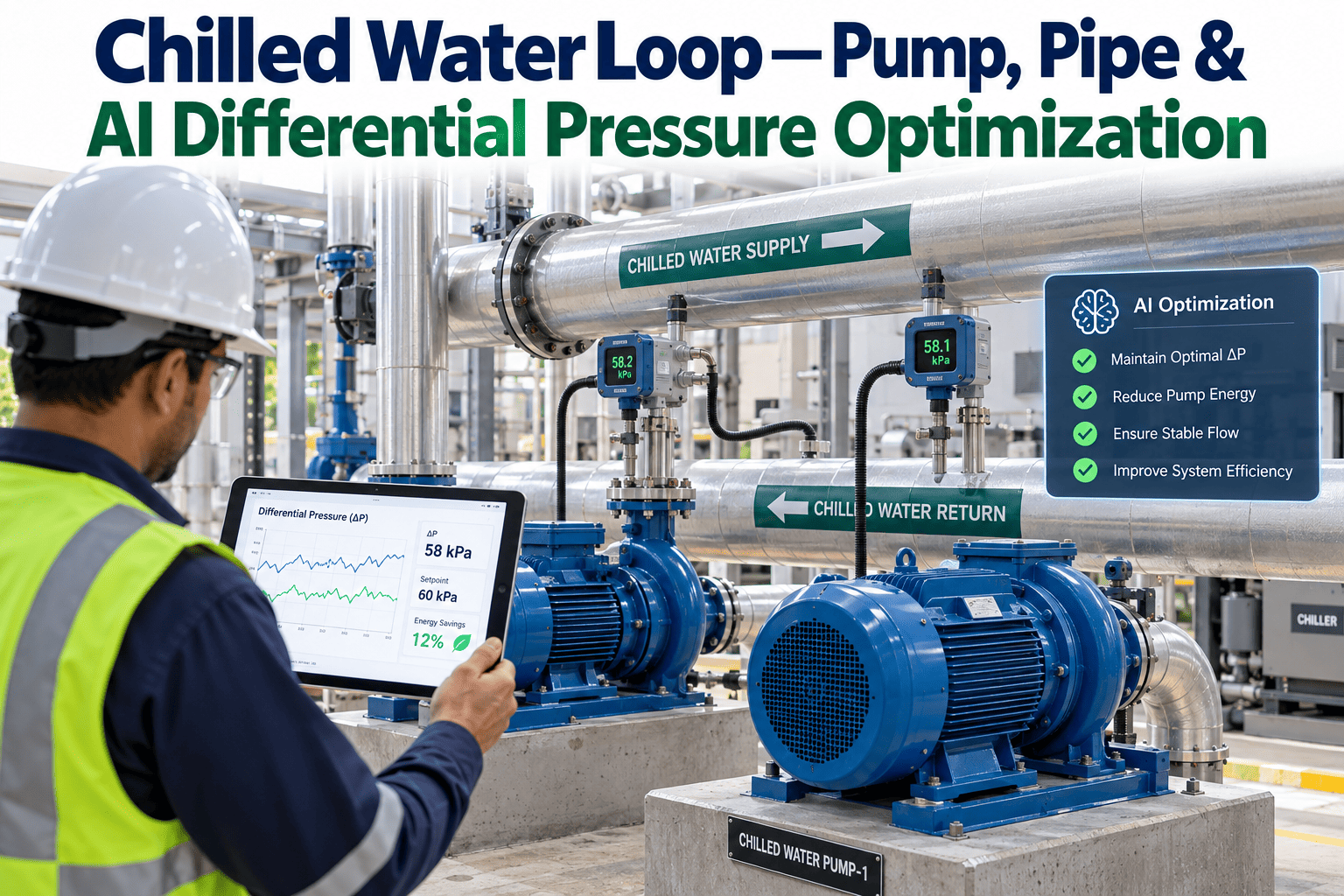
Keep Every Coil Fed Without Overworking the Pump
iFactory continuously manages differential pressure, pump speed, and delta-T stability across your chilled water loop, catching the low delta-T syndrome that quietly inflates pumping and chiller energy long before anyone notices it on a utility bill.
CHILLER
→
PRIMARY PUMP
→
DISTRIBUTION
→
COOLING COILS
→
RETURN
THE PROBLEM MOST PLANTS DON'T SEE
Low Delta-T Syndrome, By the Numbers
A plant with low delta-T syndrome doesn't look broken. Individual zone temperatures read fine, the chiller runs, the building stays cool. The only place the problem is visible is in the gap between what the system was designed to achieve across the evaporator and what it's actually achieving, and most plants have never plotted the two side by side.
TYPICAL ACTUAL DELTA-T
5.5°F
A plant running at roughly half its design delta-T needs close to double the flow to deliver the same cooling capacity, which means the primary pump is working far harder than the system was ever designed to require, and the chiller plant loses much of the partial-load efficiency it was purchased for in the first place.
WHAT AI ACTUALLY CONTROLS
Four Levers That Keep the Loop Running Efficiently
Dynamic Differential Pressure Reset
Rather than holding a single fixed DP setpoint at the worst-case zone, the target resets continuously based on which valve is actually working hardest right now.
Pump Speed Optimization
Variable speed pumps are commanded to the minimum speed that satisfies real demand, rather than a conservative fixed curve that assumes worst-case load year-round.
Delta-T Stability Monitoring
Supply and return temperatures are tracked continuously so a degrading delta-T is flagged as a developing trend, not discovered months later on a utility bill.
Valve and Coil Diagnostics
Individual terminal units contributing most to delta-T degradation, a stuck valve, a failed actuator, get identified specifically rather than treating the whole loop as one undifferentiated problem.
Find out what your loop's actual delta-T is costing you
iFactory can benchmark your current chilled water loop performance against its original design values.
WHAT RUNNING BLIND ACTUALLY COSTS
The Cost Nobody Puts a Line Item On
Up to 2x
the required flow to deliver the same capacity when delta-T drops to half its design value
15-30%
typical pumping energy savings once differential pressure resets to actual demand
Higher
chiller cycling and reduced part-load efficiency when flow is forced artificially high
Silent
degradation, since a single stuck valve rarely trips any alarm on its own
FIXED SPEED VS AI-OPTIMIZED
What Changes When the Loop Manages Itself
| Factor |
Fixed DP Setpoint |
AI-Optimized Loop |
| DP setpoint |
Static, set once for worst-case conditions |
Reset continuously to actual critical zone demand |
| Pump energy |
Runs harder than needed most of the year |
Matched to real-time load, 15-30% typical savings |
| Low delta-T detection |
Invisible until a utility bill or capacity issue appears |
Flagged as a trend within days of onset |
| Root cause visibility |
Whole-loop guesswork |
Specific valve or terminal unit identified |
| Chiller part-load efficiency |
Eroded by artificially high flow |
Preserved by matching flow to real demand |
TURNKEY DEPLOYMENT
How iFactory Gets Your Loop Under AI Control
What Gets Built
Delta-T and DP monitoring across supply, return, and critical zones
Dynamic DP reset logic tuned to your actual loop layout
Pump speed optimization integrated with your existing VFDs
Valve-level diagnostics to isolate delta-T degradation sources
Ongoing dashboard access for facilities and maintenance teams
Rollout Timeline
Weeks 1-2: Loop audit and sensor gap assessment against design documents
Weeks 3-5: Control integration and DP reset calibration
Week 6: Go-live with continuous delta-T and pump performance tracking
FREQUENTLY ASKED QUESTIONS
What Maintenance Managers Ask Before Optimizing a Loop
How do we know if our loop actually has low delta-T syndrome?
The clearest test is comparing your current supply and return temperature difference against the value your system was originally designed around, which for most chilled water plants sits somewhere near ten degrees Fahrenheit. If your actual delta-T consistently runs well below that design figure, particularly during moderate load conditions rather than only at extreme peak demand, that gap is a strong indicator that mixing is occurring somewhere in the distribution system, most commonly through valves that aren't fully closing or older three-way bypass hardware still installed on some terminal units.
Book a demo to compare your current readings against your original design values.
Can this work with our existing building automation system, or does it replace it?
This is built to work alongside your existing BAS rather than replace it, integrating with the control points, VFDs, and sensors already in place to add the continuous optimization layer most building automation systems weren't originally configured to provide. Most BAS platforms are capable of variable DP control in principle but are commonly left on a conservative fixed setpoint because tuning a dynamic reset strategy by hand is time-consuming and easy to get wrong, which is specifically the gap this fills without requiring a full controls replacement.
Contact our support team to review compatibility with your specific BAS platform.
Will optimizing pump speed risk under-delivering cooling to any zone?
No, and this concern is exactly why the reset logic tracks the most demanding zone continuously rather than applying a single blind reduction across the board. The differential pressure setpoint is reset based on real-time feedback from whichever valve is currently working hardest to meet its load, which means the system always maintains enough pressure to satisfy the most demanding zone at any given moment, it simply stops maintaining unnecessarily high pressure everywhere else when that critical zone's demand is lower.
Book a demo to see how critical zone reset works in practice.
How is a specific problem valve actually identified out of dozens of terminal units?
Rather than treating delta-T degradation as a single whole-loop number, the system tracks temperature and flow behavior at the individual terminal unit level where sensor coverage allows, and correlates degradation patterns against valve command signals to identify which specific units are contributing most to the mixing problem. A valve that isn't fully closing when commanded closed produces a distinctive signature, elevated return temperature at that specific unit relative to its neighbors, that this analysis is built to surface directly rather than leaving a maintenance team to manually inspect valves one at a time.
Contact our support team to discuss sensor coverage requirements for your specific loop.
How much energy savings is actually realistic for our specific plant?
Savings depend heavily on how far your current fixed DP setpoint sits above actual real-time demand, which varies significantly by building type, load profile, and how conservatively the original setpoint was configured, but plants moving from a static worst-case setpoint to dynamic reset typically see meaningful reductions in pumping energy, with the largest gains at buildings that spend most of their operating hours well below peak design load. A loop benchmark against your specific historical trend data is the most reliable way to estimate your actual opportunity rather than relying on an industry-wide average that may not reflect your building's particular load pattern.
Book a demo to get a savings estimate specific to your loop's actual load history.
EVERY COIL FED, NO WASTED PUMP ENERGY
Stop Running Your Chilled Water Loop on a Guess
iFactory continuously optimizes differential pressure, pump speed, and delta-T stability across your loop, catching the low delta-T syndrome most plants never see coming.