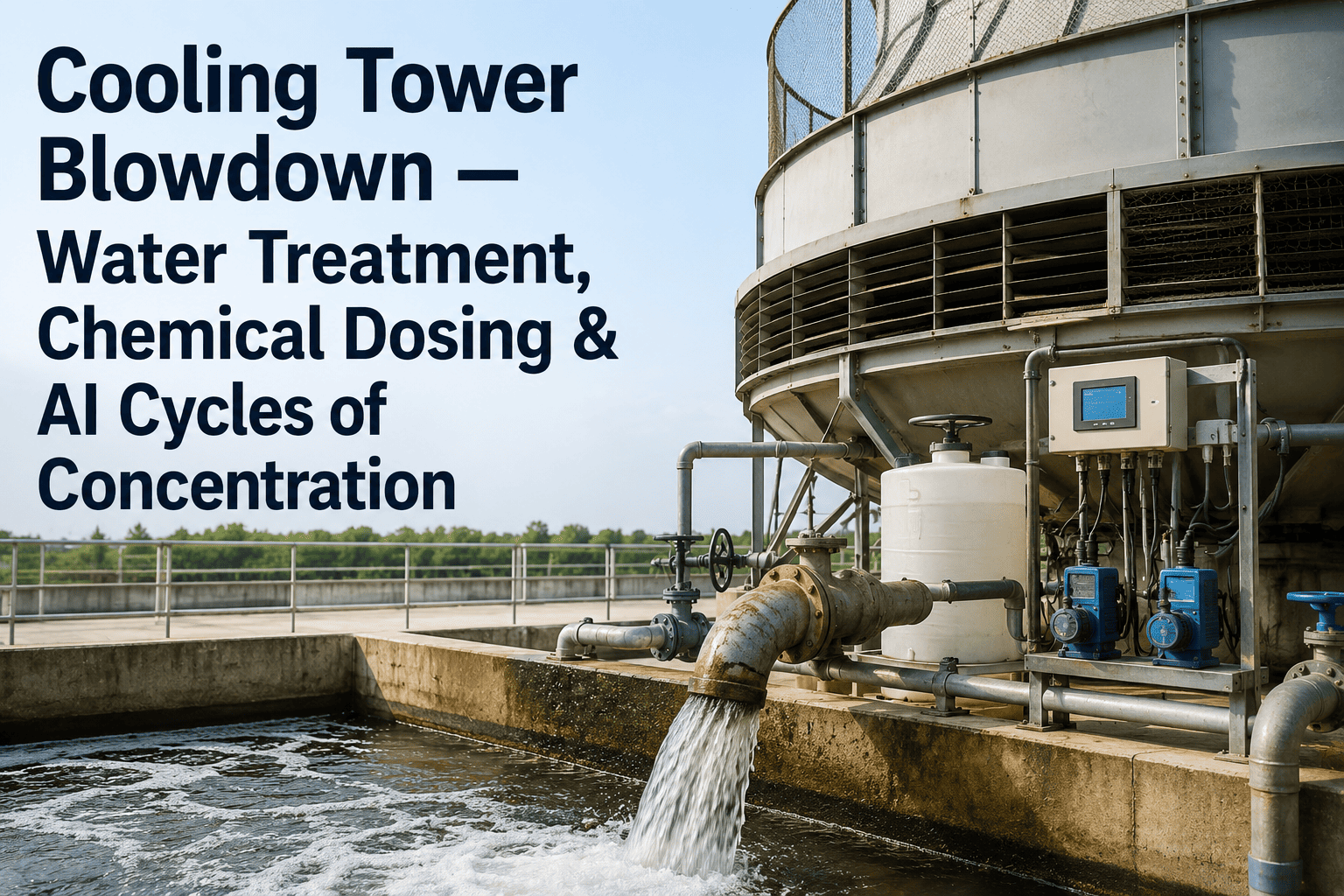
Cooling tower water management is a balancing act most maintenance teams manage with a fixed conductivity setpoint and a monthly water bill that tells them whether they got it roughly right. Run too few cycles of concentration and blowdown wastes water and treatment chemical for no reason. Run too many and dissolved solids concentrate past the point where scale starts forming on condenser tubes or corrosion starts eating away at tower internals, both of which quietly reduce heat transfer efficiency long before anyone notices a problem. The right cycles of concentration target shifts constantly with makeup water quality, load, and weather, which is exactly why a static setpoint gets the balance wrong more often than it gets it right. AI-based blowdown management adjusts continuously instead of guessing once and leaving it alone. See what optimized blowdown looks like for your tower's water chemistry.
Every Cooling Tower Is Fighting Two Costs at Once
Too little blowdown concentrates scale and corrosion risk. Too much wastes water and chemical treatment cost. AI-managed cycles of concentration hit the actual optimum instead of a static guess.
of a cooling tower's total water consumption typically goes to blowdown, most of it set by a fixed conductivity target
of scale buildup on a condenser tube can reduce heat transfer efficiency by roughly 10 percent
typical reduction in makeup water and blowdown volume achievable through continuously optimized cycles
Why a Fixed Blowdown Setpoint Almost Always Gets It Wrong
A conductivity setpoint chosen once during commissioning assumes makeup water quality, cooling load, and ambient conditions stay constant — none of which is true across a real operating year. Makeup water hardness shifts with the season and the source, cooling load swings with production schedules and outdoor temperature, and evaporation rates change with humidity, all of which move the actual optimum cycles of concentration target in ways a static setpoint can never track. The result is a tower that spends most of the year running either too conservative, wasting water and chemical unnecessarily, or too aggressive, letting dissolved solids creep past the point where scale and corrosion start compounding. Continuous water chemistry monitoring tracks these shifts in real time and adjusts the blowdown target dynamically, keeping the tower closer to its true optimum on any given day instead of a number chosen once and left alone for years.
What AI-Managed Water Treatment Actually Tracks
Three continuously monitored variables together determine whether a tower is running at its real optimum or drifting toward waste or risk.
Cycles of Concentration
Real-time conductivity and makeup water quality data continuously recalculate the optimal cycles target instead of relying on a fixed setpoint chosen at commissioning.
Chemical Dosing Control
Scale and corrosion inhibitor dosing scales dynamically with actual water volume and chemistry rather than a flat rate that over- or under-treats as conditions shift.
Makeup Water Quality Monitoring
Hardness, alkalinity, and total dissolved solids in incoming makeup water are tracked continuously so treatment adjusts before scale risk builds rather than after.
Find Your Tower's Actual Optimal Cycles Target
iFactory analyzes your makeup water chemistry, current blowdown practice, and treatment program to show exactly how much water and chemical cost is on the table.
Cycles of Concentration and the Risk Trade-Off
Every cycles of concentration range carries a different balance between water savings and scale or corrosion risk, and the right target shifts with makeup water hardness.
What a Blowdown Optimization Rollout Involves
Moving from a static setpoint to continuously managed cycles of concentration is a data and control integration project more than a hardware overhaul.
Baseline water chemistry audit
Makeup water hardness, alkalinity, and current blowdown practice are documented first to establish exactly how far the current setpoint sits from the true optimum, and where the biggest near-term savings opportunity lives.
Continuous conductivity and dosing control
Automated conductivity controllers connect to real-time chemical dosing pumps, so blowdown volume and treatment chemical both adjust together rather than one lagging behind the other.
Ongoing chemistry trend monitoring
Continuous tracking of dissolved solids, pH, and inhibitor residual confirms the system is holding the optimized target over time rather than drifting back toward a conservative default.
What Changes When Blowdown Is Continuously Optimized
Figures reflect typical results within the first two quarters after moving from a fixed conductivity setpoint to continuously managed cycles of concentration.
A Maintenance Manager's View on Blowdown Optimization
We'd set our conductivity target once, years earlier, and never really revisited it because nothing seemed obviously wrong. Once we had continuous water chemistry data, it turned out we'd been running conservative for most of the year and aggressive during summer peak load without realizing it, which explained why our condenser tubes needed cleaning every single summer. Letting the system adjust cycles dynamically instead of holding one number fixed cut our water bill and gave us a full extra season between tube cleanings.
The Bottom Line on Cooling Tower Water Management
A fixed blowdown setpoint is a compromise chosen once and rarely revisited, and it almost never matches the tower's true optimum across a full year of shifting makeup water quality, load, and weather. Continuous cycles of concentration management and dynamic chemical dosing close that gap, cutting water and chemical waste on one side while reducing scale and corrosion risk on the other — the two costs every cooling tower is fighting at the same time.
Frequently Asked Questions
What are cycles of concentration and why does the target keep changing?
Cycles of concentration measure how many times dissolved solids in makeup water have been concentrated in the tower system before blowdown removes them, and the optimal number depends on makeup water hardness, cooling load, and evaporation rate, all of which shift throughout the year. A number that was optimal during a mild spring week is rarely still optimal during peak summer load with a different water source blend. Book a chemistry review to see where your current target sits.
How much water can realistically be saved through optimized blowdown?
Savings depend heavily on how conservative the current fixed setpoint is, but towers running a static, cautious target often see meaningful reductions in both makeup water and blowdown volume once cycles are managed dynamically against real chemistry data rather than a single number chosen years earlier and never revisited.
Does pushing cycles higher always increase scale and corrosion risk?
Higher cycles concentrate dissolved solids further, which does raise scale and corrosion potential if chemical dosing and monitoring don't scale with it, but that risk is manageable when dosing is continuously matched to real-time water chemistry rather than a flat rate. The danger comes from pushing cycles higher without also tightening the monitoring and dosing control around it.
Can this integrate with an existing water treatment vendor's chemical program?
Yes — continuous monitoring and dosing control typically layer on top of an existing treatment chemistry program rather than replacing it, adjusting dosing rate and timing based on real conditions while keeping the same chemical formulation a facility already has approved and in place.
How is condenser tube scaling actually detected before a cleaning is scheduled?
Approach temperature trending between condenser inlet and outlet is one of the earliest indicators, since scale buildup reduces heat transfer efficiency measurably before it becomes visible during a manual inspection. Combined with continuous water chemistry data, this lets a maintenance team schedule tube cleaning based on actual fouling trend rather than a fixed calendar interval. Talk to a specialist about connecting this data to your maintenance scheduling.
Stop Guessing at a Blowdown Setpoint
Book a 30-minute assessment. iFactory reviews your tower's water chemistry and shows exactly where continuous cycles management pays off first.