A maintenance manager walks a manufacturing floor in July and can feel the difference the moment they step off the office corridor onto the shop floor, ten degrees warmer, thick with heat rising off machinery that never stops running. A spot cooler near the welding cell has been rattling for two shifts, a makeup air unit on the far wall is short-cycling, and nobody has logged either one because the work order system tracks production equipment, not the climate systems keeping people and machines from overheating. iFactory brings that same visibility to industrial thermal systems, and you can see how by choosing to book a demo with our team.
Industrial Climate Systems Sit Between Facilities and Production, Owned Fully by Neither
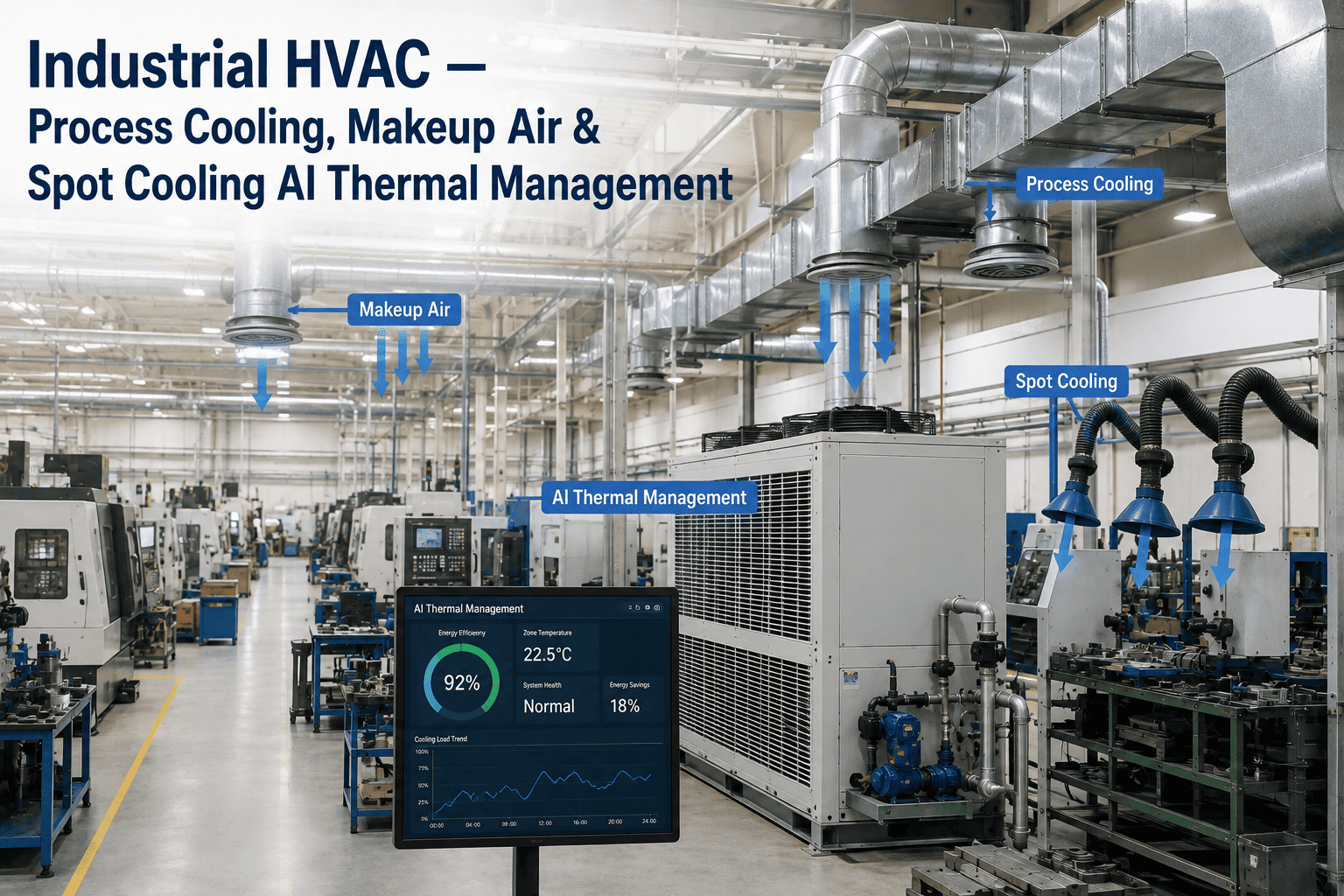
Chillers, makeup air units, and spot coolers on a manufacturing floor operate continuously under demanding load and are routinely under-maintained because responsibility for them is split across teams. iFactory gives maintenance managers one system that tracks every thermal asset, tied directly to the production line criticality it protects.
Traditional Air Conditioning Was Never Built for a Sprawling, High-Heat Production Floor
Maintaining a comfortable, workable temperature in a large open-bay factory is one of the hardest facilities problems a maintenance manager faces, and standard commercial air conditioning is simply not a viable answer at that scale. The energy cost of trying to condition a warehouse-sized volume of air to office comfort levels is prohibitive, and the environmental load of the attempt is severe, which is why industrial facilities lean instead on a mix of process cooling, makeup air handling, and targeted spot cooling rather than one uniform system trying to do everything at once.
Leaving the floor uncooled is not a workable alternative either. Extreme heat measurably increases worker fatigue, slows concentration, reduces production throughput, and drives up absenteeism, all of which show up on a production report long before anyone connects the dip back to a climate system that has been quietly underperforming. The three technologies that actually solve this problem, process cooling, makeup air, and spot cooling, each target a different part of the heat and airflow challenge, and confusing one for another is a common and costly planning mistake.
Chiller failures, air handler filter bypass, and process cooling circuit contamination are consistently the top causes of production climate failures in manufacturing environments. A three-degree deviation in a controlled process temperature can be enough to reject an entire production batch, which means the cost of a neglected process cooling system is not measured only in comfort, it is measured directly in scrapped product and lost production hours.
Process Cooling, Makeup Air, and Spot Cooling Are Not Interchangeable
Plant teams sometimes treat industrial climate control as a single undifferentiated budget line, but each of these three technologies is solving a distinct problem, and applying the wrong one to a given area wastes both capital and energy without actually fixing what is uncomfortable or unsafe.
See Every Chiller, MAU, and Spot Cooler From One Screen
iFactory tracks runtime, temperature deviation, and maintenance status across every thermal asset on the floor, tied to the production line each one protects.
Why These Systems Sit Between Facilities and Production, and Fall Through the Crack
A production line has an owner. A quality system has an owner. The chiller cooling that production line's process, or the makeup air unit feeding the room it sits in, frequently does not have a clearly assigned owner at all, because it sits at the intersection of facilities and production engineering, and each team assumes the other is tracking it.
That ambiguity is exactly why industrial climate systems are so often the ones running on borrowed time. Filter bypass on an air handler goes unnoticed because it does not stop the production line directly, it just gradually degrades air quality and increases energy load. A process cooling circuit slowly accumulating contamination does not trip an alarm until the temperature deviation is already large enough to affect a batch, at which point the cost has already been incurred rather than avoided.
Tying thermal asset criticality directly to the production asset it protects closes that gap. When a chiller's maintenance priority is explicitly linked to the production line it cools, rather than treated as a generic facilities asset, it gets scheduled, tracked, and escalated with the same urgency as the equipment it supports, instead of sitting in a separate maintenance queue that nobody is actively watching.
Choosing the Right Approach for Different Zones on the Same Floor
| Zone or Need | Best-Fit Approach | Why This Fits |
|---|---|---|
| A controlled production process sensitive to temperature | Dedicated process cooling loop | Holds a precise, independent setpoint regardless of ambient shop conditions |
| A room with active exhaust or dust collection running | Makeup air unit sized to match exhaust volume | Prevents negative building pressure and maintains safe, breathable conditions |
| A single hot workstation in a large open bay | Targeted spot cooling | Cools the worker and equipment directly without conditioning the whole building |
| Emergency or seasonal peak demand | Temporary rental cooling layered onto the base system | Adds capacity quickly without committing to permanent oversized equipment |
Moving From Reactive Repairs to a Tracked, Criticality-Linked System
These are the outcomes maintenance managers consistently report once every chiller, air handler, makeup air unit, and spot cooler on the floor is registered, scheduled, and tracked against the production criticality it supports, rather than managed as a loose collection of equipment nobody owns end to end.
Undersized and Oversized Thermal Systems Fail for Opposite Reasons
An undersized process cooling or makeup air system struggles constantly to keep pace with load, running at or near maximum capacity for most of the shift and giving the maintenance team almost no operating margin when ambient conditions spike or a piece of equipment runs hotter than usual. Components under that kind of sustained strain wear out faster than their rated service life would suggest, and the system rarely has the headroom to absorb an unplanned demand spike without a noticeable performance dip somewhere on the floor.
An oversized system carries the opposite problem, and it is just as costly even though it looks safer on paper. Equipment that short-cycles because it was sized well beyond actual peak load wastes energy, wears out compressors and fan motors through frequent starts and stops, and in humidity-sensitive applications can actually undermine dehumidification performance in the same way an oversized PTAC does in a hotel room, satisfying temperature quickly without running long enough to remove moisture from the air.
Getting sizing right depends on accurate load data gathered under real operating conditions, not just a design-stage calculation based on nameplate ratings and assumed occupancy. A maintenance manager evaluating a replacement or expansion project benefits enormously from actual runtime and load history pulled from the equipment already in place, since it reveals how the floor actually behaves rather than how it was originally assumed to behave when the building was designed.
When Adding Permanent Capacity Is Not the Right First Move
Not every capacity gap calls for a capital equipment purchase. Emergency response situations, seasonal demand spikes, and planned maintenance shutdowns that temporarily take a primary cooling system offline are all scenarios where rental or temporary cooling equipment provides a faster, more flexible answer than committing to permanent infrastructure sized for a peak that only occurs a few weeks a year.
Evaluating a temporary cooling need properly means being honest about several factors at once: how long the additional capacity is actually required, whether the facility's existing electrical infrastructure can support the added load without risking an overload, and how humidity control needs to be factored in alongside raw temperature reduction, particularly in facilities where condensation or corrosion risk from added moisture is a real concern.
Many industrial facilities get the most value from combining a right-sized permanent system with a layered temporary strategy for genuine peak periods, rather than sizing permanent equipment for the worst case scenario and running it underutilized for the rest of the year. That layered approach keeps capital spend proportional to actual year-round need while still preserving the ability to respond quickly when conditions genuinely demand more capacity than the base system provides.
Questions Maintenance Managers Ask About Industrial Thermal Management
Give Every Thermal Asset on the Floor a Clear Owner and a Tracked Schedule
iFactory links chillers, makeup air units, and spot coolers directly to the production lines they support, so nothing sits in a maintenance blind spot.