A facilities director overseeing 180 stores gets the same phone call every August: a district manager reporting a sales floor that feels warm, customers commenting, an RTU that has apparently been struggling for weeks. Nobody flagged it earlier because nobody was watching that specific unit at that specific store, and with 180 stores each running two to four rooftop units, watching all of them by phone and spreadsheet was never actually possible in the first place. iFactory exists to close exactly that visibility gap, and you can see how by choosing to book a demo with our team.
Managing HVAC Across Hundreds of Stores Should Not Depend on Which One Complains First
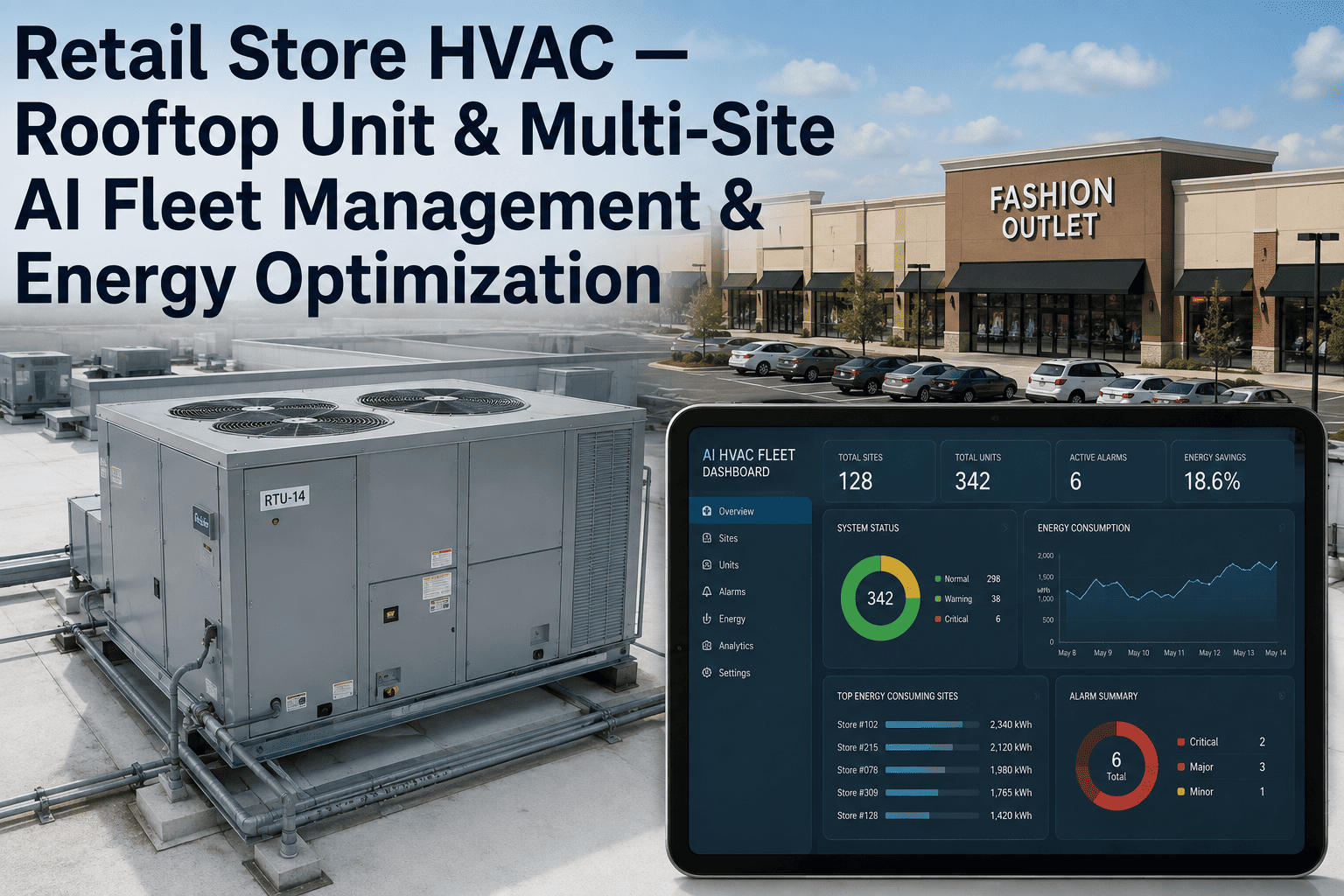
Retail facilities teams are consistently running lean against a portfolio of stores that keeps growing, and rooftop units are usually the largest hidden operating cost on the roof. iFactory gives multi-site retail teams one dashboard for RTU health, PM compliance, and energy performance across every location, so problems surface before a district manager has to call about them.
A 200-Store Chain Is Not One HVAC Problem, It Is Hundreds of Slightly Different Ones
A single large commercial building has one HVAC system, or at most a handful, all installed around the same time and managed by one on-site team. A 200-store retail chain typically has four to seven different RTU models across the fleet, three generations of thermostats, and at least one location still running a manual controller installed before the rest of the portfolio was standardized. There is no single retail HVAC system to optimize, there is a fleet of variations that all need to be visible from the same place.
Facilities directors overseeing that kind of portfolio almost never have real-time visibility into which stores have overdue preventive maintenance, which specific units are degrading, or which locations are consuming energy well above the portfolio average. That visibility gap typically closes only after a complaint, a breakdown, or a utility bill spike forces attention onto a store that had been quietly drifting out of spec for months.
Store-level HVAC also competes for attention against a long list of other responsibilities. Retail facilities managers are frequently accountable for lighting, refrigeration, security systems, and general repairs across the same footprint, which means HVAC often gets the least proactive attention of any major building system simply because nothing about it is visibly broken until a customer notices the temperature.
The Same Problems Repeat Across Every Retail Portfolio, Regardless of Format
Retail HVAC failure patterns are remarkably consistent whether the format is a big-box store, a strip-mall retailer, or a small-footprint specialty chain. Recognizing these patterns at the portfolio level, rather than treating each as an isolated store issue, is what makes a fleet-wide maintenance program actually work.
See Every RTU Across Every Store From One Screen
iFactory standardizes PM schedules, flags degrading units, and benchmarks energy performance store to store, so your team acts on the pattern instead of chasing the loudest complaint.
What Changes When a Chain Moves From Store-by-Store to Fleet-Wide Visibility
Most retail chains start with HVAC managed at the individual store level, where a store manager calls a local contractor whenever something feels wrong. That approach scales reasonably well up to a handful of locations, but it breaks down predictably as the portfolio grows past what a small facilities team can track by memory and spreadsheet.
| Dimension | Store-by-Store Approach | Fleet-Wide Platform Approach |
|---|---|---|
| PM Scheduling | Set individually by each store manager or local contractor | Built once, deployed identically across every location automatically |
| Fault Detection | Discovered only after a complaint or visible failure | Flagged from runtime and performance data before failure occurs |
| Energy Benchmarking | Reviewed store by store against last year's bill, if at all | Compared across the portfolio in real time to isolate outliers |
| Contractor Coordination | Each store manages its own vendor relationships and pricing | Preferred contractors receive standardized digital work orders |
Why the Cheapest Repair Is Almost Always the One Made Before Anything Breaks
Retail rooftop units carry a rated service life of twelve to eighteen years, but units managed reactively typically fail somewhere between eight and twelve years, well short of what the equipment was built to deliver. Units placed on a structured quarterly PM program, by comparison, consistently reach fifteen to twenty years of service, which changes the entire capital replacement timeline for a portfolio the size of most national retail chains.
The gap shows up just as clearly in emergency response. An avoided after-hours dispatch typically saves several hundred dollars in emergency labor premium and expedited parts shipping alone, before accounting for the lost sales and customer experience cost of a store running without proper climate control during business hours. Targeted dispatches, where a technician arrives already knowing what is wrong and with the right part in hand, raise first-visit fix rates dramatically compared with a technician troubleshooting blind on arrival.
None of these gains require replacing equipment ahead of schedule or adopting an unfamiliar HVAC platform. They come from applying the same discipline to two hundred rooftop units that a well-run single building already applies to two or three, and doing it consistently enough that no single store's degrading unit goes unnoticed for months at a time.
What a Facilities Director Actually Needs to Show Finance Before Rolling Out Fleet Monitoring
Retail facilities teams rarely have trouble convincing themselves that portfolio-wide RTU monitoring makes sense, the harder conversation is usually with finance, who wants a defensible number before approving a new platform investment across hundreds of stores. The strongest case is built from data the organization already has: current emergency dispatch frequency, average repair cost per incident, and how many RTUs are already past their expected replacement window without a documented condition assessment.
A useful starting exercise is simply totaling the emergency, after-hours dispatches from the last twelve months across the portfolio and multiplying by the typical premium cost of an emergency call versus a scheduled one. That gap alone, before counting any energy savings or extended equipment life, is often enough to justify the platform cost on its own, since emergency dispatches carry both a labor premium and an expedited parts cost that a scheduled repair avoids entirely.
Energy savings should be presented as a range rather than a single confident number, since the actual improvement depends heavily on how degraded the existing fleet's economizers and refrigerant charge already are. A portfolio that has never had systematic fault detection typically sees savings at the higher end of the range in the first year, simply because there is more accumulated inefficiency to correct, while a portfolio already on a disciplined PM program will see a smaller but still meaningful improvement.
You Do Not Need to Replace Equipment to Start Getting Visibility
One of the most common misconceptions facilities directors have about fleet-wide RTU monitoring is that it requires standardizing on new equipment first. In practice, a monitoring platform is designed to sit on top of whatever mix of RTU models, thermostat generations, and controller types already exists across the portfolio, reading performance data from each without requiring a hardware refresh before rollout can begin.
A typical rollout sequences stores by risk rather than by geography or convenience, starting with locations that have the oldest equipment, the highest energy cost per square foot, or the most frequent emergency dispatches in the prior year. This lets a facilities team demonstrate value quickly at the highest-risk stores before extending the same monitoring layer across the rest of the portfolio, rather than attempting a single simultaneous rollout across every location at once.
Standalone thermostats without any BMS connection, common in older or smaller-format stores, are typically the last piece to bring online, since they require a small sensor retrofit rather than simply reading data the equipment is already producing. Even with that additional step, the retrofit cost per store is modest relative to the visibility gained, and it closes the single largest blind spot in most retail portfolios.
The Fastest-Growing Category of Useful Signal Is Still the Store Team on the Floor
Sensor and runtime data catches a great deal of what matters, but a store manager who notices the sales floor feels warmer than usual, or hears a rooftop unit cycling more frequently than it used to, often has the earliest real-world signal of a developing problem, ahead of any threshold a monitoring platform would flag on its own. A simple, low-friction way for store teams to log that observation, tied to the specific unit and store rather than a generic maintenance request, turns hundreds of store managers into an extended sensor network the facilities team would otherwise never have.
The real value shows up when that store-level observation gets correlated with the same unit's runtime and performance data automatically. A store manager's note about unusual noise paired with a rising energy draw trend on that exact RTU gives a facilities director a far more confident basis for prioritizing a dispatch than either signal would provide sitting on its own in a separate system.
Questions Retail Facilities Directors Ask About Fleet-Wide RTU Management
Stop Finding Out About a Failing RTU From a Customer Complaint
iFactory gives retail facilities teams one dashboard for PM compliance, RTU condition, and energy benchmarking across every store in the portfolio.