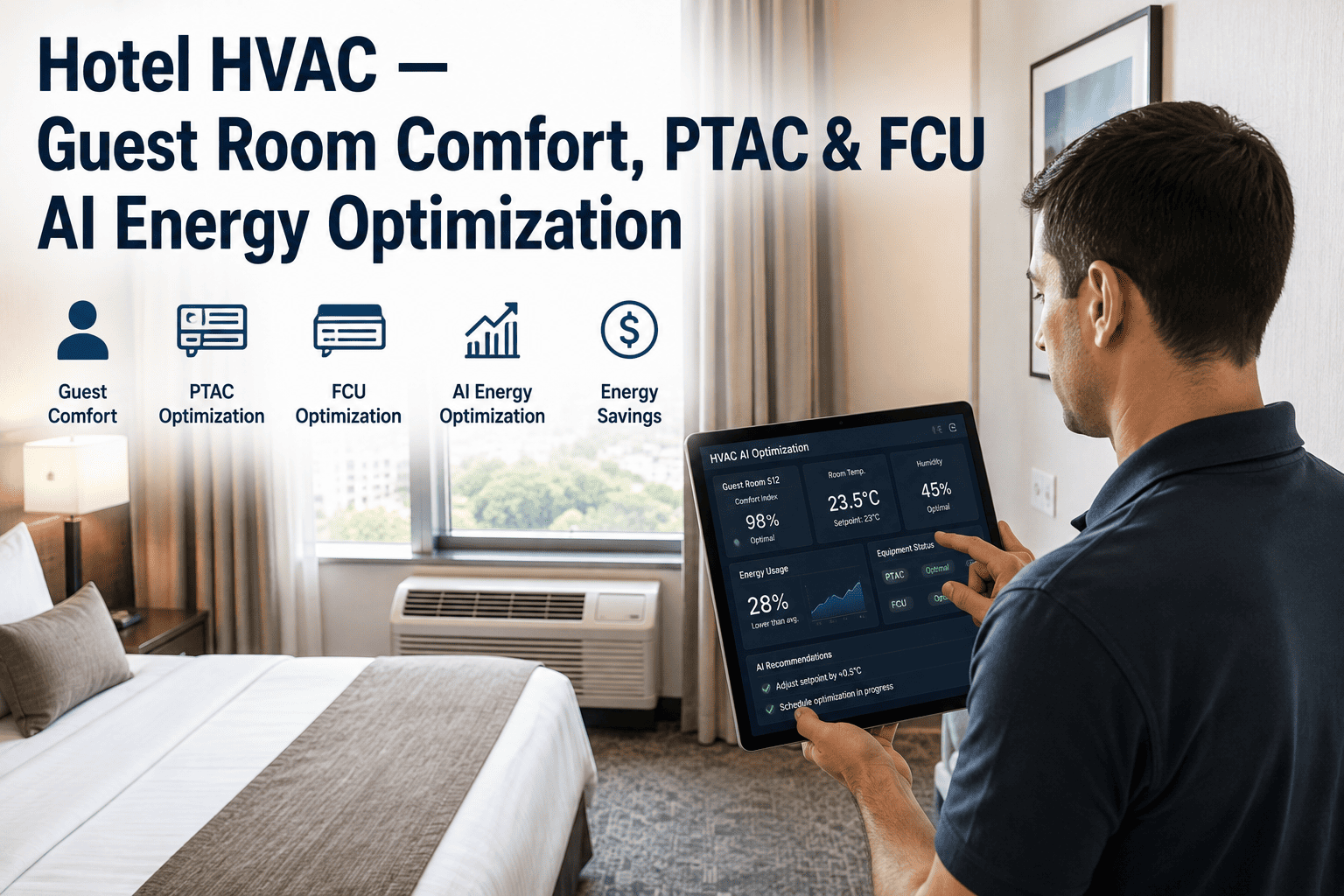
A guest checks into room 412 at 6 PM, sets the thermostat to 68, and by 9 PM is calling the front desk because the room still feels muggy even though the display reads the right number. The PTAC is running, the compressor cycles normally, and nothing on the unit looks broken, but the room feels three to five degrees warmer than the thermostat claims because humidity is sitting above 60%. That single call becomes a room block, a maintenance dispatch, and a review mentioning a stuffy room, and it happens in some form at hotels every single night. iFactory helps engineering teams see the pattern behind calls like this before they reach the front desk, and you can explore how by choosing to book a demo with our team.
Guest Room Temperature Complaints Are the Maintenance Call Hotels Cannot Afford to Ignore
Temperature-related issues account for a large share of all guest maintenance calls, and every one of them carries a review, a comp, or a room reassignment attached to it. iFactory brings AI-driven comfort management and energy optimization to PTAC, FCU, and WSHP fleets so engineering teams catch the drift before the guest picks up the phone.
A Hotel Room Is Not a Zone, It Is a Standalone Comfort System With Its Own Failure Mode
Most commercial HVAC serves an open floor plate where sensors, thermostats, and airflow can average out across a large shared space. A hotel guest room is the opposite: one PTAC, FCU, or WSHP serving one small enclosed space, judged entirely by how one person feels standing in it at that specific moment. There is no averaging effect to hide a fouled coil, a drifting thermostat, or a unit sized wrong for the room, and every one of those problems shows up as a guest experience rather than a maintenance metric first.
Humidity is the variable engineering teams underestimate most. Wet bulb temperature, the combination of dry temperature and humidity that determines how a room actually feels, can run three to five degrees warmer than the thermostat reading whenever relative humidity climbs above roughly 60%. A guest who feels that gap almost never blames humidity, they lower the thermostat instead, which increases energy draw without solving the actual problem and often makes the room feel clammy rather than cool.
Unit sizing compounds the issue in a way that is nearly invisible without data. An oversized PTAC cools a room quickly on the temperature sensor but shuts off before it has run long enough to meaningfully dehumidify the air, since dehumidification is a function of runtime, not just cooling capacity. The room reads cold and feels damp at the same time, a combination that drives complaints even when every number on a routine inspection looks fine.
The Right Comfort Platform Depends on Property Type, Not Just Purchase Price
Hotels rarely run one HVAC platform across an entire property. A limited-service roadside property might be entirely PTAC, a full-service downtown hotel might mix FCUs in guest rooms with a central plant, and a resort with a shared loop might lean on water-source heat pumps throughout. Each platform carries different comfort characteristics, different maintenance rhythms, and a different energy profile, and choosing or managing the wrong mix for a property's guest expectations is a common source of chronic complaint clusters on specific floors or wings.
| Platform | Typical Guest Experience | Maintenance Rhythm | Where It Fits Best |
|---|---|---|---|
| PTAC | Direct, quick response but audible cycling and less refined dehumidification | Monthly filter checks, quarterly deep coil cleaning | Limited and select-service properties, value and midscale brands |
| Fan Coil Unit (FCU) | Quieter operation, more even temperature and humidity control | Quarterly service, condensate line checks, valve inspection | Full-service and upper-upscale properties tied to a central plant |
| Water-Source Heat Pump (WSHP) | Consistent comfort with strong dehumidification across seasons | Loop water treatment, strainer cleaning, refrigerant checks | Resorts and larger properties on a shared condenser water loop |
The Path From a Dirty Filter to a Negative Review Is Shorter Than It Looks
Every temperature complaint traces back through a chain of small, individually unremarkable events. A filter goes unreplaced for one extra cycle. Airflow across the coil drops. The compressor runs longer to hit the same setpoint, which raises energy draw without the guest noticing anything yet. Humidity in the room creeps upward because runtime per cycle is shorter even as total runtime rises. The guest feels the gap between the thermostat number and how the room actually feels, and that is the moment the maintenance problem becomes a guest-facing one.
See Which Floors Are Trending Toward a Complaint Before They Get One
iFactory correlates runtime, filter status, and humidity trend per unit so engineering teams can act while it is still a scheduled filter change, not an angry call at 9 PM.
Four Layers That Turn Guest Room Data Into a Property-Wide Comfort Program
A structured comfort program is not a single tool, it is a stack of four coordinated layers, each doing a distinct job. Skipping any one of them leaves a gap that eventually shows up as either a complaint the team could have prevented or an energy bill higher than the property's comfort standard actually requires.
The Measurable Shift From Reactive Engineering to Proactive Comfort
These are the outcomes engineering teams consistently report once comfort monitoring, filter tracking, and humidity awareness replace a calendar-based PM schedule and a maintenance team that mostly reacts to whichever room called down first.
Choosing How Deep Guest Room Comfort Should Connect Into the Property
Engineering teams generally choose between two architectures for guest room control, and the right one depends on property size, guest profile, and how much visibility engineering actually needs at a portfolio level rather than a single-room level.
| Approach | How It Works | Best Fit |
|---|---|---|
| Standalone Room System | Presence and door sensors manage setback locally, with no connection to systems outside the room | Smaller properties with a single engineering team on site full time |
| BMS and PMS-Integrated | Room data feeds a central platform tied to occupancy from the property management system | Larger and multi-building properties where portfolio-level trend visibility matters most |
Why Spring and Fall Are Often Harder on Guest Room Comfort Than Peak Summer
Peak summer is predictable. Every unit runs near capacity, engineering teams expect high load, and PM schedules are usually built around that expectation. Shoulder seasons are where comfort programs actually break down, because outdoor temperature and humidity swing widely from morning to afternoon, and a unit that is perfectly sized for a hot, dry summer afternoon can struggle to dehumidify a mild, humid spring evening properly.
This is precisely when the wet-bulb gap described earlier becomes most pronounced. A guest checking into a room on a 68-degree, 80% humidity evening in April can feel just as uncomfortable as a guest in a room on a 95-degree August afternoon, but the maintenance team is far less likely to be watching closely for it, since shoulder-season load is generally assumed to be lower and less risky than peak summer demand.
Properties that track humidity trend data year-round, rather than treating comfort monitoring as a summer-only concern, consistently catch more of these shoulder-season complaints before they reach the front desk. The pattern tends to cluster on specific floors or wings with different sun exposure or airflow characteristics, which is exactly the kind of signal that is invisible without portfolio-level trend data but obvious once it is visualized across a full season.
Not Every Monitoring Tool Actually Solves the Guest Room Comfort Problem
Hotel engineering teams evaluating a comfort management platform often focus on whether it can report temperature per room, which is table stakes rather than the differentiator that actually prevents complaints. The more important question is whether the platform tracks humidity alongside temperature, since temperature alone consistently misses the exact condition that drives guest dissatisfaction most often.
A second question worth asking directly is whether the platform ties comfort data to filter age and runtime automatically, or whether it requires engineering staff to manually cross-reference two separate systems to spot the connection between a degrading filter and a rising humidity trend. Manual cross-referencing rarely happens consistently at scale, which means the insight technically exists in the data but never reaches anyone in time to act on it.
Finally, for any property managing more than a handful of buildings, portfolio-level aggregation is not optional. A platform that only shows data one property at a time forces an engineering director to check each hotel individually, which reproduces the same visibility gap a comfort platform was supposed to solve in the first place, just with slightly better data per property instead of a genuinely connected view across the whole portfolio.
Housekeeping and Front Desk Notice Comfort Drift Before Any Sensor Does
Data platforms catch a great deal, but housekeeping staff walk into every room daily and often notice subtle cues, a slightly musty smell, condensation on a window, a unit that sounds different than it did last week, well before those cues show up as a measurable trend in runtime or humidity data. Properties that give housekeeping a simple, fast way to flag these observations, rather than relying only on a guest complaint to trigger a maintenance response, close the gap between when a problem starts and when engineering actually learns about it.
The value of this front-line signal multiplies when it feeds into the same system tracking sensor data, since a housekeeping note about a specific room paired with a rising humidity trend on that same unit gives engineering a far more confident basis for prioritizing which rooms to inspect first, rather than treating either source of information in isolation from the other.
What Hotel Engineering Teams Ask About Guest Room Comfort AI
Stop Learning About Room Comfort Problems From the Front Desk
iFactory gives hotel engineering teams one place to see runtime, filter status, and humidity trend across every PTAC, FCU, and WSHP on property, so comfort issues get fixed before they reach a guest.