Most facilities teams are paying for HVAC maintenance contracts they cannot fully account for — services missed without notice, contract terms that favour the vendor, and no system to verify that what was promised in the agreement is actually being delivered. The average commercial building operator manages 3–7 HVAC service contracts simultaneously across chillers, rooftop units, split systems, and BMS — and fewer than one in five has a platform that connects contract obligations directly to scheduled work orders and completion records. The result is value leakage: estimates suggest 20–30% of contracted HVAC services go unverified, unchallenged, or undelivered every year. iFactory's contract management module transforms how facilities teams handle HVAC maintenance agreements — mapping every contracted service visit, PM obligation, and emergency response commitment directly to work orders, completion records, and asset histories. Every clause becomes a trackable deliverable. Every visit gets verified. Every renewal decision is backed by data. Book a free demo and see how iFactory turns your service contracts into a managed, measurable programme.
HVAC Maintenance Agreement
Management: Maximizing Value
from Service Contracts
Stop guessing whether your HVAC contractors are delivering what your contracts promise. iFactory maps every agreement obligation to a work order, tracks every visit against the schedule, and flags every missed service before renewal time catches you off guard.
Book Free Contract Management DemoWhere Your Contract Value Is Leaking — Right Now
Six ways facilities teams consistently lose value from HVAC service agreements — and why none of them show up until you're sitting across from a contractor at renewal time.
Missed Visits Go Unnoticed
Contractors miss scheduled quarterly or biannual PM visits. Without a system that tracks visit obligations against a calendar and flags non-attendance, facilities managers only discover missed visits when equipment fails — or never. Industry research shows an average of 1.4 contracted visits per asset go uncompleted annually in unmonitored programmes.
Scope Creep on Extras
Contractors invoice for "additional works" that were already included in the base contract. Without clear scope mapping in a searchable system, facilities teams approve charges they've already paid for.
SLA Breaches Unchallenged
Emergency response SLAs of 4 or 8 hours are routinely breached without penalty because the breach is never formally recorded and the contract's remedy clause is never invoked. Manual logs rarely capture actual response timestamps.
Auto-Renewal Without Review
Contracts auto-renew at inflated rates because no system sends a review prompt 60–90 days before the end date. Most renewals occur without comparing contractor performance data to the new pricing.
No Parts Inclusion Clarity
Contracts specify included vs. excluded parts lists but these are buried in appendices. Technicians and facilities managers cannot quickly verify at point of service whether a replacement component is covered — leading to disputes and overpayments.
Renewal Without Performance Data
Contract renewal decisions are made on relationship and price alone because no performance record exists. Equipment downtime, repeat faults, and poor first-time fix rates are never surfaced to inform the negotiation. See performance tracking →
How iFactory Manages HVAC Maintenance Agreements
Every feature built around closing the gap between what your contract says and what your contractor delivers.
Centralised Contract Register
Every HVAC maintenance agreement stored in one searchable repository — contract document, covered assets, included services, parts inclusions, exclusions, emergency response commitments, pricing, start date, end date, and auto-renewal notice period. Search any contract by vendor, asset type, building, or expiry date in seconds.
Obligation Scheduling & Tracking
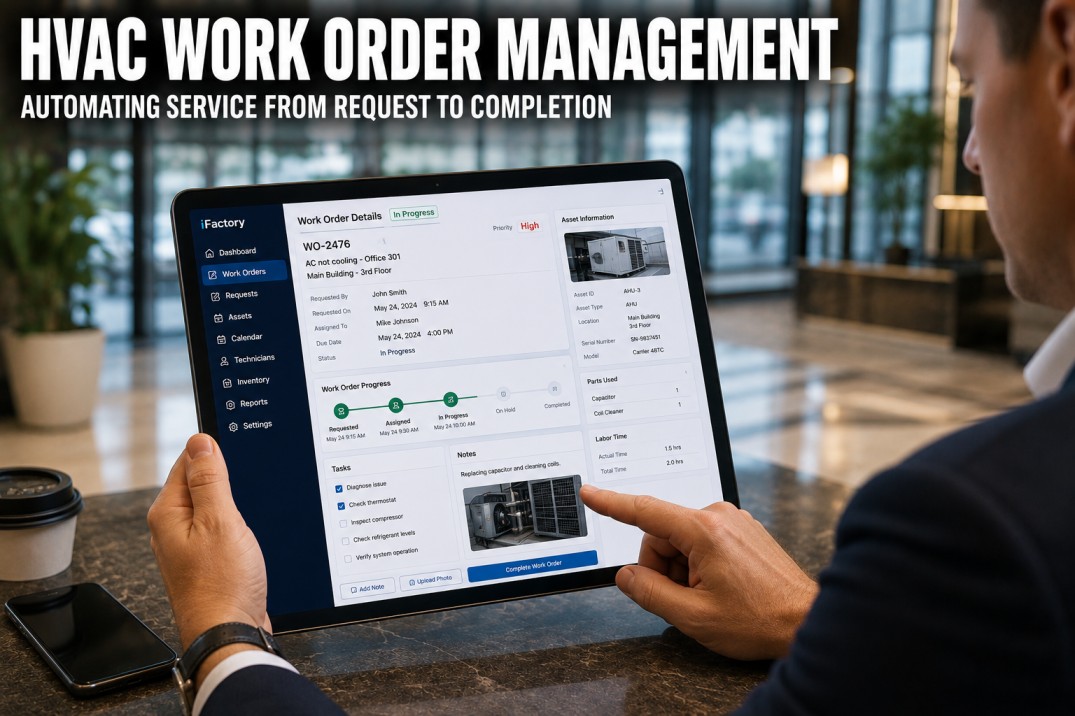
Every contracted PM visit, inspection, and service obligation automatically generates a scheduled work order in iFactory's maintenance calendar. When the date arrives, if no completion record exists, an escalation alert fires to the facilities manager. Contractors cannot invoice for visits that have no corresponding completion record in the system. See obligation tracking →
SLA Response Time Monitoring
Emergency call-out requests are timestamped from the moment they're raised. Contractor acknowledgement and arrival times are logged via mobile check-in. iFactory calculates actual response time against the contracted SLA window and flags breaches in real time — before the contractor's invoice arrives and before your memory of the incident fades.
Contractor Performance Scorecards
Each vendor receives an automatically updated performance scorecard: visit completion rate, first-time fix rate, average response time vs. SLA, call-back rate, and customer satisfaction scores from digital job sign-off. Performance data feeds directly into the contract renewal assessment — no more guesswork, no more renewing on relationship alone.
Renewal Workflow & Alerts
iFactory sends configurable renewal alerts at 90, 60, and 30 days before contract expiry. Each alert includes the full performance summary, cost vs. market benchmark, and a checklist of negotiation points based on identified service gaps. Auto-renewal can be blocked pending formal review sign-off by the facilities manager or procurement team. See renewal workflow
Contract Management: Unstructured vs. iFactory
Every HVAC Maintenance Agreement Type — Managed in One Place
iFactory handles the full spectrum of HVAC service contract structures — from basic annual PM agreements to comprehensive full-service contracts with SLA penalties.
Planned Preventive Maintenance (PPM) Only
Scheduled service visits on a defined frequency — quarterly, biannual, or annual — covering filter changes, coil cleaning, belt inspection, refrigerant checks, and operational testing. No reactive call-out coverage included. iFactory tracks each scheduled visit, generates the PM work order, logs the completion record, and flags overdue visits.
PPM + Reactive Call-Out
Combines scheduled preventive maintenance with emergency response coverage — typically 4-hour or 8-hour response SLA. Labour for reactive call-outs included; parts may be additional. iFactory monitors both PM visit completion and response time compliance, automatically recording SLA performance against each reactive call-out raised.
Full Comprehensive (Labour & Parts)
All-inclusive contracts covering labour, materials, and replacement parts for covered equipment up to defined component thresholds. Highest value — and highest leakage risk. iFactory maps the included parts list to the asset register so any additional charges can be immediately cross-referenced to the contract scope at point of invoice. See parts tracking →
Multi-Vendor Portfolio Contracts
Large facilities with multiple contractors — one for chillers, one for AHUs, one for controls — need a single platform to manage all simultaneously. iFactory's portfolio view shows all active contracts, upcoming renewals, performance comparisons between vendors, and spending analysis across the entire HVAC service budget. See portfolio view →
The Financial Case for Structured Contract Management
For a mid-sized facilities portfolio spending £250,000–£500,000 annually on HVAC maintenance contracts, structured management with iFactory typically delivers £45,000–£90,000 in annual savings through recovered value and avoided overpayments.
Writing Better HVAC Maintenance Contracts — 8 Clauses That Protect Your Budget
Most HVAC maintenance contract problems begin before the contractor sets foot on site. These eight contract provisions reduce disputes and make performance measurable from day one.
Defined Visit Frequency & Asset Schedule
Specify visit frequency per asset type — not per contract. A chiller may need quarterly visits while split units need biannual. Attach a numbered asset schedule as an appendix. Changes to covered assets require formal contract amendment — not verbal agreement.
Explicit Parts Inclusion & Exclusion Lists
Name included part categories (consumables, belts, filters, contactors) and excluded categories (compressors, heat exchangers, BMS controllers) explicitly. "Fair wear and tear" clauses must define what constitutes a covered vs. excluded failure. Ambiguity always benefits the contractor.
Measurable Response Time SLAs with Penalties
Define emergency response time as "engineer on site within X hours" — not "acknowledge within X hours." Specify the remedy for breach: service credit, rate reduction, or termination right. Without a defined penalty, an SLA is just a target, not a commitment.
Completion Record Requirements
Require the contractor to provide a digital service report — timestamped, signed, and listing work performed, readings taken, and parts replaced — for every visit within 24 hours of completion. Make this a contractual obligation, not a courtesy. Tie invoice approval to receipt of the completion record.
Quarterly Performance Review Mechanism
Build in a contractual right to quarterly performance review meetings. Define the KPIs that will be reviewed — visit completion rate, response time compliance, first-time fix rate, repeat fault rate. Specify that sustained underperformance below defined thresholds triggers a cure period or termination right.
Price Escalation Cap
Annual price increases should be capped — typically at CPI or a fixed percentage (e.g., 3%). Uncapped escalation clauses can see service costs increase 10–20% annually. Specify the index, the cap, and the notice period required before any increase takes effect.
Renewal Notice & Break Clauses
Specify a minimum notice period for non-renewal (typically 60–90 days before expiry). Include a break clause allowing early termination with notice (e.g., 90 days) in cases of sustained performance failure or material change in scope. Never allow automatic renewal without explicit written confirmation.
Data Ownership & Handover on Exit
All service records, readings, part histories, and asset data generated during the contract belong to the facility owner. Require the contractor to export all digital service records in a standard format (CSV, PDF) within 30 days of contract termination. This ensures continuity when switching contractors and prevents data being held hostage. See how iFactory stores contract data
Frequently Asked Questions
Every HVAC Contract Obligation.
Tracked. Verified. Maximised.
iFactory gives your facilities team complete visibility over every maintenance agreement — from the first scheduled visit to renewal negotiation. Know exactly what your contractors owe you, verify that they're delivering it, and walk into every renewal with 12 months of performance data backing your position.
Book Free Demo — See It Live