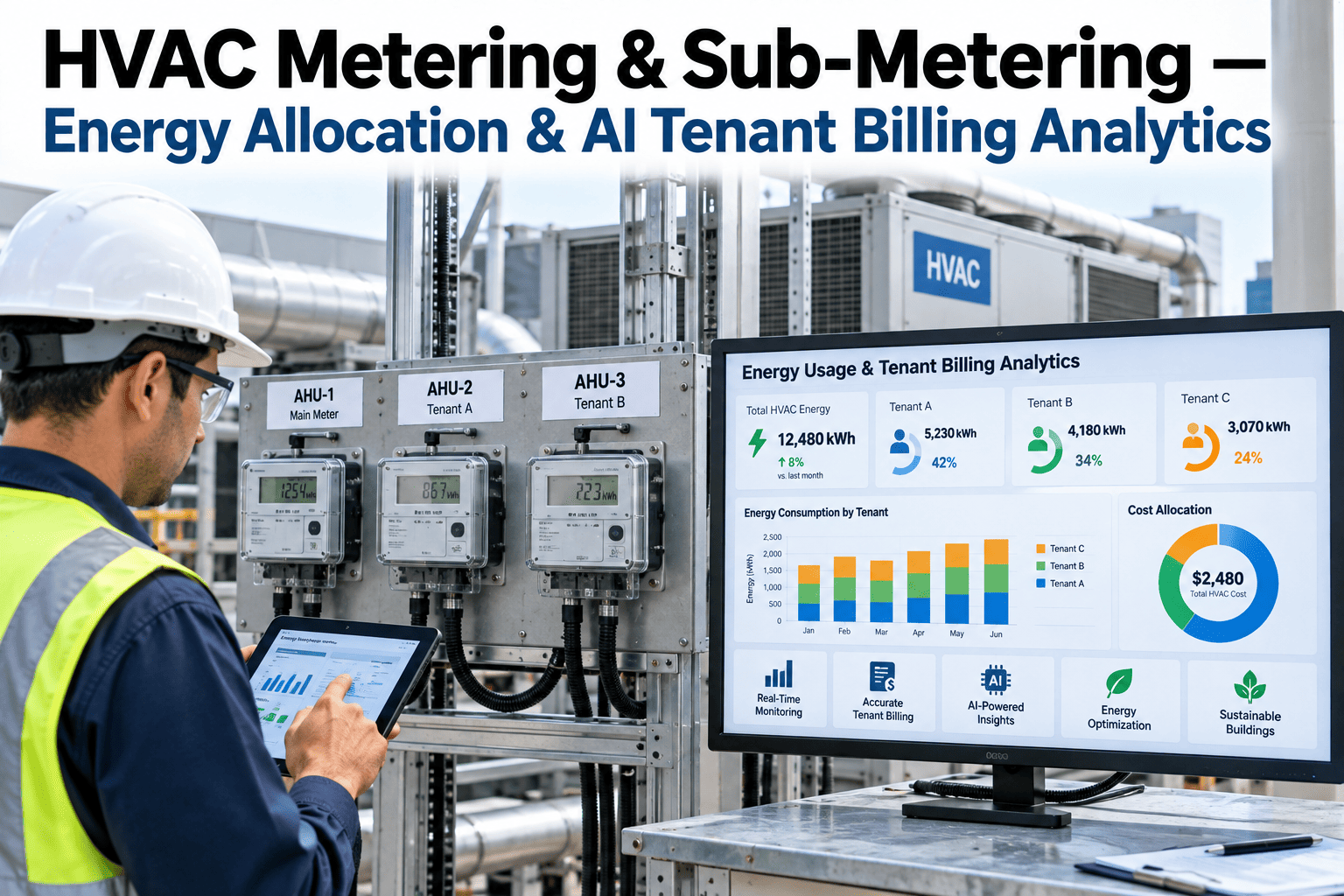
Floor-area-based energy billing assumes every tenant uses HVAC in rough proportion to how much space they lease, which is rarely true once you look at actual consumption data. A tenant running a server room or a 24-hour call center draws far more cooling per square foot than a tenant with standard office hours and light equipment loads, yet both get billed the same rate per square foot under a floor-area allocation model. The tenant with light usage ends up subsidizing the one with heavy usage, and when a lease renewal or a rate dispute finally surfaces the mismatch, the property owner has no actual consumption data to defend the allocation with. AI-based sub-metering replaces that estimate with real, tenant-specific HVAC consumption data. See how accurate sub-metering changes your tenant billing conversation.
Floor Area Is a Guess. Sub-Metering Is a Measurement.
Tenants rarely use HVAC in proportion to the square footage they lease. AI-based sub-metering replaces a floor-area estimate with actual, defensible, tenant-specific consumption data.
the HVAC consumption variance commonly found between tenants of similar floor area within the same building
of multi-tenant commercial buildings still allocate HVAC cost purely by leased square footage
the amount of actual consumption data most property owners have on hand when a tenant disputes their allocated share
Why Floor-Area Allocation Breaks Down in Practice
Floor-area billing was never designed around actual thermal load — it was designed around simplicity, back when metering every tenant individually was expensive and impractical. That simplicity comes at a real cost once tenant mixes diversify: a data closet, a commercial kitchen, or an extended-hours operation all draw dramatically more HVAC energy per square foot than a standard office suite, and a flat per-square-foot rate has no way to reflect that difference. Tenants with lighter usage effectively subsidize tenants with heavier usage every month, and because nobody has metered consumption data to point to, disputes tend to get resolved through negotiation and relationship management rather than an objective number both sides can trust.
The Same Floor Area, Very Different Actual Usage
Three tenants leasing similar square footage in the same building can show dramatically different actual HVAC consumption once sub-metered.
Standard Office Tenant
Floor Area Share
Actual Metered Usage
Call Center Tenant (24-Hour)
Floor Area Share
Actual Metered Usage
Light-Use Storage Tenant
Floor Area Share
Actual Metered Usage
See What Your Tenants Are Actually Using
iFactory reviews your building's tenant mix and current allocation method to show exactly where floor-area billing is diverging from actual consumption.
Allocation Method Compared
Each allocation approach carries a different balance between how easy it is to implement and how well it actually reflects what each tenant consumes.
What a Sub-Metering Rollout Involves
Moving from floor-area estimates to tenant-level metering is primarily a data integration project layered onto whatever metering hardware already exists.
Metering coverage assessment
Existing meters and VAV box data are inventoried first to identify which tenant spaces already have usable consumption data and where new metering points are actually needed.
Consumption-to-tenant mapping
Metered data streams get mapped to specific tenant lease boundaries, handling the common complication of shared systems serving multiple tenant spaces.
Automated billing analytics
Actual consumption data feeds directly into billing calculations, replacing a manual floor-area spreadsheet with a transparent, tenant-visible usage report.
What Changes When Billing Reflects Actual Usage
Figures reflect typical outcomes within the first year after a multi-tenant building moves from floor-area billing to tenant-level sub-metering.
A Facility Manager's View on Sub-Metering
We had one tenant convinced they were subsidizing everyone else in the building, and honestly we couldn't prove otherwise because we'd never metered anyone individually. Once we had actual per-tenant data, it turned out they were right — a neighboring tenant's after-hours server room was drawing a disproportionate share of the cooling load. Being able to show both tenants the real numbers turned a tense lease renewal conversation into a straightforward one.
The Bottom Line on HVAC Sub-Metering
Floor-area billing was a reasonable compromise when metering every tenant individually was expensive, but that trade-off doesn't hold up once tenant usage patterns diverge as much as they typically do in a real building. AI-based sub-metering replaces the estimate with an actual measurement, giving both property owners and tenants a transparent number to work from instead of a formula built on square footage alone.
Frequently Asked Questions
Does sub-metering require replacing existing HVAC equipment?
No — sub-metering typically layers on top of existing HVAC infrastructure using flow meters, VAV box airflow data, or electrical submeters on dedicated tenant equipment, rather than requiring equipment replacement. Most buildings already have some usable data points in the BMS that simply need to be mapped to specific tenant spaces and consolidated into a billing-ready format. Book a review to see what your building's existing systems already support.
How are shared HVAC systems handled when a single unit serves multiple tenants?
Shared systems are typically sub-metered at the VAV box or terminal unit level, allocating the shared central plant's energy proportionally based on each tenant's actual measured airflow and temperature differential rather than an assumed even split, which captures real usage variance even when tenants share upstream equipment.
Can tenants see their own consumption data directly?
Many sub-metering programs include a tenant-facing usage dashboard or regular usage report, which tends to reduce disputes on its own since tenants can see the same data driving their bill rather than receiving a number with no visibility into how it was calculated.
Is sub-metering worth it for a building with a relatively uniform tenant mix?
Even buildings with seemingly similar tenants often show meaningful consumption variance once actually metered, driven by differences in occupancy hours, equipment density, or how conscientiously each tenant manages their own thermostat settings, so the value of accurate data tends to hold even in buildings that look uniform on paper.
How does this integrate with existing lease language around operating expense allocation?
Most leases include language allowing for metered or sub-metered allocation as an alternative to a pro-rata floor-area share, and transitioning existing tenants typically happens at lease renewal or through an amendment, since retrofitting metering methodology mid-lease usually requires tenant agreement. Talk to a specialist about sequencing this transition across your tenant lease expirations.
Replace the Estimate With a Measurement
Book a 30-minute assessment. iFactory reviews your building's tenant mix and shows exactly what accurate sub-metering would change about your billing.