HVAC analytics transforms raw building data into actionable intelligence that reduces energy consumption, prevents equipment failures, and optimizes maintenance spending. This guide presents a complete system approach to HVAC analytics covering measurement infrastructure, data processing pipelines, diagnostic algorithms, and workflow integration. Whether you are evaluating analytics for a single building or planning an enterprise-wide deployment, this guide provides the framework to select, implement, and scale analytics that deliver 18% to 35% energy savings and 40% to 60% reduction in unplanned downtime.
Transform Building Data Into Energy Savings With HVAC Analytics
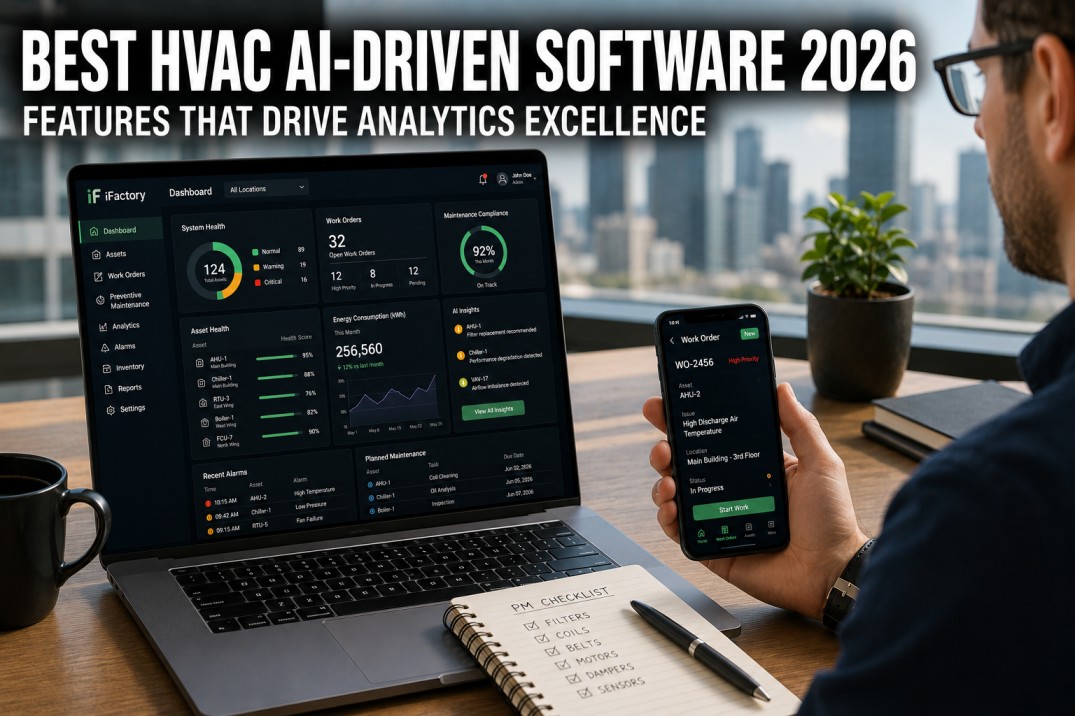
iFactory's HVAC analytics platform provides fault detection, predictive maintenance, and continuous commissioning analytics in a single dashboard. Book a demo to see how data-driven HVAC management reduces energy costs 18-35% and cuts downtime 40-60%.
What Is HVAC Analytics? Capabilities, Benefits & Implementation Models
HVAC analytics is the application of data processing, machine learning, and domain expertise to HVAC system data to detect faults, diagnose root causes, and recommend corrective actions.
Fault Detection & Diagnostics (FDD)
Automated algorithms identify abnormal operation: sensor drift, stuck dampers, economizer failures, refrigerant issues, and control sequence errors. Detects problems 3-8 weeks before they cause failures. Savings: 10-20% energy reduction.
Performance Monitoring & Benchmarking
Continuous measurement of KPIs: kW/ton, temperature splits, approach temperatures, static pressure, and runtime. Compare actual vs. expected performance across equipment and buildings. Identifies underperforming assets.
Predictive Maintenance Analytics
Machine learning models trained on historical failure data predict remaining useful life. Predicts failures 2-6 weeks in advance. Reduces emergency repairs 50-70% and extends equipment life 3-5 years.
Measurement Infrastructure: Sensors, Data Collection & Connectivity
Effective HVAC analytics depends on quality data from the right measurement points collected at appropriate intervals and transmitted reliably to processing platforms.
| Sensor Type | Measured Parameter | Installation Point | Sampling Interval | Cost |
|---|---|---|---|---|
| Temperature Sensor | Supply air, return air, mixed air, outdoor | Across each coil, discharge, zones, OA | 1-5 min | $30-120 |
| Pressure Sensor | Static pressure, duct pressure, filter drop | Across fan, filter, key duct sections | 1-5 min | $80-250 |
| Current Transducer | Compressor, fan, pump amps | At starter/disconnect for each motor | 5-15 min | $50-150 |
| Flow Meter | Chilled water, hot water, condenser water | At primary supply/return piping | 1-5 min | $200-800 |
| Humidity Sensor | Space RH, return RH, outdoor RH | In representative zones, main return, OA | 5-15 min | $60-180 |
| Vibration Sensor | Fan bearing, compressor, pump | Mounted on bearing housings | Continuous (10kHz+) | $150-400 |
| CO2 Sensor | Space CO2 concentration | In occupied zones (1 per 10K sq ft) | 5-15 min | $100-250 |
| Power Meter | Whole HVAC system or major equipment | At electrical distribution panel | 1-15 min | $300-2K |
Implementation Path: From Data Collection to Actionable Insights
A successful HVAC analytics implementation follows a phased approach that builds capability incrementally while delivering value at each stage.
Phase 1: Connect & Collect
Install sensors, connect to BMS/gateway, establish data pipeline to analytics platform. Verify data quality. Timeline: 4-8 weeks. Captures 20% of potential savings through visibility alone.
Phase 2: Monitor & Alert
Configure automated fault detection rules, set up dashboards, establish alert thresholds and notification workflows. Timeline: 4-6 weeks. Identifies 30-50 faults per 100K sq ft in year one.
Phase 3: Diagnose & Act
Train staff on diagnostic workflows, integrate work order system, establish closed-loop processes from alert to resolution. Timeline: 6-12 weeks. Reduces MTTR by 40-60%.
Phase 4: Predict & Optimize
Deploy ML models for predictive maintenance, optimize schedules based on analytics, implement continuous commissioning. Timeline: 8-16 weeks. Additional 10-15% savings beyond monitoring.
HVAC Analytics ROI: Cost, Savings & Payback Benchmarks
Investment in HVAC analytics delivers documented returns across multiple value streams with typical payback between 8 and 18 months.
Energy Savings
Verified energy savings from fault correction and schedule optimization. Average 22% in commercial buildings. $0.15-0.40/sq ft annual savings. Largest single value stream.
Downtime Reduction
Predictive analytics catches developing failures 3-6 weeks before breakdown. Avoided emergency repairs: $3K-$8K per compressor failure, $1K-3K per fan/motor failure.
Life Extension
Equipment operating at design conditions with fewer stress events lasts longer. Deferred capital: $50K-$200K per 100K sq ft over equipment lifecycle.
Labor Efficiency
Analytics routes technicians to actual problems rather than wasting time on checklists. Reduces PM labor 20-30% through condition-based triggers.
Stop Reacting, Start Predicting With Analytics-Driven Maintenance
iFactory's platform uses machine learning to predict equipment failures 3-6 weeks in advance, enabling planned interventions instead of emergency repairs. Book a demo to see how predictive analytics transforms your maintenance program from reactive to proactive.
Analytics Capability Comparison: Platforms & Feature Sets
HVAC analytics platforms vary in depth of diagnostics, integration capabilities, and deployment models.
| Capability | Basic Monitoring | FDD Platform | Predictive Analytics | Enterprise Cx |
|---|---|---|---|---|
| Fault Detection | Alerts only | Rule-based + ML | ML with remaining life | Full diagnostics suite |
| Integration | BMS read-only | BMS + CMMS | BMS + CMMS + Utility | BMS + CMMS + Utility + Weather |
| Diagnostic Depth | Threshold alerts | Root cause analysis | Root cause + prediction | Root cause + prediction + simulation |
| Deployment | Cloud basic | Cloud advanced | Cloud + edge | On-prem + cloud hybrid |
| Cost/sq ft | $0.01-0.03 | $0.03-0.08 | $0.08-0.15 | $0.12-0.25 |
| Typical Payback | 12-24 months | 8-18 months | 10-20 months | 12-24 months |
Frequently Asked Questions
What is HVAC analytics and how does it work?
HVAC analytics is the systematic application of data collection, processing, and machine learning to HVAC system data to detect faults, diagnose root causes, predict failures, and optimize performance. It works by continuously collecting data from sensors installed on HVAC equipment (temperature, pressure, current, vibration, etc.), transmitting it to a processing platform where algorithms compare actual operation against expected behavior, identifying anomalies, diagnosing their root causes, and generating actionable alerts. Advanced platforms use machine learning models trained on historical failure data to predict remaining useful life and recommend preventive action. Typical implementations detect faults 3-8 weeks before they would be found during routine inspections and 2-6 weeks before failure.
How much energy can HVAC analytics save?
HVAC analytics typically delivers 18-35% energy savings in commercial buildings with an average of 22% across published case studies. Savings come from four sources: schedule optimization (5-12% savings by eliminating conditioning during unoccupied hours), fault correction (8-15% by detecting and fixing economizer failures, sensor drift, and control sequence errors), commissioning maintenance (3-7% by preventing performance degradation over time), and predictive optimization (2-5% through model-predictive control and demand-based operation). A 100,000 sq ft office with $150,000 annual HVAC costs saves $27,000-$52,500 per year. Payback ranges from 8-18 months depending on starting efficiency and selected platform.
What is the difference between fault detection and predictive analytics?
Fault detection and diagnostics (FDD) identifies problems that currently exist or have already occurred. It answers: what is wrong right now? Predictive analytics forecasts problems that will occur in the future. It answers: what will fail and when? FDD uses rule-based or ML algorithms to compare current operation against expected ranges, detecting anomalies, and diagnosing root causes. Predictive analytics trains ML models on historical failure data, sensor trends, and operating conditions to estimate remaining useful life. FDD reduces mean time to repair by 40-60% by eliminating diagnostic guesswork. Predictive maintenance reduces emergency repairs by 50-70% by enabling planned interventions before failure. Most comprehensive platforms include both.
How do I get started with HVAC analytics for my building?
Start with a readiness assessment: audit existing BMS points and sensor coverage, verify data accessibility, and identify the 10-20 highest-value faults for your building type. Most buildings lack sufficient sensors for comprehensive analytics. Install supplementary sensors at critical points: temperature across each coil, pressure across filters and fans, and current on major motor circuits. Budget $0.03-0.08/sq ft for basic FDD deployment or $0.08-0.15/sq ft for comprehensive predictive analytics. Choose a cloud-based platform for easiest deployment. Plan for a phased rollout: phase 1 connects and visualizes data (4-8 weeks), phase 2 adds fault detection (4-6 weeks), and phase 3 enables predictive capabilities (8-16 weeks).
What are the most common faults detected by HVAC analytics?
The most commonly detected faults include: economator damper failure (40-60% of buildings have stuck/malfunctioning dampers), schedule optimization opportunities (70% of buildings start conditioning 2-4 hours before occupancy), sensor drift (30% of temperature sensors drift >3F within 5 years), control sequence errors (simultaneous heating/cooling affects 15-25% of buildings), refrigerant charge issues (18% of units have improper charge), air filter loading (filter pressure drop exceeds design 60% of the time), duct leakage (15-25% of conditioned air lost), VAV box failures (20-30% of boxes have stuck dampers or failed reheat valves), and condenser coil degradation (approach temperature rises 5-10F per year uncleaned).
From Data to Decisions: Complete HVAC Analytics With iFactory
iFactory's Preventive analytics module delivers comprehensive HVAC analytics including fault detection, root cause diagnosis, predictive maintenance, and continuous commissioning. Book a demo to see how complete system analytics optimizes your entire HVAC portfolio.


.jpg)