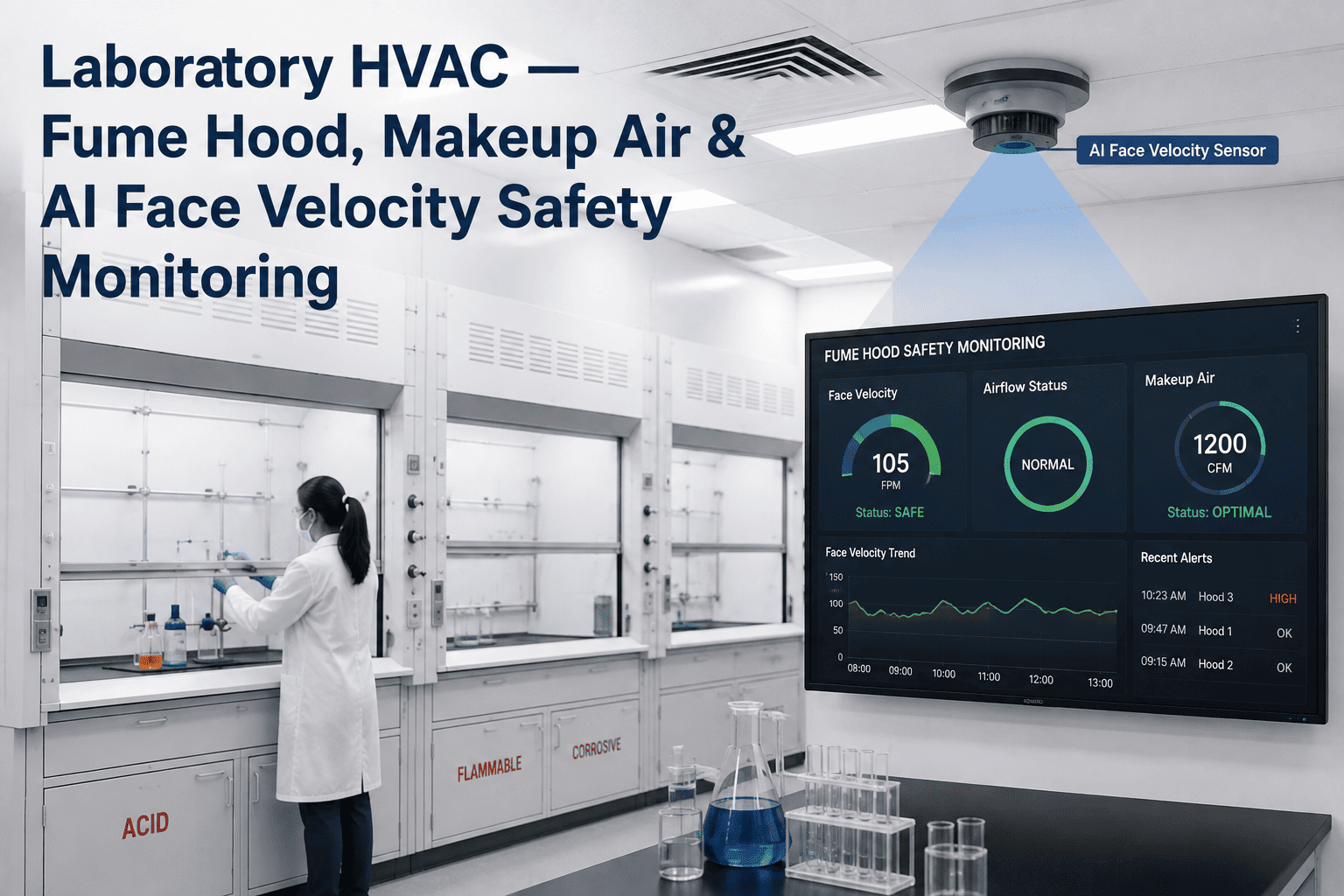
A researcher opens a fume hood sash quickly to grab a reagent bottle mid-procedure, and for a few seconds the airflow system cannot keep up with the sudden change in opening size. Face velocity dips, a small pocket of turbulence forms right at the opening, and vapor that should have stayed contained gets pulled out into the room instead. Nobody sees it happen, no alarm sounds because the annual certification was passed months ago, and the exposure never gets logged. iFactory helps process engineers monitor exactly this kind of transient failure, not just the annual snapshot, and you can see how by choosing to book a demo with our team.
Annual Fume Hood Certification Tells You the Hood Passed a Test, Not That It Is Safe Today
Face velocity testing is the standard method for verifying fume hood containment, but a static annual test cannot catch the transient failures that happen during normal daily use. iFactory gives process engineers continuous face velocity, sash position, and makeup air visibility so containment risk is caught in real time, not once a year.
Face Velocity Testing Verifies a Snapshot, Sash Movement Happens Continuously
ANSI/AIHA Z9.5 requires routine fume hood performance tests at least annually, and OSHA's laboratory guidance reinforces that same minimum. That standard exists because it is a workable baseline, not because annual testing is sufficient to guarantee containment on every day in between. A hood that measures perfectly at a static sash position during certification can still fail to protect a researcher during the exact moment that matters most: a rapid sash movement in the middle of an active procedure.
Variable air volume hoods, now the dominant design in most modern laboratories because of the energy they save relative to constant-volume systems, are also inherently more susceptible to performance drift over time than older constant-volume designs. A VAV system has more moving parts working continuously to hold face velocity steady as sash position changes, and each of those parts represents another point where calibration drift, valve wear, or a slow control response can quietly erode containment between certification cycles.
The specific failure mode process engineers should worry about most is not a hood that fails a static test, it is one that shows a slow or oscillating airflow response after a sash movement. That transitional lag is where turbulence forms and vapor escapes the hood opening, and it is a risk that a face velocity measurement taken at a fixed sash position will never detect, no matter how carefully the annual test is performed.
Waiting for the Next Scheduled Certification Is Not Always the Right Call
Several events should prompt an unscheduled face velocity check regardless of when the last annual certification was completed, since each one can materially change how a hood performs even if nothing about the hood itself was touched directly.
Catch the Transitional Lag Between Sash Movement and Airflow Response
iFactory tracks face velocity continuously alongside sash position, so a slow or oscillating response gets flagged the moment it happens, not at the next scheduled certification.
Two Different Control Strategies, Two Different Monitoring Priorities
Constant-volume hoods pull a fixed exhaust flow regardless of sash position, so face velocity actually rises as the sash is lowered and the opening shrinks. VAV hoods instead adjust exhaust flow as the sash moves, holding face velocity roughly constant while total exhausted air volume drops with a lower sash, which is the mechanism behind their significant energy advantage over constant-volume designs.
| Characteristic | Constant Volume Hood | Variable Air Volume Hood |
|---|---|---|
| Exhaust Flow Behavior | Fixed regardless of sash position | Modulates as sash position changes |
| Energy Profile | Higher, since full flow runs continuously | Lower, since flow drops with a closed sash |
| Mechanical Complexity | Simple, fewer components to calibrate or wear | More complex, with a damper or valve requiring calibration |
| Monitoring Priority | Periodic verification of stable exhaust flow | Continuous response time and drift monitoring |
A Fume Hood Cannot Perform Correctly Without Enough Air to Replace What It Exhausts
Every cubic foot a fume hood exhausts has to be replaced by makeup air entering the room, and when that supply falls short, the room runs under negative pressure that a hood alone cannot overcome. A constant-volume hood exhausting 750 to 1,000 cubic feet per minute needs a makeup air system engineered to match that draw, and any shortfall shows up as poor face velocity uniformity, doors that are difficult to open, or air being pulled in from adjacent, potentially uncontrolled spaces.
Energy cost is the other half of the makeup air conversation, since every cubic foot pulled into the lab has typically already been heated, cooled, humidified, or dehumidified before it ever enters the room. A single constant-volume hood can represent several thousand dollars per year in HVAC energy cost once seasonal heating and cooling loads are factored in, which is exactly why VAV adoption and hood consolidation are among the highest-return efficiency projects available to a laboratory building.
Balancing makeup air correctly against fume hood exhaust demand is not a one-time commissioning task, it is a relationship that needs to be revisited any time hood count, sash usage patterns, or building occupancy changes meaningfully, since a supply system sized correctly at commissioning can fall out of balance as a lab's actual usage evolves.
The Gap Between a Compliance Requirement and an Actual Safety Program
These are the specific risks that a well-run continuous monitoring program identifies well ahead of the next scheduled certification, closing the exposure window that a purely annual testing cadence leaves open by default.
What Distinguishes a Compliance Checkbox From a Program That Actually Reduces Risk
Many laboratories treat fume hood safety as a documentation exercise: perform the annual test, file the certificate, and move on until the next cycle comes due. That approach satisfies the letter of ANSI/AIHA Z9.5 and OSHA's guidance, but it leaves the entire interval between certifications essentially unmonitored, which is exactly the window where most real containment failures actually occur during normal daily use.
A program built around genuine risk reduction instead treats the annual certification as a floor, not a ceiling. Continuous or high-frequency monitoring of face velocity and sash position fills the gap between certifications, and documented training on sash discipline, meaning teaching researchers to move the sash deliberately rather than snapping it open quickly, addresses the human behavior side of the same risk that instrumentation alone cannot fully solve.
Process engineers overseeing multiple labs across a research building or campus also benefit from being able to compare hood performance across the portfolio, since a hood design or installation pattern that is prone to drift in one lab is very likely to show the same tendency in structurally similar labs elsewhere in the same building. Spotting that pattern early lets a facility address a systemic issue once, rather than discovering and fixing the same underlying problem lab by lab as each one eventually fails its own certification.
Not Every Hood in a Building Needs the Same Face Velocity Target
A common but avoidable inefficiency in laboratory design is applying a single conservative face velocity target across every hood in a building, regardless of what is actually being handled at each one. A hood used exclusively for low-toxicity general chemistry work does not need the same 125 to 150 feet-per-minute target appropriate for highly toxic or hazardous material handling, and running it at that higher rate unnecessarily increases the volume of conditioned air the hood exhausts every hour.
High-performance low-flow hood designs extend this principle further, achieving safe containment at face velocities of 60 to 80 feet per minute instead of the conventional 100 feet-per-minute baseline, which meaningfully reduces the energy cost of conditioning replacement makeup air over the life of the hood. Matching each hood's target to a documented hazard assessment, rather than defaulting every hood in a building to the same conservative number, is one of the more effective ways a facility can reduce energy cost without compromising researcher safety anywhere in the building.
Getting hazard-matched targets right depends on accurate, per-hood data about what is actually happening at each hood over time, not just a one-time assessment performed when the lab was first commissioned. Usage patterns change as research programs evolve, and a hood's original hazard classification can become outdated well before anyone thinks to revisit it.
What an Inspector Actually Wants to See Beyond a Signed Certificate
A signed annual certification is the minimum record most regulatory frameworks expect, but a lab that can also show a continuous performance history, sash movement response times, drift trends between certifications, and a documented log of every trigger-based inspection performed outside the normal cycle, presents a materially stronger safety case than one relying on the certificate alone. That distinction matters most in the moments it counts, when an incident investigation or a routine audit asks not just whether the hood was certified, but whether the facility had any visibility into how it was actually performing on the days in between.
Process engineers overseeing labs across a research campus also benefit from a documentation trail that makes it straightforward to demonstrate consistency across many hoods at once, rather than assembling a separate paper record for each one individually when a program-wide review comes due. Centralized, continuously logged data turns what used to be a time-consuming audit preparation exercise into something closer to a report that already exists and simply needs to be pulled.
Questions Process Engineers Ask About Fume Hood and Makeup Air Monitoring
Move From an Annual Compliance Check to Real-Time Containment Visibility
iFactory gives process engineers continuous face velocity, sash position, and makeup air data across every fume hood, so containment risk is caught in the moment it happens.