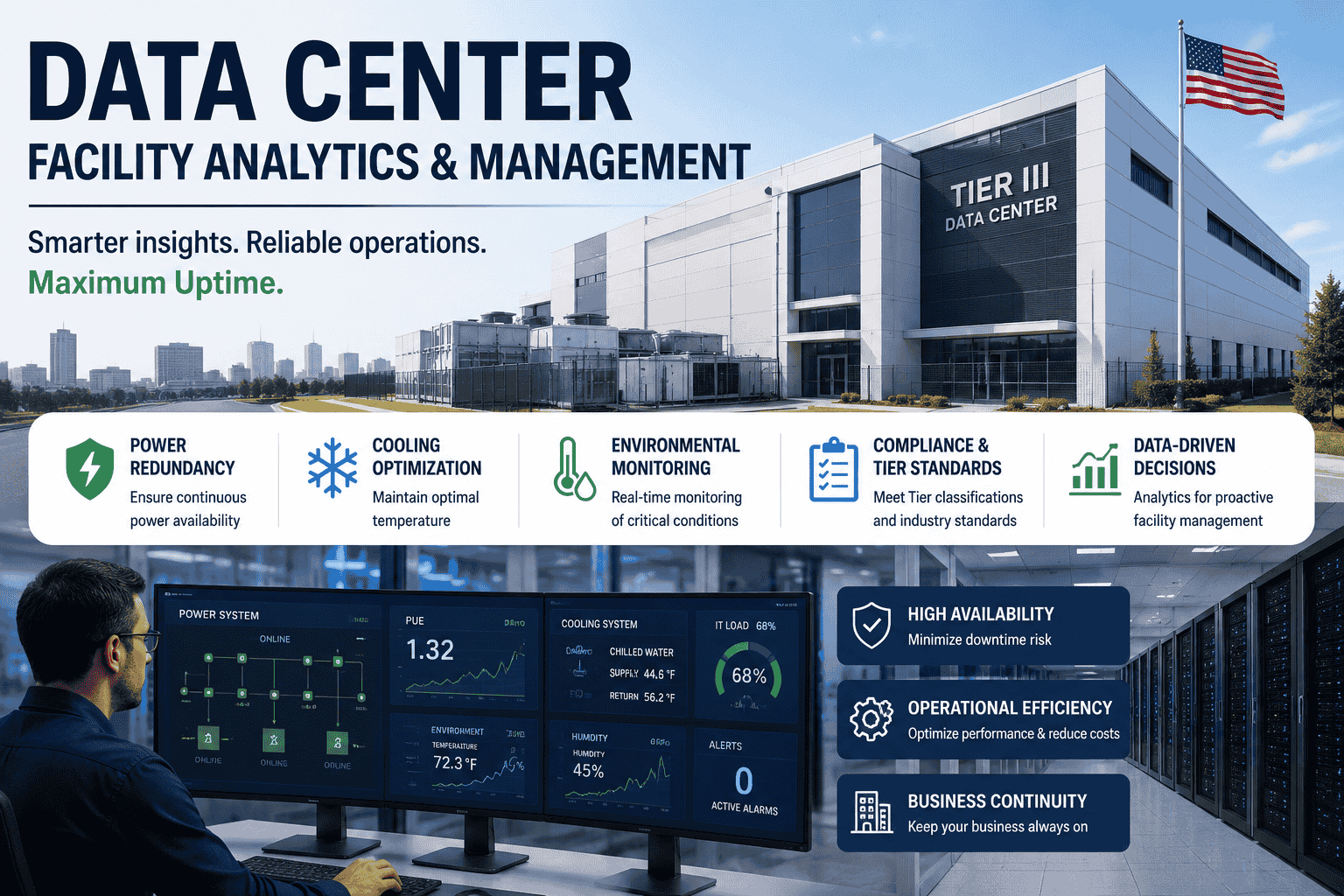
Data center cooling failures cost $300,000 or more per hour — and 41% of organizations report even higher losses. In an industry where 99.999% uptime means just 5.26 minutes of downtime per year, cooling system reliability isn't just an operational concern — it's the single largest determinant of whether a data center meets its SLA commitments. The global data center HVAC market reached $13.7 billion in 2025 and is growing at 9.8% CAGR toward $36 billion by 2035, with the broader data center cooling market valued at $18.78 billion and projected to reach $54 billion by 2034. Google has achieved 99.999% uptime across 1GW of liquid cooling capacity deployed in 2,000 pods. AI workloads are driving power densities beyond what traditional air cooling can handle — liquid cooling now accounts for over 38% of new high-density installations. Meanwhile, the AIM Act mandates an 85% reduction in HFC production by 2036, with R-410A banned from new equipment since January 2025. Preventive maintenance reduces HVAC energy consumption by 15–20% and extends equipment life by 30–50% according to the US Department of Energy. Data center cooling power demand reached 62 gigawatts in 2025 and is projected to nearly triple to 134 GW by 2030. For data center operators, every maintenance task on every CRAC unit, chiller, CDU, and containment system directly determines whether the facility meets its uptime commitment. iFactory's CMMS platform manages mission-critical HVAC maintenance for data centers with redundancy-aware scheduling, predictive analytics integration, SLA-aligned priority routing, and complete audit documentation for Uptime Institute tier certifications. Book a free demo and protect your facility's uptime.
HEROData Center HVAC Maintenance: Ensuring 99.999% Uptime for Critical Cooling
Every CRAC unit, chiller, CDU, and containment system in your data center is a link in the uptime chain. One missed maintenance task, one undetected refrigerant leak, one failed fan bearing can cascade into a thermal event that takes down an entire hall. This guide covers every maintenance practice, technology, and organizational strategy that separates 99.999% facilities from the rest.
The Cascade: How Cooling Failures Become Outages
Data center thermal events don't happen in isolation. A single cooling component failure cascades through the facility in minutes — understanding the failure chain is the first step to preventing it.
Total Cooling Loss
Complete failure of primary and backup cooling systems. Server inlet temperatures exceed thermal thresholds within 5–15 minutes depending on rack density. Automatic thermal shutdown begins to protect hardware, causing cascading service outages. At $300K+/hour, every minute counts. This scenario is what Uptime Institute tier certifications are designed to prevent through redundancy requirements.
Partial Cooling Degradation
One CRAC unit fails in an N+1 configuration. Remaining units compensate but operate at higher capacity, accelerating wear. Hot spots develop in affected zones. If not resolved within the maintenance window, a second unit failure collapses the redundancy and creates a critical event. This is the most common scenario — and the most preventable with predictive maintenance. See predictive alerts
Efficiency Degradation
Dirty coils, low refrigerant charge, miscalibrated sensors, or blocked airflow paths gradually reduce cooling capacity and increase energy consumption. PUE creeps upward. The system still functions but at reduced margin — any additional thermal load (new rack deployment, ambient temperature spike) can push it into failure. This silent degradation is detected only by continuous monitoring.
Compliance & Certification Risk
Incomplete maintenance documentation, expired certifications, or missed PM schedules don't cause immediate outages — but they fail Uptime Institute audits, void equipment warranties, and create liability exposure. When something does go wrong, undocumented maintenance history compounds the operational failure with a compliance failure.
Every Cooling System Type — And What Maintenance Each Demands
Computer Room Air Conditioning / Handlers
Central chilled water systems
Cold plates on processors/GPUs
Full server submersion in dielectric fluid
Airside and waterside free cooling
Preventive + Predictive — The Dual Strategy for Five-Nines Uptime
Neither scheduled maintenance alone nor sensor monitoring alone achieves 99.999%. The combination of both — with redundancy-aware scheduling — is the operational foundation of mission-critical cooling.
Preventive Maintenance (Time-Based)
Scheduled tasks performed at fixed intervals regardless of condition — the baseline that prevents known failure modes.
Predictive Maintenance (Condition-Based)
Continuous monitoring that detects degradation between scheduled visits — catching failures that calendar-based PM would miss.
AIM Act Compliance — R-410A Phase-Out and What Replaces It
R-410A is banned from new equipment since January 2025. The AIM Act mandates 85% HFC production reduction by 2036. Data center operators must plan refrigerant transitions now.
R-410A (HFC)
GWP: 2,088. Banned from new equipment January 2025. Existing systems can continue using R-410A but supply will tighten and prices will rise as HFC production quotas decrease. Plan retrofit or replacement timelines now.
R-454B (Opteon XL41)
GWP: 466. Lower-GWP synthetic alternative. A2L mildly flammable classification requires updated safety protocols and leak detection. Compatible with many existing system designs with modifications. Most common drop-in transition path for data center CRAC/CRAH units.
R-744 (CO₂)
GWP: 1. Superior environmental profile. Operates at higher pressures requiring specialized equipment and training. Gaining traction in large-scale data center cooling. Proven in industrial refrigeration for decades. Excellent thermodynamic efficiency for large cooling loads. Plan refrigerant transition
R-717 (Ammonia)
GWP: 0. Exceptional thermodynamic efficiency. Long proven in industrial cooling applications. Requires specialized safety systems and trained technicians due to toxicity. Increasingly adopted for large-scale data center cooling — the line between data center and industrial refrigeration is blurring.
How iFactory Manages Data Center Cooling Maintenance
Redundancy-Aware Scheduling
Schedule maintenance on individual CRAC units, chillers, and CDUs without compromising N+1 or 2N redundancy. The system verifies that sufficient cooling capacity remains online before approving any maintenance window — preventing the #1 cause of maintenance-induced outages.
SLA-Aligned Priority Routing
Cooling alerts are automatically prioritized by impact severity and SLA exposure. Critical thermal events escalate to on-call technicians immediately. Degradation alerts route to the next available qualified technician. Compliance items schedule into planned maintenance windows. See priority routing
Predictive Analytics Integration
Connect vibration sensors, thermal cameras, refrigerant monitors, and BMS data feeds into CMMS. When predictive analytics flag developing issues, work orders generate automatically with diagnostic context, affected zone, estimated time to failure, and recommended procedures.
Tier Certification Documentation
Maintain complete audit trails for Uptime Institute tier certification requirements. Document every PM task, emergency response, redundancy test, and system modification with timestamps, technician identification, and photo evidence. Audit-ready reporting generates on demand.
Every Cooling System Component — Maintained and Documented
Frequently Asked Questions — Data Center HVAC Maintenance
How do you maintain cooling systems without breaking redundancy?
Redundancy-aware maintenance scheduling is the foundation. Before any cooling unit goes offline for service, the CMMS verifies that remaining online capacity meets the facility's redundancy requirement (N+1, N+2, or 2N). Maintenance windows are staggered so that no two redundant units are serviced simultaneously. For critical facilities, maintenance occurs during low-load periods (typically overnight or weekends) when ambient temperatures are lower and cooling demand is reduced. The CMMS tracks real-time cooling capacity and blocks maintenance requests that would compromise redundancy — preventing the most common cause of maintenance-induced thermal events. See redundancy-aware scheduling
What's the ROI of predictive maintenance for data center cooling?
The math is straightforward: unplanned downtime costs $300K+ per hour, while a comprehensive predictive maintenance program for a typical data center cooling plant costs $50K–150K per year. One prevented outage pays for multiple years of predictive monitoring. Beyond outage prevention, the US DOE reports that preventive maintenance reduces HVAC energy consumption by 15–20% and extends equipment life by 30–50%. Google reduced cooling costs by 40% using AI-optimized cooling management. For a facility spending $2–5M annually on cooling energy, a 15–20% reduction represents $300K–$1M in annual savings — plus the avoided catastrophic cost of downtime.
How does liquid cooling change maintenance requirements?
Liquid cooling (direct-to-chip and immersion) introduces maintenance tasks that don't exist in air-cooled environments: coolant quality testing, leak detection systems (critical — liquid near electronics), CDU maintenance, pump operation monitoring, manifold integrity checks, and heat exchanger fouling prevention. Liquid cooling also eliminates some traditional tasks (raised floor plenum management, CRAC filter replacement in liquid-cooled zones). The key difference is risk profile: a coolant leak in a direct-to-chip system can damage multiple servers simultaneously, making leak detection and prevention the highest-priority maintenance task. Immersion cooling requires dielectric fluid quality management to maintain thermal and electrical properties. See liquid cooling maintenance
How should we plan for the R-410A phase-out?
With R-410A banned from new equipment since January 2025 and the AIM Act mandating 85% HFC reduction by 2036, operators should audit all existing systems for refrigerant type and charge, estimate remaining useful life of R-410A equipment, and develop a phased replacement or retrofit plan. Most data center CRAC/CRAH units can transition to R-454B (lower-GWP synthetic) with modifications. Larger chiller systems may transition to R-744 (CO₂) or R-717 (ammonia) for superior environmental and thermodynamic performance. Budget for refrigerant price increases as supply tightens. Track all refrigerant quantities, recovery records, and leak history for AIM Act compliance documentation.
What maintenance documentation is needed for Uptime Institute tier certification?
Uptime Institute tier certifications require documented evidence of cooling system redundancy testing, preventive maintenance program execution, emergency response procedures, spare parts inventory, and staff training/certification. Specific requirements include: documented PM schedules and completion records for all cooling equipment, annual redundancy testing (demonstrating that backup systems engage correctly), refrigerant management logs, infrared thermography records, and evidence of 24/7 monitoring capability. CMMS with complete audit trails, timestamped work orders, photo documentation, and technician identification satisfies these requirements and significantly streamlines the certification audit process.
How does AI change data center cooling maintenance?
AI transforms cooling maintenance in three ways: optimization (dynamically adjusting cooling systems based on real-time thermal loads, weather data, and energy prices — Google achieved 40% cooling cost reduction), prediction (analyzing sensor data patterns to identify developing equipment failures weeks before they cause outages), and anomaly detection (identifying efficiency degradation invisible to human operators by correlating thousands of data points simultaneously). AI doesn't replace physical maintenance — it tells you exactly which equipment needs service, when, and why, before the problem manifests as a thermal event. The Uptime Institute found that AI deployment in data center operations is growing rapidly across the industry. Explore AI-integrated CMMS
Every Minute of Uptime Starts with Every Maintenance Task Completed
99.999% isn't a target — it's 5.26 minutes of total allowable downtime per year. Your cooling maintenance program either achieves it or it doesn't. iFactory's mission-critical CMMS ensures it does.