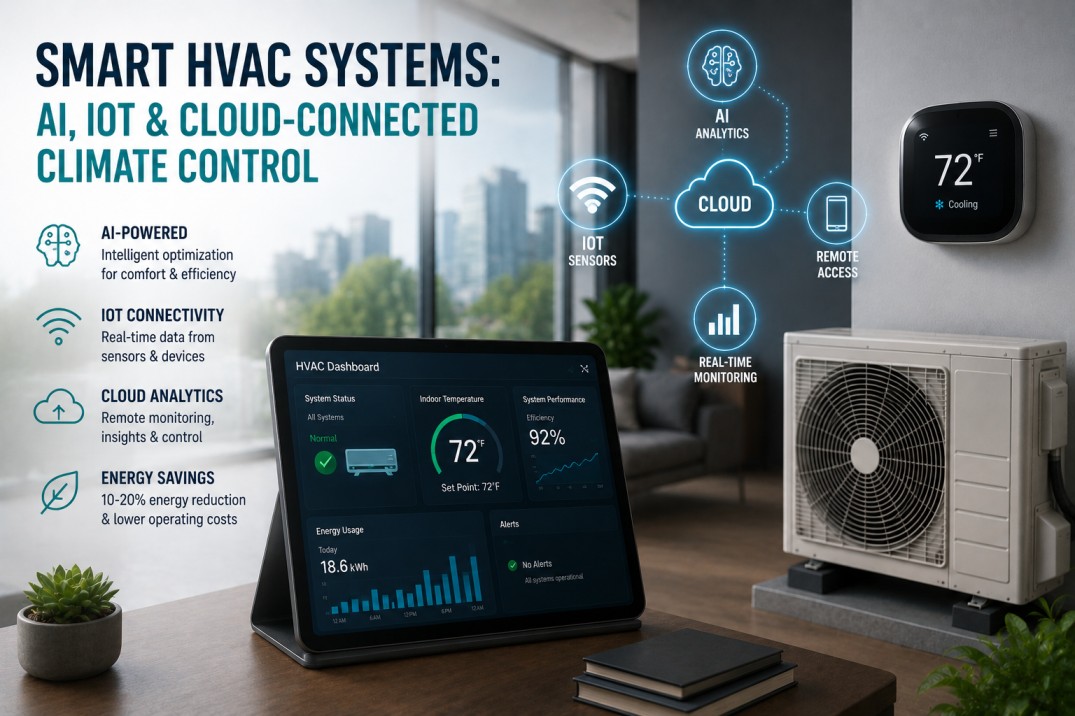
HVAC systems account for nearly 40% of a commercial building's total energy consumption — and when they fail, the consequences cascade fast. Productivity drops within 30 minutes of a temperature swing. Server rooms overheat. Tenants complain. Emergency repair callouts cost 3–5 times more than planned maintenance. Yet most facilities still maintain HVAC equipment on fixed schedules that ignore actual equipment condition, or worse, wait until something breaks. In 2026, IoT sensors combined with AI-powered CMMS platforms are making zero-downtime HVAC operations a reality — detecting refrigerant leaks before they escalate, predicting compressor failures weeks ahead, and optimizing energy consumption in real time. iFactory's IoT platform brings this transformation to your facility. Book a free consultation to see how IoT-driven HVAC monitoring eliminates unplanned downtime.
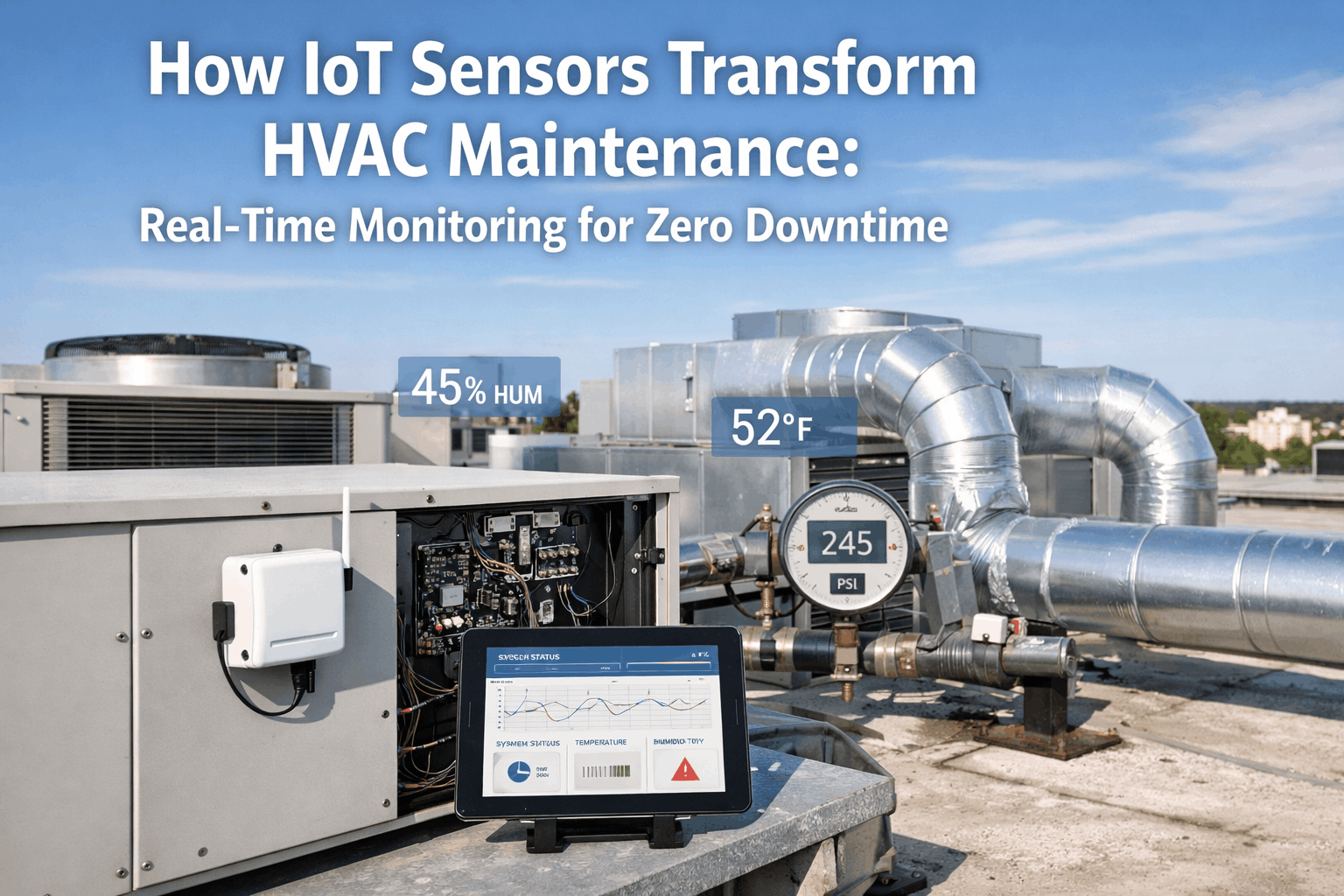
How IoT Sensors Transform HVAC Maintenance
Real-Time Monitoring for Zero Downtime
Every unplanned HVAC failure is a chain reaction — uncomfortable occupants, emergency callouts, wasted energy, and budget overruns. IoT sensor networks now give facility managers something they have never had: continuous, real-time visibility into every compressor, air handler, chiller, and rooftop unit across their entire portfolio. This guide shows you exactly how the technology works, what it monitors, and the measurable results facilities are achieving today.
Book Free HVAC IoT Demo ↗Consumed by HVAC
Are Preventable
Emergency vs Planned Repair
IoT-Optimized HVAC
Why Traditional HVAC Maintenance Is Failing
Calendar-Based PM Wastes Money
Changing filters every 90 days when some last 120 and others clog in 45 wastes both materials and labor. Fixed schedules ignore actual equipment condition — over-maintaining healthy units while under-maintaining stressed ones. Studies show 30–40% of scheduled PM tasks are performed unnecessarily.
Failures Are Detected Too Late
A refrigerant leak that starts as a slow seep becomes a complete system failure within days. A compressor bearing generating abnormal vibration goes unnoticed until it seizes. Without continuous monitoring, problems are only discovered when occupants complain or equipment stops entirely.
Energy Waste Is Invisible
A chiller running 15% above its design efficiency looks normal on the building automation system — it is still cooling the building. But that 15% inefficiency costs thousands per month in wasted electricity. Without IoT benchmarking, energy waste hides in plain sight across every unit in the fleet.
Multi-Site Visibility Does Not Exist
Facility managers overseeing 10, 50, or 500 buildings have zero standardized visibility into HVAC health across their portfolio. Each site has its own BAS, its own maintenance crew, and its own reporting format. Systemic problems — like a specific compressor model failing across multiple sites — go undetected.
What IoT Sensors Monitor on HVAC Equipment
Each sensor type targets a specific failure mode or efficiency loss. Together, they create a complete health picture of every unit.
Temperature Sensors
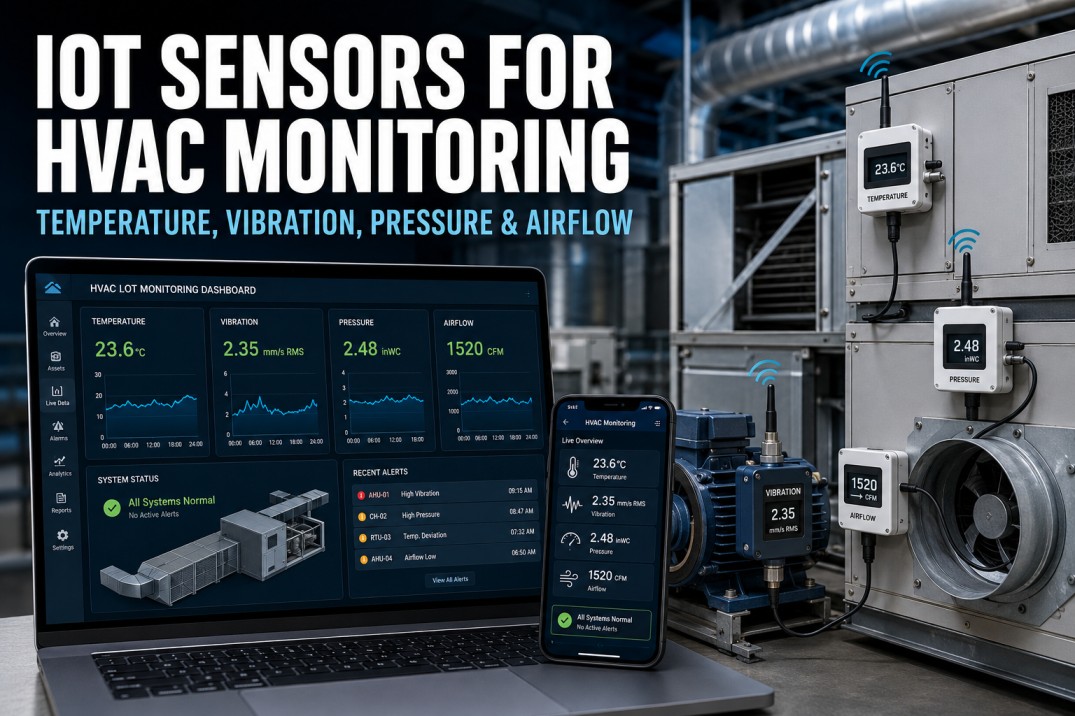
Supply/return air delta-T, refrigerant line temperatures, discharge air, and ambient conditions. Detects inefficient heat exchange, frozen coils, and improper superheat/subcooling.
Failure Mode: Coil freeze, low efficiencyVibration Sensors
Mounted on compressors, fan motors, and pump bearings. Tri-axial accelerometers detect imbalance, misalignment, looseness, and bearing wear — weeks before audible noise or failure.
Failure Mode: Bearing failure, motor burnoutCurrent/Power Sensors
Non-invasive CT clamps on compressor and fan motor feeds. Tracks real-time power draw, detects locked rotor conditions, phase imbalance, and efficiency degradation versus nameplate ratings.
Failure Mode: Motor degradation, energy wastePressure Sensors
Refrigerant suction/discharge pressure, filter differential pressure, and duct static pressure. Identifies refrigerant charge issues, clogged filters, and airflow restrictions before they cascade into bigger problems.
Failure Mode: Low charge, blocked filtersHumidity Sensors
Measures relative humidity in supply air, return air, and occupied spaces. Detects dehumidification failures, coil performance issues, and conditions that promote mold growth in ductwork and drain pans.
Failure Mode: IAQ issues, mold riskRefrigerant Leak Detectors
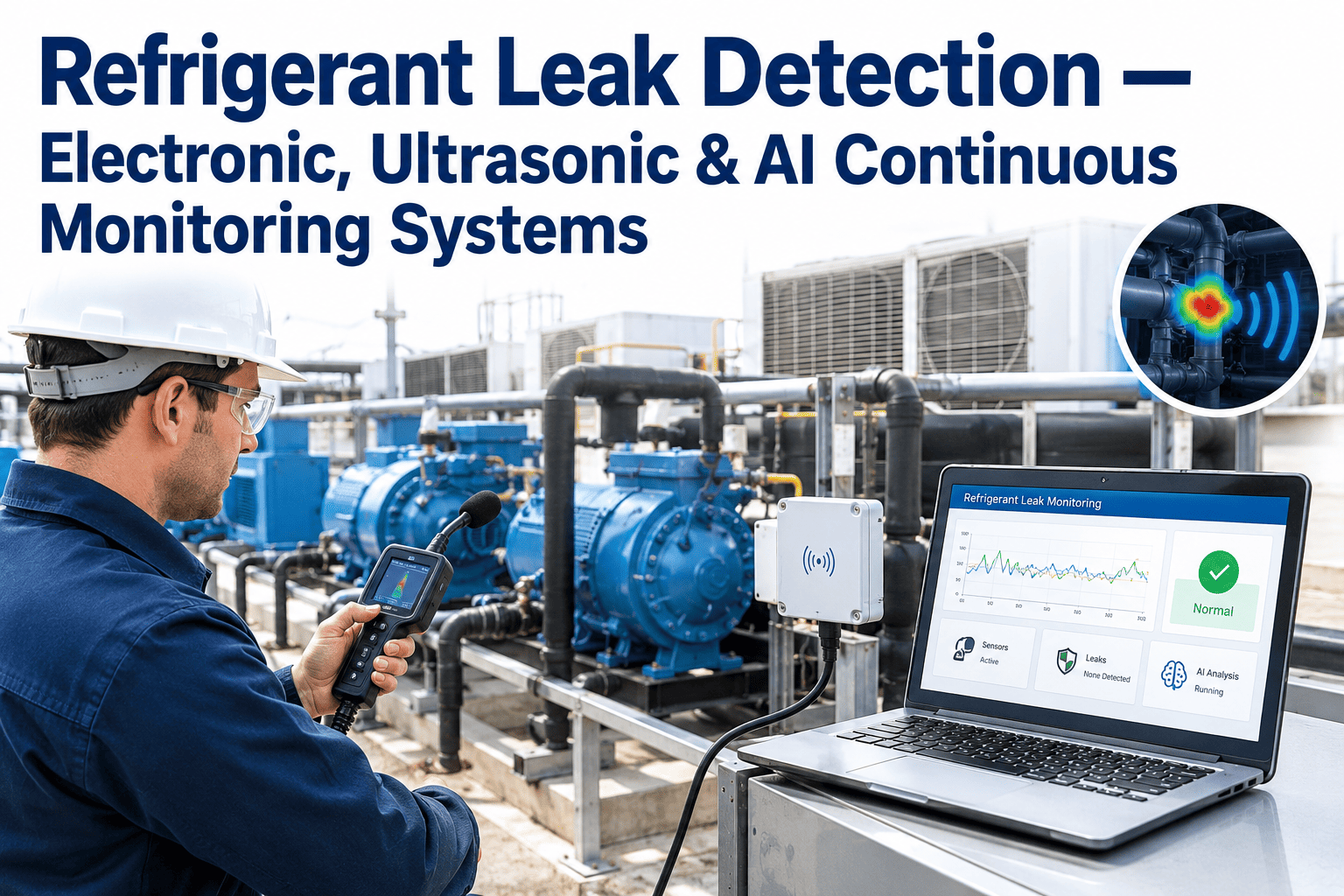
Semiconductor or infrared sensors in mechanical rooms and near evaporator coils. Detects refrigerant leaks at parts-per-million levels — long before system performance degrades or environmental reporting thresholds are triggered.
Failure Mode: Charge loss, EPA violationFrom Sensor Data to Zero Downtime — The Workflow
Deploy
Wireless IoT sensors installed on compressors, AHUs, RTUs, chillers, and fan coils in under 30 minutes per unit. No wiring, no BAS modification, no downtime required.
Collect
Edge gateways aggregate sensor data every 30–60 seconds. Local processing filters noise and performs initial fault detection before transmitting to the cloud platform.
Analyze
AI models compare real-time readings against baseline performance, manufacturer specs, and fleet-wide benchmarks. Pattern recognition identifies anomalies invisible to threshold-based alarms.
Predict
Machine learning forecasts remaining useful life for bearings, compressors, and belts. Predicts when efficiency will drop below acceptable thresholds — giving weeks of advance notice.
Act
CMMS auto-generates work orders with diagnosis, priority, parts needed, and skill requirements. Dispatches the right technician before any occupant notices a problem.
What Facilities Are Achieving With IoT HVAC Monitoring
| Metric | Before IoT | After IoT | Impact |
|---|---|---|---|
| Unplanned HVAC Downtime | 8–15 events/year per building | 0–2 events/year | 85% reduction |
| Energy Consumption | Baseline | 20–30% lower | 25% avg savings |
| Emergency Callout Costs | $15K–$50K/year per building | Under $5K/year | 75% reduction |
| Equipment Lifespan | 12–15 years average | 18–22 years | 40% longer |
| Comfort Complaints | 10–20/month | 0–3/month | 85% fewer |
| Filter Change Efficiency | Calendar-based (30% waste) | Condition-based (on-demand) | 30% cost savings |
Reduction in unplanned HVAC downtime across monitored portfolio— ASHRAE Journal Study
Saved for every $1 invested in IoT HVAC monitoring within year one— Facility Management Report
Of all HVAC failures could have been predicted and prevented with continuous monitoring— NIST Building Study
Reactive HVAC Maintenance vs. IoT-Powered Predictive Operations
IoT HVAC Monitoring for Every Building Type
Commercial Office Buildings
RTUs, VAV boxes, chillers, and cooling towers serving tenants who expect 72°F and will leave if they do not get it. IoT monitoring ensures SLA compliance, reduces tenant complaints by 85%, and generates energy savings that drop straight to NOI.
Hospitals and Healthcare
Precision temperature and humidity control is not a comfort issue — it is a patient safety issue. Operating rooms, pharmacies, and isolation rooms require strict environmental monitoring. IoT ensures compliance with ASHRAE 170 and Joint Commission standards 24/7.
Data Centers
A 5-minute HVAC failure in a data center can cause millions in hardware damage and SLA penalties. IoT monitors CRAC/CRAH units, in-row coolers, and hot aisle/cold aisle temperatures with sub-minute granularity — triggering alerts before thermal thresholds approach.
Schools and Universities
Aging HVAC systems in education buildings waste 30–40% of energy budgets. IoT sensors on rooftop units and split systems identify the worst-performing units for targeted upgrades, optimize scheduling around class timetables, and improve indoor air quality for student health.
Managing multiple building types? Book a free consultation to see portfolio-level IoT HVAC monitoring across your entire fleet.
HVAC Assets Monitored by IoT Sensor Networks
IoT HVAC Monitoring — Frequently Asked Questions
How quickly can IoT sensors be installed on existing HVAC equipment?
Most wireless IoT sensors are installed in 15–30 minutes per unit with no downtime, no wiring, and no BAS modification. A typical 50-unit commercial building can be fully instrumented in 2–3 days. Battery-powered wireless sensors communicate via LoRaWAN or cellular gateways — no IT network changes required. See installation in a live demo.
Does this replace our existing Building Automation System (BAS)?
No — it layers on top of your existing BAS. IoT sensors provide supplementary monitoring data that BAS systems do not capture (vibration, power quality, refrigerant leak detection). The two systems work together: BAS handles control, IoT handles condition monitoring and predictive analytics. Many facilities integrate both into a unified CMMS dashboard.
What ROI can we expect from IoT HVAC monitoring?
Most facilities see full ROI within 8–14 months. The three primary savings drivers are: energy optimization (20–30% reduction), emergency repair elimination (75% fewer callouts), and equipment life extension (30–40% longer). A 100,000 sq ft commercial building typically saves $25,000–$60,000 annually. Get a custom ROI projection for your portfolio.
How does the system handle multi-site portfolios?
The platform provides a unified portfolio dashboard showing every HVAC unit across all buildings on a single screen. Cross-site benchmarking identifies which buildings are underperforming. Fleet-wide analytics detect systemic issues — like a specific compressor model failing across multiple properties — enabling bulk procurement and coordinated repair campaigns.
Can IoT detect refrigerant leaks for EPA compliance?
Yes. Semiconductor and NDIR infrared sensors detect refrigerant leaks at parts-per-million concentrations — far below EPA Section 608 reporting thresholds. Leak alerts are generated instantly, and the CMMS creates a compliance-documented work order with timestamps, leak rate calculations, and repair verification — ready for EPA audit.
What happens if the internet connection goes down?
Edge gateways continue collecting and processing sensor data locally during network outages. Critical alerts (refrigerant leak, compressor lock-rotor) trigger local alarms via SMS or on-site beacon. When connectivity restores, all buffered data syncs automatically to the cloud platform with no gaps. The system is designed for reliability in real-world building environments.
Ready for Zero HVAC Downtime?
Every unplanned HVAC failure costs 3–5x more than a planned repair, drains energy budgets, and drives occupant complaints. Join thousands of facility managers who have eliminated HVAC surprises with IoT-powered predictive monitoring. See the platform configured for your equipment fleet in a free 30-minute demo.