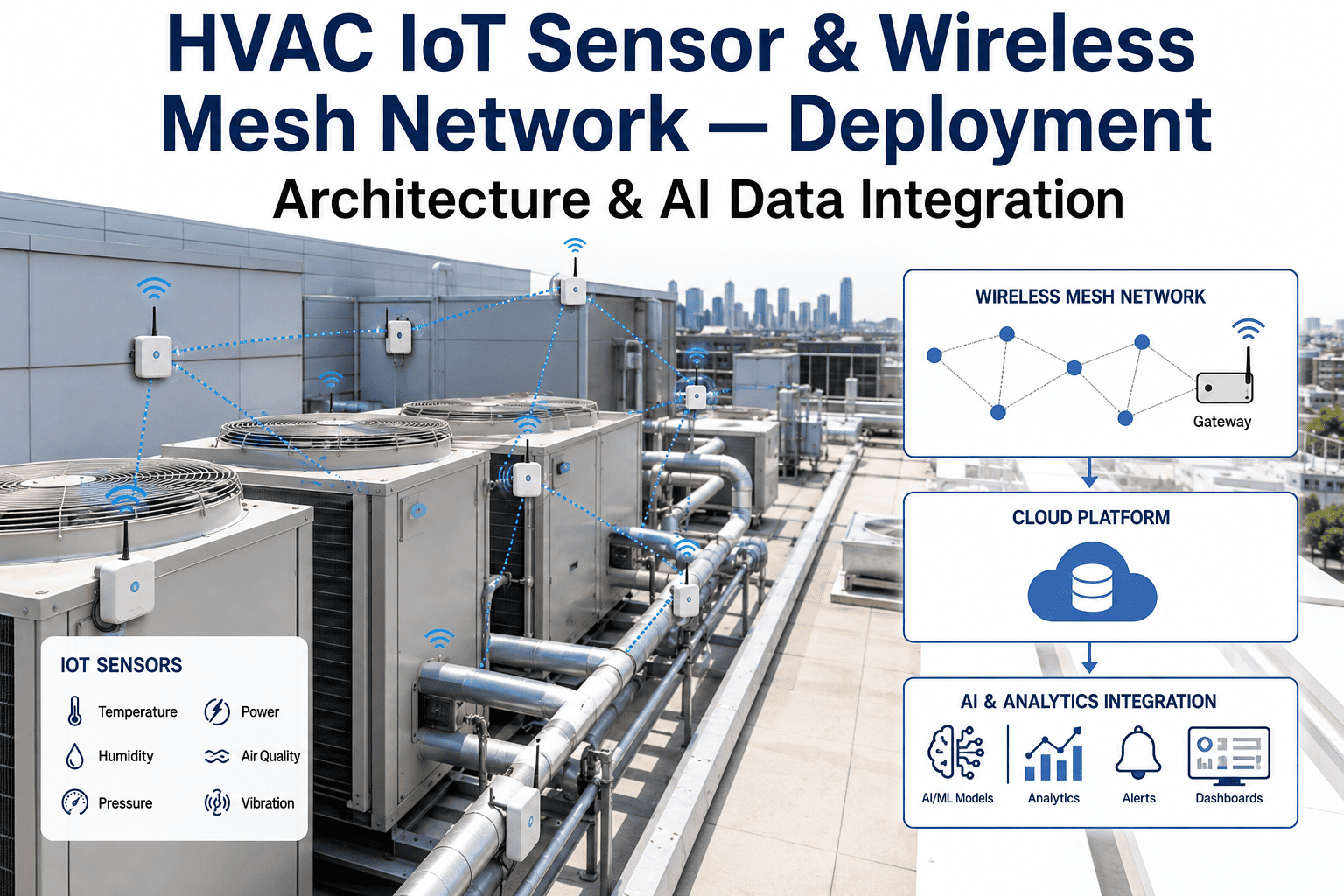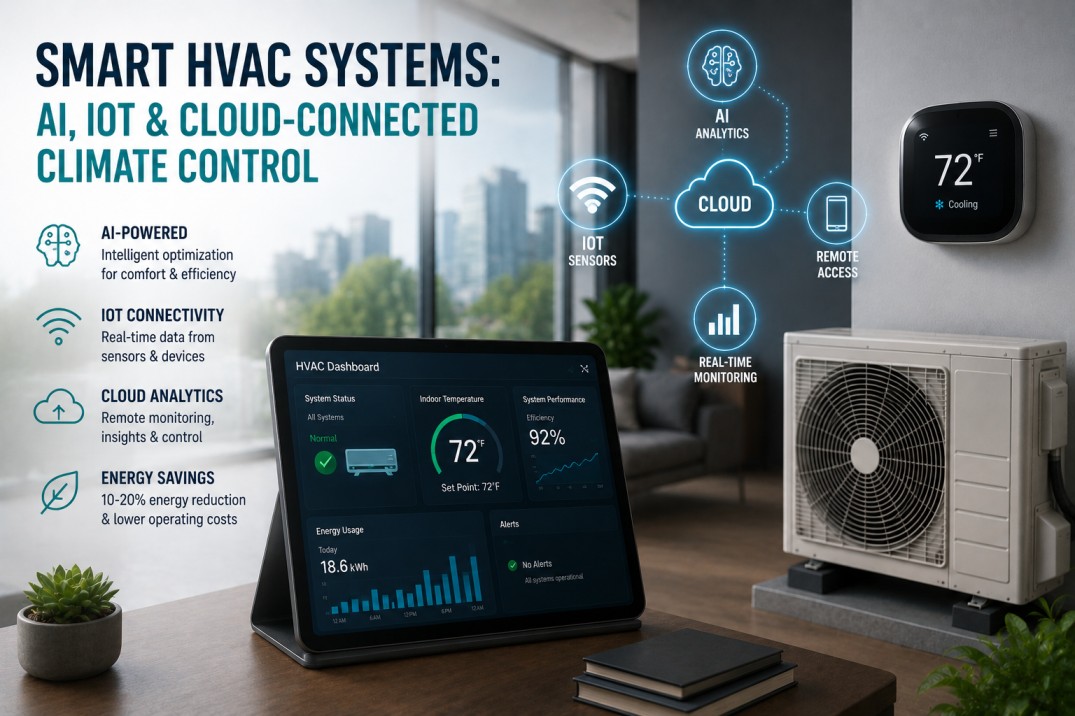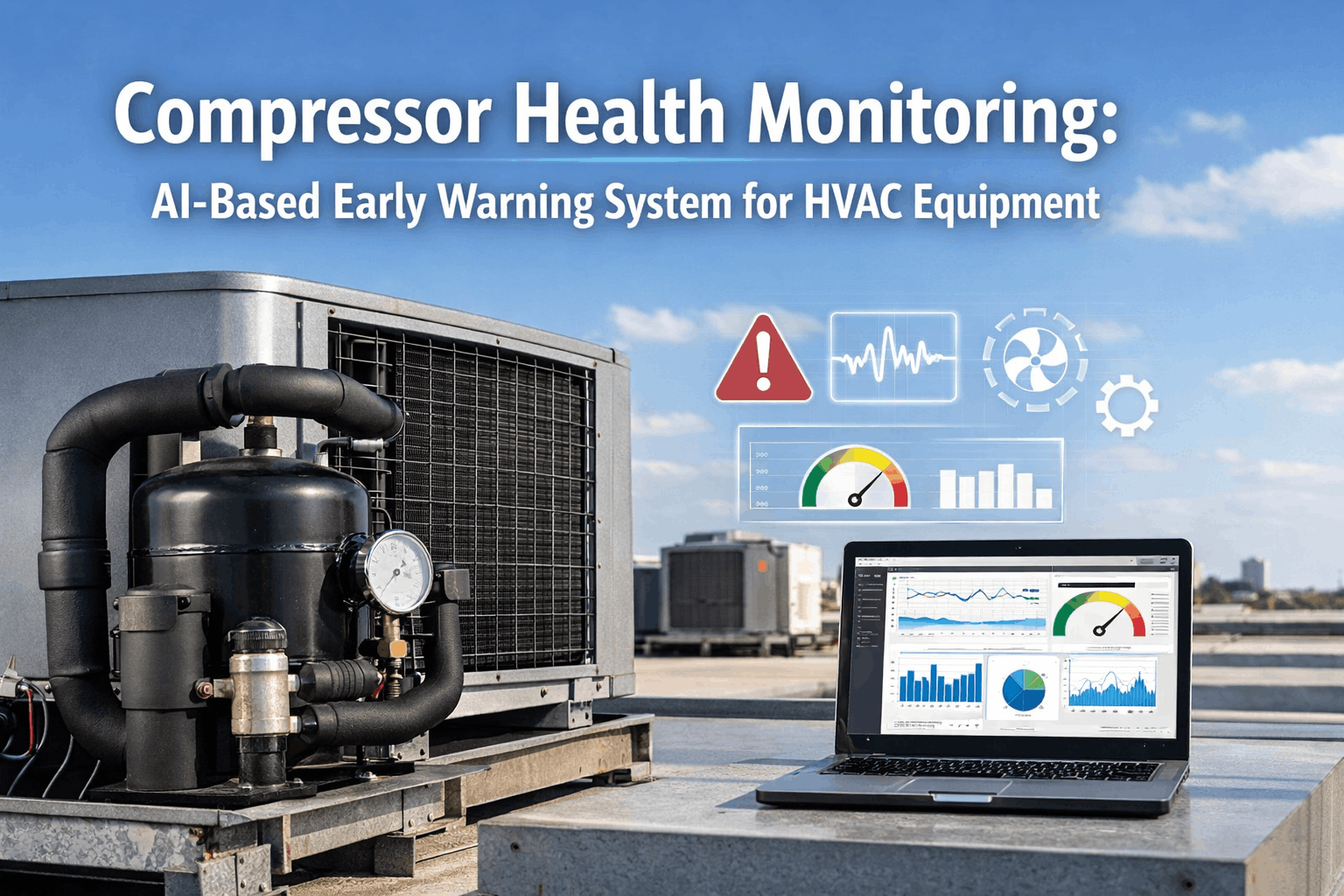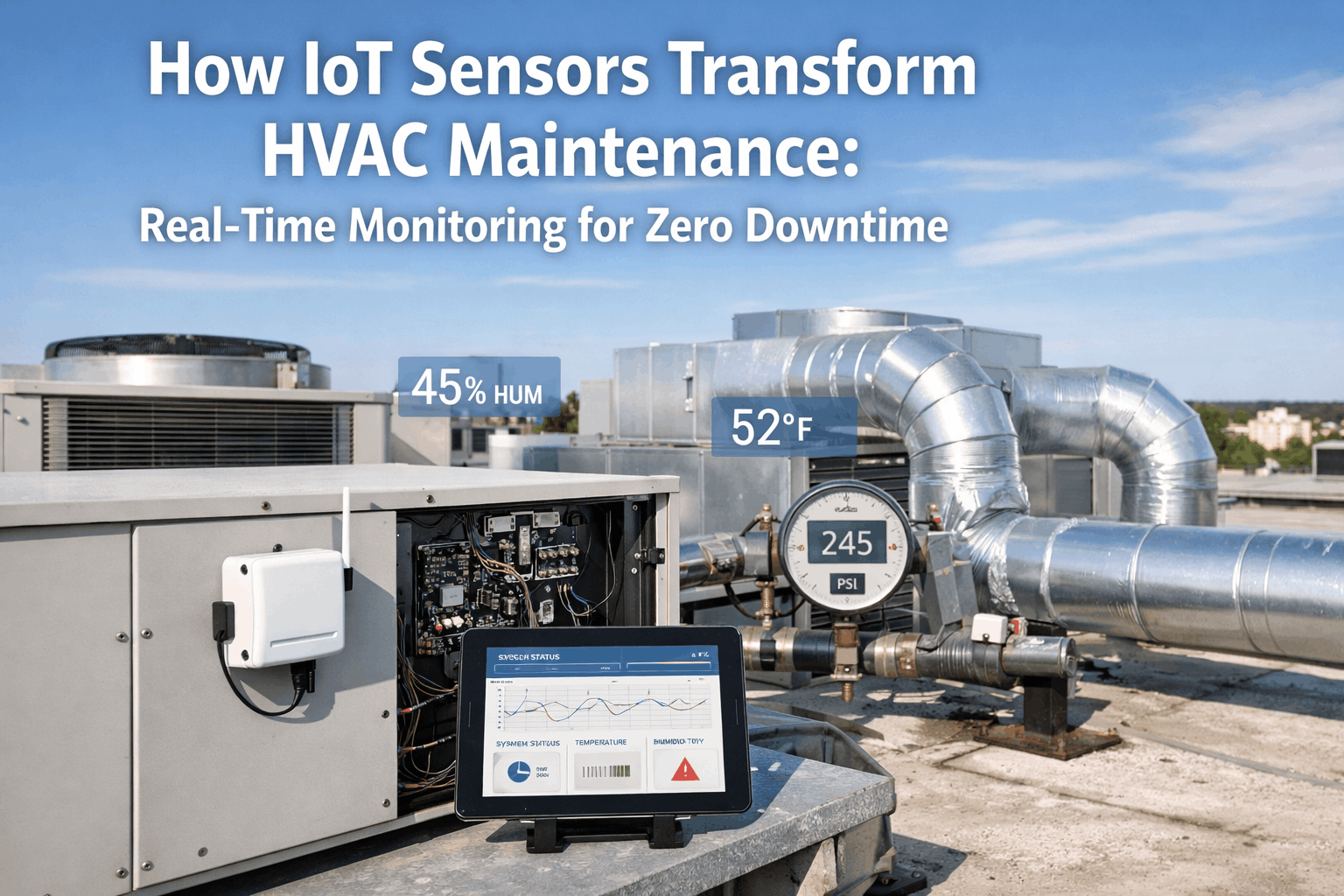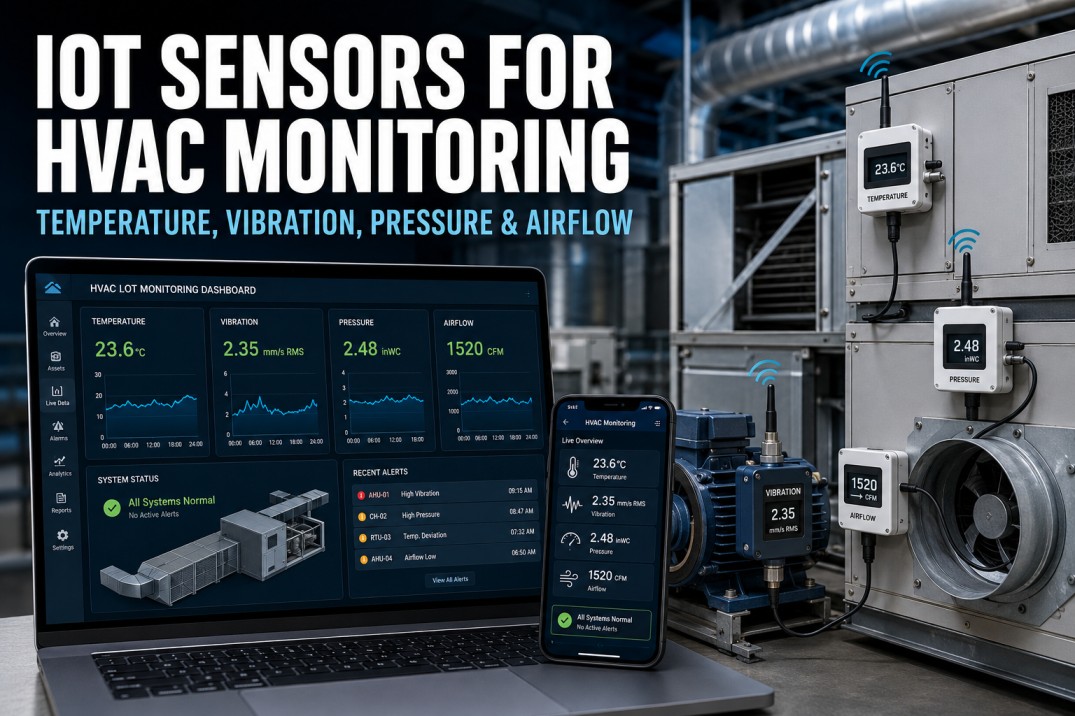
IoT sensors are the foundation of any data-driven HVAC analytics program, converting physical equipment parameters into digital signals that enable real-time monitoring, fault detection, predictive analytics, and automated optimization. Temperature sensors, vibration transducers, pressure transmitters, and airflow stations each capture specific dimensions of equipment health and performance. When deployed strategically and connected through a reliable IoT platform, these sensors provide continuous visibility into HVAC operations, detect developing faults 4 to 8 weeks before failure, and enable facility teams to manage systems from anywhere.
Deploy IoT Sensors That Transform HVAC Data Into Action
iFactory's IoT Integration module provides sensor selection, deployment planning, connectivity management, and data pipeline integration. Book a demo to see how strategic IoT sensor deployment unlocks HVAC analytics.
IoT Sensor Types for HVAC: What Each Measures and Why It Matters
Each sensor type captures a specific dimension of equipment health. Strategic deployment maximizes diagnostic coverage per dollar.
Temperature Sensors
Measure ambient air, duct air, coil surface, chilled water, and refrigerant line temperatures. Thermocouples, RTDs, and thermistors. Accuracy +/-0.5F. Cost $30-120. Most fundamental HVAC sensor. Required for 80% of diagnostic algorithms.
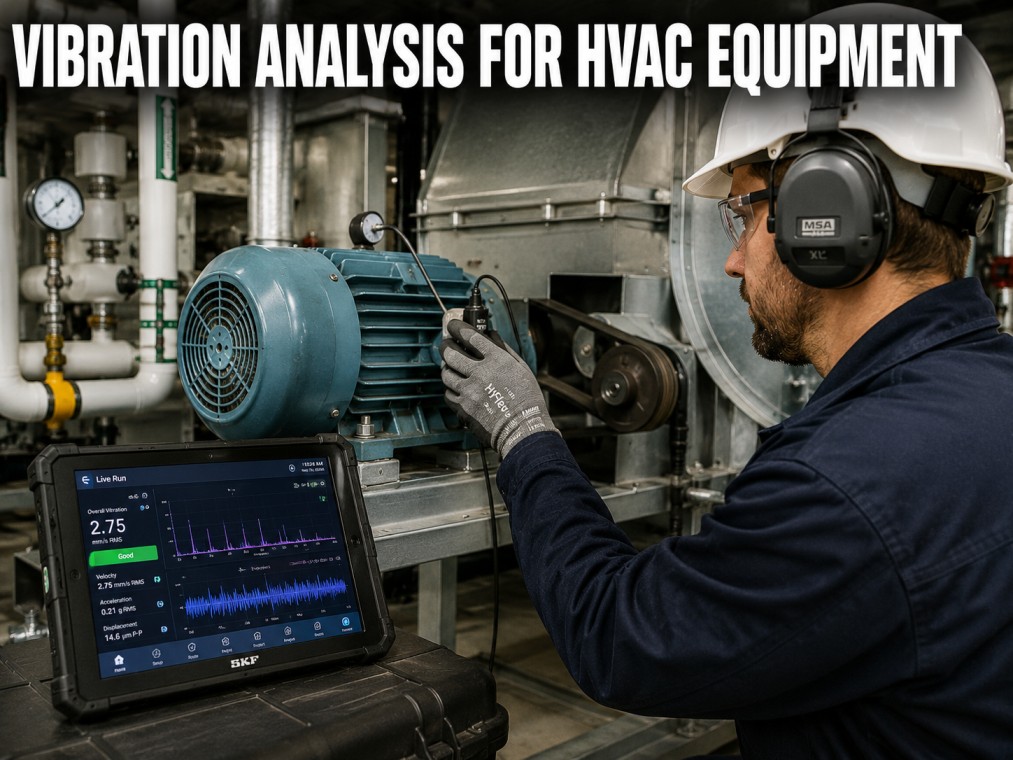
Vibration Sensors
Accelerometers measuring velocity (in/sec) and acceleration (g) on bearings, compressors, and motors. Detect imbalance, misalignment, bearing wear. Cost $100-400. Payback 3-6 months on critical rotating equipment.
Pressure Sensors
Static pressure transmitters across filters, coils, and fans. Refrigerant pressure transducers for suction and discharge. Differential pressure for flow. Cost $80-250. Essential for filter monitoring and refrigeration diagnostics.
Current & Power Sensors
CTs and power meters measuring motor amps, kW, power factor, and energy. Detect mechanical degradation, electrical faults, schedule optimization. Cost $50-500. Highest ROI sensor: drives energy savings directly.
Sensor Deployment Strategy: Where to Place Sensors for Maximum Coverage
Strategic placement maximizes diagnostic value while minimizing hardware and installation costs.
| Equipment | Minimum Sensors | Optimal Sensors | Key Diagnostics | Priority |
|---|---|---|---|---|
| Rooftop Unit (RTU) | 1 temp (supply) | 4: temp OA/SA/RA, pressure filter, amps comp | Compressor cycling, filter loading, economizer | 1 |
| Air Handler | 2 temp (SA, RA), 1 pressure filter | 5: + pres fan, amps motor, temp MA | Filter loading, fan degradation, coil fouling | 1 |
| Chiller | 2 temp (CHWS, CHWR), amps comp | 6: + pres refrig, vib comp, temp condenser | Fouling, refrigerant loss, bearing wear | 1 |
| Cooling Tower | 1 temp (CW supply) | 3: + vib fan, amps fan | Fan degradation, bearing wear, approach temp | 2 |
| VAV Box | None | 1: temp zone (if not in BMS) | Zone temp control, airflow | 3 |
| Boiler | 2 temp (supply, return) | 4: + pres gas, O2 sensor flue | Combustion efficiency, fouling, safety | 2 |
Connect, Collect, and Analyze HVAC Sensor Data at Scale
iFactory's platform ingests data from any sensor type and protocol, providing unified visibility across all equipment. Book a demo to see how IoT data integration creates a single source of truth for HVAC.
IoT Connectivity Options: Protocols, Gateways & Data Transmission
Reliable data transmission from sensor to platform is critical for continuous monitoring.
Wired (BACnet MS/TP or IP)
Most reliable, existing in most BMS. BACnet/IP for modern systems. Cost: lowest with existing wiring. Best for: buildings with functional BMS. Limitation: requires dedicated IT infrastructure. Supports 100-10,000+ points.
Wireless Mesh (Zigbee/Z-Wave)
Low-power mesh for sensor-to-gateway. Range 30-100 ft per hop. Battery life 2-5 years. Cost: $50-150 per node. Best for: retrofits without wiring access. Limitation: metal equipment reduces range.
Cellular LTE-M / NB-IoT
Direct sensor-to-cloud via cellular. No gateway required. Cost: $5-15/mo per device. Best for: remote sites, rooftop equipment, multi-site portfolios. Limitation: higher ongoing cost, battery 1-3 years.
Sensor Data Management: Collection, Storage & Processing
Raw sensor data must be processed through a structured pipeline before delivering actionable insights.
Data Volume
100 sensors generate 1-5 MB/day (0.4-2 GB/year). Cloud storage: $0.10-0.50/GB/mo. Retain raw data 12 months, aggregated 36 months, events 60+ months.
Sampling Frequency
Critical sensors (vibration, current) need 1-5 min. Trend sensors (temperature) fine at 5-15 min. Higher frequency increases volume without proportional diagnostic value.
Edge Processing
Reduces cloud data 80-90% by sending only anomalies and summaries. Latency under 100ms for real-time alerts. Enables operation during cloud interruptions.
Data Quality Impact
Common issues: sensor drift, dropout, out-of-range values. Automated validation checks 100% of incoming data. Budget 20% of deployment cost for data quality.
IoT Sensor ROI: Cost, Savings & Payback by Sensor Type
Each sensor type delivers different payback profiles based on failures prevented and savings enabled.
| Sensor Type | Installed Cost | Annual Savings | Payback | Primary Savings |
|---|---|---|---|---|
| Temperature (per point) | $75-200 | $200-800 | 2-6 months | Fault detection, schedule optimization |
| Vibration (per point) | $200-500 | $500-2,000 | 3-6 months | Bearing failure avoidance |
| Pressure (per point) | $150-350 | $300-1,200 | 4-8 months | Filter efficiency, refrigerant diagnostics |
| Current/Power (per point) | $100-600 | $400-2,000 | 2-6 months | Energy savings, mechanical degradation |
| Full suite (100K sq ft) | $8K-25K | $25K-60K | 4-8 months | Combined: energy, repairs, labor, life extension |
Frequently Asked Questions
What IoT sensors are most important for HVAC monitoring?
The four most impactful sensor types are temperature, pressure, current, and vibration. Temperature provides 40% of diagnostic value at 15% of cost. Pressure adds filter loading and refrigerant diagnostics. Current measures mechanical degradation through amp draw trends. Vibration catches bearing failures 4-8 weeks before other methods. Minimum viable: temperature on every AHU supply/return, pressure across filter banks, current on all compressors.
How many IoT sensors does a typical commercial building need?
Minimum viable: 15-30 sensors per 100K sq ft. Optimal: 50-100 per 100K sq ft adding vibration, zone temps, chilled water, OA temp. Comprehensive: 100-200+ with individual VAV monitoring and equipment-level power. Budget: $0.05-0.15/sq ft for minimum, $0.15-0.40/sq ft for optimal. Payback 4-12 months regardless of density.
Can IoT sensors work with existing BMS systems?
Yes. Most IoT sensors support BACnet, Modbus, and API integration. BACnet/IP is most widely supported. For older BMS without IP, IoT gateways bridge MS/TP to IP. For buildings without BMS, wireless sensors with cellular provide standalone monitoring. IoT should augment, not replace, existing BMS.
How accurate are IoT HVAC sensors?
Commercial-grade: temperature +/-0.3-0.5F, pressure +/-0.5-1.0%, current +/-1-2%, vibration +/-5-10%. Sufficient for fault detection and trend analysis. Premium sensors for research labs: +/-0.1F at 2-5x cost. All sensors drift: temperature 0.1-0.3F/yr, pressure 0.5-1.0%/yr. Annual calibration verification on 10-20% sample detects drift.
How do I ensure IoT sensor data quality?
Implement five practices: validation rules on every point (reject out-of-range, flag frozen values), cross-validation between correlated sensors (SA vs RA temp should differ 14-20F when cooling), communication health monitoring (packet loss, battery status), routine calibration verification (annual spot check 10-20% of sensors), and redundancy for critical sensors. Target: 99.5%+ data availability, <1% invalid readings.
Complete IoT-Driven HVAC Analytics With iFactory
iFactory's IoT Integration delivers end-to-end sensor management from deployment through data quality, connectivity, and analytics. Book a demo to see how reliable sensor data powers predictive maintenance.