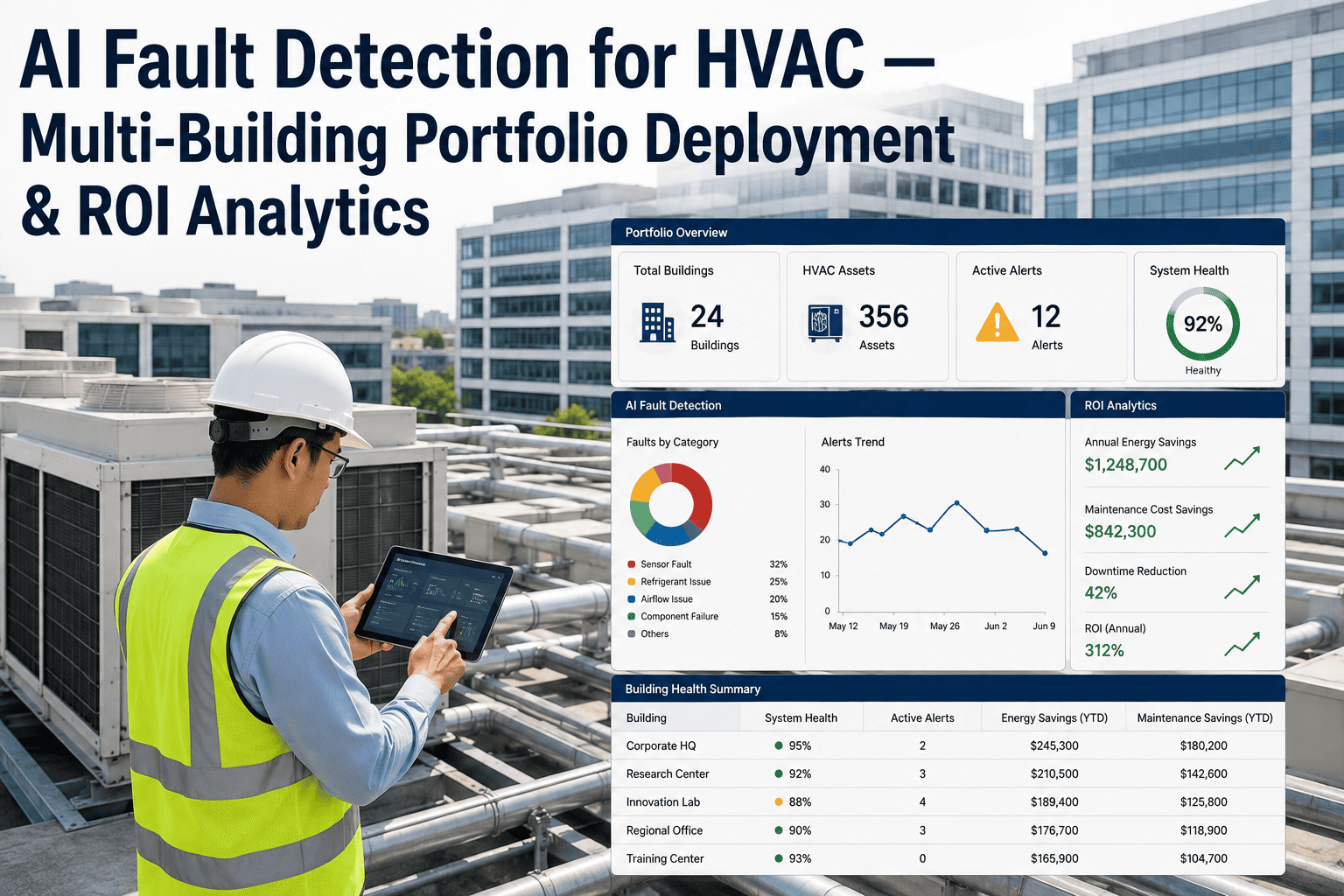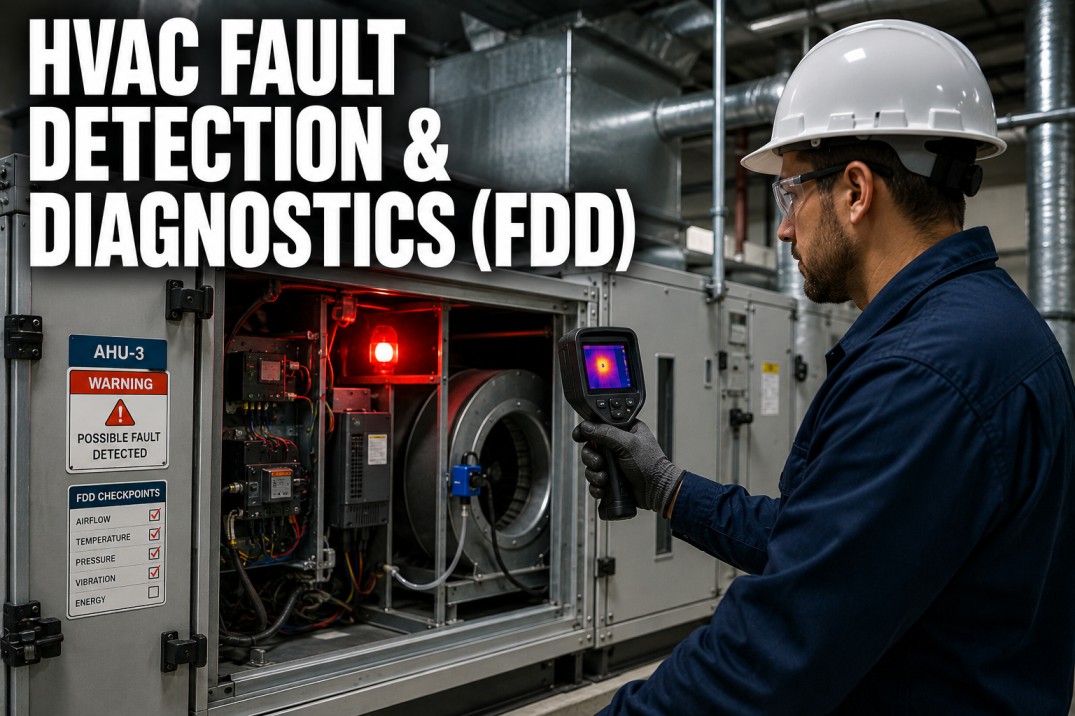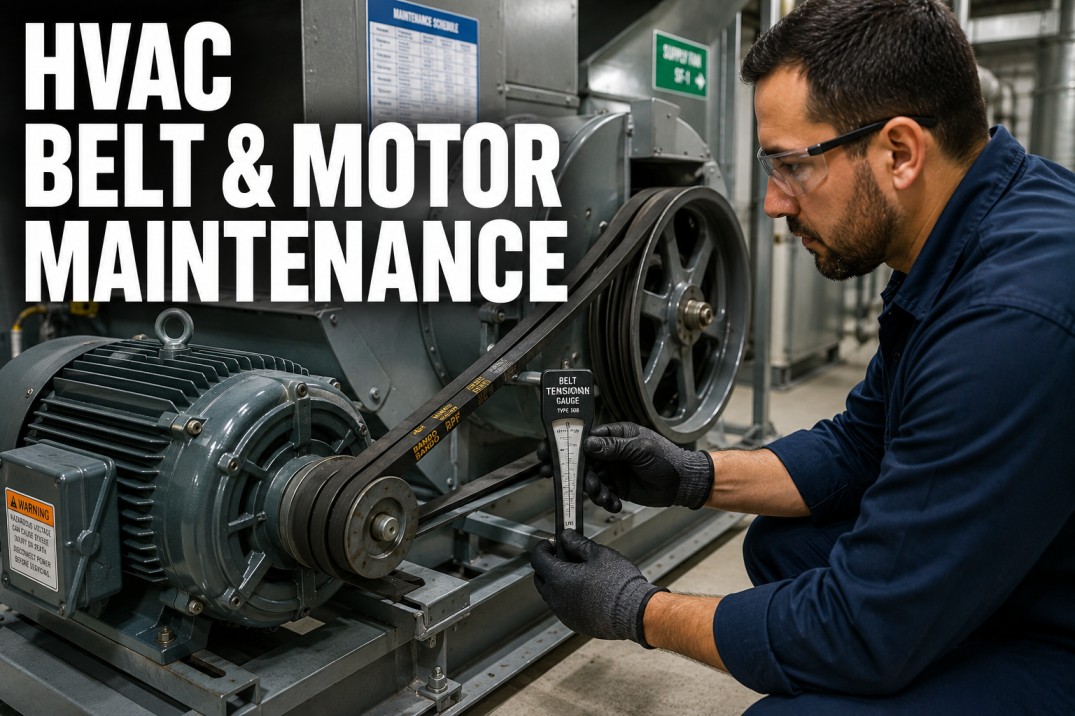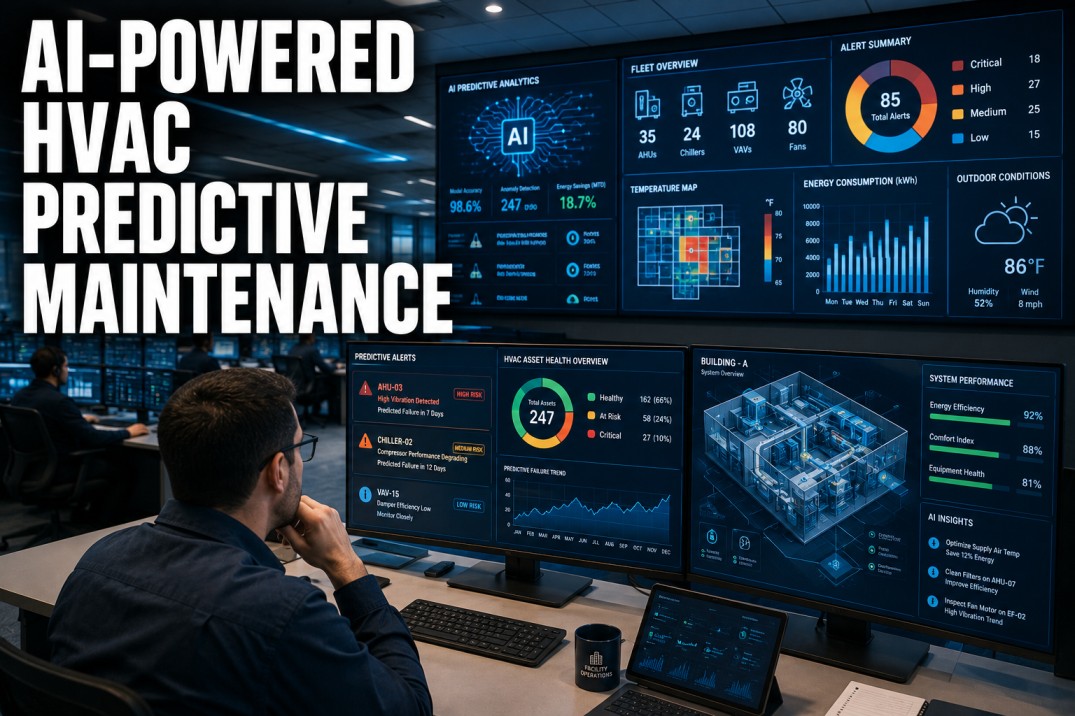
AI-powered predictive analytics is transforming HVAC maintenance from a reactive cost center into a strategic asset that predicts failures before they happen, optimizes energy consumption in real time, and extends equipment life by years. Unlike traditional preventive maintenance that follows fixed schedules, AI analytics continuously monitors sensor data, learns normal operating patterns, detects anomalies that precede failures, and recommends precise interventions reducing emergency repairs by 25% to 40%, cutting energy waste by 15% to 25%, and extending equipment life by 3 to 7 years.
Predict HVAC Failures Before They Happen With AI Analytics
iFactory's Predictive analytics Console uses machine learning to predict equipment failures 3-6 weeks in advance. Book a demo to see how AI-powered prediction transforms maintenance economics.
AI Predictive Analytics Capabilities: What Can Be Predicted
AI models can predict a wide range of HVAC failures with varying lead times and accuracy.
Compressor Failure
Predict 3-6 weeks ahead. Models use current draw trends, temperature differential, vibration patterns. Accuracy: 85-92%. Avoided cost: $8K-15K per emergency replacement.
Fan & Motor Failure
Predict 4-8 weeks ahead. Models use vibration spectrum, bearing temperature, amp draw. Accuracy: 88-95%. Avoided cost: $2K-5K per motor failure.
Coil Fouling Degradation
Predict 4-12 weeks before cleaning needed. Models use approach temperature trends, pressure drop, energy per degree day. Accuracy: 90-95%. Energy savings: 10-20% from timely cleaning.
Refrigerant Leak Detection
Detect within 2-7 days of leak onset. Models use superheat trend, subcooling change, compressor amp draw. Accuracy: 80-90%. Refrigerant savings: $500-3K per leak.
Machine Learning Models: How AI Learns Equipment Behavior
Different ML architectures suit different prediction tasks and data availability.
| Model Type | How It Works | Best For | Data Required | Training Time |
|---|---|---|---|---|
| Autoencoder | Learns normal behavior, flags deviations | Anomaly detection, sensor validation | 2-4 weeks normal data | 2-8 hours |
| Random Forest | Ensemble of decision trees | Remaining useful life estimation | 6-12 months failure-labeled data | 4-24 hours |
| LSTM Neural Network | Recurrent network learns temporal patterns | Time-series prediction, degradation trending | 3-12 months hourly data | 8-48 hours |
| Gradient Boosting | Sequential decision tree refinement | Failure probability scoring | 6-18 months labeled failure data | 2-12 hours |
| Gaussian Process | Probabilistic model with uncertainty bounds | Small data or sparse sensor scenarios | 1-6 months daily data | 1-4 hours |
Deploy AI Analytics That Learn Your Equipment Behavior
iFactory's platform trains custom ML models on your equipment data, detecting anomalies with 85-95% accuracy. Book a demo to see how AI that knows your equipment delivers predictions you can trust.
Deploying AI Predictive Analytics: Phased Implementation
Successful AI deployment follows a proven methodology building capability incrementally.
Phase 1: Data Foundation (Weeks 1-8)
Audit existing sensors and BMS points, identify data gaps, install supplementary sensors on critical equipment, establish data pipeline, verify data quality. Deliverable: clean historical dataset.
Phase 2: Model Training (Weeks 6-16)
Train fault detection models on normal operation data, train failure prediction models, validate model accuracy, establish baseline metrics. Deliverable: production-ready models.
Phase 3: Operational Deployment (Weeks 12-24)
Integrate model outputs with work order system, configure alert thresholds, train facility staff, establish closed-loop tracking. Deliverable: live predictive alerts driving maintenance.
AI Predictive Analytics ROI: Cost, Savings & Payback
AI predictive analytics delivers documented returns with typical payback under 12 months.
Emergency Repair Reduction
AI predicts 60-80% of compressor failures 3-6 weeks ahead. Predictive replacement during planned downtime: $5-8K vs emergency $8-15K. Net savings: $3-7K per avoided failure.
Energy Optimization
AI identifies schedule optimization, fault correction, and degradation recovery. Saves 15-25% on HVAC energy. For 100K sq ft at $150K: $22K-38K energy savings per year.
Labor Efficiency
AI routes technicians to actual problems instead of fixed inspections. Reduces PM labor 25-35% through condition-based triggers. Enables more proactive work per technician.
Equipment Life Extension
Equipment protected by predictive analytics operates within design parameters longer. Deferred capital: $50K-200K per 100K sq ft.
AI Predictive Analytics in Practice: Real-World Results
Published case studies demonstrate consistent results across building types.
| Building Type | Size | Annual Savings | Payback | Key Results |
|---|---|---|---|---|
| Office Tower | 500K sq ft | $187,000 | 7 months | 42% fewer emergency calls, 22% energy reduction, 96% uptime |
| Hospital Campus | 1.2M sq ft | $420,000 | 11 months | 65% compressor failure prediction, 31% PM labor reduction |
| School District | 18 buildings | $98,000 | 6 months | 54% fewer after-hours calls, 18% energy savings |
| Data Center | 50K sq ft | $310,000 | 4 months | Zero unplanned downtime in 2 years, 15% cooling energy reduction |
| Manufacturing | 250K sq ft | $265,000 | 9 months | 78% prediction accuracy, 2.8 year average life extension |
Frequently Asked Questions
How does AI predictive analytics work for HVAC systems?
AI predictive analytics continuously collects data from HVAC sensors (temperature, pressure, current, vibration, humidity, flow) and processes it through ML models that learn each equipments normal operating pattern. When deviations are detected a temperature trend rising faster than expected, vibration increasing at a specific frequency, current draw shifting the AI calculates failure probability and remaining useful life. Results: 3-6 week advance warning for 60-80% of mechanical failures.
What is the accuracy of AI HVAC failure prediction?
Compressor failure prediction: 85-92% accuracy with 3-6 week lead time. Fan and motor bearing failure: 88-95% with 4-8 week lead time. Coil fouling: 90-95% with 4-12 week notice. Refrigerant leak: 80-90% within 2-7 days. False positive rate: 5-15%. Well-tuned systems achieve 80%+ precision and 75%+ recall simultaneously.
What data is needed to deploy AI HVAC predictive analytics?
Minimum viable data: temperature (supply, return, mixed, outdoor air, coil leaving), pressure (static, filter drop, refrigerant), current (compressor, fan, pump), and runtime status. Collect at 1-15 minute intervals for at least 3 months. Ideal: add vibration, humidity, flow, valve position feedback, and maintenance history. Most buildings have 60-80% of needed sensors in existing BMS.
How much does AI HVAC predictive analytics cost?
Total year-1 cost: $20,000-70,000 for 100K sq ft including sensor installation ($5K-25K), cloud platform ($0.03-0.10/sq ft/yr), implementation ($10K-40K), and support ($3K-10K). Recurring annual: $5K-20K. Savings: $30K-80K/yr. Payback: 6-14 months. Year-2+ ROI: 3-8x annually.
Can AI predictive analytics replace preventive maintenance?
No, AI complements preventive maintenance. PM handles fixed-schedule tasks (filter changes, belt replacement, safety testing). Predictive optimizes condition-based tasks (coil cleaning, refrigerant, bearing replacement). Combined: reduces total labor 20-30% while catching failures 3-6 weeks before they would be found under PM-only programs.
Complete AI-Driven HVAC Analytics With Predictive Console
iFactory's Predictive analytics Console delivers end-to-end AI predictive analytics including sensor integration, model training, alert workflows, and ROI tracking. Book a demo to see how AI transforms HVAC maintenance.