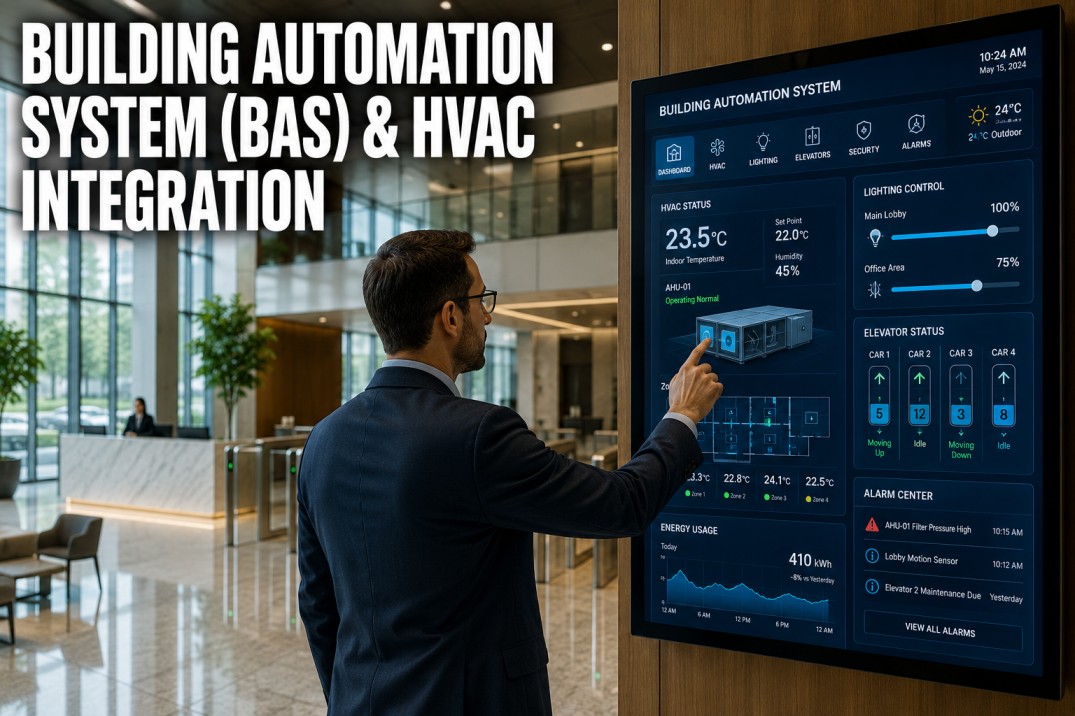
Building Automation System (BAS) integration with HVAC operations is the foundation of smart building management, enabling centralized control, automated optimization, real-time monitoring, and data-driven analytics. A properly integrated BAS connects HVAC equipment chillers, boilers, air handlers, VAV boxes, RTUs, and zone controls through open communication protocols, enabling coordinated operation that reduces energy consumption by 15% to 30%, extends equipment life, and provides the data infrastructure required for advanced analytics.
Integrate BAS With HVAC Analytics for Connected Operations
iFactory's IoT Integration module connects to any BACnet or Modbus BAS, providing unified visibility and AI-driven optimization. Book a demo to see how BAS integration unlocks smart building management.
BAS Integration Architecture: Layers, Components & Data Flow
Modern BAS integration follows a layered architecture separating field devices, controllers, supervision, and enterprise analytics.
Field Layer (Sensors & Actuators)
Physical devices: temperature sensors, pressure transmitters, valve/damper actuators, VFDs, relays. Communicate via analog (4-20mA, 0-10V), digital (dry contact), or native BACnet to controllers.
Controller Layer (DDC)
Programmable controllers executing control sequences: PID loops, schedules, setpoint resets, alarm logic. Each controller manages 8-64 points. BACnet Building Controller (B-BC) standard.
Supervisory Layer (BAS Server)
Central server aggregating controller data, hosting graphics, managing alarms, storing trends, providing operator workstation. BACnet Operator Workstation (B-OWS). Supports 100-10,000+ points.
Enterprise Layer (Analytics)
Cloud or on-prem analytics platform: FDD, predictive, energy management, commissioning. Connects via BACnet/IP, REST API, or gateway. Adds ML and workflow automation.
Integration Protocols: BACnet, Modbus, LonWorks & API
Protocol choice affects interoperability, data resolution, cost, and future flexibility.
| Protocol | Type | Speed | Interoperability | Best For |
|---|---|---|---|---|
| BACnet/IP | Open standard | 100 Mbps | Excellent (native) | New construction, multi-vendor, analytics |
| BACnet MS/TP | Open standard | 76.8 Kbps | Good (native) | Existing retrofit, simple HVAC |
| Modbus TCP | Open standard | 100 Mbps | Moderate (mapping) | Industrial equipment, VFDs, meters |
| Modbus RTU | Open standard | 19.2-115 Kbps | Moderate (mapping) | Simple sensors, legacy equipment |
| LonWorks | Open standard | 78 Kbps | Good (native) | Existing LonWorks installations |
| REST API / MQTT | Modern web | 1 Gbps+ | Excellent | Cloud analytics, IoT sensors |
Connect Legacy and Modern BAS to Advanced Analytics
iFactory's platform bridges existing BAS of any age or protocol to modern cloud analytics. Book a demo to see how protocol-agnostic integration future-proofs your building.
BAS-HVAC Integration Capabilities: What Connected Operation Enables
Integration unlocks capabilities impossible with standalone unconnected equipment.
Automated Scheduling & Optimization
BAS controls occupied/unoccupied schedules, optimal start/stop, supply air temp reset, chilled water reset, demand-controlled ventilation, load shedding. Combined savings: 15-30% energy reduction.
Centralized Alarm Management
BAS aggregates alarms from all equipment, prioritizes by severity and criticality, routes to appropriate staff, tracks response times. Target: acknowledge critical alarms within 15 minutes, resolve within 4 hours.
Data Infrastructure for Analytics
BAS provides trend data temperature, pressure, flow, status, setpoint history that feeds FDD and predictive analytics. Minimum: 3-12 months of 5-15 minute interval data from critical points.
BAS Implementation: Phased Integration Approach
Successful BAS integration follows structured phases from assessment through optimization.
| Phase | Activities | Deliverables | Duration | Budget % |
|---|---|---|---|---|
| 1. Assessment & Design | Audit controls, identify gaps, design architecture, specify protocols | Integration plan, equipment list, network design | 4-8 weeks | 15% |
| 2. Infrastructure | Install controllers, upgrade network, configure BACnet/IP backbone | Controllers installed, network verified, server up | 8-20 weeks | 40% |
| 3. Integration & Testing | Connect all equipment, configure points, program sequences, test | All points communicating, sequences verified | 8-16 weeks | 30% |
| 4. Analytics & Optimization | Connect to analytics, configure FDD, train ML, optimize | Dashboards live, FDD operational, sequences optimized | 8-16 weeks | 15% |
BAS-HVAC Integration ROI: Cost, Savings & Payback
BAS integration delivers documented returns through energy savings, labor efficiency, and equipment protection.
Energy Savings
Schedule optimization 5-12%, supply temp reset 3-7%, DCV 5-10%, fault correction 5-10%. Combined: $0.15-0.60/sq ft/yr. Payback from energy alone: 2-4 years.
Labor Efficiency
Centralized monitoring eliminates 2-4 hrs/day of manual checks per technician. Remote diagnostics reduces truck rolls 30-50%. Automated alarming before occupant complaint.
Equipment Life Extension
Optimal operation reduces stress. Early fault detection prevents escalation. Runtime balancing across redundant equipment. Deferred capital: $50K-200K per 100K sq ft.
Tenant Comfort
Proactive comfort management: monitor zones, adjust setpoints remotely, detect problems before occupants complain. Improved satisfaction reduces turnover 2-5%.
Frequently Asked Questions
What is a Building Automation System (BAS) for HVAC?
A BAS is a centralized control system that monitors and manages building services. For HVAC, it connects controllers on chillers, boilers, air handlers, VAV boxes, RTUs through BACnet or Modbus. The BAS enables: automated scheduling, setpoint optimization, alarm management, trend logging, and remote monitoring. Modern BAS platforms support API integration with cloud analytics, IoT sensors, and enterprise systems.
What protocols are used for BAS-HVAC integration?
BACnet (ASHRAE 135) is the most widely supported HVAC protocol, available as BACnet/IP (Ethernet) and BACnet MS/TP (serial). Modbus is common for industrial equipment and VFDs. REST APIs and MQTT are increasingly used for cloud and IoT integration. BACnet/IP recommended for all new construction and major retrofits.
How do I integrate existing HVAC equipment with a new BAS?
Equipment under 10 years with native BACnet/Modbus: connect directly. Equipment 10-20 years with proprietary controls: install protocol gateway (Carrier CCN, Trane Comm, Johnson N2 to BACnet). Equipment over 20 years with pneumatic/analog: replace controllers with new DDC. Budget: $200-500/point simple, $500-1,500/point gateway, $1,500-4,000/point replacement.
What is the cost of BAS integration for HVAC?
Retrofit integration to analytics: $5K-20K for connectivity setup. Retrofitting uncontrolled equipment: $1,500-4,000 per controller. Full BAS replacement for 100K sq ft: $100K-300K. Annual maintenance: 5-10% of installed cost. Cloud analytics: $0.03-0.10/sq ft/yr. Payback from energy alone: 2-5 years.
How does BAS integration enable HVAC analytics?
BAS provides trend data (temperature, pressure, flow, status at 1-15 min intervals), alarm history, schedule data, and equipment configuration. Analytics platforms connect via BACnet/IP, REST API, or ODBC. Without BAS, analytics requires separate IoT sensors, increasing deployment cost 2-5x.
From BAS Data to Actionable Insights in One Platform
iFactory's IoT Integration delivers end-to-end BAS connectivity including protocol bridging, data pipeline management, and analytics integration. Book a demo to see how connected BAS transforms HVAC operations.

.png)