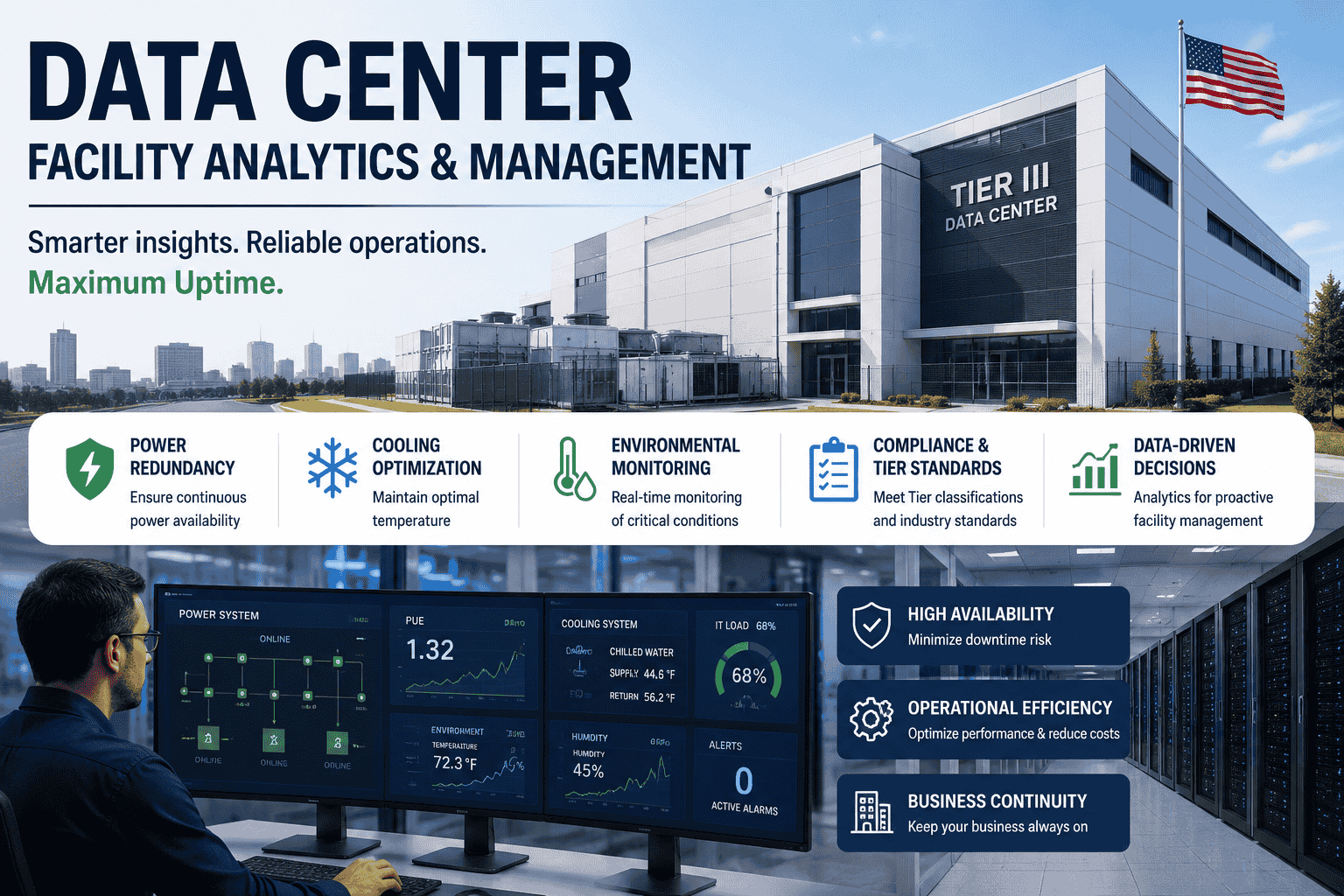
Data centers operate on a different maintenance philosophy than any other commercial property — every minute of downtime can cost $5,000 to $9,000, every degree of temperature drift threatens millions in equipment, and every preventive task must happen without interrupting the workload. The phrase "we'll fix it during the weekend window" doesn't exist here. iFactory Data Center Operations Intelligence brings Tier-aligned PM scheduling, concurrent maintainability workflows, and real-time environmental monitoring into one platform built for mission-critical facilities. Book a demo to walk through a complete data center program.
Where Downtime Is Measured in Dollars Per Second
A practical guide to data center facility maintenance — covering Tier classification compliance, concurrent maintainability workflows, power redundancy verification, cooling optimization, and the environmental monitoring discipline mission-critical operations demand.
Four Tiers, Four Different Maintenance Disciplines
The Uptime Institute Tier Classification is the international standard for data center performance. Each tier defines not just uptime expectations but the maintenance philosophy required to deliver it. Higher tiers don't just have better equipment — they require fundamentally different operational discipline.
Basic Capacity
- Single distribution path
- No component redundancy
- Maintenance requires full shutdown
- Suited to non-critical workloads
Redundant Capacity
- N+1 component redundancy
- Single distribution path
- Partial maintenance possible
- Mid-tier business operations
Concurrently Maintainable
- Multiple distribution paths
- N+1 throughout
- Maintenance without downtime
- Enterprise standard
Fault Tolerant
- 2N+1 redundancy throughout
- Multiple active distribution paths
- Survives single-component failure
- Mission-critical workloads
Where Data Center Maintenance Concentrates
Despite all the complexity, data center facility maintenance concentrates in three core domains. Each has its own failure signatures, its own monitoring discipline, and its own catastrophic potential when neglected. These are the pillars every program must master.
Power Systems
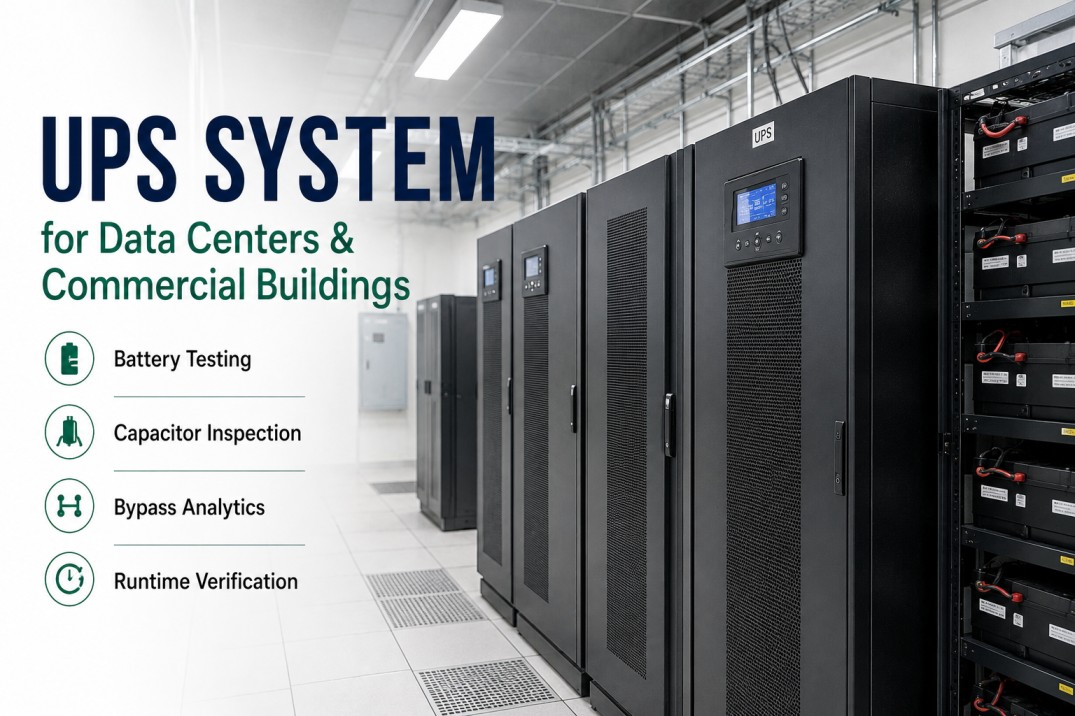
UPS modules, generators, ATSs, PDUs, switchgear, and battery banks. The most failure-sensitive infrastructure in any data center — and the one with the most ruthless maintenance discipline.
Cooling Infrastructure
CRAC/CRAH units, chillers, cooling towers, and air containment systems. The second largest energy consumer in any data center — and with AI workloads, increasingly the limiting factor in deployment density.
Environmental Monitoring
Temperature sensors at every rack, humidity controllers, leak detection at every plumbing run, smoke detection, and DCIM platforms. The early warning network that prevents catastrophic failures.
The Operating Envelope Every Data Center Must Hold
ASHRAE TC 9.9 publishes the recommended and allowable environmental envelopes for data center operations. Drifting outside these ranges accelerates equipment wear, voids warranties, and increases failure risk dramatically. These are the numbers your DCIM platform should be reading second-by-second.
| Parameter | Recommended | Allowable | Critical Limit |
|---|---|---|---|
| Inlet Air Temperature | 64.4 – 80.6°F | 59 – 90°F | > 95°F triggers shutdown |
| Relative Humidity | 40 – 60% | 20 – 80% | < 20% ESD risk |
| Dew Point | 41 – 59°F | 33.8 – 62.6°F | Drives condensation risk |
| PUE Target | < 1.4 modern facility | 1.5 – 1.8 typical | > 2.0 inefficient |
| Rack Density | 8 – 15 kW typical | Up to 30 kW (air) | > 30 kW liquid cooling |
| UPS Battery Runtime | 15 min minimum | Until generator stable | < 10 min insufficient |
Build a Concurrent Maintainability Calendar in 30 Minutes
Our team maps your data center's Tier classification, redundancy configuration, and equipment inventory — and shows you how iFactory schedules every PM task so primary equipment stays online during maintenance windows.
How Maintenance Happens Without Disrupting Workloads
Tier III and Tier IV facilities are defined by concurrent maintainability — the ability to take any single component offline for service while the data center continues operating. This requires a specific workflow that combines redundancy verification, careful transfer sequencing, and rigorous post-maintenance validation.
Redundancy Verification
Before any PM task starts, confirm the redundant path is fully operational. Run load tests on backup equipment. Verify no concurrent maintenance is scheduled on the failover side.
Load Transfer Sequence
Methodically transfer critical loads to the redundant path. Each transfer is documented, verified by telemetry, and confirmed by an operator at the equipment rather than from a control room screen alone.
Maintenance Execution
Perform the PM work on isolated equipment. Photo-document conditions, capture readings before and after, and follow lockout-tagout procedures rigorously. Every action timestamped.
Restoration & Verification
Bring serviced equipment back online and verify operation under no-load conditions first. Then transfer a portion of load back, monitor for any anomalies, then complete the load transfer.
Post-Work Documentation
Full work order documentation with photos, readings, technician attribution, and load transfer log. Filed with the asset record for Tier audit defense and future trend analysis.
Frequency Discipline That Matches Mission Criticality
Data center PM frequencies are aggressive — measured in weeks and months rather than the quarters and years that work for conventional commercial facilities. Each asset class has its own rhythm, set by manufacturer guidance and Uptime Institute best practices.
Frequently Asked Questions
What's the realistic Tier for most enterprise data centers?
Tier III has become the de facto enterprise standard. It delivers 99.982% uptime (about 1.6 hours of downtime per year) and supports concurrent maintainability — meaning major PM work can happen without taking the workload offline. Tier IV remains the gold standard for financial services, healthcare, and other zero-downtime applications, but the capital and operating costs roughly double compared to Tier III.
How is data center maintenance different from regular commercial HVAC service?
Three things make it fundamentally different: the inability to shut down for service (concurrent maintainability is mandatory), the precision tolerances (rack inlet temperature drift of just a few degrees creates real risk), and the load patterns (24/7 operation at near-full capacity, unlike office HVAC). Frequencies are also dramatically more aggressive — what's annual in an office building might be monthly in a data center.
What's the biggest failure risk in a data center facility?
Industry data consistently identifies cooling failures and human error during maintenance as the top two causes of significant downtime. Power infrastructure has improved dramatically with modern UPS systems, but cooling failures can shut a facility down in minutes — and human error during maintenance accounts for an outsized share of preventable outages. Both are addressed primarily through procedural discipline, not equipment alone.
How is AI workload density changing data center cooling requirements?
Dramatically. Traditional air-cooled facilities top out around 20-30 kW per rack — but AI training and inference workloads can push rack densities to 50-100 kW. This is driving rapid adoption of liquid cooling, rear-door heat exchangers, and immersion cooling. Maintenance programs must adapt to handle these new technologies alongside legacy air-cooled infrastructure within the same facility.
How does iFactory support concurrent maintainability workflows?
Every redundant asset pair is mapped in the platform with explicit failover relationships. PM work orders automatically check redundancy status before scheduling — if the failover side is in maintenance or fault, the work won't auto-schedule. Load transfer steps, lockout-tagout records, before/after readings, and technician attribution are all captured in the work order, building a complete Tier audit defense.
Run Your Data Center Like Every Second of Uptime Matters
Stop relying on spreadsheets and tribal knowledge to manage mission-critical infrastructure. Bring Tier-aligned PM scheduling, concurrent maintainability workflows, and real-time environmental monitoring into one platform built for data center operations.