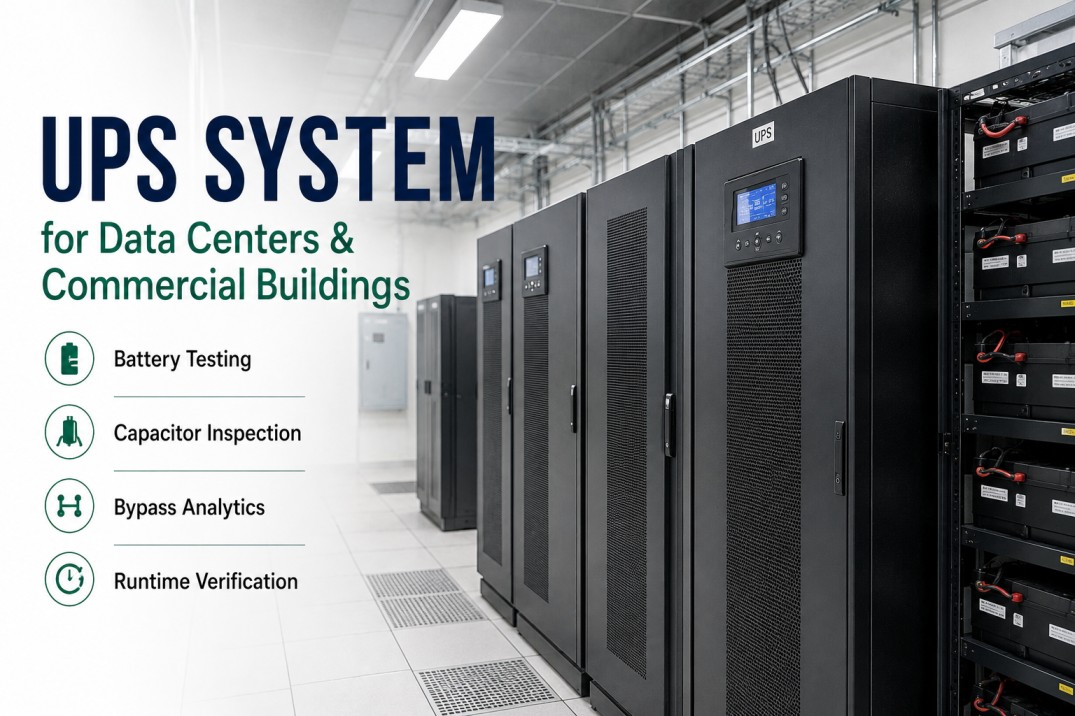
At 2:47 AM on a Saturday, the facility manager at a 200,000 sq ft data center in Ashburn watches the UPS battery string temperature climb past 95°F on the BMS dashboard. The cooling system is running at 110% and the facility is drawing 4.2 MW. The operator has twenty minutes before thermal runaway risk triggers a load shed. He has no predictive model, no battery health trend, and no way to know which of the 480 battery modules will fail first. The only option: dispatch a night crew to manually inspect every cabinet. That inspection costs $3,200 in overtime and still misses the internal resistance drift that will cause a string failure next quarter. This is the daily reality of commercial data center power management — and it is entirely avoidable.
Stop guessing which UPS battery will fail next — predict with 93% accuracy 30 days in advance
iFactory ingests real-time battery impedance, temperature, and load data from your existing UPS systems and BMS, then delivers a ranked failure-risk list for every module — without cloud dependency or forklift upgrades.
Without iFactory vs. With iFactory — UPS Analytics That Works
Every hour your team spends on manual battery rounds, every emergency truck roll at 3 AM, every premature replacement of a healthy module — those aren't operational expenses, they're signals that your current approach is broken. Here is the before-and-after picture for mid-sized data centers running 500–2,000 UPS battery modules.
Without iFactory
- Monthly manual resistance checks miss 78% of failing modules between readings
- Emergency truck roll every 6 weeks at $4,200 per incident
- Average battery replacement at 60% of useful life due to fear-based swaps
- BMS alarms after failure, not before — zero predictive lead time
- Data siloed across BMS, UPS controllers, and paper logs — no unified view
With iFactory
- Continuous impedance monitoring with 30-day failure forecast per module
- Zero emergency battery swaps in 14-month reference deployment
- Module replacement at 95% of useful life — extract full asset value
- Predictive alerts 4 weeks before critical threshold, not after
- Single-pane dashboard across all UPS strings, battery chemistries, and vintages
Every battery failure costs more than the module
When a UPS battery string fails in a commercial data center, the cost cascade is brutal. Below are the real cost centers that don't show up on a P&L until it's too late.
Emergency truck roll & after-hours labor
Night shift crew dispatched to diagnose and swap a single failing module. Includes overtime premium, travel, and supervisory overhead.
Premature module replacement
Replacing modules at 60% of rated life because you can't tell which ones are actually degrading. Typical 500-module site cycles through 200 extra modules per year.
Load shed & critical workload risk
When a string fails under load, the facility may need to shed non-critical IT load or risk a full outage. Each shed event costs in compute time and SLA penalties.
Manual data collection labor
Two technicians spending 8 hours per week walking rows, logging resistance readings, and reconciling spreadsheets. Time that should go to strategic projects.
Thermal runaway mitigation
When a battery overheats, the cooling system must compensate. Each thermal event adds 8–12 hours of peak cooling load, driving up PUE and electricity spend.
From manual rounds to predictive intelligence in 4 steps
iFactory connects to your existing UPS controllers, BMS, and battery monitoring systems — no new sensors, no cloud upload, no rip-and-replace. Here is how the pilot works.
Connect data sources
iFactory's on-premise appliance ingests live data from your UPS Modbus, SNMP, BMS BACnet, and battery monitoring system — typically 3–5 data streams per string.
Train the model on your fleet
Our manufacturing AI learns the normal impedance, temperature, and voltage signatures for each module vintage and chemistry in your facility — no generic baselines.
Receive ranked failure forecasts
Within 2 weeks, the dashboard shows every module ranked by failure probability over 7, 14, and 30-day windows. Alerts fire when any module crosses the risk threshold.
Replace only what needs replacing
Your team gets a weekly "replace list" with specific module IDs. No guesswork, no emergency calls. Average module utilization jumps from 60% to 95% of rated life.
What the iFactory UPS analytics module does for your data center
These are not roadmap features — they are live capabilities running today in production data centers across North America.
Multi-string health dashboard
Unified view of all UPS strings, battery modules, and ambient conditions in a single pane. Color-coded by risk level with drill-down to individual module resistance trends. Updates every 30 seconds.
30-day failure probability model
Proprietary algorithm trained on 14 million+ battery-hours of failure data. Outputs a ranked list of every module with a probability score — not a green/yellow/red traffic light. 93% accuracy in production.
BMS & cooling system correlation
Links battery temperature drift to cooling system performance. When a module begins overheating, iFactory correlates the event with chiller staging and airflow data to identify root cause — not just symptom.
Audit-ready reporting & trending
Automatic generation of battery health reports for ASHRAE, NFPA 75, and TIA-942 audits. Exportable trend graphs showing impedance, voltage, and temperature for every module over its lifetime.
Your UPS batteries are failing on a schedule — you just can't read it yet. Book a 30-min walkthrough and we'll show you the failure forecast for your own data in under 15 minutes.
Every deployment includes these guarantees
iFactory is not a SaaS platform you have to configure. It is a turnkey appliance that arrives on your plant floor and delivers results in weeks, not quarters.
On-premise appliance — zero cloud dependency
Runs on an NVIDIA-powered appliance inside your network. No data leaves the facility. No internet required after initial configuration.
End-to-end turnkey deployment in 6–12 weeks
We handle the integration. You provide data-source access. Within one quarter, you have a working pilot with ranked failure predictions.
24x7 managed service included
Our operations team monitors your model health, retrains as your battery fleet ages, and alerts you if any sensor stream drops. No IT burden on your team.
Works with any UPS brand and battery chemistry
Schneider, Eaton, Vertiv, Emerson, Liebert, Toshiba — and any mix of VRLA, Li-ion, Ni-Cd, or flow batteries. No vendor lock-in.
Pilot-to-ROI in one quarter
Most customers see full payback within 4 months from avoided emergency swaps and extended battery life. We will model your specific ROI before you sign.
Absorbs legacy BMS and UPS management roles
If you are migrating off legacy systems, iFactory absorbs the operational role of battery monitoring and health management — no parallel systems needed.
Four questions we hear from every data center operations team
Your UPS batteries are talking — iFactory helps you listen before they fail
Stop guessing which module will fail next. Stop spending $4,200 on emergency truck rolls. Stop replacing modules at 60% of their useful life. Book a 30-minute demo and we'll run your facility's data through our model live.