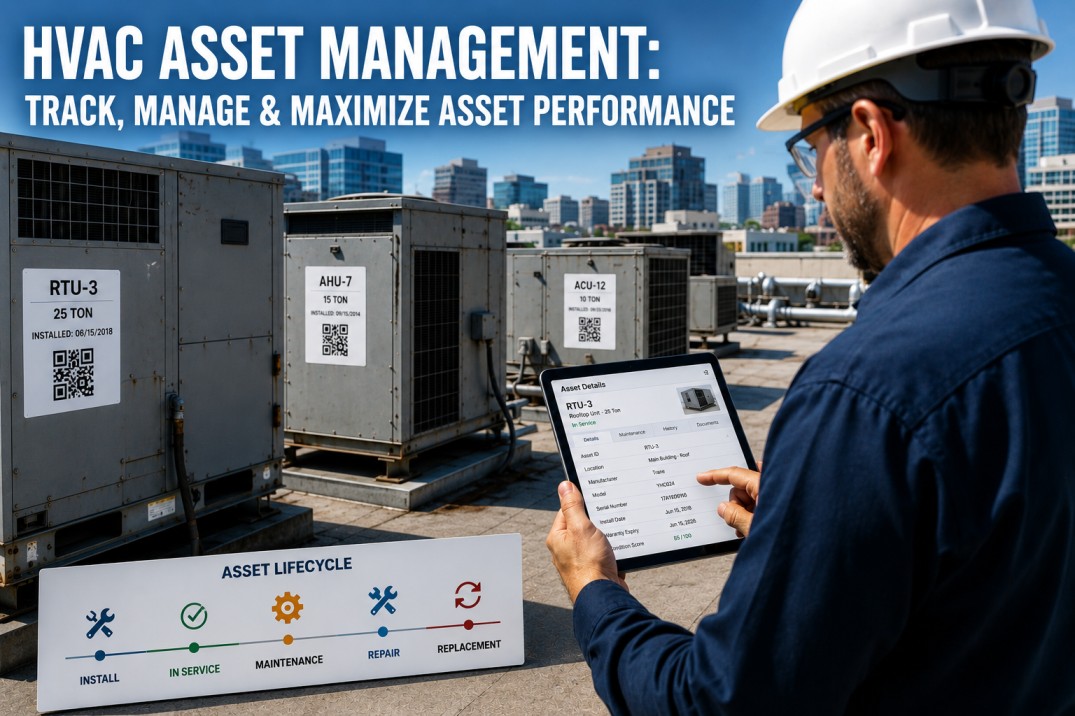
HVAC asset management is the systematic process of tracking every piece of heating, cooling, and ventilation equipment from the moment it is specified and purchased through installation, commissioning, ongoing maintenance, repair events, and eventual replacement or decommissioning. A well-structured asset management program provides a single source of truth for equipment data: serial numbers, model specifications, warranty terms, service history, condition assessments, energy consumption, and replacement cost projections that together enable facility teams to optimize maintenance spend, plan capital budgets accurately, and extend equipment life by 3 to 7 years through data-driven intervention timing.
Track Every HVAC Asset From Install to Replacement
iFactory's Asset Management module provides complete equipment lifecycle tracking with condition scoring, warranty management, and capital planning. Book a demo to see how centralized asset data transforms maintenance decisions.
Building a Complete HVAC Asset Register: What Data to Capture
The asset register is the foundation of all HVAC asset management. Every piece of equipment needs a comprehensive data record from day one.
Core Identification Data
Every asset needs: unique equipment ID (barcode or QR), manufacturer, model number, serial number, year manufactured, installation date, and physical location with zone/building/floor/room coordinates. Capture manufacturer nameplate data exactly: voltage, FLA, phase, refrigerant type, tonnage, and efficiency rating. This single record eliminates the 2-4 hours per technician per week spent hunting down equipment information during service calls.
Warranty & Financial Data
Track warranty type (parts, labor, or comprehensive), warranty start and end dates, warranty provider and claim contact. Record purchase cost, installation cost, expected useful life, current book value, and replacement cost. This data enables accurate capital planning and ensures warranty claims are filed before expiration, capturing 5-15% of equipment replacement value that is otherwise left on the table.
Documentation & History
Link all documentation: submittal drawings, commissioning reports, startup sheets, O&M manuals, wiring diagrams, refrigerant logs, and filter schedules. Maintain full service history: every inspection, repair, replacement, and modification with dates, costs, parts used, and technician notes. A complete history spanning the full equipment life enables failure pattern analysis and provides defensible data for capital planning approval.
Equipment Condition Assessment: Scoring, Frequency & Methodology
Regular condition assessment transforms equipment data from static records into actionable intelligence for maintenance and replacement decisions.
| Condition Score | Description | Remaining Life | Maintenance Strategy | Action Required |
|---|---|---|---|---|
| 5 Excellent | Like-new condition, all metrics within design spec | 80-100% | Routine PM only | Continue standard PM schedule |
| 4 Good | Minor wear, all readings within normal range | 60-80% | PM + monitoring | Monitor trends, maintain PM |
| 3 Fair | Noticeable degradation, some readings elevated | 40-60% | Enhanced monitoring | Increase inspection frequency, plan for mid-life rebuild |
| 2 Poor | Significant degradation, approaching failure thresholds | 15-40% | Condition-based repair | Plan replacement within 12-18 months, budget approved |
| 1 Critical | Imminent failure, unreliable operation | Under 15% | Run-to-fail or replace | Replace immediately, emergency budget |
Know the Condition, Cost, and Life of Every Asset
iFactory's platform delivers real-time equipment condition scores, lifecycle cost analysis, and replacement forecasting. Book a demo to see how data-driven asset management eliminates guesswork from capital planning.
Asset Lifecycle Costing: Purchase, Operate, Maintain, Replace
Total cost of ownership extends far beyond purchase price. Lifecycle costing captures all costs across the equipment lifespan.
Purchase & Installation
Equipment purchase represents only the initial investment. Installation, commissioning, startup, and initial refrigerant charge add 25-50% to purchase cost. For a $20K chiller: $20K purchase + $8K-10K install = $28K-30K initial.
Energy Cost
Energy is the largest lifecycle cost component by far. A 50-ton chiller running 3,000 hours/year at $0.12/kWh costs $18K-25K/year in energy. Over a 20-year life: $360K-500K. Improving efficiency by 15% saves $54K-75K.
Maintenance & Repairs
Annual PM: $500-2K per unit. Unscheduled repairs: $200-5K per event. Major overhaul (compressor rebuild, tube replacement): $5K-20K every 5-10 years. Total maintenance over life: $30K-80K for a typical chiller.
Replacement & Disposal
End-of-life disposal: crane, rigging, refrigerant recovery, recycling. Cost: $2K-8K per unit. Replacement: new purchase + installation, typically 1.5-2.5x original purchase adjusted for inflation.
Capital Planning: Forecasting Replacement Timing & Budget
Data-driven capital planning replaces reactive emergency replacement with optimized, budgeted equipment refresh cycles.
Condition-Based Forecasting
Score each asset annually (1-5 scale). Set trigger: replace when score drops to 2 (poor) or when repair cost exceeds 50% of replacement value. Forecast 3-5 years forward. Accuracy: +/- 20% on timing with annual updates.
Life Expectancy Models
Equipment type base life: RTU 15-20 years, chiller 20-25 years, boiler 25-30 years, cooling tower 15-20 years, VAV box 20-25 years. Adjust for: maintenance quality (+/- 5 years), run hours (+/- 3 years), environmental conditions (+/- 2 years), manufacturer quality (+/- 3 years).
Budget Optimization
Replace at optimal point: too early wastes remaining useful life, too late risks failure cost. Optimal: when annual maintenance + energy premium exceeds annualized replacement cost. Typically at 60-80% of expected life for most equipment.
Portfolio Prioritization
Score every asset on: condition, criticality, energy waste, safety risk, and tenant impact. Prioritize replacement budget across entire portfolio. Ensures capital dollars go to the worst equipment, not the loudest complaint.
Digital Twins: The Future of HVAC Asset Management
Digital twin technology creates a virtual replica of every asset that mirrors real-time conditions and enables simulation.
Real-Time Performance Mirror
A digital twin ingests live sensor data (temperature, pressure, flow, current, vibration) and maintains a real-time virtual model of each asset. Performance deviations between the physical asset and the digital model indicate developing faults. Updates every 5-15 minutes.
What-If Simulation
Run simulations on the digital twin without affecting real equipment: what if chilled water setpoint changes 2F, what if condenser tube cleaning is delayed 3 months, what if VFD speed increases 10%. Simulations predict outcomes in seconds that would take days to test physically.
Lifecycle Prediction
The digital twin accumulates operating history and applies ML models to predict remaining useful life with increasing accuracy. As the asset ages, the twin refines its prediction based on actual wear patterns, not manufacturer averages. Accuracy improves from +/- 3 years at install to +/- 6 months after 5 years.
Frequently Asked Questions
What is HVAC asset management?
HVAC asset management is the systematic process of tracking and managing every piece of HVAC equipment throughout its entire lifecycle from specification and purchase through installation, operation, maintenance, and eventual replacement. It includes maintaining a complete equipment database with serial numbers, model data, warranty terms, service history, condition scores, and cost records. Effective asset management enables optimized maintenance scheduling, accurate capital planning, and data-driven replacement decisions.
What data should be tracked for each HVAC asset?
Minimum: equipment ID, manufacturer, model, serial number, installation date, location, refrigerant type, tonnage/capacity. Ideal: warranty terms, purchase cost, installation cost, expected life, replacement cost, service history with all work orders, parts used, and costs, condition assessment scores over time, energy consumption data, and linked documentation (submittals, manuals, test reports). Comprehensive asset data enables accurate lifecycle cost analysis and capital forecasting.
How do I assess HVAC equipment condition?
Use a standardized 1-5 scoring system based on: visual inspection (corrosion, leaks, physical damage), performance data (efficiency, capacity, energy consumption compared to baseline), maintenance history (frequency and cost of repairs), age relative to expected life, and vibration/oil analysis results. Assess annually for all equipment, quarterly for critical or poor-condition assets.
What is the ROI of HVAC asset management software?
Facility teams transitioning from spreadsheets to asset management software typically achieve: 15-25% reduction in maintenance spend through optimized PM, 20-30% fewer emergency repairs through condition-based intervention, 3-7 year equipment life extension, 40-60% reduction in capital planning time, and 80-95% elimination of missing equipment data during service calls. Average payback: 6-14 months.
How does asset management integrate with predictive analytics?
Asset management provides the equipment registry, maintenance history, and cost data that predictive analytics needs for context. Predictive analytics adds real-time condition monitoring and failure prediction. Together they create a complete picture: asset management says "this chiller is 18 years old with fair condition" and predictive analytics adds "compressor bearing wear detected, failure probability 65% within 8 weeks."
Complete HVAC Asset Lifecycle Management With iFactory
iFactory's Asset Management delivers end-to-end equipment tracking from asset register through condition assessment, lifecycle costing, and capital planning. Book a demo to see how structured asset management optimizes every dollar.